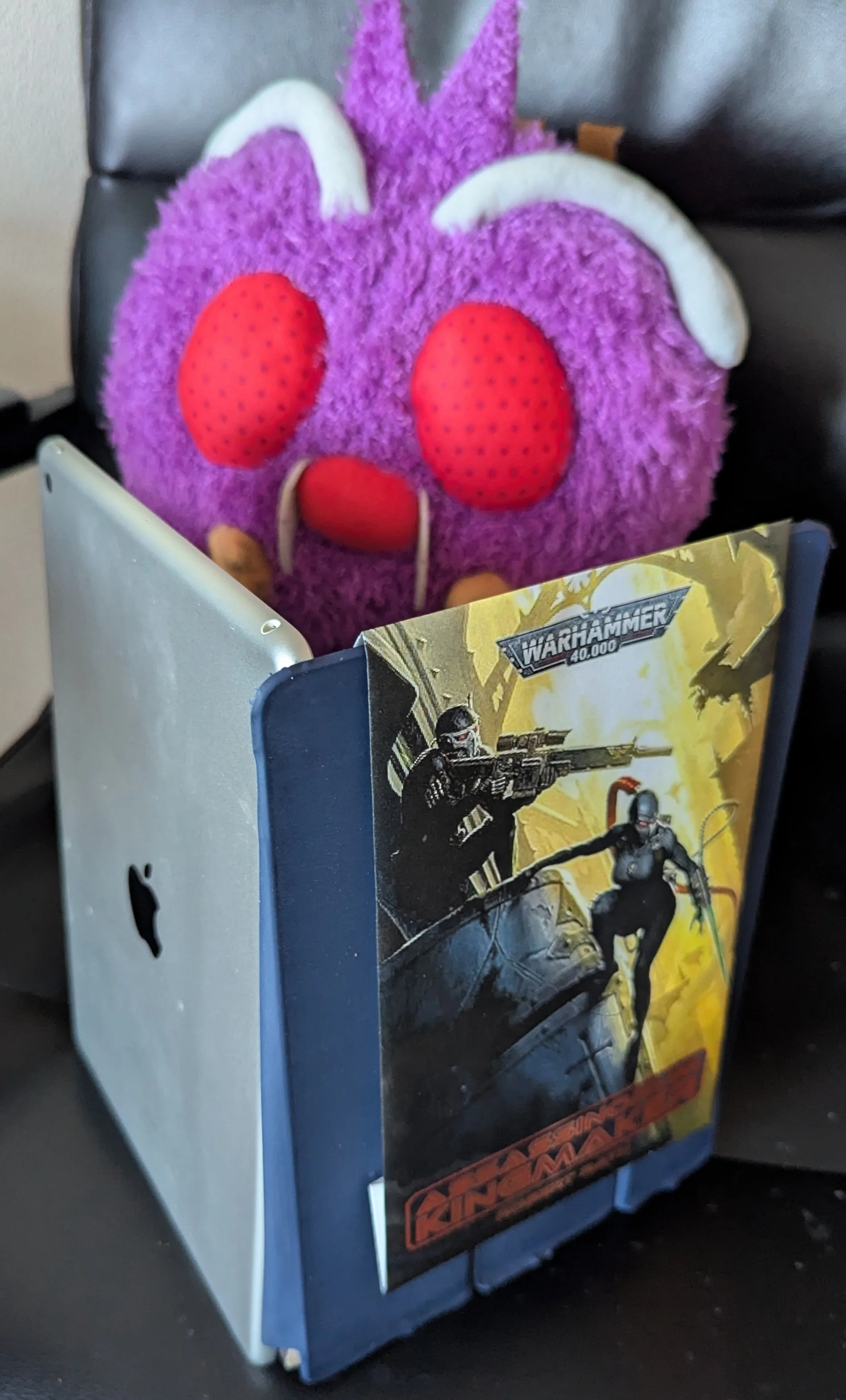
Kingmaker (An Assassinorum Novel) (Part 3 - Characters & Worldbuilding)
Hello, all. Welcome to the conclusion of the Assassinorum: Kingmaker review series.
This final part will focus exclusively on the analysis of characters and worldbuilding. If you’d like the overview, please see Part 1. An analysis of the plot can be found in Part 2.
If you’re all caught up (or don’t care about that), strap in. Let’s bring the Emperor’s Mercy to secessionists and heretics.
STATS
Title: Kingmaker
Series: Assassinorum
Author(s): Robert Rath
Genre: Science Fiction (Space Opera)
First Printing: April 2022
Publisher: Black Library (Games Workshop Publishing)
Rating: 8/10
SPOILERS
Throughout this review, there will be mild, unmarked spoilers for the events of Kingmaker. I will keep the first paragraph of each section as spoiler-free as possible. Heavy spoilers will be confined to clearly marked sections.
There will be heavy, unmarked spoilers throughout the review for the events of the Warhammer 40K stories that we have cover thus far.
CHARACTERS
Static Yet Functional
I don’t feel that any if the core cast members in this book undergo any sort of character arc. The book nods in the general direction of character arcs for a few of them, and there's a somewhat paint-by-numbers arc about the execution squad coming together as a team, but individual character aren’t fundamentally changed between the beginning and the end of the book. The one who comes closest to changing is Rakkan. In his case, it’s not less a change of who he is and more a change of circumstances around him.
That being said, this band of characters works very well for the roles they fill. Rath gives them very clear identities. In the case of the assassins, while their characterizations align with typical traits of their temple (Raithe is precise and disciplines, Sycorax is chaotic and improvisational, and Koln is constantly taking the initiative and working to gather and much information as possible about any situation), he puts in the legwork to Show these traits to the audience, rather than just expecting the audience to already know what assassins from their respective temples are like.
So, while I am about to spend a lot of time laying out criticisms about these characters, please understand that this is about how good characters were set up to be great, rather than because these are bad characters.
Sycorax
If any one character could be argued as the main character, I would argue that it is Sycorax. As a member of the shapeshifting Callidus Temple, the most delicate aspects of the operation fall upon her shoulders. She has to not only impersonate Rakkan in front of the nobility of Dominion but also deceive and pilot his Knight, the Jester.
Much of the conflict early in the story pits Sycorax’s improvisational style and relaxed attitude against Raithe’s controlling leadership. As the narrative progresses, though, she and him come to respect each other on at least a professional level.
One idea that Rath toys with is Sycorax losing her identity amidst the strain of playing Rakkan. Fooling the Knight suit is a burden she is not familiar with. However, if this was intended as an arc, it comes to a non-resolution. Sycorax just has a moment where she gets caught out as an impersonator, owns up to it, and uses that honesty to turn the tables on those trying to all her own. It’s a satisfying development, don’t get me wrong, but it does make me wonder why she was being set up for an identity crisis.
All that said, it is fun to watch Sycorax operate. Rathe really gets inside her head as an infiltrator and gives her cool action moments with both her phase blade and neural shredder.
Absolom Raithe
An elite sniper and the leader of the execution squad, Raithe is the first of the assassins introduced. His opening scene does a very effective job of establishing his obsessive pursuit of perfection, with him undergoing a brutal exercise regime to punish himself for getting injured during his last mission. Going into the mission, it’s clear that he’s not just being uptight because Vindicare are upright (even if Sycorax writes it off as that) - he will not tolerate another mistake.
Coupled with this is his refusal to properly take care of the shoulder that he injured in that aforementioned mission and his inability to sleep. Raithe is a man who is pushing both his mind and his body to the breaking point.
And … well …
He never really changes.
Rath implies that Raithe is unwinding a bit by the end of the story. He lets Sycorax help him with his shoulder, the pair team up effectively in the climax, and he apparently is able to sleep again after the mission. I just don’t understand how these outcomes reflect a shift in character. All these things feel like a function of him putting the mission first, and that’s consistent with who he was at the start.
That being said, Raith is still a fun character. Despite Vindicare being snipers first, which deprives him of a lot of chances to showcase his skills for the first half of the book, he manages to be very handy in various rights throughout the story. And when the time comes to see him be a sniper, it’s fun to watch him plan out shots and switch out specialty ammunition on the fly.
Avaaris Koln
Koln is the most subdued of the three squad members. The Vanus specialty in information gathering and cyber warfare means she isn't at the forefront in the same was as a sniper or a shapeshifter with a phase blade are. She instead serves as the heart of the team, keeping peace between Raithe and Sycorax and moderating the pair’s more extreme ideas. It’s thanks to her that Rakkan and Gwynne survive behind the first third of the book.
I wish I had more to say about Koln. She’s a likeable character who works well in her role. It's just that she never really has the chance to really stand out, nor does she get setup for an arc that doesn’t pay off. She is what she is. Rath sets up her for a potential sequel where she’ll get to operate alone, and I think I’ll read it when it comes out, because I’d like to read more content featuring her.
Sir Linoleus Rakkan
A member of the Lists (the nobles who balance the power of the two noble houses of Dominion and who are eligible for the monarch position), Rakkan left Dominion to become a Freeblade Knight after someone tries to kill him after a tourney (with this scene serving as the prologue of the book). Koln arranges to have him, his sacristan, and his Knight delivered to the execution squad so Sycorax can impersonate him. While Raithe’s initial impulse is to interrogate Rakkan and then execute him, Koln argues to keep him alive so long as he cooperates. Rakkan ends up becomes a sort of Man in the Chair archetype, sitting in the background drinking while he coaches Sycorax through the intricacies of impersonating him.
Rakkan is a likeable character. While he comes across as someone who wallows in self-pity and blames his circumstances rather the reflecting upon himself, and his decision to help the execution squad is motivated by self-interest, he really is in a bad spot and making the best of things that he can. He was burdened wThe story sets him up for a redemption. However, much like with Sycorax and Raithe, that doesn’t really pay off. He sort of stumbles into his role in the climax (see Part 2 if you want the spoilers on that) and then feels better afterwards.
Gwynne (Heavy Spoilers)
Gwynne is the assigned to Rakkan’s Knight. Her outlook on the world is very solidly Mechanicus: she is loyal to the Knights, not Dominion or even Rakkan, and so is easily swayed to aid the execution squad. For most of the story, she is a quiet presence in the background.
In the climax, though, Rath tries to give her a bigger role. It’s not a terrible idea. It’s just badly executed.
A revelation that Koln comes to in the climax is that Rakkan was not the target of that prologue murder attempt. Gwynne was. It turns out the heretek sacristans affected by the conqueror_wyrm tried to induct her into their ranks, and when they realized she wasn't open to it but already knew too much, they tried to have her killed. The attempt failed, but Gwynne’s injuries included damage to her augmented nervous system, causing memory loss that included any memory of the conspiracy.
This is a twist that flops about as badly as Yarros retconning Xaden as an inntinnsic. It does nothing to enhance the narrative, and Koln explaining the mystery feels like an argument being made to the audience rather than a mystery being answered. That being said, it’s not being milked to force conflict or drive the narrative forward. It just warrants an eye roll before being forgotten.
Gwynne having a past connection to this heretek force could have worked. She just needed to have a larger roll in the story, with more focus put on the murder attempt (in which, from her perspective she was merely shot because she tried to shield Rakkan) and/or her lost memories.
WORLDBUILDING
The Officio Assassinorum
I think the premise oversells the idea that this book explores the relationship between the assassin temples. Still, I think it provides a fascinating look into the operations of the Vindicare, Callidus, and Vanus Temples. It’s emphasized within the text that are three leads are typical for members of their respective orders. Someone new to this aspect of Warhammer 40K will learn a lot just by watching the execution squad operate.
Additional, Rath takes time to explore the more signature pieces of assassin gear: polymorphine, Exitus firearms, the Vindicare mask, the phase blade and neural shredder. This never enters the territory of fanservice or info-dumping. We are Shown and Told exactly we amount we need to understand the story.
An interesting point that is called out in this story is that all three members of the execution squad have some degree of neural augmetics. My reading is that this is standard for Vindicare (to allow the interface with their masks and firearms) and Vanus (to aid in data collection). In the case of Sycorax, though, this was non-standard. A mission in her backstory required her to impersonate a member of the Dark Mechanicum, so she was augmented to the degree necessary to pass as a tech-adept.
The reason this matters is a plot thread that I haven't brought up because it ended up not going anywhere: Dominion was supposed to be a suicide mission. All three members of the execution squad previously had missions that exposed them to the conqueror_wyrm. They are potential carriers. Koln observes that other augmented assassins who come into contact with the virus have a suspiciously high mortality rate on subsequent missions. This, coupled with the fact that Raithe is up for promotion if the Dominion mission is a success, leads her to conclude that all three assassins are marked for death. This is an idea that ultimately doesn’t go anywhere, but it does make sense in terms of the mythos.
And speaking of the virus …
conqueror_wyrm
This is Chaos computer virus. It was invented by a heretek of the Dark Mechanicum, and it corrupts or outright possesses both sufficiently advanced computer systems and augmented humans in the same way as a powerful psyker might. Adding to this effect is the fact the virus can be broadcast, so any seemingly innocuous transmission can lead to instant corruption.
I don’t know if the conqueror_wyrm has a wider role in the Indomitus Crusade stories. In isolation, though, it’s a neat bit of lore. Rath introduces it and integrates it into character backstories in such a manner that it feels like a natural extension of the established mythos.
Knights
As mentioned when discussing the action, Rath doesn’t explain much in terms of what Knights look like, how big they are, what their weapons are, and the like. I had to look a lot of things up. What he does convey is the experience of being a pilot.
A good chunk of Sycorax’s prep to impersonate Rakkan is her deceiving the “ancestors” (digital echoes of past pilots) stored within his Knight’s computers. We see how she struggles to do more than basic movements. We are explicitly told that, while Knights are piloted by a neural link, they are not like Titans (where the leader of the crew feels the mech as an extension of his or her own flesh), and we are Shown that they have manual backup controls that enable limited mobility.
Aside from the mechs, there is also the matter of Knight Houses. Rath doesn’t go too deep into the weeds about the general structure of these, outside of the minimum needed to understand the execution squad’s plans and the obstacles they face. We do get a very Warhammer 40K explanation for why there are two Houses sharing a planet: bureaucracy. One House was sent to settle the world and vanished into the Warp for centuries, a second House was sent and successfully colonized the world, and then the first House arrived and asserted their original claim, with the Imperium decided both claims were equally valid. We also get some fun history, with these Houses nearly joining Chaos during the Heresy, only siding with the Imperium because they chose not to honor an oath with a (soon-to-be) Dark Mechanicum forgeworld.
I can’t pretend to be an expert on Knight lore. As someone new to stories to feature this faction, I can only say that I found this book quite satisfying as an introduction to them. I also feel like this book ultimately delivered more as a story about mechs than Titanicus did. Not intended as shade at Titanicus, just rather interesting for a story sold on the premise of an unrelated faction.
“THE OUTCOME JUSTIFIES THE DEED.”
Assassinorum: Kingmaker is one of those stories that feels like it should be the baseline for traditional publishing. It’s a fun story that delivers on its premise and then goes above and beyond. The plot is dynamic, the characters are engaging, and the worldbuilding is, at the very least, internally consistent. The flaws are either insignificant to the narrative as a whole or else are merely an issue of something not being as effective as it could have been. I highly recommend checking out this book if you are a Science Fiction person or a Warhammer 40K fan.
Our next Warhammer 40K review was originally going to be Hive (which, at the time of writing this, I am still working through). However, as my review of “Sorrowcrown” no doubt gave away, I have gotten my hands on The Long Vigil and begun working my way through it. Until the Hive review is ready, we will review stories from The Long Vigil here and there. I’ve also finished reading The Vaults of Terra: The Carrion Throne. That review may also come out before Hive.
If you’re looking for more stories of soldiers fighting to keep the light of civilization burning again chaos and barbarism, I’m happy to announce that my first Military Fantasy serial, Moral Support, is now posting over in Tales of the Five Worlds! Chapter 1 through Chapter 3 Part 2 are now available. I’ll hope you’ll join me for these new adventures!
Thank you all for stopping by. Please remember to subscribe and share if you enjoyed what you read here. Take care, everyone, and have a good weekend.