Moral Support (Chapter 1)
Motorbikes were the second-worst thing about the Tamseszén Front.
These awful machines – or, at the very least, the carmot engines that propelled them – were supposedly the next great innovation in alchemy. Staff Sergeant Levi Gvish heartily disagreed. Innovation was the perpetual progress that set the Kimian Empire above the barbarians. The carmot-lined gambeson, the bolt-action rifle, and the radio were innovations. They were far superior to whatever the barbarians could cobbled together without alchemy.
The motorbike couldn’t be an innovation, because it was a step backwards. A carmot engine had no instincts, and no reflexes hummed through a motorbike’s steel frame. A horse, a camel, or a mule would recognize danger and, if properly trained, anticipate the will of the Ranger riding it. A motorbike would suicidally hurl itself and its rider into every fallen tree, every gaping pit, and every horde of barbarian pikemen.
The volcanic gloom that shrouded the Tamseszén Front made matters worse. Midday was as dark as dusk here. Even with the headlamps on the bikes, a Ranger would have mere heartbeats to react to obstacles.
Gvish doubted the top brass of the Ranger Corps cared about such things. If anything, two decades of service told him that this blind stupidity was the “innovation” they craved. Horses, camels, and mules feared the Front. Perhaps they sensed how unnatural these accursed forests were, with the trees growing tall and thick despite the eternal dusk. Perhaps they smelled the boars, the apes, and hordes of unwashed zealots. Whatever the reason, the Empire could only maintain this occupation with mounts that lacked survival instincts.
Gvish wasn’t prone to seeing signs, but this one was hard to ignore. The Empire shouldn't be here.
Not that Gvish could voice such an opinion. Duty to Archon and Empire came before his own feelings. His squad looked to him for stability, not doubt. The only person he could confide in at times like these would be his morality officer, and that was out of the question.
The morality officer in question, Tzviel Bracha, was the first worst thing about the Front.
He somehow possessed less instinct than a motorbike.
* * * * *
Today, Gvish had to deal with both the Front’s worst elements at the same time. Bracha rode in the sidecar of his motorbike. The rest of the squad rode around them, four bikes with sidecar gunners and two without.
Gvish would need a stiff drink once they delivered Bracha to Fort Jahangir. Riding these roads was like being bottled into a ravine. The Empire’s alchemists had fused the soil into slabs of glass, creating a smooth lane wide enough for eight horses, but there was nothing that could be done about the oaks and pines that soared fifty meters to either side and spread their vast canopies above the roadway. Black thickets clogged the shoulders. Barbarians could easily stage an ambush at any point. They just needed to hide musketeers in the canopy and stage infantry behind the thickets.
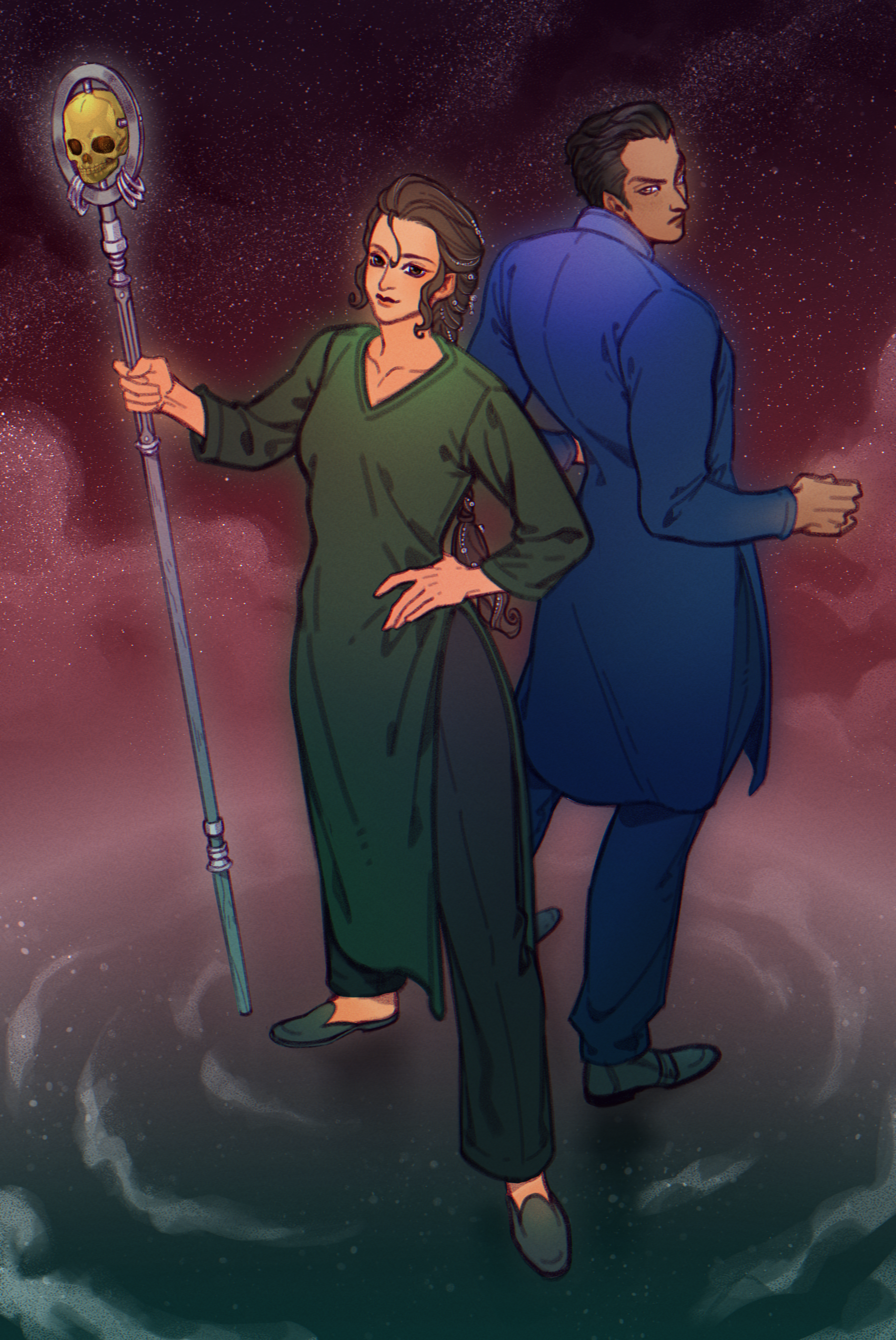
A morality officer also made for a tempting target. The headlamps of the bikes behind Gvish shone on Bracha’s back, exposing that he wore the black of the Inquisition instead of the green-gray of the Ranger Corps. He’d buttoned his leather trench coat up to his throat to keep out the chill wind that tugged at his turban. He was seemingly unarmed.
Gvish knew better. May Truth have mercy on his soul.
That flicker of compassion was a mistake. Bracha perked up, like a hyena that had smelled fresh carrion. Gvish imagined the eager twinkle hidden behind Bracha’s goggles as the inquisitor declared, “This foul chill really gets into a man’s bones, doesn’t it, Brother?”
You are not my brother.
Gvish bit back those words and offered a more diplomatic answer. “Indeed, Inquisitor. It does get into a man’s bones.”
“Do you know what it reminds me of? The Three Years’ Winter. Do you remember that?”
Obviously, Gvish remembered that. Bracha knew he remembered that. The man was only a decade younger than Gvish. “Yes, Inquisitor. I remember.”
“Did you family have a carmot stove to get you through it? Mine didn’t, not in the first year. We had to live in one of the shelters until a stove could be issued.”
Frustration twisted Gvish’s in gut. “Yes, Inquisitor. We had a stove.”
In the bike just ahead of them, Privates Awan and Eskandar exchanged glances. Despite the wind and the purr of the bike’s engines, the pair could probably discern that Gvish was speaking in Kimian – as regulation demanded – but Bracha was using Habarzelan. Gvish could imagine what they were thinking. Their whole outpost was probably thinking the same thing.
Our morality officer is playing favorites.
Bracha had every right to requisition Gvish’s squad for escort duty, to accompany him on inspections, to help him execute arrests. However, he was supposed to split the burden and prestige equally among the available personnel. In the two months since Gvish arrived on the Front, Bracha went out of the way to utilize his squad – and, more importantly, utilize him, the only other Habarzelan present – almost exclusively. Anyone who wasn’t blind noticed that their morality officer was favoring the only other copper-skinned, jade-eyed man among hundreds of people whose complexions ranged from jasper to olive, whose eyes were amber, steel, or chestnut.
You know better, Inquisitor. Other Rangers can’t trust me or my people if we’re getting preferential treatment. You have no right to put us in this position.
Bracha refused to read the air. “I remember my cousin stuck his tongue to a streetlamp. Not the brightest bulb, him. Did you? Know someone who did that,” Bracha amended hastily, “not doing it yourself, of course.”
“No, Inquisitor. No one I knew made that mistake,” Gvish replied.
That was the best way to deal with Bracha. He couldn’t be discouraged by tone of voice, and if ignored, he had the patience of the Archon himself. It was best to deflect his questions with brief answers that offered little to latch onto. Eventually, he’d run out of small talk and retreat.
Truth, let it happen quickly. I’ve got enough to keep track of right now.
Ahead, the familiar silhouette of Thunderhill Hill loomed above the canopy. Gvish sucked in a deep breath and shouted, “Sharp right turn, two klicks!”
A chorus of affirmatives rolled back from the squad.
“Is there a fork in the road?” Bracha asked, as if the reason for the turn wasn’t right in front of them.
“There’s no fork, Inquisitor. We just don't want anyone to go sliding off when we make the turn.”
“Ah.” Bracha glanced over the edge of the sidecar at the glassy slabs of the roadway. “These were transmuted before we invented motorbikes, weren’t they? Too smooth for these speeds. We should have considered the consequences of that and made changes.”
Hypocrite.
Gvish bit his tongue to keep the accusation from slipping out. This was precisely why he couldn’t take Bracha to task for his favoritism. It was too hard to separate Bracha’s personal sins from his flaws as a morality officer. Duty to Archon and Empire demanded that Gvish keep things professional, and thus, he needed to bear this harassment in silence.
Thunderhill Hill loomed closer. Soon it was a black wall, taller than Ir Habarzel’s steel towers and wider than the Golden Palace in the Empire’s capital. The steep slopes rose to a flat, rocky crown. The road swerved at the toe of the hill. Gvish and his squad slowed to a crawl to execute the turn safely.
They’d just started to accelerate again when their headlamps revealed an oak tree that had toppled across the road.
Gvish braked hard. The entire squad skidded to a halt just a few meters shy of the tree. Heart in his throat, Gvish barked, “Weapons up! Cover –”
A fiery spark gleamed in the canopy to his left, and then a fusillade of musket fire drowned out his orders.
A musket ball went under his upraised arm and punched him below the ribs. The carmot fibers inside his gambeson converting the impact into a whisper of warmth that rolled through the armor, down into the motorbike, and from there into the glassy ground. The musket ball tumbled off Gvish, clattering off the sidecar on the way down.
“Return fire!” Gvish roared once the fusillade faded.
The sidecar gunners raised their rifles and fired into the canopy, targeting the spots where they thought the musketeers were hiding. The drivers seized their own rifles from the brackets between the bikes and sidecars. Screams came from the canopy, and bodies began crashing to the ground.
Gvish reached for his weapon. Instead of finding it, he got a painful jolt to his knuckles. Bracha had grabbed the rifle first and tried to ram it up into his grip.
Crashing undergrowth and shrieked chants drowned out Gvish’s pained curse.
Two boars bulldozed out of the thickets. Each was the size of a hippopotamus, and leather barding armored their charcoal-black fur. Tamseszén shamans in indigo gambesons rode on their backs. They rode into the middle of the road, blocking the bikes’ escape route.
Gvish swung his rifle towards the shamans, but then he noted the cut of those gambesons: past the knee, with a slit at the front to ensure the legs could move freely. That was Kimian armor.
Scavengers.
Gvish didn’t have time to warn the squad to aim for the head. A thicket to the right side of the road collapsed, revealing itself to be a blind. A screaming horde of barbarians trampled over it and charged towards the Rangers.
If you’d like to read more adventures from the Kimian Empire, you can find them here!