Scion (Part 1 - Overview)
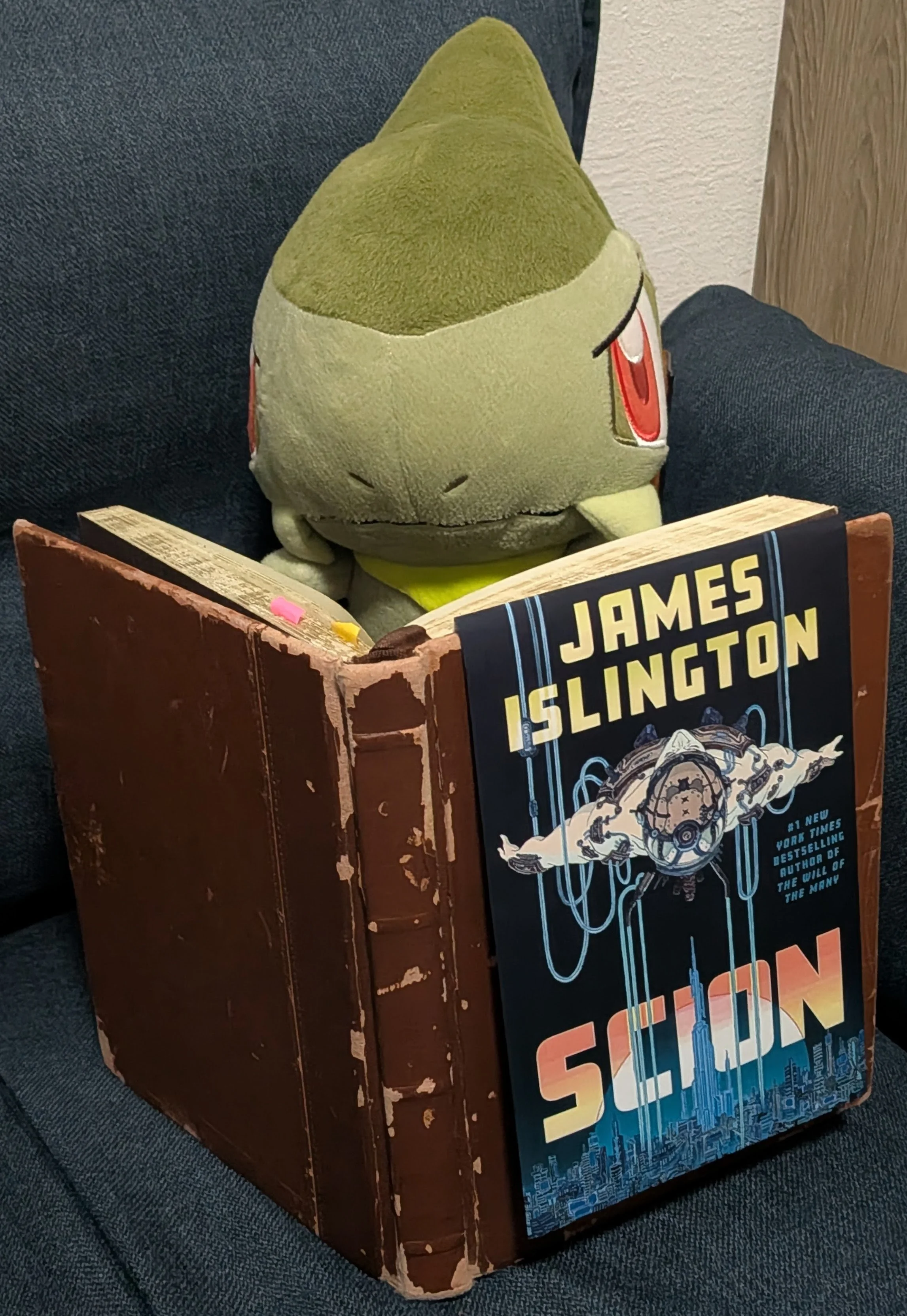
Hello, all. Thank you for joining me for this review of James Islington’s latest offering.
I feel like the best way to explain this book to people is to just quote Islington himself from the Acknowledgements section of this …. nearly 230 page … “novella”.
This story began as a way for me to take a break from the often more serious tone of Hierarchy - basically to have a little pressure-free fun with my writing now and then. Because of that, and because it’s different to and much shorter than my other books, I wasn’t even necessarily planning to publish it in the beginning: I liked it, but I wrote it so specifically for myself, I didn’t have a good sense of whether it would click with other people too.
In other words, Scion is a story suffused with the energy of a high schooler writing Ghost in the Shell fanfiction to blow off steam before completing his book report.
And I do not mean that as a criticism.
This story is a lot of fun. Islington was clearly having a ball writing this, and that fact makes this book a very quick and entertaining read. However, whereas other stories written with this kind of focus would cut corners and rely upon the audience being too caught up in the fun to actually think about the story, Islington put in the work to make the narrative coherent. Really the worst thing that I can say about this book is that, similar to “I’m Not a Superhero”, it teases greater depth that it doesn’t follow through on.
Link up to the network, everyone. It’s time to go hunting.
STATS
Title: Scion
Series: N/A
Author(s): James Islington
Genre: Science Fiction (Cyberpunk)
First Printing: September 1st, 2026
Publisher: Saga Press (imprint of Simon & Schuster)
SPOILERS
Mild, unmarked spoilers for Scion will be included throughout this review. Heavy spoilers will be confided to clearly labelled sections. I’ll strive to keep the first paragraph of any given section spoiler-free.
STRUCTURE
We’re going to divide this review into two parts:
Part 1 (Today)
Premise
Rating
Content Warning
Prose
Part 2 (Wednesday, November 11th)
Worldbuilding
Character
Plot
PREMISE
The Amazon Kindle product page gives us the following to work with:
John Wick meets Ghost in the Shell in this fast-paced cyberpunk thriller by the #1 New York Times bestselling author of The Will of the Many and The Strength of the Few.
My job, when you think about it, isn’t so different from a lot of people’s.
The more old-fashioned crowd do still get hung up on the "killing people" part of it, I guess, but that’s a them problem: it’s been perfectly legal to take out lifers for ages. Besides, once ultrawealthy morons realised they had a way to live forever—limited resources be damned—there was only ever going to be one genuinely practical deterrent.
So, sure, I have to deal with a ton of boring planning. Inconvenient hours. Some pretty awkward face-to-face interactions. And like most of us, I’m really only clocking in to try to crawl out from beneath my debts. But someone’s got to do it.
Luckily, my genetic compatibilities make me really, really good at doing it.
Still. This next job...I don’t know. It’s something I haven’t had to deal with in years. Kind of the opposite of my regular duties. Strange, that it got thrown my way.
I’m sure it’ll all go totally fine though.
Reaction
Full disclosure: I did not take a close look at this premise before buying this book. I only registered the cyberpunk assassin bit. I bought this book purely because Islington’s name is attached to it.
Now, as a book that is marketed based on the author’s name: if you are a fan of Islington and not put off by cyberpunk, you will get what you paid for. The narrative voice of this book is the same as what we see in the Hierarchy Quartet. Islington’s action and character work are engaging. He convincingly sells the idea that the 1st Person POV is in meaningful danger and throws in surprising twists.
Now that I’m studying the premise more closely, I’d say that it delivers exactly what is promised. My one complaint is that Islington (whom I assume prepared this) uses it as a crutch. Within the story itself, it takes way too long to actually explain what a “lifer” is, let alone the fact that there is an industry dedicated to killing them off. I don’t think that this damages the narrative. It’s just an unnecessary source of confusion, and given how easily it is explained here, it didn’t need to be.
RATING: 8/10
Scion is a fast-paced adventure through a cyberpunk world. The protagonist, Azure, feels relatable and sympathetic despite his career as a professional killer. The worldbuilding dives deep into the applications of the various technologies of this future, creating a setting where the elements beyond our own reality feel like natural inclusions rather than things just stuck in because they seemed cool. The plot manages to keep up that high pace without ever feeling exhausting.
It really is wild to think that this is something Islington wrote as a break from the Hierarchy Quartet. This book reads like a novel that was given just as much thought as either book in that series. If anything, the only real hint that this isn’t one of Islington’s usual books is the length. It may be comparable to a shorter mass market paperback (or, for that matter, a lot of indie novels), but it is a fraction of the bulk of any of his Fantasy titles.
Perhaps more impressive, though, is the quality. In a world where far too many writers show a blatant lack of investment in telling their stories well, Islington put in the effort to make this cascade of action setpieces into something coherent and internally consistent. The one significant plot hole or contrivance that I found was a worldbuilding detail that actually does make an amount of sense when one thinks about the broader mechanics of the society.
The only reason I don’t rate this book higher is that, in the back half of the book, the narrative grasps for depth that it hasn’t earned. Certain thematic notes and character beats are plucked out, and they just ring hollow. I wouldn’t say that this hollowness damages the narrative - after all, the story works just fine as a roller coaster of spectacle with a sympathetic protagonist - but this really was something that Islington could have avoided by making these elements matter more in the narrative.
CONTENT WARNING
Scion features lots of mildly gory violence, implications of sex, and substance abuse. Language is limited to cursing, though there’s quite a lot of that. Beyond that, there are elements of trauma, though this is muted by the fact the narrative doesn’t take enough time to really dig into that subject matter.
PROSE
I’m going to use this section as something of a catch-all to cover all of the core issues with this book, including the ones that aren’t really about the prose itself. This is because all of those issues really trace back to the manner in which this story conveys information to the audience. If I were to go over these issues individually, in the sections where it makes more sense, this review would get excessively repetitive.
That's not to say the prose here is all bad. There are also points of praise here.
Accessibility & Voice
This book is a lot easier to digest than Hierarchy.
I can’t quite out my finger in why that is, but I suspect that it’s a least partially a function of the density of the worldbuilding. Islington isn’t feeding us world history, a fleshed-out magic system with a literal heirarchy to it, an elaborate culture, or a plot that hinges on the mechanics of parallel universes and the undead. 90% of the concepts he feeds us are easily grasp archetypes from cyberpunk or Science Fiction in general, and another 5% are explained with minimal exposition. It’s really only that renaming 5% where there are any problems.
Then there is our narrator. Azure is … well, not to sugarcoat it, he’s just Vis 2.0. Normally, that would be a source of criticism, but the thing about similar character voices is that they are really only an objective writing problem if they clash with the story being told (such as by not fitting the world or making POV characters in the same story interchangeable). A character possessing Vis’s dryness and analytical capabilities fits well in this story of assassins in a corporatocratic dystopia. I’d go so far as to argue that it works even better here. Azure’s backstory is less complex than Vis’s. Combine they with the less dense worldbuilding, and it’s a lot easier to get immersed into Azure’s perspective.
If you have been on the fence about reading Hierarchy, I would encourage you to read Scion first. If it hooks you, you are ready to at least attempt to crack into that epic. If you are struggling (or simply find Azure insufferable), then that’s a good sign that Hierarchy may not be an enjoyable experience for you.
Shallow Delivery (Heavy Spoilers)
There are a couple points in this story where I just sort of shrugged and reacted with, “Okay, Bro, whatever you say.”
Azure apparently can’t feel strong emotions. There is a scene where he takes a drug that allows him to process regret and grief.
Azure decides to strike back at his employers, the Keres, in the name of freedom or fighting The Man or whoever we’re supposed to phrase that theme in cyberpunk
Azure is a clone who was lied to be the Keres about being his original, and he has to defeat another clone named Crimson.
All of these elements are fine in concept. They make sense when you think about them in context. Them being as thin as cardboard doesn’t damage the story, because the story doesn’t actually lean upon them. The story is a spectacle of survival from beginning to end. Tacking on extra ideas doesn’t topple it off this foundation.
The issue here is purely that Islington tried to wring something more out of them, and it simply wasn’t earned. He could have earned it. He successfully sets up other twists, mechanics, and character traits with just one or two scenes, so clearly, he could do this effectively even in a fast-paced and … shorter … story like this. The fact these elements feel extraneous shows a lack of commitment to them. If he couldn't find a good moment to set them up, he could and should have just cut them entirely to streamline things.
Time Is Not His Friend
The way Islington paces exposition in this story is actually slower than the exposition in Hierarchy. And while that’s great for less dense reading, it turns basic questions into mysteries that get unceremonious answers rather than meaningful solutions.
For example, consider the lifers. Islington may explain them in the premise, but he doesn’t do so in the text until nearly the halfway point. Again, this fact doesn't damage the narrative. It is a background detail that the story functions perfect we'll without. It's just I spent far too long trying to puzzle out what a lifer even was, when the exposition needed to clarify it was handled as a throwaway line while fleshing out a secondary character’s backstory.
I love slow and diegetic exposition. This just wasn’t the story for it.
BONUS TOKENS
All right, now that we’ve gotten the bad out of the way, let’s dig into the good. Next week, we’ll dive deeper into the worldbuilding, character work, and plot of Scion. The work Islington put in there is a testament to his passion for the story he chose to tell.
Speaking of stories an author is passionate about, I have a free, ongoing web serial, A Chime for These Hallowed Bones. It’s a Fantasy featuring a city of necromancers who recycle the bones of their dead to build their technology. Chapters 1 through Chapter 11 Part 3 are currently available!
Thank you all for stopping by. Please remember to subscribe and share if you enjoyed what you read here. Take care, everyone, and have a good week.