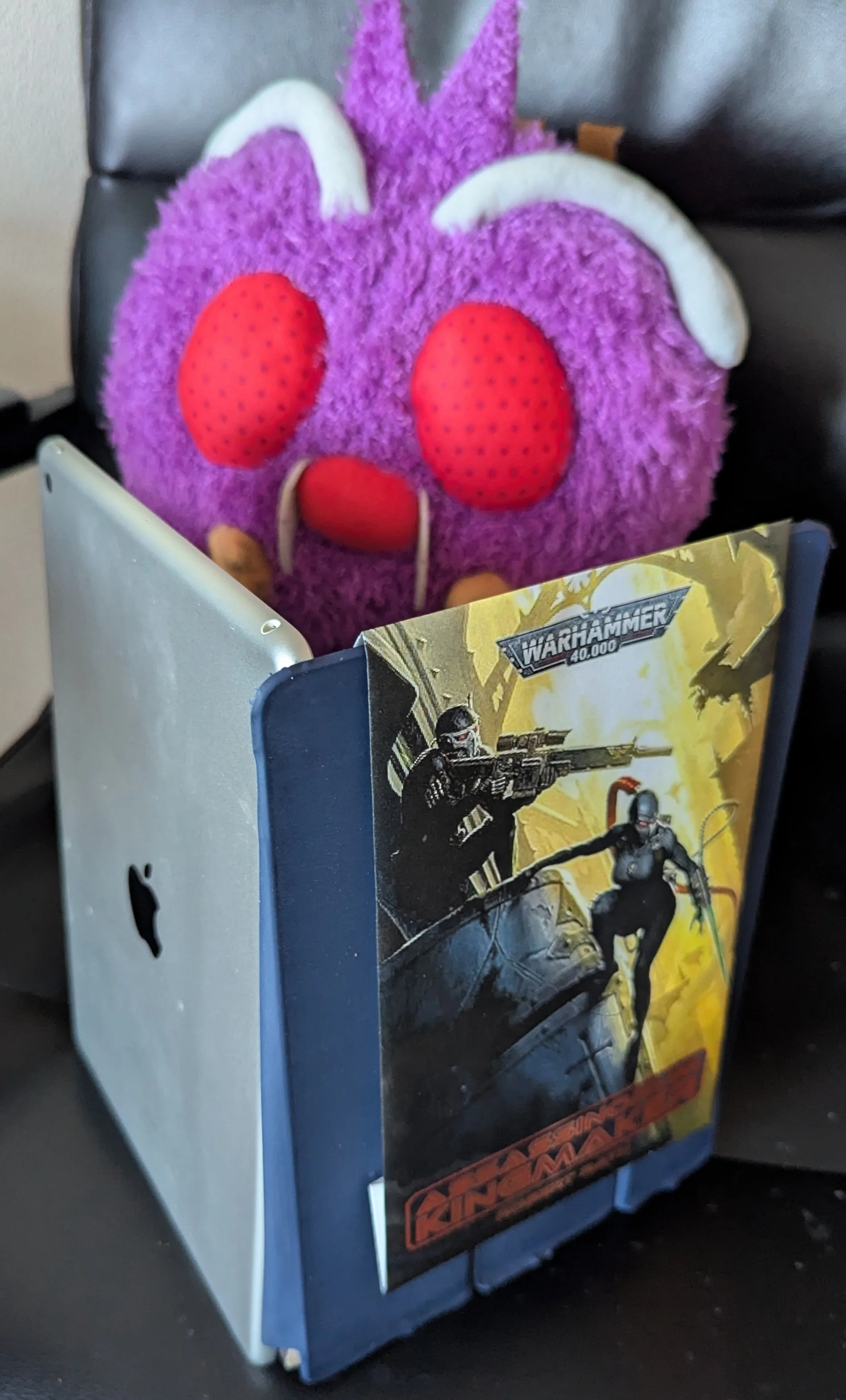
Kingmaker (An Assassinorum Novel) (Part 2 - Plot)
Hello, all. Welcome back to the review of Assassinorum: Kingmaker.
This part will specifically be a dissection of the plot. If you are looking for the overview, please see Part 1. The characters and worldbuilding will be covered next Sunday in Part 3.
If you’re all caught up (or don’t care about that), strap in. It’s time to bring the Emperor’s Mercy to secessionists and heretics.
STATS
Title: Kingmaker
Series: Assassinorum
Author(s): Robert Rath
Genre: Science Fiction (Space Opera)
First Printing: April 2022
Publisher: Black Library (Games Workshop Publishing)
Rating: 8/10
SPOILERS
Throughout this review, there will be mild, unmarked spoilers for the events of Kingmaker. I will keep the first paragraph of each section as spoiler-free as possible. Heavy spoilers will be confined to clearly marked sections.
There will be heavy, unmarked spoilers throughout the review for the events of the Warhammer 40K stories that we have cover thus far.
PLOT
Contact with the Enemy
The objectives of the Assassinorum execution squad on Dominion are fairly straightforward, as spelled out in the premise:
Assassinate the king of Dominion
Steer a pro-Imperial candidate onto the throne (predominantly by assassinating any competitors)
All of this needs to be done discretely. This isn’t an assassination where the Imperium wants to send a message while having plausible deniability. Dominion needs to be a willing participant in the Indomitus Crusade going forward.
Rath could have made this story purely about the obstacles in the way of these objectives. Indeed, a lot of time is spent setting up how hard the assassination will be: the king never leaves his “throne”, a Dominus-pattern Knight Castellan named the Crown of Dominion (hereafter referred to as “the Crown”), which means there at several centimeters of admantine plating between him and any potential assassins. If this book had been simply about progressively overcoming obstacles to get to the king, with the maneuvering of a new candidate being handwaved after the climax, that would have been a fine story.
Instead, Rath steps up and delivers a dynamic, evolving narrative.
A little under the first two-thirds of the book IS this straightforward narrative about killing a single target. A third for just initial planning and prep before arriving on Dominion, a slow introduction to establish the main characters and feed the audience key worldbuilding about Knight Worlds and the operation of the Knights themselves. The remainder of this part of the story is the infiltration and buildup to the right moment to strike.
Once the assassination is carried out, the pacing kicks into gear. The next few chapter is a high-speed montage of the execution squad monitoring the efforts by Dominion’s nobility to choose a new monarch and quickly killing any who aren’t suitably pro-Imperial.
The last quarter of the story … well, I can’t go into details without heavy spoilers, but the story transforms yet again. The book goes into a spectacular action climax. The execution squad are pushed to their limits as they try to contain a far larger crisis than the one they were originally sent to prevent.
The way the story evolves is one of the reasons I think it is so good. Rath did not need to do this. He could have told a perfectly functional, perfectly entertaining narrative by keeping the mission tightly focused on the original objectives. By going the extra mile and letting the story change over time, he kept things engaging and made it harder to predict how it would all end.
Setups and Payoffs (Heavy Spoilers)
Now, regarding that big action climax … there are definitely strengths and weaknesses to it, and the weaknesses are why I don’t this book higher.
The Final Spectacle
Dominion is a world hosting two Knight households. A good chunk of the build-up and intrigue to the assassination involved navigating the manipulating the tensions between these two Houses. Mentioned throughout, though, was a third House that was the mortal enemy of these two, one that had embraced Chaos (via loyalty to the Dark Mechanicum) during the Horus Heresy.
Also brought up throughout the book are repeated references to a heretek computer virus, “conqueror_wyrm”. This virus is able to corrupt cogitator systems - or anyone with augmetic enhancement to their Brian's - to the service of Chaos.
The big twist that kicks off the climax is that the Crown is infected with conqueror_wyrm, due to a clash with that house of Chaos Knights (a clash we see in the flash back). The tainted Knight has spread this corruption to the Mechanicum sacristans who maintain Dominion’s Knights, and from there, multiple other Knights and their pilots have been corrupted. The nobility of Dominion who are muttering about secession are actually Traitors waiting for their chance to rise up. When the new king is coronated, the Crown itself makes its move, openly rallying Dominion to join forces with the Traitor House will also welcoming an invasion force of those same Traitors onto the planet.
From there, the mission of the heroes (namely, the three members of the execution squad and two natives they have recruited for their mission) have to destroy the Crown, kill the Traitor nobles, and fend off the invasion.
Machina ex Machina
Much of this climax and its resolution are set up very well. Unfortunately, one detail is not: Leviathan.
One of the two natives who aids the execution squad is a Knight pilot named Rakkan. Sycorax actually spends a good chunk of the story disguised as him while he helps guide her through the intricacies of Dominion's social hierarchy and the challenges of piloting his Knight. Outside of helping the assassins (since the alternative is death), Rakkan also has this running thread about feeling worthless within that same hierarchy.
At first, I thought Rath was building Rakkan up for an arc where he ended up being the king to take over after the assassins finished their mission. That is what ends up happening, but it isn't what the arc built towards. Instead, the buildup was for Rakkan to discover the legendary Leviathan, a Dominus-pattern Knight Valiant. He finds this by …
… just happening to flee into the crypt where the Leviathan is hidden …
… just happening to have his father's piloting helmet …
… and just happening to say the code phrase needed to use the helmet to unlock the Leviathan’s hanger bay.
Oh, plus the Leviathan was only set up with two passing statements that make the setup of the venin in Fourth Wing seem rock-solid by comparison.
And this might not have been an issue, except the Leviathan then plays an instrumental role in repelling the invasion and killing Traitor nobles, while the assassins are busy dealing with the Crown and tainted sacristans.
The layers of convenience and the weak foreshadowing behind this twist are extremely frustrating. It wouldn’t have been hard to at least layer in more setup for the Leviathan so that it felt like the inevitable conclusion to Rakkan’s arc. This is a glaring weak point in an otherwise solid narrative.
A Gold Standard
While the Leviathan is a twist that falls short, the twist that kicks off the climax is magnificently constructed. It manages to be both a surprise on a first read and the inevitable endpoint of the narrative once one looks back and sees how all the pieces click together.
The most important piece of this is the conqueror_wyrm virus. This is introduced very early in the narrative as one of the threats that the Indomitus Crusade needs to contend with. All three members of the execution squad have assassinated at least one target who was connected to this virus, and Rakkan fought against heretek forces that deployed the virus during his years as a Freeblade Knight. It is referenced at multiple points through the narrative when discussing the Crusade and why Dominion’s nights are so vital to continuing the war effort. So when it is revealed that the Crown was infected by an early form of the virus a generation previously, it’s not an ass-pull. An established but background threat instead reveals it is very present.
A key point with the conqueror_wyrm is that, despite being firmly established, it’s not telegraphed. Yes, it gets a lot of discussion, but always in a manner that feels natural for the scene and the characters involved in that scene. This indirect focus makes it feel like as much an integral part of this book’s lore as Chaos itself. Put another way, this is the sort of treatment I wish the venin had gotten in Fourth Wing to make their reveal feel less like a complete flipping of that book's narrative.
The invasion is likewise set up. Throughout the book, there are repeated references to a character named Baron Rallan Fontaine and a hinterland rebellion he’s away from court to out down. The twist reveals that Fontaine was actually securing a landing site for the Traitor Knights to drop in an invasion force. When the Crown calls for Dominion to embrace Chaos, this force launches a lighting raid on Dominion’s orbital defenses to open the path for a larger invasion fleet.
All these pieces fall into place naturally - but, again, aren’t telegraphed. When the (seemingly) pro-Imperial monarch is installed, it was clear that the story wasn’t done yet (by virtue of the number of remaining pages). However, the Crown going rogue and welcoming an invasion was the last thing I expected. I actually thought a third party would step in an kill the new monarch right away, forcing the assassins to hunt down this new threat before trying to install another replacement. It’s only looking back that all the pieces fall into place.
Action
Given that this is a story about both the Assassinorum and Knights, this story had to juggle action at both the scale of individual assassins eliminating their targets and of mid-sized mechs fighting each other. I’d say that Rath does very well with both. While I wouldn’t go so far as to say the action feels choreographed, it is fast and exciting, and each assassin has a distinct fighting style that matches their respective temple (Raithe is a skilled marksman, Sycorax favors her phase blade, and Koln is skilled at both hand-to-hand and with deploying the arsenal of digital weapons inside her augmetic hands). As for the Knights, there is a sense of ponderous weight to their movements that’s similar to what we saw with the Titans in Titanicus.
My only real complaint about the action is that the narrative assumes that the audience is already full aware of Knight lore, from what the different patterns of Knight are to what each weapon does. For the most part, we don’t even get clear physical descriptions or sizes for things. This makes it very hard to fully visualize the mech battles if you aren’t already a fan and don’t have the time or patience to research these details mid-book.
ALLIED BY CIRCUMSTANCE
Next Sunday, we will wrap up this review with a dissection of characters and worldbuilding.
Neither the cast nor the mythos of Kingmaker reinvent the wheel. These are functional for the story being told. That said, outside of the issue of Rath not fully describing Titans or their weaponry, he takes the time to properly establish who people are and how the worldbuilding elements most relevant to the narrative work. The audience is not left in the dark or expected to understand everything in advance.
If you’re looking for more stories of soldiers fighting to keep the light of civilization burning again chaos and barbarism, I’m happy to announce that my first Military Fantasy serial, Moral Support, is now posting over in Tales of the Five Worlds! Chapter 1 through Chapter 3 Part 2 are now available. I’ll hope you’ll join me for these new adventures!
Thank you all for joining this week. Please remember to subscribe and share if you enjoyed what you read here. Take care, everyone, and have a good weekend.