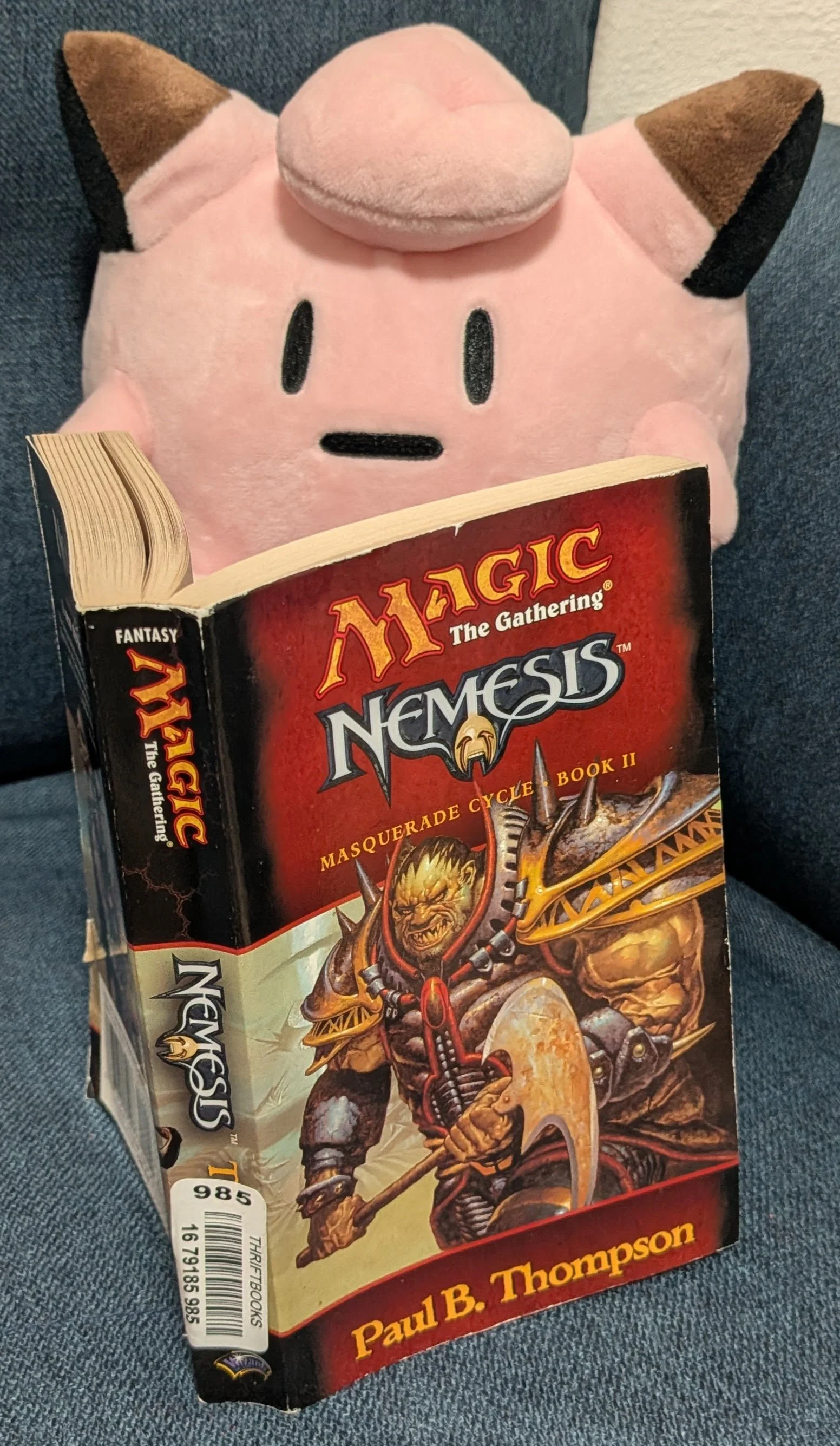
Nemesis (Masquerade Cycle, Book 2)
Hello, all. Welcome back to our exploration of MTG tie-in fiction and the adventures of the skyship Weatherlight … or, in this case, the adventures of those the Weatherlight left behind.
Much like Mercadian Masques, Nemesis picks up the instant that Rath and Storm left off. The story follows Crovax and Ertai as they fend for themselves on Rath, as well as describing the succession crisis over the throne of Rath’s “evincar”. I remember this being the only book of the Masquerade Cycle that I liked in my youth, and it was also the only one that I reread.
How does it hold up?
Not as well as I remember … but it could be worse.
Let’s dive in.
STATS
Title: Nemesis
Series: Masquerade Cycle (Book 2)
Author(s): Paul B. Thompson
Genre: Epic Fantasy
First Printing: February 2000
Publisher: Wizards of the Coast LLC
SPOILER WARNING
Mild, unmarked spoilers for Nemesis will be provided throughout this review. Heavy spoilers will be confined to clearly labeled sections. I will keep the first paragraph of any given section spoiler-free.
Throughout this review, I will also be providing heavy spoilers for later events within MTG canon. While I will be steering clear of details that would spoil the progression of this book specifically, there is a strong chance that you will figure out certain spoilers if you pay attention to these bits of lore. I’ll confine the heavy spoilers that are relevant to this book into clearly marked sections.
Heavy, unmarked spoilers for previously reviewed Magic: the Gathering tie-in novels may also be provided, regardless of where they fall in the timeline relative to this book. I will also assume that you’ve already read my reviews of those books, though they aren’t essential to understand this one.
PREMISE
Per the back cover of my mass market paperback copy, we get:
A new threat looms on the horizon.
The long-awaited completion of Rath is approaching. The Dark Lord’s plans to invade Dominaria will soon see fruition. Only the struggle for power in this artificial plane remains. Urza Planeswalker will not stop the Phyrexian empire.
Witness the creation of his nemesis.
Reaction
This is a premise that describes a vague worldbuilding premise, rather than a plot … and yet, somehow, is still wrong.
Yes, this story is about the “struggle for power” over the throne of evincar. Yes, this is happening right on the eve of the invasion of Dominaria. However, this story is not the “creation” of Urza’s “nemesis”. For that matter, because Rath is already so close to completion, the struggle for power isn’t even that important to the overall struggle between Urza and Phyrexia. The story is a fight over who gets to sit in the big chair and claim credit for finishing a project that was actually done by all the previous evincars.
Still, credit it where it is due, this book does indeed have the vibe of the story being described. This is a story about the villains of the Weatherlight Saga. If that’s all you want, you may be quite satisfied with what you get here.
TIMELINE
Nemesis adapts the 19th MTG expansion, which shares the same name and was released in the same month.
According to the MTG Wiki timeline, the events of this book occur in 4205 AR (with the beginning potentially being in 4204 AR, depending on when, exactly, the new year began). This lines up with the story of Mercadian Masques. Both books begin at the same moment, and since it’s implied that the overlay of Dominaria is beginning at the end of Nemesis, that means that both books all end at about the same time.
That being said, now’s a great time to call out one of the biggest issues with this book: time.
We are explicitly Told that the entire story of Nemesis, from the prologue (which may or may not have occurred in the middle of Rath and Storm) to the climax, covers a span of five weeks, as relayed in exchange between Eladamri and his daughter-turned-Phyrexian-corpse-puppet, Belbe.
“Perhaps you really don’t know, but you were once my daughter. Her name was Avila. She was killed on the orders of Volrath and her body stolen. That was five weeks ago. How long have you been here?”
“I’ve been on Rath three weeks. Before that, on Phyrexia, two weeks …”
Belbe’s time on Phyrexia appears to have been swallowed by the post-prologue time skip, as she arrives on Rath just two days after the end of Chapter 1. In other words, this book covers only three weeks. There are two problems with this, one that doesn’t hurt the narrative and one that does.
First, the timelines do not line up. Mercadian Masques has at least one timeskip that is longer than the entire plot of this book. Furthermore, because of the potential two-week timeskip between the prologue and Chapter 1, Belbe seems to have gotten her mission to oversee the selection of a new evincar in the wake of Volrath abdicating the throne to infiltrate the Weatherlight crew … before Volrath abdicated the throne to infiltrate the Weatherlight crew. These inconsistencies don’t hurt the story. In the case of Mercadian Masques being far longer, this seems like the result of these books being written by two different authors while the WotC editorial staff failed to stay on top of the timeline. Still, coming from Mercadian Masques, I was expecting a far larger timespan to be covered.
(Also, with the hindsight of the Invasion Cycle, if this book is ending right as Invasion begins, then Rath should be covered in vast Phyrexian armies who are staging for the invasion, which isn’t the case.)
Second, and more importantly, the compressed timeframe of this story undermines the plot and the character work. Developments that could have been rationalized by timeskips of many months instead arbitrarily occur within days. This drains the emotional weight out of moments that should have been significant.
RATING: 4/10
I liked this book better than Mercadian Masques, but if I’m being totally honest, it doesn’t work nearly as well.
The story Thompson sets out to tell is a dark, political Fantasy. The throne of a Dark Lord archetype is open, and someone has to step in and fill it. While the Phyrexians have their favored candidate, the vampire Crovax, they task Belbe with assessing the situation on the ground and selecting the best candidate out of those available. Since she doesn’t think Crovax will be suitable for the job, she instead choose the wizard Ertai and grooms him as her own candidate. Rebels also use this period of transition to attempt to do lasting damage to the Phyrexian regime.
Consequently, while this book does have plot stuff happening, this is really more a story of character. We see Crovax embracing his vampiric nature and Phyrexian augmentations, Ertai struggling to survive and escape from this Phyrexian-controlled realm, Belbe beginning to desire her own self-actualization and considering breaking away from her masters, and Eladamri reacting to the “death” of his daughter by launching a more daring campaign against the regime. This is a refreshing change of pace after Mercadian Masques, which was plot at a breakneck pace with minimal character work.
The issue is that, while more character work is good, it needs balance. Things need to happen either to the characters or because of the characters. If character development just happens because we are Told is happens, that doesn’t feel like a natural progression.
Those of you who read the Onyx Storm review may remember me complaining about how Violet’s grief arc didn’t feel earned. She was catatonic for a couple days, then she just decided not to be catatonic. Imagine an entire book where character development was written like that. Sure, maybe the concepts make sense, but for whatever reason (probably a combination of schedule and a desire to limit the page count), Thompson didn’t give us enough material to fully execute those concepts.
WORLDBUILDING
This book doesn’t do a lot of new worldbuilding for Rath. Stuff like the role of evincar (to oversee flowstone production and maintain order on Rath), the purpose of Rath (to overlay Dominaria), and Phyrexia’s ability to access and monitor the plane with relative ease were all covered in Bloodlines. That said, Thompson does take time to explore flowstone in greater detail. We learn how flowstone is manipulated, see how many things it can imitate, and even explore some of the interesting limitations of what flowstone can imitate. For example, there’s a scene midway through the book where Ertai reflects on how a flowstone lantern imitates flame without generating heat, and then later see a rebel try and fail to start a fire because she mistakes a flowstone lantern for real flame. I wouldn’t say this worldbuilding is strong enough to make this book a worthwhile read just for the setting, but it’s still a nice touch.
PLOT & CHARACTER (Heavy Spoilers)
The character work of Nemesis is heavily dependent on the events of the plot, and vice versa. This is why the issue of time causes this book so many problems. We are Shown events that propel the story in a direction that makes sense, prompting character reactions that also make sense … and then suddenly, characters are reacting to things that never happened. This creates moments that are confusing at best or outright contradictory at worst.
The Ascendant Evincar
Crovax is going to sit in the big chair at the end of the story. This is inevitable. His card in the Nemesis MTG set (the 19th expansion of the game) is named “Ascendant Evincar”. Sort of gives the game away.
The issue is that Belbe treats his ascension as inevitable when, per the rules established in this book and the precedent by Bloodlines, Crovax nukes his candidacy before the halfway point of the book.
Crovax insists that he can wipe out the rebellion and demands that he be given command of Rath’s army to do so. This is explicitly stated to be a demonstration of his ability. He marches the army out, and … before he even gets to the rebel case in Skyshroud Forest, his vast force is assaulted by a far smaller rebel group, suffering horrific casualties and being routed after a single battle. Crovax then abandons the army, using magic to teleport back to the Stronghold of the evincar, where he juices himself up by draining the life essences of a bunch of hostages.
At this point, Crovax has undeniably failed. His bid to prove himself has not only humiliated him but also cost the Rathi army dearly. Bloodlines showed us the Phyrexians have zero patience for failure. Why, then, does the story continue to act as if Belbe has no choice but to appoint Crovax? Because he’s powerful? The evincar isn’t just a brute with a noble pedigree and an understanding of military command. It’s a position that demands good management skills. So when Belbe carries on as if she honestly things her superiors will accept Crovax as the next man to sit in the big chair, it really doesn’t feel earned. Seems like Crovax’s switch to underhanded tactics should have been a tactic of desperation after she outright rejected his claim, rather than entitlement and impatience on his part.
Feelings
Belbe’s story is a real mess.
The concept I think Thompson was going for is that, despite being dissected and reassembled by the Phyrexians, something of her old identity has leaked back in and his shifting her alignment away from Phyrexia. This is set up in the prologue of the book, when the Phyrexian assassin sent to kill Eladamri’s daughter and steal her corpse froze up during the assassination, with it later being revealed that he’d been fabricated from the corpse of her dead fiancé.
However, none of Belbe’s POV scenes actually indicate that this is the case. Furthermore, the book establishes that Phyrexians can outright remove conscience from a person, as seen when they improved Crovax. Maybe that assassin was imperfect, but someone altered to the ridiculous degree that Belbe was doesn’t have any excuse for such oversight.
So when Belbe starts reacting to Crovax with moral revulsion rather than just disdain at his failures, or when she decides to have sex with Ertai, or when she decides to sabotage Rath’s flowstone factories to spite Phyrexia and disrupt the overlay, all of these developments come out of left field. There’s no weight to any of it. The story just decides that the Phyrexian diplomat has turned her coat.
This extends out to Ertai, too. Things are a lot simpler from his POV, as his motivations are always just to survive and to find a way off Rath. Then, after he has sex with Belbe, he starts wondering what he means to her. I get that Ertai is a young man and that Belbe is an attractive woman, but that only explains why he would be agreeable to a sudden offer of sex. It doesn’t explain why a character defined by his overwhelming arrogance is suddenly having the feelings.
Timeskips
Adding longer timeskips, covering months instead of days, would have helped this book a lot. It wouldn’t have fixed the issues outright, but at the very least, the far greater passage of time (perhaps supplemented by Telling us about additional developments) would have smoothed out the flaws somewhat. We’d have room to fill in the blanks.
If Crovax had months after his initial failure to redeem himself, and we were Told he scored victories against the rebels during that time, it would make a lot more sense that he is still a credible candidate.
Larger gaps in time would allow changes in Belbe’s motivations to feel like a evolution (perhaps prompted by her association with Ertai) rather than a blunt change.
CONTENT WARNING
As mentioned above, Belbe and Ertai have sex around the midpoint of the book. This is handled in a fade-to-black manner. Even the nudity is only implied.
That said, much like the nudity of Orim in Mercadian Masques, there are a couple times when Belbe is naked that do feel like fanservice, especially since the back cover of the book features art of Belbe that isn’t from any MTG card.
There is, of course, a lot of bloody violence and death. It’s a bit gorier than Mercadian Masques, but not so much as to be more impactful.
IT IS WRITTEN
I was disappointed by this reread of Nemesis. It has things I really want to like. The execution just isn’t there to make it feel satisfying.
Only one book remains in the Masquerade Cycle. We’ve seen what’s happening on Mercadia and Rath during this time period. Now it’s time to turn our gazes back to Dominaria. We’ll get into that next week, when we review Prophecy.
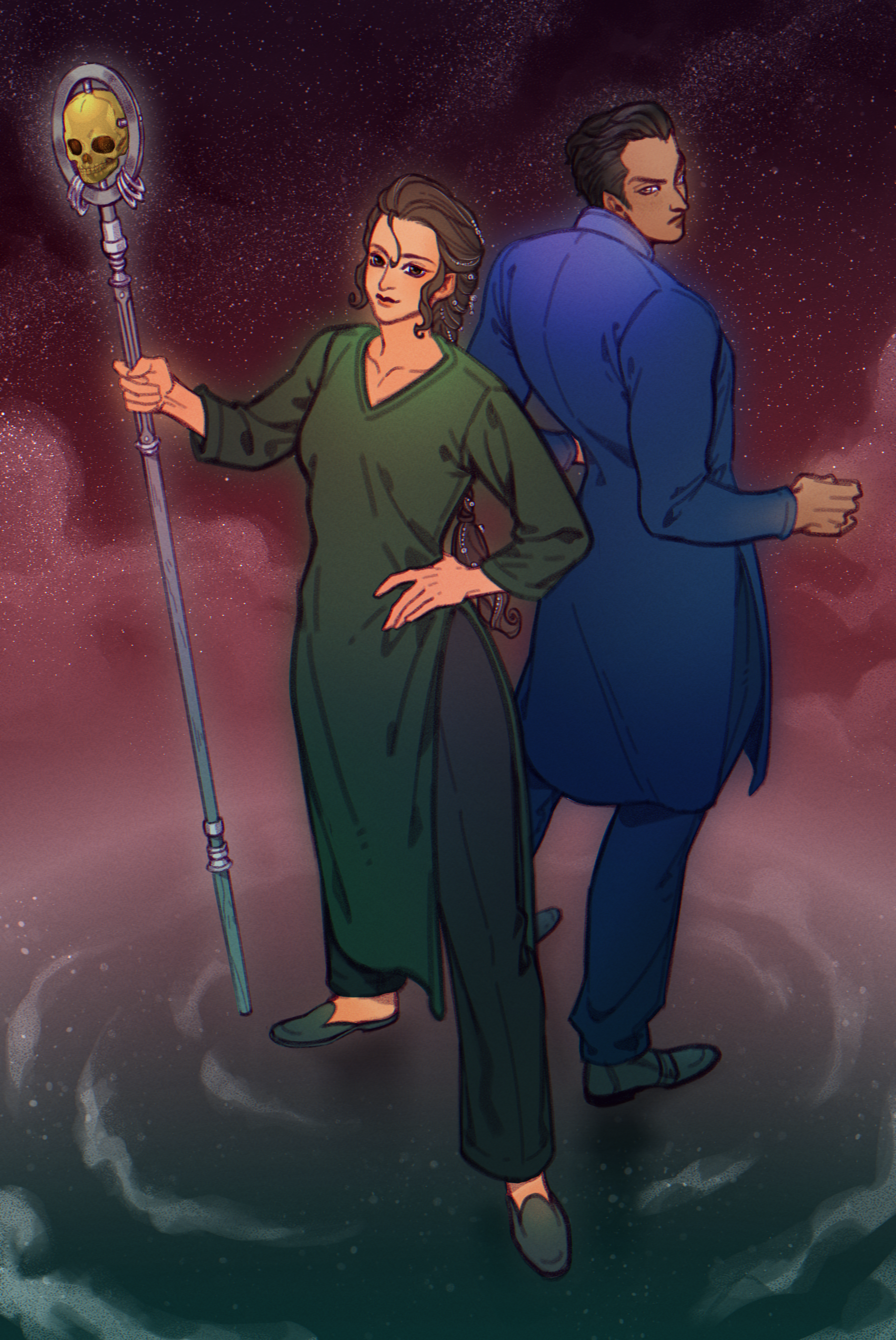
If you’re looking for more stories of magic and intrigue, I recommend my ongoing necromancer serial, A Chime for These Hallowed Bones. Chapter 1 through Chapter 10 Part 2 are now posted. Join in for the ongoing adventure!
Thank you all for joining this week. Please remember to subscribe and share if you enjoyed what you read here. Take care, everyone, and enjoy the rest of your week.