A Wet Blanket on a Dune (Part 2 - Reinvigorated Adaptation)
Hello, all. Welcome back to Reflect & Redraft’s dissection of Chani in Denis Villenueve’s Dune films.
On Tuesday, we dissected how the root of Chani’s ills in these films (but most especially Dune - Part 2) is that fact that she’s consistently characterized for a completely different story. Her behavior does not line up with Paul’s actions. The result is that she seems to be actively fighting against Paul fulfilling the very goal that’s supposedly her entire motivation.
Today, we discuss how Chani could be amended to best line up to what Paul actually did within Dune - Part 2.
DISCLAIMER
For the purposes of this analysis, I will not be taking the original Dune books into account (other that to acknowledge a few things that were changed in the adaptation). I will be accepting the interpretation of the story by Villeneuve as the correct interpretation of the story. The reason for this is twofold:
I have only seen the movies.
Arguing about Media Literary does not erase the flaws in Chani’s writing. Even if one argues that Villeneuve’s vision perfectly reflected the spirit, intent, and themes Frank Herbert’s work, that does not give him a free pass for poor execution of that vision.
The point of this analysis is to explain how, even if we meet the movies on their own terms, Chani is badly written. She didn’t need to be. We are going to fix that.
Also, for the purposes of this analysis, the first two Villeneuve Dune films will be abbreviated as follows:
Dune - Part 1 = D-1
Dune - Part 2 = D-2
HANGING OUT TO DRY
Restrictions
Not Paul’s Problem
For the purposes of redeeming Chani’s character in Villeneuve’s Dune films, I am going to focus on reworking Chani specifically.
Ideally, if Villeneuve’s goal was the amplify the idea that Paul is the villain of the story (at least, within the timeframe covered by D-1 and D-2), then Paul’s story should have been amended to remove any ambiguity. When people read Paul as the hero of the story (most especially in the films) that’s not a lack of Media Literacy. That’s a neutral reading of the situation:
Paul and Jessica are just trying to survive in a world where even the Good Guys initially only value them for the water that can be harvested from them.
Paul’s goal is not to become a tyrant. He is trying to destroy his enemies before they destroy him, and that makes him and the Fremen allies.
Within the time frame covered by the movies, everything up to the point of him seizing the Imperium’s throne for himself is justified (or, at the least, explained) as a justified grievance boiling over into bloody revenge. Paul is not grabbing power for its own sake.
What Villeneuve needed to do was make Paul overtly tyrannical. He instead opted to have Chani hold the audience’s hand. This made Chani’s writing a casualty of adaptational convenience. For the purposes of fixing her characterization, we will therefore focus solely on changing Chani.
Betrayal
Having Chani in ceaseless opposition to Paul throughout the story is a key reason why she comes across as a wet blanket. Also, it doesn’t help achieve Villeneuve’s Media Literacy goal. Saying, “Paul is the Bad Guy,” doesn’t really work when the guys he’s fighting are:
a morbidly obese murderer who casually murders his servants;
a coward who casually murders his underlings;
a “psychotic” teenager who casually murders his servants, his underlings, and his own mother.
What would pack much more punch is to amplify Chani's feelings. We are meant to think that she genuinely loved Paul and that he betrayed her by following the path that he did. Amplifying this, leaning into it so that it becomes the audience experience, would better sell the idea that he is doing something wrong by defeating the obvious villains.
Both of the potential rewrites we explore will therefore make Chani far more supportive of Paul and then establish a clear point where he turns to the dark side in an unambiguous betrayal of her.
Two Sides of a Coin
The rewrites being proposed here could be implemented at the same time for maximum effect. I am presenting them as separate solutions to prove a point. Villeneuve did not need to do much to fix Chani. Doing only one of these things (in a sense, a half-measure) would have been enough.
The Acolyte
As covered when breaking down why Chani’s character falls apart, Paul riding the grandfather worm should have been the point where Chani stopped pushing back against him as a religious figure. His have proven himself as a Fremen and as a warrior, and she sees how this is inspiring her people. Regardless of whether or not she truly believes he is a prophecized savior, logic dictates she should embrace the hype.
Paul later betraying this hype would then be what breaks her and exposes that he is the villain.
Here’s how it would go: instead of gazing in horror at her follow Fremen, Chani would react with joy. If she is truly converted, she falls to her knees in joyful rapture; if she merely acknowledges that maybe this Mahdi thing isn’t so bad after all, she could keep her feet, but repeat Stilgar’s, “As it is written,” line with a smile on her face.
In the next scene, where Paul and Chani talk after sex, they will still discuss his mother proclaiming him as a messiah. This time, Chani is positive about it. She speaks of how Paul is inspiring people and proving the truth of Jessica’s sermons, establishing both of these things as a cause of hope. Paul, of course, is not pleased by this, because his visions have warned of the suffering this would cause. Indeed, the fact that Chani is now on the hype train gives him even more motivation to tell Jessica off in the next scene that the pair share.
Most of the changes from this point onwards are obvious. Chani supports Paul instead of undermining him, urges him to go south to kick those fundamentalist Southerners into action, willingly and eagerly participates in reviving him after the Water of Life ritual, supports him (if only by keeping quiet) during the council meeting, and goes into the climax as a devout supporter of Paul. There is only one scene where her opposition remains: the scene where Paul contemplates aiming the atomics at the spice fields.
In this iteration, Chani would be shocked by Paul’s suggestion, but she wouldn't accuse Paul of trying to control the Fremen. She would then impress upon him that spice is integral to the Fremen identity. This would be supplemented by an account of Harkonnens previously destroying a spice field in an attempt to demoralize the Fremen in the past. She extracts from Paul the promise to never threaten the spice supply. After all, the Mahdi, as savior of the Fremen, wouldn’t do such a thing.
Fast forward to the climax. When Paul tries to bully the Landsraad into compliance, he issues his ultimatum to bomb the spice fields … and then, to show he is not bluffing, does indeed bomb one of them. This causes Chani to react in horror: first in reaction to Paul, then to the realization that her fellow Fremen are not horrified by this. Paul has blinded them to anything except victory, even at the expense of their souls. Here Chani gets to shout at the Fremen in a failed bid to bring them back to their senses.
When the Landsraad don’t back down, Paul launches the jihad and urges Chani to join him, but Chani refuses, telling him that he isn’t the savior she thought her was. Then she abandons him to go off into the desert, symbolically leaving behind not only him but also the Fremen in his thrall. (I think maybe Villeneuve intended this interpretation of Chani walking off in the film we got, but as covered in the last part, it wasn’t earned there.)
The goal of this rewrite option is to lean into the idea of Paul as a savior and how that twists from something heroic to a cult of personality. Chani is meant to be the audience avatar. We come to believe in and cheer for Paul with her, then are betrayed with her when Paul strays from the righteous path.
Daughter of Arrakis
This is a more mild option that leans upon a detail that didn’t get much focus on the film.
When Paul rallies all the Fremen to him with his big speech, he displays the Atrileides signet ring and announces himself as, “Paul Maud’dib Atreides”. This appears to have been an attempt to assert that he has legitimate authority in the Imperium beyond Arrakis and the associated power to bring about a lasting victory. What none of that characters appear to register (including Chani, who has already turned against Paul) is that this declaration sets him apart from his fellow Fremen in a way that being the Mahdi does not. He is effectively laying aside his Fremen identity by reasserting his original name.
In one of the trailers for Dune - Part 3, Chani accuses Paul of betrayal because he took “power in [his] name”. This is likely meant figuratively. Still, it does provide a clear through line for Paul to betray Chani in D-2.
In this version of the story, the bulk of Chani’s antagonism is still dropped when Paul rides the grandfather worm. After all, even if she doesn’t believe he really is the Mahdi, he is properly a Fremen, and his inspiring her people is reason enough to let the religious elements of their fervor slide. So there’s no looking around in horror at the worship, no warning that he should be afraid to go south, and no nonsencial shouting about Paul enslaving them to a prophecy by using the prophecy to free then from slavery. She will be furious with Paul for endangering himself with the Water of Life ritual, but she will indeed understand after the fact.
There are two major changes that need to be made to build up to Paul betraying her when he reclaims his name.
In the scene where Paul deliberates using the atomics on the spice fields, Chani will assert that this isn’t what a Fremen would do. She tells him to stop thinking about the atomics like “Paul Atreides,” the foreigner, and instead think about them the way “Usual,” the Fremen, would. Paul agrees that he is Usul.
The scene would be expanded to include the discussion of political marriage. To streamline things for the audience, Chani would lump this in with the idea of bombing the spice fields as a foreigner’s notion. Even if Paul can marry Irulan for political power and love Chani as a man, that is still thinking like “Paul Atreides” instead of “Usul”.
Paul declaring himself as “Paul Maud’dib Atreides” would therefore be the moment that alarm bells started ringing for Chani. She will confront Paul about this. Paul will assure her that he said what he saw that he needed to say. We’ll still get that line about him loving her as long as he breathes, yet this, too, will be expanded, with him clarifying that he is not gunning for the throne of the Emperor. He promises her that Paul Atreides only wants to stand between the Imperium and Arrakis.
When Paul then makes a liar of himself at the climax, demanding the hand of Irulan in marriage, Chani is understandably heartbroken. Yes, she (and the audience) can understand the pragmatic necessity of Paul's action, but the fact he has so blintly lied to her will throw his moral integrity and intentions into question. Chani leaving him will reflect the loss of trust.
The goal in this rewrite is to lean into the divide between fighting for freedom and fighting for control. Chani (and the audience) would see the former as heroic. Putting more focus on Paul’s chosen name and the decision to take the throne will establish a clear moment when his actions become villainous.
Seeing Things As They Are
What makes Chani “the wettest of blankets” is not the fact that she opposes him. It’s the fact that opposing him doesn’t make sense in the films. It does against her established motivations and the way in which Paul’s rise to power is portrayed.
The fix did not have to be either (or both) or the solutions I’ve proposed here. I really do think it would be more effective to revise Paul’s actions and behavior so as to make him an obvious villain without Chani hammering in that point. Still, with things as they now stand, Chani is the one who does not fit, and revising her would be far easier.
THE GOLDEN PATH
I’m apprehensive about Dune - Part 3. The second and third trailers have really milked on the idea that Paul is this horrible villain who needs to be taken down, and it’s to the point that I fear the film will lack nuance. Given the things I'm aware of from the books, Chani was supposed to be on Paul's side at the end of D-2, and given how the change already caused problems in D-2, I’m not optimistic about how those expanding ripples will affect the sequel. In any case, I will most likely be seeing Dune - Part 3 when it comes out.
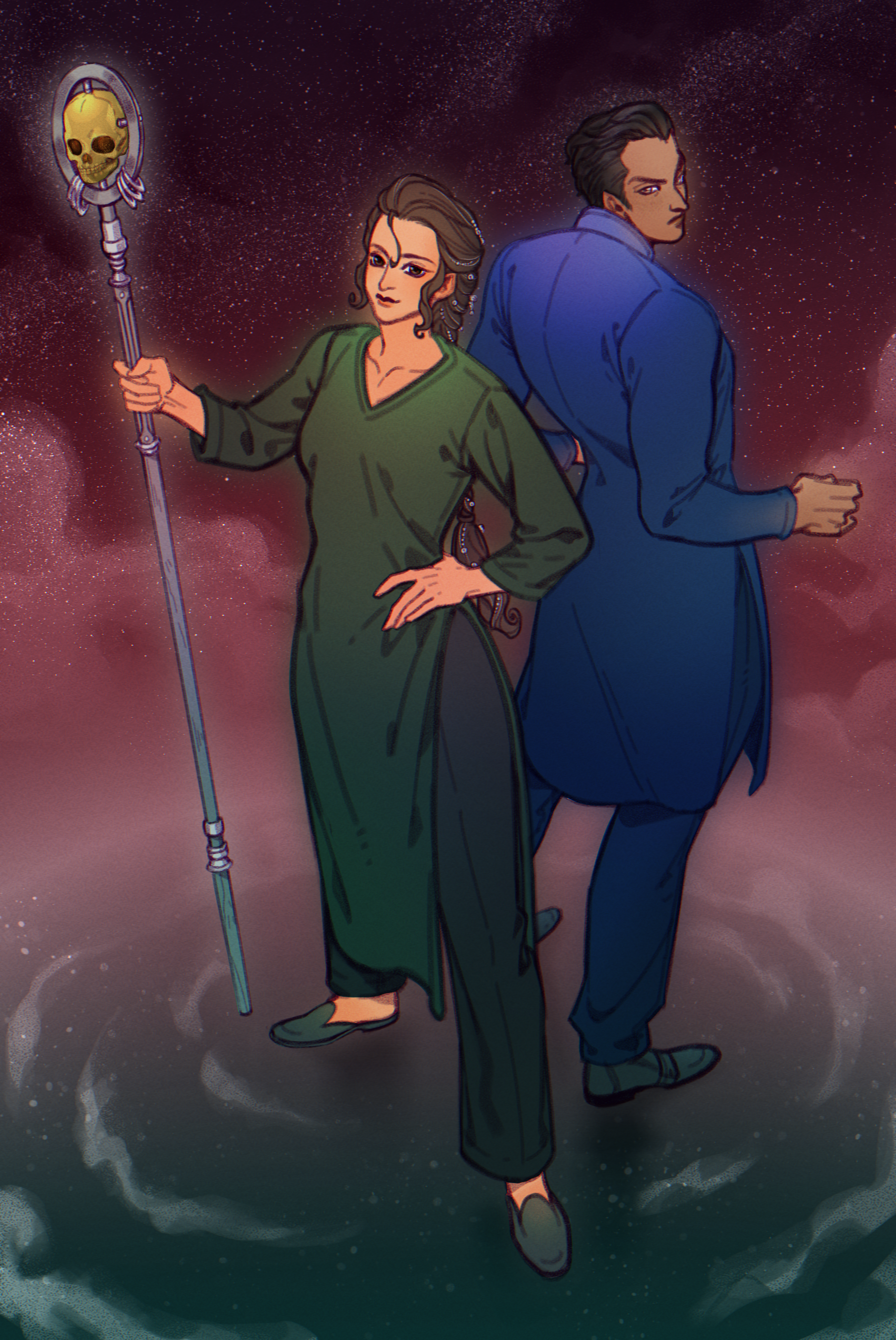
In the interim, if you’re looking for stories of love and betrayal involving a foreigner of questionable honor, my Romantasy serial A Chime for These Hallowed Bones is ongoing. It’s an Enemies to Lovers story that’s Alchemized meets Fourth Wing, featuring necromancers in a Desi-influenced setting. Chapters 1 through Chapter 11 Part 3 are currently available, and Chapter 12 arrives Friday!
Thank you all for stopping by. Please remember to subscribe and share if you enjoyed what you read here. Take care, everyone, and have a good week.