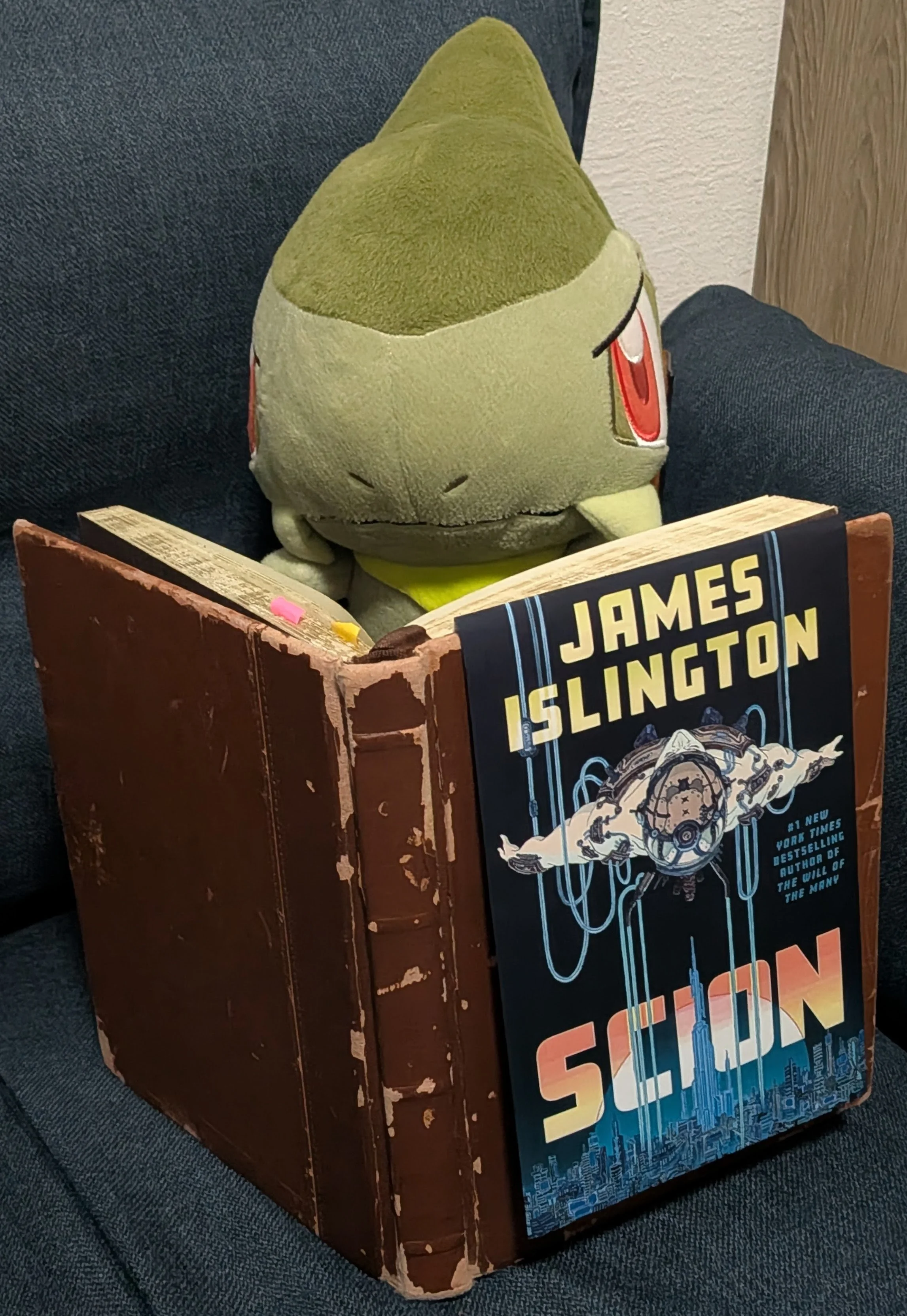
Scion (Part 2 - Worldbuilding, Character & Plot)
Hello, all. Welcome back for the second and final part of the Scion review.
If you haven’t already, please check out Part 1. In addition to providing the overview and rating, that’s also where I go into detail about the prose of this story, including the primary flaw of the story. Today, we’re going to be focusing on the highlights of the novella and why it works as well as it does.
Link up to the network, everyone. It’s time to go hunting.
STATS
Title: Scion
Series: N/A
Author(s): James Islington
Genre: Science Fiction (Cyberpunk)
First Printing: September 1st, 2026
Publisher: Saga Press (imprint of Simon & Schuster)
Rating: 8/10
SPOILERS
Mild, unmarked spoilers for Scion will be included throughout this review. Heavy spoilers will be confided to clearly labelled sections. I’ll strive to keep the first paragraph of any given section spoiler-free.
WORLDBUILDING
I’m not usually a cyberpunk person. Much like my distaste for Norse-inspired stories, I just don't care much for it personally. I was nevertheless enthralled by what Islington whipped up here.
Just to set the bar for how good this worldbuilding is, I’m going to kick things off by exploring the weakest aspect of the story.
Contrivance (?)
Scion is set in a world of limited resources and limited opportunities to grow. A collapsed human population has been packed into megacities, most of them sustained on something called Basic (implied to be a form of universal basic income) due to the lack of jobs available. People are not happy about this, and most of their ire is directed at the lifers.
Lifers are an ultra-wealthy elite who have become ageless thanks to a drug called Ichor. So long as they keep taking it, they cannot die of natural causes. This allows these already-wealthy elites to continue accruing resources, thereby tying up cart amounts of wealth that make the common folk bitterly jealous. (I phrase it that way because the story never even suggests that people think the resources could ever be redistributed to them.)
The government of the world, such that it is, exploits this discontent. They have created the Proscription lists, which include all lifers (and some group called Talios, who are implied to be terrorists but never adequately explained). People can use their disposable income from Basic to crowdfund assassination contracts. Companies like Keres then dispatch assassins like Azure to fulfill these contracts.
Here is the potential contrivance: why do the governments of the world not just make Ichor illegal? That would kill off lifers just as effectively. We meet a character in this story who stopped taking Ichor and ended up aging from that point onwards. The story also established the government has ruled addictive substances illegal, while specially formulated non-addictive drugs called nostrums had to be legalized. For that matter, the mere existence of Proscription lists implies that murder is not generally legal, since there would be no point in such lists if anyone could kill anyone else without consequence. So why not just make Ichor illegal and kill off the lifers that way?
Well, when I thought about it, there are actually multiple reasons, both in the form of real-world logic and in-world information, that justify this dynamic.
Simply ripping resources away from wealthy people is, at best, a short-term patch for poverty. Wealthy people usually maintain their wealth through some activities that sustain the economy. Allowing lifers to live indefinitely and continue making money would be a massive stimulus for the economy.
The use of Proscription lists provides the government with a scapegoat. People hate the lifers (and terrorists). Instead of putting time and resources into toppling the system that makes them miserable, they are channeling their ire into the lifers. There's all a Bread and Circuses element here, with people find catharsis and a reason to celebrate every time someone on this list gets killed.
The precedent set with drugs shows that the government is fairly libertarian. They are willing to permit things that make people happy so long as the damage is contained. Proscription allows the wealthy to have Ichor while still leaving an option to legally dispose of them, and it allows the poor to indulge violent impulses via proxy.
It is established that, if an assassination attempt fails, the money is expended. The corporation is paid, but the crowdfunding needs to restart. This delays the point at which the government will need to find other scapegoats and allows lifers a chance to survive and continue sustaining the economy. Plus, the funding goals are publicly displayed, so lifers would have the ability to prepare to defend against an assassination (and, thus, force the reset).
Therefore, while this is certainly a convenient set of circumstances, it does not feel contrived to kick the story into motion. There is enough logic to it to save the story from artificiality.
Genetic & Biological Engineering
While this cyberpunk future has all the neon signs, hover cars, high-tech swords, and advanced AIs that you could ever ask for, it’s the technology to manipulate life that takes center stage.
Azure’s body is augmented with “revs” and “cogs” that enhance his physiology and allow him to selectively turn parts of his brain on and off (such as to manage pain from severe injuries). He is special in that his genetics can support far more of these enhancements than most humans could handle, but the technology itself is not limited to him. The world also features such technologies as the “wash”, nanotech injections that will reactively feed false genetic information to any DNA tests, and surgeries that can radically alter physical appearance. Cloning is possible, but illegal, since it treads in the same immortality issues as the Ichor. (And, of course, there is the Ichor itself.)
Then are is biosecurity, usually shortened to “bios”. A common security measure in this world are adjustable “EMP rings” that disable electronic equipment within large areas, and the people who employ these systems will purchase artificial lifeforms to patrol these zones and overpower any tech-less intruders trying to infiltrate the area. The Argos, a many-eyed giant, is a common model. Various enhanced animals are also Shown during the story.
It's hard for me to say too much more on this element without getting into spoilers. The long and short of it is, Islington did not just ram cool thing upon cool thing into this story until it imploded. He chose a concept and stuck with it, exploring it in depth rather than expanding outwards. This made the world feel fully fleshed-out instead of superficial.
Corporatocratic Dystopia
The future shown in Scion is one in which environmental collapse and resource shortages have forced humanity into a small handful of megacities, with the few areas of inhabitable wilderness that remain belonging to the ultra-rich (namely, the lifers). Corporations don’t directly govern, but they are framed as the power behind everything. Digital surveillance is everywhere, with the vast amounts of data sifted through by AIs. The most powerful AIs are the three sapient ones, who are publicly traded commodities loyal to their shareholders first (hence providing the corporations with immense power and influence).
The story does not make it clear if this setting is on Earth or another planet. Space travel is confirmed to exist, so it could very well be a colony. However, we are told that the total population on-world is “one and a half billion”, with population controls in place, and that “seven thousand” people are lifers. This paints a clear picture of how deteriorated the natural world is. I don’t think Islington was going for an environmental statement here. It just feels like background details that synergize well.
The Proscription killings are a privatized industry. Corporations like the Keres make a fortune in carrying out the crowdfunding assassination contracts. They also hire out bodyguards to protect lifers from those same contracts.
On the whole, this dystopian future feels a lot more organic than the one glimpsed in the opening of The Last Contrast of Isako. I find this world and the methods with which it privatizes violence far more believable. This feels like an organic reaction of various factors than that forced vibes.
CHARACTER
While Azure is not the only character in this story, this story is told through his POV, and he is the only one to get significant character work.
Azure is a very dry and sarcastic character. He works for the Keres, executing contracts on Proscription targets on their behalf, both because it’s an economic opportunity and because he owes Keres a great deal of money for his physical augmentations and for medical expenses they paid for years earlier. He isn’t someone who feels strongly one way or the other about his work. He agrees with killing lifers because their being acceptable targets is ingrained into his society, but he’s not someone who enjoys killing or suffering unless that person has harmed him personally. (I think Islington was trying to build off this when he brought up Azure’s inability to feel strong emotions, but on the page, it doesn’t feel like his detachment from his work is anything more meaningful that desensitization to death.)
Despite being a man who kills people for a living, Azure is relatable. This book is effectively the story of a man doing a job to pay the bills, only to be handed a nigh-impossible task that he doesn’t particularly enjoy. Furthermore, the task in question is bodyguard duty, rather than an assassination contract. This means that the stakes of this story are built around Azure preserving his own life and the life of his client, rather than on him successfully murdering someone.
Islington also gives Azure a sympathetic backstory and motivation. In order to keep him focused, the client offers Azure a file on an incident from his past in the Oceanus megacity. This was the event that resulted in all those medical expenses, and it was an event that deeply affected Azure, as he had been tasked with bodyguarding a man who was then killed on his watch. Azure is therefore doing everything in his power to acquire this file so that he can learn the truth about what happened back then.
Now, there is the matter of Azure having the same narrative voice as Vis. I don’t think this damages the story in and of itself. Where I do see an issue, though, is with the subjective reaction. Even more so than Vis, Azure reads like an overpowered fanfiction OC:
He has the special genetic markers that allow him to have more cogs and revs than anyone else, meaning he’s also one of the most physically and intellectually powerful people on the planet.
He is an awesome combatant who can take on Argos bios single-handedly. In the entire book, there’s only one opponent who ever poses a meaningful challenge to him. Without getting into any spoilers, the nature of said opponent actually makes the power fantasy even more glaring.
As the story progresses, he gains access to god-tier resources.
Much like in The Strength of the Few, I don’t think this breaks the narrative, yet it is still very noticeable, and thus has the potential to annoy anyone who doesn’t like this sort of power fantasy. If this is something you hated about Vis, you would find it even more frustrating here.
On the flip side, though, Islington doesn’t just leave things at, “Azure is special and awesome and really cool.” He makes a convincing case for Azure failing or getting killed at multiple points throughout the story. His genetic specialness even becomes a very important plot point later in the novella. So while I think this is a subjectively annoying aspect of the character, I think Azure as a whole is still a fine protagonist to follow throughout this adventure.
PLOT
Pacing
This book starts off with action and does not slow down. This oversized novella really flies by. There is always something going on to keep the reader engaged, whether that thing is another action sequence or a chance to flesh out the world and characters.
I initially thought that this was merely a matter a there being a whole lot of action scenes crammed in here. It’s actually a bit more complicated than that. Islington does still have slower scenes for developing characters and worldbuilding, as well as to simply let the reader reset between action spectacles. What he has done is trim away the fat.
The cast is small.
There are no meaningful subplots. The closest thing to a subplot is the mystery of what happened in Oceanus, and that’s subsumed into the main plot as a motivation for Vis to succeed in his protection duties.
The world is only explored to the depth necessary to sustain the story. This is so bare-bones that it leads to some issues with exposition, as we have previously covered.
What we are getting here is essentially a 400-page novel that has been dehydrated down to about half its length. It feels like such a rush because it’s the same experience as taking a cyberpunk action novel and skim-reading everything but the action scenes. If Islington wanted, he could have easily plumped this up into a full novel by just adding a few more characters to the cast and taking more time to explore the world and characters via subplots.
This was a risky choice, but I think it paid off, so long as one doesn’t mind the loss of depth that we previously covered. It made this book a very light and engaging read.
Twists (Heavy Spoilers)
While there were parts of this story where I feel like Islington wasn’t fully committed to making them work, the twists are not among those neglected parts. Islington takes the time and effort to properly set up and execute some fairly significant twists. They are shocking in the moment, and yet they make sense in hindsight.
Azure is a clone, created after the incident his Oceanus. The fate of his original is unknown and not dwelt upon. What matters is that the Keres found his genetics too valuable to let go, and thus they violated the law to create multiple clones of him. One of this clones, Crimson, is the overpowered antagonist who is Azure’s only meaningful challenger in the book. (Incidentally, this is where the title of the book comes from. The creator of the clones prefers to refer to them as “scions” rather than clones.)
Azure’s client gets killed by crimson a little over halfway through the story. He has failed his mission, and now is just trying to survive. This was a shocking development that shifted the focus of the story from fulfilling a mission to just surviving.
Azure was not actually defending the client. He was defending a clone of the client who was acting as a decoy.
The man Azure failed to protect in Oceanus was his client’s son. She arranged for Azure to protect her through intermediaries because she knew the Keres was going to send Crimson after her. This was all part of an elaborate scheme on her part to get the Oceanus file from the Keres (because, as it turns out, she didn’t have the file at the time she originally promised it to Azure).
All of these twists are pretty wild. I think that one about Azure guarding a decoy was not a good twist, since it cheapens the concept of death in this story and will hang over any sequels Islington may write to this. At the same time, none of them feel contrived. All of them are the surprising yet inevitable culminations of previous set up elements.
THE PLEASANT SURPRISE
It is truly bonkers to me that Islington wrote Scion as way to burn off steam. This project, written primarily to have fun, came out far better than novels that other authors build their platforms off of. It is a stunning example of what what genuine passion and commitment to quality can do for a book. I highly recommend this book, especially if you are either a fan of Islington or someone looking to sample his work.
In the interim, if you’d like to sample a project that I’m also passionate about, you can check out my free serial Moral Support. It’s a Dark Fantasy story where motorbike-riding Persian alchemists face off against medieval Balkan soldiers in a haunted forest. Chapter 1 through Chapter 5 Part 2 are now available!
Thank you all for stopping by today. Please remember to subscribe and share if you enjoyed what you read here. Take care, everyone, and have a good week.