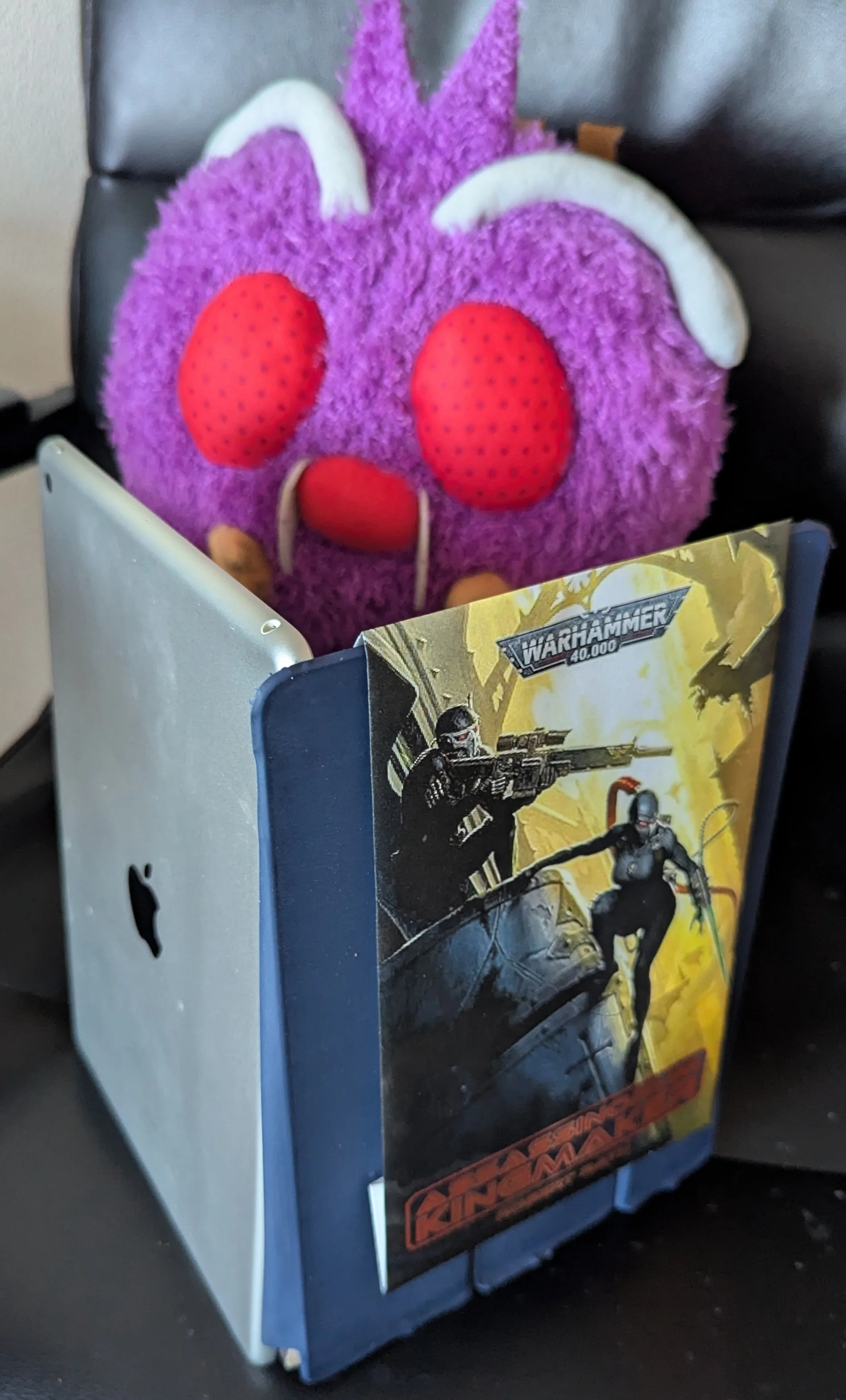
Kingmaker (An Assassinorum Novel) (Part 1 - Overview)
Hello, all, welcome back to the grim darkness of the 41st …
… sorry. 42nd Millennium.
Yes, this latest entry in our exploration of the Warhammer 40K mythos comes from the time of the Indomitus Crusade. Roboute Guilliman is in charge, Belisarius Cawl had committed mass amounts of tech heresy, and Chaos has figured out its own form of the logic plague from HALO. It’s a really bad time for anyone vital to the Imperium’s war effort to consider secession. And, for those with the chutzpah to try anyway, the Officio Assassinorum would like to discuss a change in leadership.
After I didn’t enjoy Titanicus as much as I’d hoped, I figured I keep my exploration to the small-scale (or, at least, more individual-focused) stories for the time being. And since an extract from Assassinorum: Kingmaker was recommended at the end of Ravenor - The Omnibus, it seemed like a good choice.
This book was a lot of fun. I think it’s pretty good (though not perfect) in terms of objective merits, but above all else, it’s just fun. It’s as much a novel about intrigue on a Knight World as it is about the operations of the Imperium’s assassins, and it manages to make both of these elements enjoyable. No matter whether you like mechs with chivalric trappings or futuristic assassins using all of their skills and Sci-Fi hardware to eliminate their targets, I think you will have a good time reading this book.
Now, strap in. It’s time to visit the Emperor’s Mercy on secessionists and heretics.
STATS
Title: Kingmaker
Series: Assassinorum
Author(s): Robert Rath
Genre: Science Fiction (Space Opera)
First Printing: April 2022
Publisher: Black Library (Games Workshop Publishing)
SPOILERS
Throughout this review, there will be mild, unmarked spoilers for the events of Kingmaker. I will keep the first paragraph of each section as spoiler-free as possible. Heavy spoilers will be confined to clearly marked sections.
There will be heavy, unmarked spoilers throughout the review for the events of the Warhammer 40K stories that we have cover thus far.
TIMELINE
I can’t nail down an exact year when this book takes place, other than to say it takes place during the Indomitus Crusade. It’s my understanding that this war kicks off in 001.M42 (roughly 500 years after the events of the first two Bequin Trilogy novels) and lasts at full century. Kingmaker is instigated by and repeatedly references the logistical issues caused by the Crusade, so I assume it’s at least a few years in. Additionally, the character of Rakkan has explicitly served 4 years as a Freeblade Knight in the Crusade. Maybe someone with deeper knowledge of the lore could pin down an exact date, but for me, all I can say is this book takes place sometime from 005.M42 onward.
STRUCTURE
This will be a 3-part review, divided up as follows:
Part 1 (Today)
Premise
Rating
Content Warning
Prose & Genre
Part 2 (September 27th)
Plot
Part 3 (October 4th)
Character
Worldbuilding
PREMISE
Per Amazon’s Kindle e-book product page, we have:
An Officio Assassinorum story
On the Knight World of Dominion, a Vindicare and a Callidus Assassin are tasked with eliminating a seditious leader and safely steering a pro-Imperial candidate to the throne.
READ IT BECAUSE
Kingmaker shows the fascinating relationship between two very different temples of the Assassinorum, as two agents navigate the complex social hierarchy of a Knight World. The stakes are high and the pressure is on, for an Imperial war effort hinges on them executing their duty before disaster strikes.
THE STORYThe Officio Assassinorum safeguards the future of humanity. Its agents are the bloody-handed, secret saviours of the Imperium, killers charged with achieving the impossible... and Vindicare assassin Absolom Raithe has just been handed the most difficult assignment of his career.
The Knight World of Dominion is on the verge of seceding from the Imperium, its court riven by factionalism and ruled by an increasingly unhinged monarch. With the aid of the shapeshifting Callidus assassin Sycorax, Raithe must remove the king from his throne – and safely steer a pro-Imperial candidate to victory through the brutal succession crisis that will inevitably ensue. His team will need to infiltrate a world steeped in chivalric codes, where every move risks discovery, and every threat pilots an adamantine monster... for if the assassins fail, and Dominion falls, the entire sector will be plunged into darkness.
Reaction
Yes. This is exactly what is says on the tin. If this premise appeals to you, then you will enjoy this story.
… that said, I would be remiss not to point out that there are actually THREE assassins on this execution squad. Avaaris Koln serves as the team’s representative from Vanus Temple. While Raithe and Sycorax do most of the killing, Koln gathers data and fabricates documents (and other evidence) to support the mission. This is something that further enhances the narrative, creating more complex team dynamics and offering the overall squad greater operational flexibility.
I suspect this is another case of a premise being written before the book was commissioned. Maybe Koln was an addition made by Rath, and no one in Black Library’s marketing department was notified to update the blurb.
RATING: 8/10
Once more, I find myself saying: this book didn’t need to be this good.
When it comes to Abnett’s Inquisitor novels, or even something like Titanicus, there is a sense of epic, grand scope. The fate of the entire Imperium directly or indirectly hinges on the characters in those stories. As a result, there's a certain baseline expectation for the complexity of the narrative, the depth of the characters, the integrity if the worldbuilding, and the execution of the tone. A mistake or an underwhelming element to these aspects is forgivable, but because the author is going for big impact, those forgivable mistakes still end up deadening that impact. The errors remind us that we are reading a fictional narrative rather than experiencing events that could shake an empire.
Kingmaker is a small group of experts being sent to unclog a logistics pipeline. It’s a one-off adventure where the repercussions of failure are contained. Yes, if the assassins fail, the Indomitus Crusade will be denied access to Dominion’s Knights. Yes, that could potentially translate into billions dead or multiple worlds lost to Chaos or xenos. This isn’t going to collapse the whole crusade, though. The losses are pocket change in the grand scheme of Warhammer 40K.
What I’m getting at here is that this is a small story. So when it provides a layered and evoking narrative, complex characters, and internally consistent worldbuilding while taking itself seriously to just the right degree, the resulting experience is really impactful. And while Kingmaker does still have flaws, the fact it doesn’t try to punch above its weight class means that those flaws are a lot easier to overlook.
You’ll come to Kingmaker looking for a little escape. You’ll get a deeply engaging story out of the bargain. On top of that, you’re going to have a lot of fun.
CONTENT WARNING
Weirdly, for a book where the explicit point is to commit murder, this is the least gruesome or graphic Warhammer 40K book I’ve read thus far.
Don’t get me wrong: there is a lot of killing, with plenty of descriptions of blood and gore. People get shot, incinerated, garroted, stabbed, etc. We see Chaos Knights with human skulls and skin applied as accessories to the mechs. A corpse that is stewing in its own fluids is described. There’s some of the typical body horror one might expect when Chaos corruption kicks in, not to mention descriptions of the less pleasant aspects of polymorphine shape-shifting. On a related note, a character is tortured by having a lit cigar pressed repeatedly into his leg.
It’s just that the descriptions are so mild. Rath simply didn’t lean into the grimdark tone in the same way that Abnett does. This isn't a literary flaw. It just produces a more mild experience. I feel like anyone who is okay with Military Science Fiction in general should be okay with this book.
On a related note, there is sexual content in this book, as well as drug addiction and potential alcoholism. These are likewise kept mostly as background details. They were not the focus, so while they objectively are present, they do not have the same punch they might have in a narrative more focused on such things.
PROSE & GENRE
This book reads more like generic Military Science-Fiction than the Grimdark Space Opera (or Dark Fantasy) of Abnett’s novels. As with the content warnings, this is not objectively an issue. Rath didn’t mislead the audience as to what this sorry would be. This narrative is set up as special operatives completing a mission, and that is exactly he delivers.
In terms of narrative voice, I don’t find anything in this book to be particularly remarkable. The individual POVs do read differently, but this is primarily due to focus put in their specialties within their respective scenes, rather than because, say, Raithe’s rigid discipline shapes the prose of all of his scenes. Given how tightly the narrative focuses on the mission (and thus, on each assassin’s specialty), I don’t think this is an issue. What we are given is functional to distinguish between POVs …
… with one very important exception.
Sycorax, as a Callidus, is a master of disguise. Whenever there is a POV scene where she’s in disguise, Rath reflects the depth of her commitment to her role by referring to her by the name and 3rd Person pronouns of the person she is imitating. Not all of the people she disguises herself as are dead. This means that it can, at times be hard to tell whether the character is question is the actual character or Sycorax in disguise … which is the whole point.
I’m not sure exactly how committed Rath really was to this element. I feel like there were a couple scenes where he unnecessarily reminded the audience that the POV was really Sycorax. Still, what he put on the page is plenty effective. I am not annoyed by these reminders in the same way that I was annoyed by the inconsistent 1st Person pronouns in the Ravenor Trilogy.
THE EVOLVING CHALLENGE
Next Sunday we’ll get into the plot of Kingmaker, which I would argue is the strongest access of this narrative.
The simple premise of this story lent itself to a straightforward story. Rath could have told a story that was just about the execution squad preparing to eliminate one target, with the maneuvering of said target’s replacement into a position of power being an afterthought. Instead, he told a dynamic narrative that started with the initial mission and then evolved with each new twist, leading up to a spectacular finale.
If you’re looking for more stories of soldiers fighting to keep the light of civilization burning again chaos and barbarism, I’m happy to announce that my first Military Fantasy serial, Moral Support, is now posting over in Tales of the Five Worlds! Chapter 1 through Chapter 3 Part 1 are now available. I’ll hope you’ll join me for these new adventures!
Thank you all for joining me this week. Please remember to subscribe and share if you enjoyed what you read here. Take care, everyone, and have a good weekend.