Hive (Overview & "The Hive Opens")
Hello, all. Welcome back to the grim darkness of the 42nd Millennium …
… I think. This one’s a lot harder to place in the Warhammer 40K timeline. I assume it’s the 42nd Millennium based in references within the text, but even more so than Kingmaker, I can’t quite nail down the date.
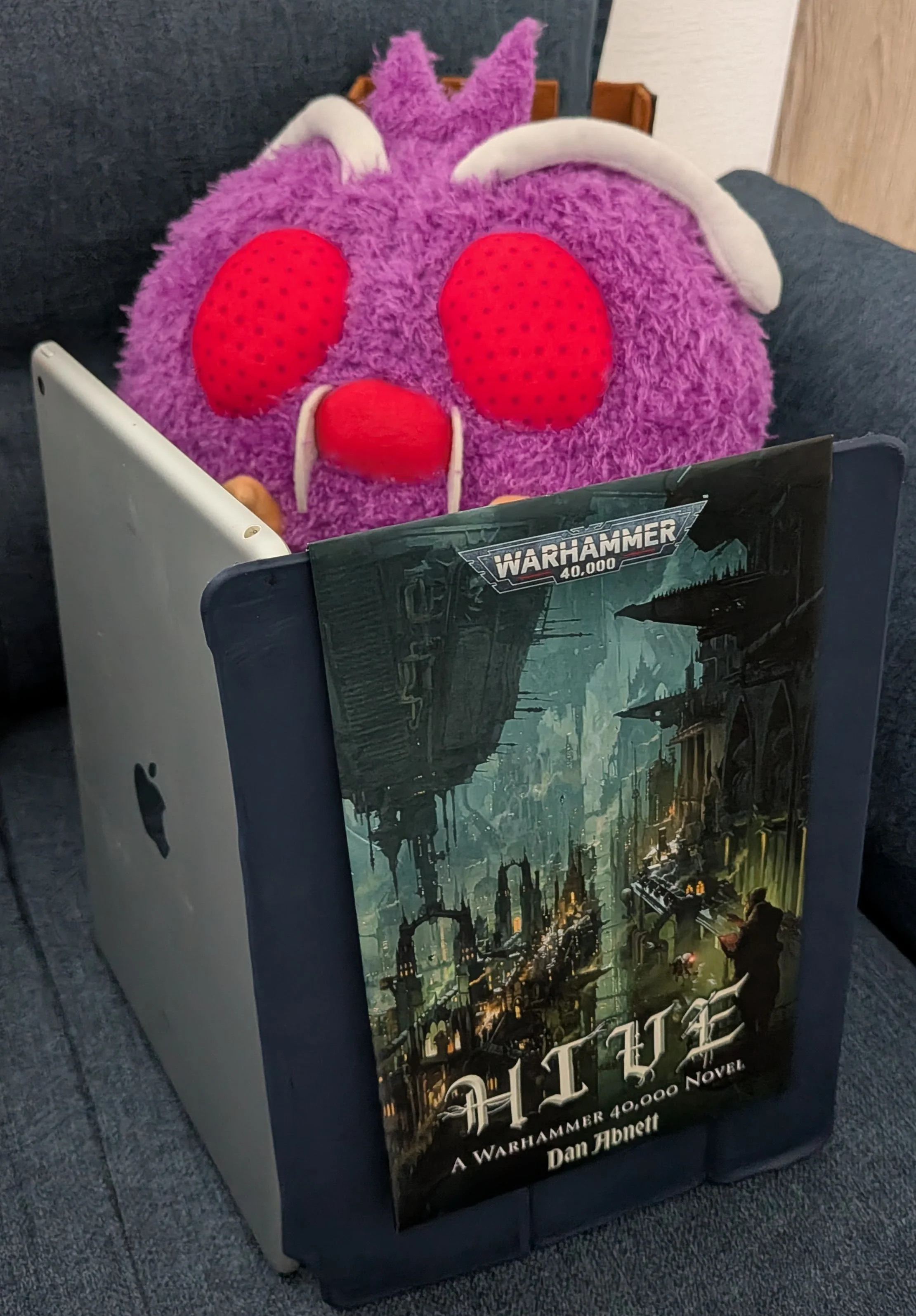
In any case, welcome back to another Warhammer 40K adventure. Today, we’ll start looking at Dan Abnett’s latest novel, Hive.
Much like the hive city that serves as its setting, this book is big. It is about 50% longer than Titanicus. It is also incredibly dense, with prose every bit as immersive as Pariah and what feels like twice as many POVs as Titanicus juggled (though perhaps the true number is actually not that different). I was shocked when I got nearly 300 pages in, only to discover that I had only gone a little over a third of the way through the book.
Because of how massive this book is, I feel like it needs a book-club style review just so that we can properly assess it. We’ll therefore do the big-picture stuff (and the prologue) here before progressing through the rest of the book as follows:
December 9th: Part I & “The Hive Shakes”
December 30th: Part II & “The Hive Ignites”
January 20th, 2027: Part III & “The Hive Wakes”
February 10th, 2027: Part IV, “The Hive Triumphs” & Final Retrospective
I wrote each of these sections as I progressed through the book. This made it easier for me to keep track of and comment upon everything going on. (This overview was actually the last part of the review to be completed.) I hope you will consider following along with this review as you do your own read-through.
Plenty be your light, bonds. Let’s get to work.
STATS
Title: Hive
Series: N/A
Author(s): Dan Abnett
Genre: Science Fiction (Space Opera)
First Printing: March 2026
Publisher: Black Library (Games Workshop Publishing)
SPOILERS
Throughout this review, there will be mild, unmarked spoilers for the events of Hive. I will keep the first paragraph of each section as spoiler-free as possible. Heavy spoilers will be confined to clearly marked sections.
There will be heavy, unmarked spoilers throughout the review for the events of the other Warhammer 40K stories that we have covered thus far.
TIMELINE
As stated in the introduction, I’m assuming this story is set in the 42nd Millennium, but not much beyond that. There are only two context clues that I could identify, both of which indicate that this story has to be happening after 999.M41:
Guilliman is up and about, and he’s already instituting reforms in the Imperium.
There are references to the Great Rift influencing the galaxy.
PREMISE
Per Amazon’s Kindle e-book product page, we have:
A Warhammer 40,000 Novel
A double-barreled set of novels from Dan Abnett, exploring the Adeptus Arbites attempts to enforce Imperial law on a sprawling hive planet amid scandals, cults, and much worse.
READ IT BECAUSE
Head down into the depths of a hive world, where a corrupted planetary governor has sent the populace into a perilous spiral they may not recover from. Will the population revolt? Can the Adeptus Arbites save this benighted world?
THE STORYWelcome to Sacramentus. Austerity and toil will teach the true measure of the Hive’s failing. No one is blameless. The planetary governor has fallen, deposed in scandal and treachery. The Adeptus Arbites roam the smog-choked vertics and zontals, rooting out traitors, enforcing the Imperial law without mercy.
As a new governor, an outsider, is crowned, the Hive teeters between order and anarchy. Whispers of rebellion echo from the heights of the Waistland to the depths of the Neg. Rival gangs seize both opportunity and territory, and forbidden cults grow ever bolder. But unbeknownst to all, a more terrifying threat awaits in the darkness.
May your light last, pilgrim. If the Emperor protects, perhaps we shall make it out alive.
Reaction
This premise is quite accurate. Arguably, it only really describes Part I, but that is very much a nitpick. The narrative naturally evolves from this starting point.
RATING: 7/10
Hive is a wonderful example of Abnett’s ability to craft an immersive setting and introduce characters who bring that setting to life. This book is a rich tapestry of life across the breadth of a hive city, from the lowest pits to the office of the governor herself. It is also a story that is free of the Inquisiton, the Astartes, assassins, Titans, mechs, or any of the other flashy factions of the Imperium. Reading this book is very much a taste of life for the common citizen of the Imperium.
Originally, I was tempted to rate this one as highly as Pariah, but there are two significant structural issues, both of which we will discuss more later in the review:
This book is way too long. I don’t mean that it's a really dense read or that it’s bloated with filler. It reads as if Abnett wrote an entire trilogy, couldn’t get Black Library to sign off on more than one book, and then decided that he’d rather make a few cuts and cram the whole thing into one book rather than risk having another trilogy get shut down.
After such a long book, the ending is far to abrupt.
The ending is also … very Warhammer 40K. I found it appropriate, and aside from the abruptness, it does work. It's just the kind of thing that someone new to the franchise might not appreciate.
CONTENT WARNING
For the most part, the content in Hive is less graphic than Abnett’s other Warhammer 40K books that we’ve reviewed. There’s certainly plenty of violence and deprivation, and a few scenes involving a Chaos cult and spontaneous manifestion of psykers get pretty gory, but for the most part, this book is fairly tame on the gore and violence. There is some disturbing imagery involving swarms of rats, but that’s it.
… well, until we talk spoilers. I’ll get to that.
Oddly, this is one of the more sexual Abnett books. All this is relative, of course, but it’s still more than he usually gives us.
There’s a fade-to-black sex scene that picks up afterwards with the two characters smoking and talking together while naked (which I mention mainly because Abnett makes sure to point it out).
There’s a homosexual kiss in Part IV, but Abnett doesn’t treat the women involved like fetish material, nor does it slap you in the face like a virtue signal.
All this is to say that the sexual content of this book is as clean as it can get while still being present. Whether or not it’s a deal breaker for you will likely come down to the principle of the matter rather than it being too detailed.
Part IV (Heavy Spoilers)
The last third of the book is significantly more graphic and disturbing than the first two-thirds.
The big twist of the story is that the Hive is under assault by Tyranids, with a genestealer cult triggering an uprising while bioforms invade from without. Naturally, the Tyranids butcher and eat everyone. We get graphic descriptions of people getting eviscerated, crushed and pulped, melted by acid or ignited by flammable liquids, annihilated by plasma discharge, or simply being eaten alive. Amplifying all this is the prose. The denizens of the Hive don't know what Tyranids are, and Abnett uses that to frame them as Lovecraftian monsters.
This is the spoiler section, so I won’t sugarcoat it: almost every POV that the audience follows across more than 700 pages dies. Some get graphic deaths, others have their stories end with Tyranids coming at them, and the rest are implied to die when the governor blows up the whole city in a desperate bid to at least keep the xenos from truly winning. The only reason I can’t say that literally every POV dies is that a single escape shuttle departs to warn the rest of the Imperium what happened, and as the story itself points out, there is no way of knowing if there was a Warp-capable craft nearby to rescue them once they cleared the atmosphere.
Effective Swearing (Heavy Spoilers)
Hive is a great example of how foul language can enhance a narrative if it is applied with moderation and deliberate purpose.
There’s a of of swearing and cursing in this book. Most of this is masked behind the conlang that Abnett created for Sacramentus. It’s not a particularly complex language (and Abnett admits in the afterword that he was making it up “off the cuff, assuming that almost all of them would be placeholders”). Still, there’s enough consistency to it that you can mostly follow along with it, and so it’s not hard to guess which words uttered in moments of passion are obscenities. Beyond this, the swearing is quite PG-13 - and I mean this quite literally, as there is exactly one F-bomb dropped in the entire book.
‘Oh, Throne,’ said Scuti very quietly. ‘Oh, Holy Throne.’
‘What is it?’
‘We took “blood” too literally,’ she said. ‘They meant organics. Genetic structures. A thief of blood.’
‘Meaning what, chastener?’
‘That’s a fucking genestealer,’ she said.
‘I don’t know what that is,’ said Eoe Moler.
This moment is pretty perfect in terms of concise worldbuilding and characterization. Dropping the F-bomb shows that Scuti - a character who has, up until this point, been characterized as very rigid and disciplined - has just suffered a severe psychological blow. It also hypes up the threat that genestealers pose for anyone in the audience who doesn’t understand how severe the threat it. Abnett then contrasts Scuti’s horror against Moler’s calm ignorance. Scuit, as a member of the Adeptus Arbites, is at least that genestealers represent a xenos threat that can threaten an entire world, while Moler is the local lawman who doesn’t have that information and thus doesn’t know he should be panicking.
This is a tiny moment that contains so much meaning. That meaning only exists because the use of foul language was moderated. Had Abnett vomited up profanities like certain other authors do, then there would be nothing special about this moment. It would instead come across as a forced attempt to seem mature.
PROSE
The prose of this book, much like in the Bequin Trilogy, is highly atmospheric. Here the focus is on capturing the essence of a hive city, both in sense of scale and its varied strata. Abnett speaks at length in the afterword about wanting to give the audience the experience of a definitive hive city, one that has a distinct culture yet establishes a benchmark that could be copied to any other hive in the Imperium. I'd say he was successful.
The structure of this book is a bit odd. The four parts aren’t even close to the same length, with Parts I and IV being short novels in their own right while Part III is a singular but very long chapter. This fed into my impression that this book was originally meant to be a trilogy. I’ll explore this more when we get to Part III.
“THE HIVE OPENS”
We already covered this prologue a bit during the analysis of The Last Contract of Isako’s opening. Rather than rehash that whole analysis, I will keep things simple here.
This prologue is a perfect example of how Abnett has really cracked the code for environmental storytelling to make even very similar Warhammer 40K planets feel unique. Within just a few pages, he captures the hive-dwellers’ perception that the Hive is their entire world, the symbolic value that light has acquired within their indoor society, and the inhospitable nature of the planet outside (which reinforces the first two elements). Even before factoring in the nature of this prologue as one of the book's inciting incidents, this is Abnett putting his best foot forward and giving the audience a taste of the story ahead.
The fact Abnett does all of this in a manner that doesn’t require the reader to understand the wider lore of Warhammer 40K adds to the experience. He isn’t treating the lore as a crutch. This is an accessible on-ramp to the Warhammer 40K universe.
THE PRESSURE COOKER
On December 9th, we’ll return to Hive for Part I and “The Hive Shakes”. This story starts off slow, but it is immersive, maintaining an incredibly engaging experience throughout. I look forward to exploring it with you.
In the interim, if you’d like to explore more stories in immersive settings, you can check out my original fiction in Tales of the Five Worlds. My latest post is Chapter 12 of A Chime for These Hallowed Bones, a tale of loyalty and honor set within a city where necromancy is the primary industry and using your grandmother’s skeleton into a servitor is considered the greatest act of respect for the dead. Chapter 13 Part 1 arrives this Friday!
Thank you all for stopping by. Please remember to subscribe and share if you enjoyed what you read here. Take care, everyone, and have a good day.