A Wet Blanket on a Dune (Part 1 - Flawed Execution)
Hello, all. Welcome back to Reflect & Redraft.
Yes, I know it’s been some time. I’m sorry that I let the Star Wars Sequel rewrite drop off. I still have my notes for it, but other priorities have repeatedly asserted themselves. It’s not my intention to leave that series in perpetual limbo, yet I do not have a deadline for it at this time.
What I have for you today instead is something that goes back to the source of Star Wars - that is to say, Dune.
Three weeks ago, author Nicholas Wolf (who brought us the Tidestone Chronicles and “Sorrowcrown”) made the following tweet about Dune.
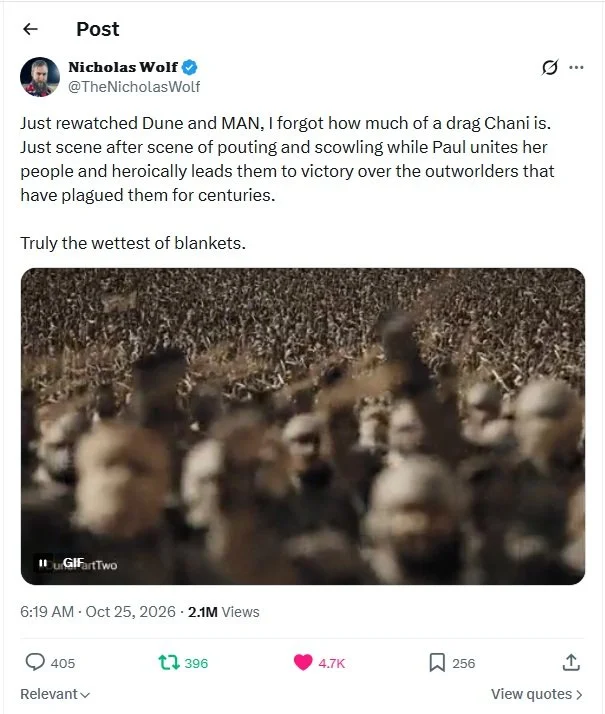
This brought the usual backlash of the Media Literary variety, including a not-insubstantial number of ad hominem attacks.
I 100% agree with Wolf. Chani is a mess in the recent Dune films (at least, the two that were released at the time of writing this). Not only that, but she is a mess of a character who does not work even if one plays the Media Literacy card to argue that her opposing Paul was justified. Never mind any adaptation arguments - she’s just badly written.
Let’s explore how, and then we can get to how she could be fixed.
DISCLAIMER
For the purposes of this analysis, I will not be taking the original Dune novels into account (other that to acknowledge one or two things that were changed in the adaptation). I will be accepting the interpretation of the story by Villeneuve as the correct interpretation of the story. The reason for this is twofold:
I have only seen the movies.
Arguing about Media Literary does not erase the flaws in Chani’s writing. Even if one argues that Villeneuve’s vision perfectly reflected the spirit, intent, and themes Frank Herbert’s work, that does not give him a free pass for poor execution of that vision.
The point of this analysis is to explain how, even if we meet the movies on their own terms, Chani is badly written. She didn’t need to be. We are going to fix that.
THE DIRECTOR’S VISION
During the press tours for Dune – Part 2 (hereafter referred to as “D-2”, with Part 1 referred to as “D-1”), two particular points surfaced regarding Villeneuve’s vision for the adaptation:
He wanted to amplify Herbert’s themes about the dangers of powerful leaders. My takeaway was that he wanted to facilitate Media Literacy, trying to make ideas from the sequels more overt in the two films based on the first book.
He wanted to increase the role and agency of female characters, especially Chani.
Setting aside the questions of whether Villeneuve is correct about the first point and whether he was virtue signaling with the second, I’m not against either one in principle. There are ways that an adaptation can make changes form an original work so as to better relay the story in a new medium and to an audience other than the contemporary one.
Peter Jackson’s Lord of the Rings trilogy is a good example of this. While there are adaptational elements that I don't personally like and others that damage aspects of Tolkien’e original vision, all of these elements serve a clear narrative function that enhances the delivery of the story to filmgoers in the early 2000s.
Removing Glorfindel from the story and giving his narrative role to Arwen streamlines and cast and allows the romance between Arwen and Aragorn to be built up more gradually.
Removing the Old Forest, Tom Bombadil, and barrow-wight chapters from Fellowship of the Ring and The Scouring of the Shire from Return if the King both streamline the plot significantly.
Making Aragorn into the reluctant Chosen One and having him behead the Mouth of Sauron played into more modern tastes for heroes.
Shuffling events between The Two Towers and Return of the King while also making Faramir into an antagonsit tempted by the Ring allowed all the events to occur in a single timeline.
With this being said, I am not against the idea of Chani being this character who scowls and pouts while Paul is trying to unite her people. I think that using her to challenge Paul and call him out for what he’s becoming also makes sense. Chani can represent the hard pragmatism if the Fremen while Stilgar embodies the spiritual dimension.
THE WET BLANKET
Unfortunately, in execution, Chani does not work from a narrative perspective.
Defining the Character
D-1 didn’t tell us a lot about Chani. She was this mysterious figure in Paul's dreams. The most we have to go on is that she is a warrior who does not believe that Paul is the Madhi but who is willing to lend Paul a knife so he can “die with honor”. Her final line in the film implies that Paul has impressed her.
The opening of D-2 continues this. Chani’s nature as a warrior is emphasized from her first scene. While she is cynical about Paul’s odds of survival, she is still impressed by him and helps him when she can. All of this is fine, and it does not necessarily contradict what came later.
The issue is the scene in which Chani’s beliefs about the Madhi are spelled out to the audience. In making her feelings crystal clear to the audience, Villeneuve inadvertently makes explicit the key factor that will turn Chani into a wet blanket.
The scene in question is where Jessica is drinking the Water of Life. While Paul and the Fremen wait outside, we see the contrast between Chani’s group of fighters and the more religious members of the Femen (including Stilgar). When Paul questions her about her lack of belief, Chani says this:
You wanna control people? You tell them a messiah will come, then they wait for centuries.
This single statement informs so much about Chani’s character in Villeneuve’s films (and, by extension, the characterization of her circle of friends, which is a detail that will be important later).
She rejects the religious teachings of their people not because it’s religion but because she sees it as an obstacle to Fremen liberation, one that keeps their warriors docile.
She rejects efforts to control the Fremen, particularly by outsiders. This would naturally include the prophecies that (at that point, to her knowledge) may or may not have referred to Paul, since those originated with the Bene Gesserit.
There are elements throughout the first two Dune films to uphold this defining moment.
The idea that Chani rejects efforts to control the Fremen and would be hostile to anything that inhibits their liberation plays into her introduction in D-1, where she was actively fighting against the Harkonnens and worried about who the next oppressors of the Fremen would be after the Harkonnens left.
At a few points throughout the story, Chani reminds Paul that he is a foreigner and questions his decisions on the grounds that he is trying to control the Fremen.
When Chani has her Karen moment at the Fremen war council, her exact wording is, “This ‘prophecy’ is how they enslave us!”
All this is a fine start. Chani seems, on the surface, to he consistent.
Unfortunately, that consistent is why Wolf is right about Chani being “the wettest of blankets.”
Chani does not exist in a vacuum. Her reactions to Paul's rise to power need to reflect … you know … Paul’s rise to power. This means that, even if her characterization is consistent, she has to make sense in context of what Paul is actually doing.
The Choice to (Not) Kneel
The pivotal moment where Chani shifts from a Strong Independent Woman on a crusade to free her people to something far soggier and cloth-based comes when Paul rides the grandfather worm.
At this point in the sorry, Paul has done nothing but prove himself to the Fremen. He has upheld his promises to lead them to victory against the Harkonnens. He has embraced their way of life. Indeed, the whole point of him riding the worm was that he would be fully recognized as one of the Fremen if he succeeded.
The men and women who have fought beside him, who have witnessed his willingness to fight alongside them and free them from oppression, see him not only prove himself but also fulfill the prophecy if their messiah. They fall to their knees in worship … but Chani doesn’t.
With how this is framed, Chani is one of the only people still standing. Her friends are not visible as she gazes around in horror at her brothers- and sisters-in-arms. Since Shishakli (the character played by Souheila Yacoub, the one who got really aggressive about the Madhi needing to be a Fremen back in that same scene where Chani dismissed messianic prophecies) was right next to Chani (so close that she could easily have fit in-frame with Chani while Chani gazes around in horror), Villeneuve has strongly implied that even Chani’s friends are now fully on the Paul hype train. (Shishakli’s later death certainly comes across like martyrdom, further lending to the impression.)
This should have been a moment of spiritual awakening for Chani. Paul hasn’t just proven himself as her messiah. He’s done so after demonstrating that he is not the pacifying presence she feared her messiah would be. What’s more, because her messiah is the warrior he yearned for, he can inspire the Southerners to get off their asses and fight. She should be utterly thrilled.
Instead, her very next scene is her manipulating Paul after sex, turning him against his mother and trying to quash the very religious fervor that is set to galvanize her people.
When Paul talks about using atomics to scare the Imperium into leaving Arrakis alone, her only reaction is to accuse Paul of wanting to be the sole dictator of Arrakis.
Then, when circumstances put Paul in a position where he had to go to the Southerners (the people resting on their asses while waiting for Paul), she insists the Southerners are people Paul should be afraid of. It makes sense for PAUL to fear them because of his visions of what will happen if he goes to them, but Chani is not operating on that logic. We are just expected to think the people resting in their asses are dangerous because … Paul might get them off their asses?
Look, this could have worked if Chani’s rejection of the Fremen religion were based upon something other than her perception that it pacifies her people. It could have worked if Paul (or Jessica) had genuinely acted in a way to suppress or enslave the Fremen. As it stands, Paul has proven her wrong, and continues to prove her wrong, yet she keeps undermining him. By the time the council meeting rolls around, it really does seem like Chani is hellbent on her people rotting until the Harkonnens’ boots. She is railing about how the prophecy (read: Paul) is meant to enslave them, but Paul has shown no interest in enslaving the Fremen. Chani is trying to smother the very uprising she blamed religion for suppressing, all because religion was doing the exact opposite of suppressing the revolution.
In other words … she is consistently portrayed as a wet blanket thrown upon the fire of revolution.
A Cold Shower of Nonsense
There are a handful of smaller moments in the back half of the movie that I think are worth highlighting, though I don’t think any one of them breaks Chani on its own (or that they would have redeemed her even if they were all corrected).
Chani’s wrath when she finds Paul dead after drinking the Water of Life makes an amount of sense. If she believes that messianic prophecies are bad because they keep the masses in check, then a prophecy that tricked the best hope of her people into killing himself would upset her. Unfortunately, she then refuses to revive Paul, which just makes her look like blind hatred of religion overrides her willingness to help her people. Why not try to revivie him, Chani? Likewise, after Paul is revivied, I could understand if she was merely angry that he risked his life. With how the movie is framed, though, she’s actually mad that he’s now going to have an even better chance of rallying the Fremen to overthrow the Harkonnens.
Chani being upset that Paul unleashes a Fremen jihad upon the Galaxy is not supported by anything at all. Did it not occur to her that the Fremen might need to take the fight to space to ensure their oppressors never came back? It’s not like Paul promised her, “No Fremen will leave the planet, we will just keep this as a ground war.”
Chani being heartbroken when Paul claims Irulan as his bride to secure political power does make sense as something that would upset her. It doesn’t facilitate the idea that Paul is a tyrant, but it does go against his claim that he would always love her … except for the fact that men marrying for politics while giving his love to another woman is an established part of this universe. Did Paul never mention to Chani that the reason Leto never married Jessica was for politics?
Soaked Through
There is a story in which Chani, as she is written in the Villeneuve films, would have worked. The problem is that the story in question is not the one put to film. The most charitable reading of Chani as she is currently written is that she is a victim of Villeneuve’s desire to talk down to the audience. She exists to insist, “Paul is bad! He is very bad! Don’t see him as the hero!” when the narrative itself does not earn that. Villenueve doesn’t show Paul doing anything evil (or, at the very least, nothing the Fremen wouldn’t have done without him). He’s just making the Fremen more effective at fighting off their oppressors. They willingly follow him because he brings them victory.
If Villeneuve was not willing to radically rework Paul’s arc to justify Chani’s reaction, he should have rewritten Chani. This would have been easy, because he was already rewriting her.
Chani was changed for the adaptation. While I have not read the books, I have consistently heard from people who have read them that she was Paul’s loyal supporter. Making her antagonistic was already a huge change. Regardless of how any of us may feel about the antagonism in and of itself, a scenario did exist in which Chani was adapted to service Villeneuve’s goals while still being coherent. It was just a matter of revising the script until she made sense.
No, I don’t have a single suggestion of exactly how this could have been done.
I have two.
THE LAUNDRY LINE
I honestly feel that, if Villenueve wanted to hammer in that Paul is the villain of the story before the end of D-2, he should have rewritten Paul’s actions to make him overtly villainous. Chani should never have needed to be the mouthpiece to force an interpretation of the story. Still, reworking Chani would require the less significant edits than reworking Paul, and Chani is the reason we’re currently here having this discussion. We will therefore be prioritizing changes to her.
That’s coming your way this Thursday, November 12th. The two solutions I have in mind would be best utilized simultaneously, but because I genuinely think that Chani would not have been hard to correct, I want to present them separately to prove that point. A few small tweaks really could have salvaged this situation.
While you’re waiting, if you’re interested in more stories about characters who don’t pay attention to what the people they’re bouncing off of are actually doing, I recommend checking out my free Military Fantasy serial, Moral Support. It’s a story for all of us dealing with that coworker with no sense of boundaries - only in this case, that coworker in the regimental morality officer, and the workplace is a haunted forest filled with barbarian zealots. Chapter 1 through Chapter 5 Part 2 are now available!
Thank you all for stopping by. Please remember to subscribe and share if you enjoyed what you read here. Take care, everyone, and have a good week.