Focus and Continuity (A Prelude to Threshing Day)
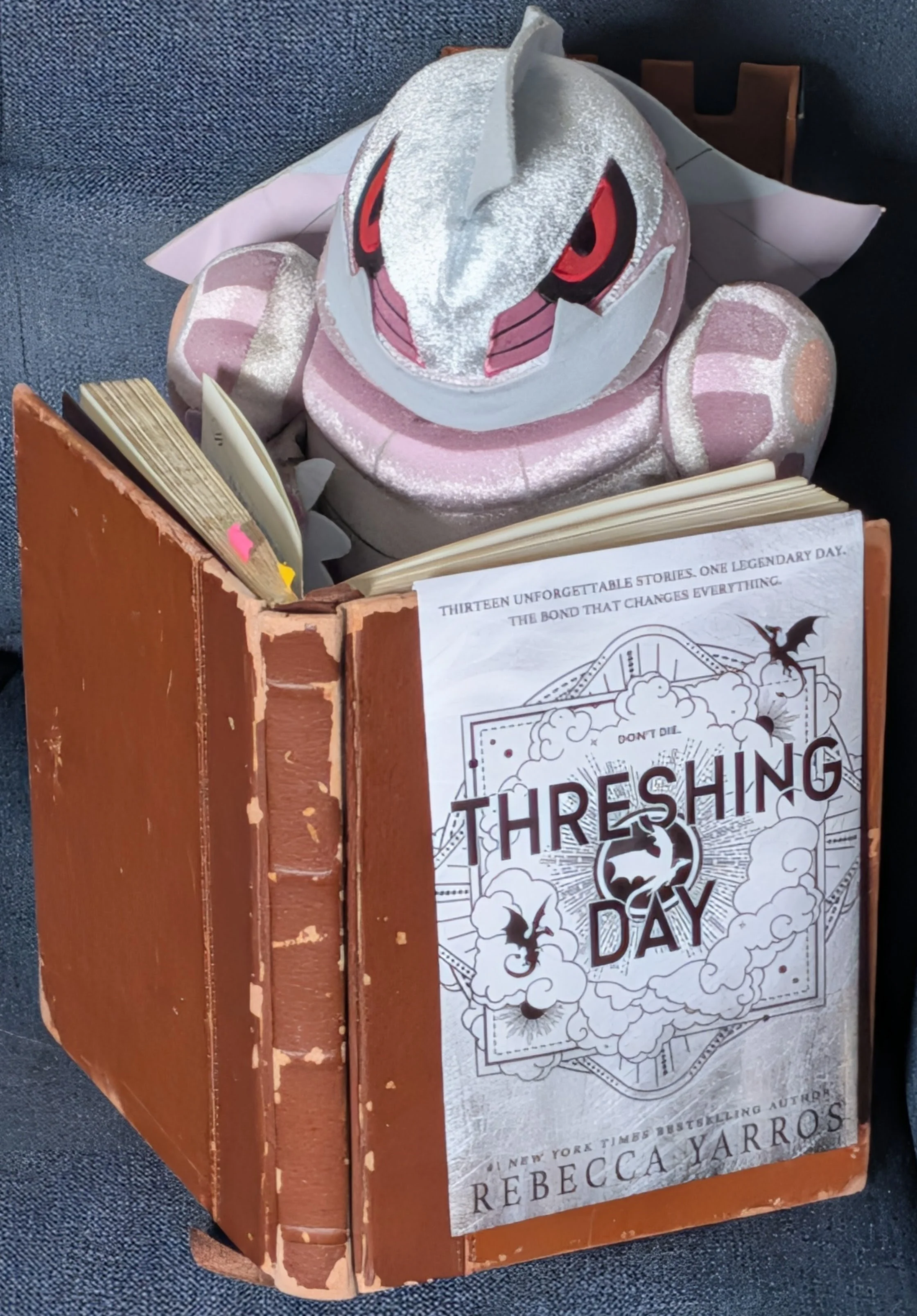
Hello, all. Welcome to the semi-official start of the review of Threshing Day, the anthology released by Rebecca Yarros to tide over audiences during the wait from Onyx Storm to Book 4 of The Empyrean. The review of the anthology’s first story is still scheduled for this upcoming Sunday, October 11th. Before we get I to that, I want to establish the parameters by which I’m going to be judging these stories.
Part of my reason for doing this is that some of you may be new to my coverage of The Empyrean. Either you’ve never read my coverage of the mainline books (as of the time of writing this, those only include Fourth Wing, Iron Flame, and Onyx Storm), or else you’ve only read my reposts from the Fourth Wing review over on Substack. The other part, though, is that my approach to Threshing Day has very key differences from those mainline book reviews. I think it’s only fair that you understand where my standards will differ and why.
At the time of my finalizing this post (the morning of Sunday, October 4th), I have read Threshing Day’s introduction section, “Trial by Fire”, as well as all of the stories up through the tenth, “Ridoc”. I’ve also already drafted the reviews for all of the stories up through the ninth, “Sawyer”. However, the bulk of this prelude was originally drafted before I read a single word of Threshing Day. I wanted to accurately capture the mindset with which I was going into this book. I did have to come back to make a few minor adjustments and clarifications while I read the book. These will be called out within the relevant sections.
Buckle into those Special Snowflake dragon saddles. It’s time to purge some initiates.
STATS
Title: Threshing Day
Series: The Empyrean (Bonus Anthology)
Author(s): Rebecca Yarros
Genre: Fantasy (Epic)
First Printing: September 29th, 2026
Publisher: Red Tower Books
THE HEART OF THE MATTER
The last anthology I read before Threshing Day was The Long Vigil. The one thing that stood out most to me about that anthology was the characters. The plots of the individual stories didn’t have a lot of variety (existing mainly as framing devices for Astartes-on-xenos carnage), but the stories that stood out the most were the ones with strong dynamics between those Astartes. Character was what made stories feel unique from one another and what gave them depth that would otherwise be tricky to convey in action stories of that length.
Threshing Day is similar to The Long Vigil in that it is (according to its own marketing) also very repetitive in its framing devices. Characters will need to do a lot of heavy lifting here. What’s more, this book was marketed on giving the spotlight to the … “characters” … of The Empyrean. It’s therefore only natural that character will be the primary focus on these reviews.
What Characters?
I have now stated multiple times that The Empyrean does not have characters. As of the end of Onyx Storm, the sole exceptions are Violet herself, Liam, and Ridoc (on the human side) and Leothan (on the dragon side). In the case of Ridoc, he only became a character in Onyx Storm, after spending the first two books not being a character.
This may seem like an extreme position. After all, this story does have a massive cast. I’ve referred to members of this cast as “characters” at multiple points (and will continue to use that word for convenience).
However, in a narrative sense, the overwhelming majority of the cast list are not truly characters, because they do not exist as entities separate from Violet or Violet’s story. They lack consistent motivations or traits, instead being interchangeable entities with superficial quirks. Any time their motivations or traits become narratively relevant, they get overwritten on a whim.
To better explain this, let’s summarize Ridoc’s transition from non-character to actual character.
In Fourth Wing, Ridoc was a mere accessory to Violet. He, along with Rhiannon and Sawyer, existed to be Violet’s accessories, a friend group who validated her but otherwise stayed in the closet. His quirks were to tokenize male homosexuality (by having sex with other men in the background) and to be quippy. This latter quirk meant he was one of the few cast members whose dialogue was not wholly interchangeable, but only insofar that a quip or sarcastic remark was more likely to come from him than anyone else if he was involved in the conversation at hand. The quips themselves weren’t actually unique to him and didn’t say anything about him as a person.
Iron Flame exacerbated the problem. Violet’s accessories remained so bland that Nadine, a character whose one trait had been introduced and then removed in Fourth Wing, slotted right into the group with zero issues (and then was painlessly ripped right back out). The only time Ridoc had a chance to exercise any agency was to hold Violet accountable for lying to him and the other accessories about the venin. He almost instantly folded and gave her unconditional support. (Yarros will later frame these fleeting seconds of hurt feelings as if Ridoc nursed a long-standing grudge against Violet that forced her to earn back his trust, which simply was not the case.)
In Onyx Storm, Ridoc suddenly gains agency. He argues his way onto the rainbow dragon fetch quest, establishing a willingness to plant his feet and get serious when motivated to do so. He exhibited this stubbornness again when taking Violet to task about overlooking Xaden’s venin nature. This moment also showed the potential of what the accessories could have been. Ridoc opposed Violet not because he was stupid and evil, but because he cared about her and saw her standing by Xaden as a self-destructive decision. Additionally, we also see in this story that he has a playful relationship with his dragon, hinting at a life and relationships outside of Violet that run deeper than his sexual orientation.
Ridoc is not perfect by any means. He can’t even stand against Violet for more than a chapter before Yarros has him cave in and go along with her for the sake of the plot. Still, the fact remains that, at least momentarily, Ridoc became more than a sock puppet. He existed for something other than to validate Violet. When his motivations brought him into conflict with Violet, he was not steamrollered for the purposes of the power fantasy.
Before Ridoc, Liam fell into the same mold. Liam never actually flexed his agency to act against Violet. Instead, Yarros took the time to flesh him out as a person and give him motivations and opinions of his own. He wasn’t bodyguarding Violet because she was a super-special person to whom he was fanatically loyal, nor was he merely a puppet who acted as an extension of Xaden. Liam was a guy put into an awkward situation by someone he respected, doing his best to make the most of the situation, and he was honest with Violet about that. It is therefore possible to have a character exist as entity independent of Violet without having to go as far as to oppose her the way Ridoc did.
Most of the cast do not have this. They may have dialogue, superficial traits, consistent quirks, or even a consistent narrative role, but their traits and motivations (i.e. the things that truly allow them to exist as independent entities) shift radically to serve the plot (and, more importantly, Violet’s power fantasy):
Xaden is a Bad Boy Love Interest whose entire being is crafted around gratifying Violet. What “conflicts” he has with Violet are either generated by and sustained by her or else quickly end with his surrender.
Jack is a Murderous Sociopath Classmate who exists to be beaten down repeatedly and experiences a brief personality shift just so he can thank Violet for killing him.
Rhiannon and Sawyer have character conflicts in the background of Onyx Storm that only progress when Violet interacts with either of them, despite her being away for an extended period in which stuff could have happened.
Mira was initially an archetype with a role in the plot: a Cool Big Sis who was potentially a tool of the rider leadership, and thus, couldn’t fully be trusted. Then Iron Flame Part 2 happened, and she just became another accessory to Violet (and a rather parodic one at that) until right before the climax of Onyx Storm, where she and Violet had a falling out just to make rescuing her feel that more emotionally urgent.
Dain exists to be abused, compromising his principles however is necessary to make Violet happy. He comes close to being a character, but that characterization is to be the victim of severe psychological and emotional abuse, and seeing as how that would run counter to the narrative of Violet always being right, this is itself not consistent.
Dragons are the equivalent of dogs with fill-in-the-blank dialogue to anthropomorphize animalistic behaviors.
The rider leadership / government of Navarre are a looming threat, yet they either become selectively incompetent or self-sabotage themselves in any instance where they could actually affect Violet or her interests.
Grady was a Good Teacher in Iron Flame, only to abruptly flip in Onyx Storm to become an incompetent fool who deserved death for not bowing before Violet’s will.
“Dragons don’t make mistakes”, but the riders of those dragons deserve to have bad things happen to them when they oppose Violet, despite Xaden outright saying in Chapter 36 of Iron Flame that said riders have no agency and must heed the wills of their dragons.
Making Up for Lost Time
By telling 13 stories with POVs other than Violet, Yarros has the chance to create more characters who exist outside of Violet. She can flesh out their motivations and traits. This anthology is a golden opportunity to play catch-up for the past three books and allow the cast surrounding Violet to become independent entities who act according to consistent motivations and traits.
Therefore, when looking at these stories, I am going to try to profile the POV characters (or anyone else who gets clear characterization). I’m going to compare what these stories tell us about them to what they said or did in the mainline books. My goal is to provide a clear reference that we can look back on to assess these entities when reviewing Books 4 and 5.
Now, on that note …
CONTINUITY IS KING
Threshing Day is being written upon the foundation set by Fourth Wing, Iron Flame, and Onyx Storm. To my knowledge, every story was written by Yarros herself (i.e. no ghostwriters). This is also not a What If situation. These stories are meant to exist in the same continuity as the previous books.
Any break in that continuity is therefore an objective flaw in the writing.
If something in Threshing Day is incongruous with the mainline books released thus far, and that incongruity cannot be explained within the bounds of the text, then that incongruity, in and of itself, is a flaw.
If something Threshing Day retroactively damages the mainline books, that is a flaw.
If Yarros choose to ignore consequences of elements set up in the mainline books that also impact the stories of Threshing Day, that is also a flaw.
That being said, I think Threshing Day is a bit of a special case. There are certain factors that affect how beholden it is to the mainline series and, in turn, how beholden Books 4 and 5 are to it.
Remember, There Are No Characters
Since The Empyrean has only three actual characters, this means that any POV in this anthology who is not one of those three characters is effectively coming into this anthology as a blank slate.
I’m not saying that continuity doesn’t matter with regards to characterization. Any contradictions that I catch will be spelled out. What I am saying is that, when it comes to characterization, I am going to treat the characterization presented within such a POV character’s own story as the correct version of the character, rather than rating the POV story lower because it clashes with quirks or superficial details in the mainline book. If Yarros then decides in Books 4 or 5 to soft-reboot the character and stick with the anthology version of the character, I wouldn’t consider that to be an issue.
The one big exception to this rule are character contradictions that open plot holes - that is to say, if the plot of a mainline book is built upon a character acting in a specific manner. This is going to be quite important when we get to the review of “Dain”. Without getting into any spoilers, Yarros gives Dain a character arc for his Threshing that turns him into a different person than he was in Fourth Wing, to the point that the trajectory of the entire series should have been radically different. The story cannot coexist with the mainline continuity.
Supplemental Content Should Not Be Mandatory
People should not be expected to read supplemental content to understand the mainline entries in a series. Just as people should not have to read the novelizations of the Star Wars Sequel Trilogy to understand the movies those novelizations are based upon, people should not have to read Threshing Day to understand Book 4.
If Yarros wanted people to read Threshing Day between Onyx Storm and what is now Book 4, then Threshing Day should have been presented as Book 4, while the current Books 4 and 5 should have been renumbered accordingly. That is not what’s been done here. It has been made excruciating clear that Book 4 is another thing entirely.
In 20 years, when all hype for The Empyrean has been forgotten, people who pick up this series are unlikely to think, “Wait! This book outside the numbering of the series is obviously necessary to understand the rest of the story! I need to halt my forward progress to read this between Onyx Storm and Book 4!” Most people are going to follow the numbering of the books, because that it what the numbering is for. Books 4 and 5 therefore cannot take for granted that readers will have read Threshing Day.
I’m hammering in this point rather hard, but for once, it's not because Yarros is doing something wrong here. This is actually a situation that works to her benefit, provided she handles it properly. If Yarros introduces a piece of lore or a character trait in Threshing Day, then decides in Book 4 or Book 5 that she doesn’t want to be beholden to that trait, this is easily done. She just has to not make any reference to the events of the story. For example, if she doesn’t want to be beholden to that incongruous character arc in “Dain”, she can just not reference the events of that story and continue to write Dain as he was at the end of Onyx Storm.
The reason I think this is okay is the same as in the previous section: people reading the mainline series shouldn’t be expected to read the supplemental material. If a flaw in Book 4 or 5 is only evident when the supplemental material, then I think it’s perfectly reasonable to say that it isn’t actually a flaw in the mainline books.
For this to work, of course, there can’t be any cherry-picking. Reference a supplemental story in the mainline canon, and EVERYTHING in that story must be treated as part of the mainline canon. If something from a supplemental story is to be kept while everything else from that same story is dropped, then the element needs to be re-introduced without the reference.
I apologize if this is very convoluted. I’m trying to offer Yarros an olive branch without outright abandoning consistent standards. This will make more sense when we get to Books 4 and 5. Then I can acknowledge contradictions to Threshing Day and clarify which ones actually damage the mainline story.
Order of Operations
When it comes to any contradictions between stories of the anthology, I will address these based upon the sequence of stories within the anthology. Yarros and/or the Red Tower editorial team chose to arrange the stories in this particular order, and thus should have made sure the stories make sense when read in that order. So if Story 2 contradicts Story 1, that is the fault of Story 2, not Story 1. (If we end up with a hodgepodge situation where, say, Story 12 agrees with Stories 2 and 7 but contradicts Stories 1 and 9, whether or not Story 12 gets a lower rating because of this will depend heavily on context.)
REGARDING THE AUTHOR
Those of you who have been with me since Fourth Wing understand that I have zero respect for Yarros as a writer. I’m not going to rehash my full list of grievances here. Suffice it to say that, while I’m sure Yarros is a lovely (or, at least, tolerable) person in real life, a combination of patterns within her writing and information revealed through publicity and social media have destroyed any benefit of the doubt that I gave her as a writer three years ago. As far as I am concerned, she has voided her right to the following two concessions that I grant to all authors by default.
Assuming bad writing is the result of mistakes, incompetence, ambition exceeding ability, ignorance, stupidity, etc. rather than any malice on the author’s part. (Incidentally, this is apparently an example of the adage known as Hanlon’s razor).
Separation of the art from the artist. Unless an author has, through publicity or social media associated with her writing, revealed information that contextualizes things within the art, I don’t ascribe actions, statements, beliefs, etc. within the work to the author herself.
Yarros did initially receive the benefit of both of these. However, she lost the first during Iron Flame, when she gaslit and lied to the audience (while projecting those flaws onto her villains, to the point of writing out a how-to manual for gaslighting that she herself then turned around and used). The lying became even more flagrant in Onyx Storm. Then, while marketing Onyx Storm, she sacrificed any separation between art and artist to make a feminist virtue signal.
The reason I’m spelling this out is that there’s a high probability that, at some point of the Threshing Day review, I may share some rather strong opinions about Yarros. This could include, but are not limited to, accusations of lying to the audience or endorsing morally abhorrent behavior, speculation as to her motivations for writing this anthology or specific stories, or theories as to what exactly is going on behind the scenes with her and Red Tower. These opinions are just that - opinions. I’m confident that they are well-informed opinions, based upon those patterns in the text combined with information gleaned from publicity or social media (not the mention all the times Yarros keeps proving my speculation correct, of which we’ll get another example when we review “Brennan”), but I make no claim that they are anything more authoritative than opinions. I simply don’t have either hard evidence or testimony from anyone who knows Yarros personally to assert that these are empirical facts.
Having said that … I’m going to share these opinions freely. They are my honest reactions as a reader who is tired of the way Yarros treats her audience. I have no interest in causing Yarros any real-world trouble. I’m just at a point where I feel it’s reasonable to call her out any time I smell bullshit.
SO IT’S NOT 13 STORIES
This Sunday, October 11th, we’re going to kick this anthology review off properly with the review of “Trial by Fire” (or, to use the full title, “Trial by Fire: Threshing Advice for Dragonkind Professors.”
Now, before anyone says anything: yes, I am aware that “Trial by Fire” is not one of the 13 short stories. What it is, though, it a good example of two things:
Yarros’s ability to re-introduce lore to an audience in a later entry to a series.
The need to follow the continuity set by the order of stories in the series.
Yarros wanted us to read this before reading the stories. She wanted us to view the stories in the light of the information contained within this piece. Before we do anything else, we need to assess what she’s conveying and how well that lines up with the rest of the series.
That’s coming on Sunday, October 11th. And, since October 12th is a holiday in both the US (Columbus Day) and Japan (Sports Day), I feel it’s fitting to do a bonus review on that day. We’ll therefore do the first actual story of the anthology, “Brennan”, right after we review “Trial by Fire”.
In the interim, if you’re looking for more Romantasy content, I have an ongoing serial over in Tales of the Five Worlds, titled A Chime for These Hallowed Bones. It was inspired in no small part by my desire to correct the issues I see in The Empyrean. I believe Romantasy is a subgenre whose potential isn’t currently being explored, and I’d like to be part of an effort to improve things. You can check out Chapter 1 through Chapter 11 Part 1 of this Enemies to Lovers story for free right now, with more chapters on the way.
Thank you all for stopping by. Please remember to subscribe and share if you enjoyed what you read here. Take care, everyone, and have a good week.