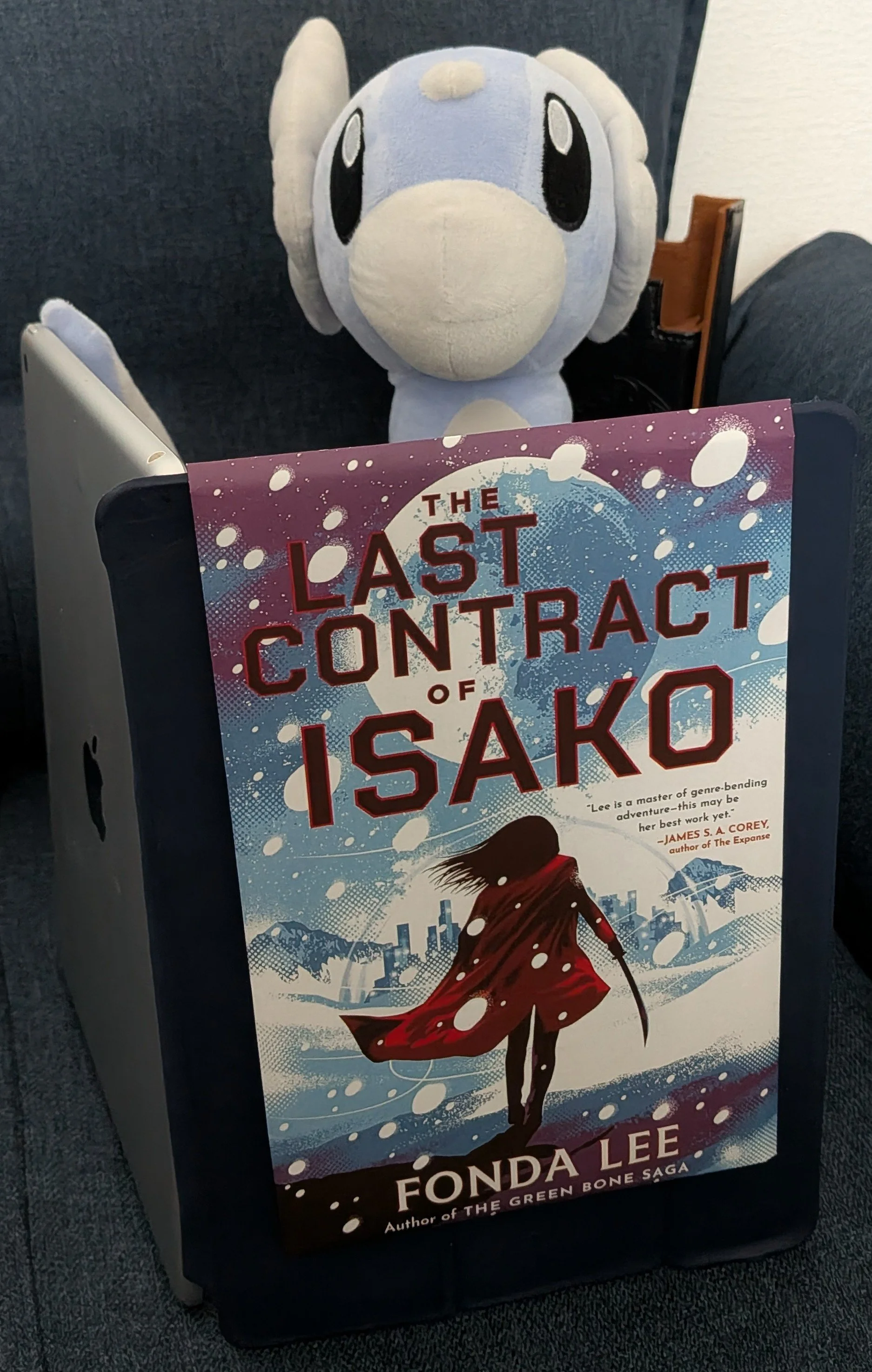
The Edgelord Opening of Isako (Part 3 - The Worldbuilding Domino Effect)
Welcome back, everyone, to the discussion of the opening to The Last Contract of Isako.
This is final part of the review series. In Part 1, I summarized the first three chapters of the book and highlighted the strengths of this opening. Part 2 broke down the issues with the tone and discussed how the opening chapter of Hive succeeded in delivering a more tonally consistent and effective version of a nearly identical inciting incident. Today, we’ll wrap up by discussing red flags in the worldbuilding presented in these opening chapters.
As a reminder, heavy spoilers from the first three chapters of The Last Contract of Isako (and only the first three chapters) will be provided throughout this post. This will only take us up through the inciting incident of the book, so the majority of the book will remain unspoiled.
Let’s get to it.
CRINGE VIBES CRACK THE WORLD
The worldbuilding within these first three chapters is good enough to help frame the narrative. Lee lays groundwork for the environment in which Isako lives and operates. When Isako’s boss dies, we fully understand why this is a major problem for her.
Does it have flaws? Sure, but not huge ones. The idea of a space colony run by a corporation is also interesting enough to make the flaws forgivable. Therefore, as long as Lee doesn’t shine a spotlight on those flaws, they could remain nitpicks that don’t hurt the story.
…
Yeah, you know exactly where I’m going with this.
Who, exactly, are the stakeholders?
The thing about corporations is that, even at this most controlling, they are not closed systems. Resources and money flow from a start point to an end point. Their employees are not their only customers (assuming said employees can even be customers). Sure, a corporation can control resources from extraction to finished product, but they need to be getting capital and resources from another market to grow.
We see this in our own world. Sure, there are company towns and special tax districts, but these aren’t closed systems. Hershey, Pennsylvania was built to facilitate workers who were manufacturing a good to be exported. The Reedy Creek Improvement District survives almost entirely on tourism, an industry that, by its very nature, requires outside capital. Even the biggest and most global corporations in our own world have to interact with other corporations and reach for new markets.
This is something that even James Cameron got right with the Avatar films. The RDA may have an absolute monopoly on space colonization and the right to rule colonies full of their employees as they see fit, and they build most of what they need using local resources, but this system is built upon outside funding. Unobtanium (and later amrita) needs to be extracted and shipped back to Earth so as to keep the corporate wheels turning. At the same time, any services the RDA provides for its employees - health care, housing, infrastructure, etc. - is work it has been contracted to do. They aren’t building Bridgehead City because the workers campaigned for it.
The reason I am explaining all this is that the idea of Aquilo being a corporate planet governed by the Starhome Exploration Group alone starts to unravel the moment it’s established that Aquilo’s population has been cut off from Earth for … four and a half centuries? That charming quote from Captain Janus Brady is dated 44 AF, and Chapter 1 is set in 500 AF. AF stands for “After Founding”.
So, what, this company had outside revenue for 44 years and then lost all of its income for 456 years? How and why is this place still being governed like a for-profit corporation? Why did they never transition into any other form of government?
With how this opening presents things, this isn’t even a case of there being a puppet government to provide public services while the company rules in the shadows. This is the only government. The divisions within the company are treated as political movements. How is this colony still functioning this way after centuries with no investment, no outside markets, no credit, and no demand for its services beyond, “Don’t let yourselves die?”
I fully admit that I’m not an economist. Maybe there is some way to explain away this situation. Perhaps Lee herself provides that explanation in later chapters. Per her own bio in the back of Jade City, Lee is a “former corporate strategist”. She, of all people, should understand how capitalism works. Still, the fact that this glaring incongruity is shoved in the audience’s faces does not make a good first impression for the worldbuilding as a whole.
The narrative functionality and the pathos of these first three chapters leans entirely upon this world being a corporatocratic space colony that has been severed from Earth for centuries. This is not something that can just be ignored. If this does not make sense, then multiple other elements fold in on themselves - in particular, resignation.
“I resign.”
This suicide ritual falls apart the moment one actually thinks through the logic of it.
Culturally, the ritual itself makes some sense. We are explicitly Told that it is seen as “selflessness”, “choosing to depart with dignity so vital resources would go towards the community’s survival”. When we are Told Isako’s own father committed suicide this way, that makes sense.
The problem is how this ritual synergizes with the corporatocratic system.
Loren does not need to resign. He’s not ordered to kill himself upon termination; even when he signs the contract for resignation, he’s only given an eviction notice, implying that he could simply renege on the contract and forfeit its benefits. As mentioned above, Isako suggests that Loren could find another job. When he refuses to be a burden to his family, he explicitly mentioned begging (meaning that beggars can and do exist in this world).
What I’m getting at here is that the suicide ritual is neither mandatory nor only applied to those too old to contribute to society. People young enough to still provide some manner of utility, if not necessarily having much left in terms of a career to be proud of, are CHOOSING to kill themselves. They could take a lesser job. They could entrust themselves to the charity of others while doing charity in turn (we are told “pilgrims” keep area around the city gates clean, which implies that the work isn’t conducted as part of some paid service). They could simply impose on the goodwill of others (not desirable, but clearly, the fact beggars exist means that the company isn’t trying to eradicate them, so some people would surely try it). To attempt none of these things and jump straight to the ritual is just suicide for its own sake.
Then there is the fact that the company incentivizes resignation. Loren does not get offered a severance package. He is offered at least three years worth of money to kill himself. This means that, instead of potentially providing value for those years (value that would probably cost the community less than the value of his corporate salary), then killing himself, the company is asking him to provide zero value while still draining resources at the same rate as when he was with the company (and this guy was implied to be somewhat high-ranking, too, not a minimum wage grunt). What incentive do they have to do this? If they want him dead badly enough to pay him, why not just pay someone less money to kill him (or to force him out the airlock at gunpoint)?
Let’s set all of that aside, though. Let’s ignore the fact that this world probably needs people to provide public services. Let’s say that Loren’s options really were limited to, “Die now or shame the family by begging.”
Lee established that his daughter is pregnant. An infant requires childcare. This is a need that will either compromise his daughter’s ability to work or else incur severe expense (after all, if there are no low-wage public service jobs or charitable efforts, then she’ll have to pay for private childcare). What if – and I know this must seem like a wild idea – Loren became the child’s full-time caregiver, thereby allowing his daughter to go back to work? It’s not like childcare needs will vanish in just three years, especially if she has more than one child (and she’ll need to, if this colony is going to expand). So why not care for her child(ren) while she works, then kill himself when he’s too old to provide this service?
Economically, this suicide ritual makes no sense as something for the company to endorse or the wagefolk to find valuable. It actively makes everyone’s lives more difficult.
Death Without Purpose
While we’re on the subject, might as well dissect the ritual itself.
The future suicides all get into the city’s airlock and are released into the sub-zero, hypoxic environment outside. They walk as far as they can before collapsing and dying, leaving their frozen corpses on display. This is see as a sacrifice to show how terraforming is progressing. Apparently, when the colony expands to their bodies, they will get streets named after them.
Here’s the thing: this colony has scientific instruments to measure the temperature and oxygen levels. Those details are broadcast to the public in this same scene. Surely, they could just simulate the effects on the human body in a computer, right? Or test these things in a laboratory?
Also, these distances are all relative to the colony’s boundary. Won’t the relative distances be thrown off by the colony expanding? Does that not distort the distances walked by later suicides?
These deaths accomplish nothing of pragmatic value. A cultural ritual does not need pragmatic value to hold symbolic value, but in this case, the symbolic value is linked to pragmatic results.
Here’s another alternative to suicide: why doesn’t the company offer contracts with hazard pay in the outside world? Maybe Loren can earn three years’ worth of wages for his family, even if he dies in a few months. Then everyone wins. He gets the money and dies with dignity, and the company and society get actual value out of him.
Broken for Vibes
To bring this back around to the beginning: I think that Lee designed this world purely for the vibes and put zero thought into making it a functional setting. She pursued aesthetics and edge with zero thought for how these would actually work within the larger setting she was designing.
A space colony governed by a corporation with zero regard for human life? Sure. A culture of ritual suicide in the name of resource conservation? Why not. But thought wasn’t put into it beyond, “Oh, if you get fired from the company, you have to die,” nor was any thought put into how it would synergize with other details being communicated to the audience.
Of course, maybe this will all be redeemed later in the book. As a first impression, though, it is a REALLY bad sign for the state of the worldbuilding, and it worsens the issue of amateurish edge. The world should not break this early just for a vibe.
CARRYING OUT THE CONTRACT
Thank you all for reading while I got that off my chest.
I don’t plan to DNF The Last Contract of Isako. I really do respect and believe in Lee as a writer. I’m just … struggling to find the motivation to keep going. The red flags have me worried that I’m just not going to have a good time. If you all really want me to continue, I’ll make an effort to get it done sooner rather than later. Otherwise, this book may sit on my TBR for a while longer.
Hive is another matter. I have already finished the first of the book’s four parts. It’s been really engaging thus far. I’m thinking of doing a book club-style review, with each post covering one of the book’s parts. The review will be coming sometime in autumn (I hope).
Once again, thank you all for joining me today. Please remember to subscribe and share if you enjoyed what you read here. Take care, everyone, and have a good week.