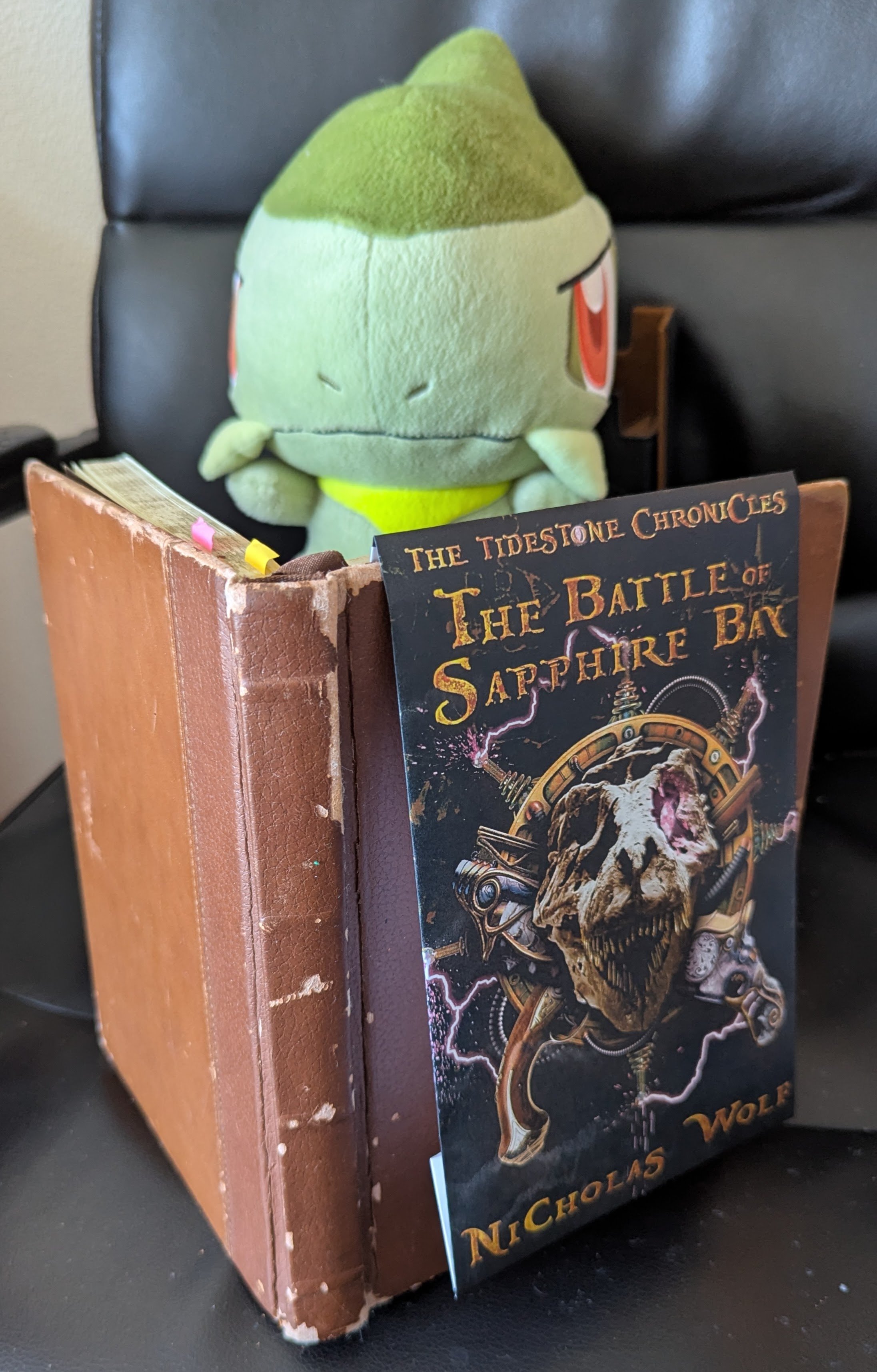
The Battle of Sapphire Bay (The Tidestone Chronicles, Book 2) (Part 1 - Spotlight on Flashbacks)
Hello, everyone. Welcome back to our ongoing voyage through The Battle of Sapphire Bay, Book 2 of The Tidestone Chronicles.
This will begin our three-part deep dive analysis. This week, we’re only going to be shining a spotlight on Wolf’s handling of flashbacks in this story. Next week, we’ll delve into the other aspects of the plot. If you just want a high-level overview of the Book, please see Part 0.
Power up the tidestone core. It’s time to take flight.
STATS
Title: The Battle of Sapphire Bay
Series: The Tidestone Chronicles (Book 2)
Author(s): Nicholas Wolf
Genre: Epic Fantasy
First Printing: April 28th, 2026
Publisher: Self-published to Amazon
Rating: 8.5/10
SPOILER WARNING
Mild, unmarked spoilers for The Battle of Sapphire Bay will be provided throughout this review. Heavy spoilers will be confined to clearly labeled sections. I will keep the first paragraph of any given section spoiler-free.
Heavy, unmarked spoilers of the previous book, Beyond the Crimson Mists, will be included throughout this review. I will also assume that you have read my review of that book, but doing so is not necessary to appreciate this review.
TERMINOLOGY
As in the last book, I’m not going to use Wolf’s names for certain fantasy races in this setting. I’ll instead be referring to these races by the archetypal fantasy races that they are appear to be derived from:
Atantyans = elves
roqlyudi =dwarves
nurians = humans
I will refer to the waraabei by their proper name. While they may be derivatives of gnolls, gnolls are a creation of D&D, so changing the name was likely necessary to avoid legal issues.
SPOTLIGHT ON FLASHBACKS
With Nyomi on the brink of death and his airship rendered inoperable by crash-landing after he fell out of it, Hawk has limited ability to drive the story forward. The smart thing for him to do would be to repair his airship and leave.
Hawk is, by his own admission, not a very smart man. He is also now fully devoted to Nyomi as a surrogate little sister figure. So in his efforts to find some way, any way, to help her, he skulks about the Sancutary, trying to find whatever secrets Malychai might be hiding. (He does repair the airship, too, but only in the interest of being able to escape Malychai once Nyomi awakens.)
This search for knowledge defines the bulk of The Battle of Sapphire Bay. The titular battle itself occupies only the last third of the book. Up until that point, we are getting the information needed to contextualize that battle … and since most of that information is historical, that means the first two-thirds of the book are really just a framing device for flashbacks.
Wolf took a titanic risk here. Flashbacks, by their nature, do not maintain the forward momentum of a story. The audience is being asked to pause to get background information before restarting. What’s more, the flashbacks in this book can be broadly split into two groups, each of which carries an additional risk.
We get backstory on how Hawk became a deserter and stole his airship. This demystifies his past. Doing this for a character backstory always carries the risk of telling a less interesting or emotionally impactful story than what the audience could imagine up on their own.
We get the history of the rise, decadence, and fall of the elves’ ancient empire. This is an exposition dump with extra steps. It’s fundamentally the same as those prologues that try to dump the core mythology of a story before giving the audience a reason to care.
Wolf more than compensated for all of these risks.
The Deserter
The flashbacks about Hawk stealing his airship and becoming a smuggler start first. It's a pretty straightforward story. After the 152nd Tidestone War, Hawk was drinking himself to death after his sister’s death, decided to break the nose of Lord Croft (the ruler of his particular country) for allowing civilians to die during the conflict, and then had to flee and become and outlaw after Croft put a price on his head. These flashbacks wrap up about a third of the way into the book and then aren't revisited.
At first, I was very skeptical about these. Beyond the Crimson Mists also had these flashbacks about Hawk’s past, but those were backstory to enhance the journey of his character, trigger be relevant circumstances in the resent. Here, the only character work is affirmation of things we already know about him.
However, then the last third of the story arrives.
Among the forces that arrive to assault the Sanctuary is a fleet under the command of Lord Croft. Hawk has to face off against this old nemesis, who embodies the unchecked ambition and greed that this story warns against, this time fighting Croft to protect Nyomi and the world rather than out of vengeance. The flashbacks aren't there to develop Hawk; they are there to flesh out Croft and build a foundation for Hawk’s dynamic with him. What seems extraneous on a first read is actually the establishment of elements that weren't necessary in the previous book yet are vital now.
Fall of Atlanis
Hawk discovers devices called “remembrances” within the Sanctuary. These are functionally identical to the Pensieve from Harry Potter, only with each memory being its own device rather than being pooled in a central storage device. Hawk uses one accidentally when he stumbles into the Sanctuary’s library, thereby allowing him to experience the day when the ancient elves first discovered tidestones. Malychai catches him and rebukes him before removing two other remembrances from the library. Hawk intuits that these two are important memories. He makes it his mission to steal and view them as well.
The content of the remembrances isn't anything remarkable in and of itself. It tells us what we already could have guessed form the obvious Atlantis parallels: the elves grew too proud and too greedy and became victims of their own vice. Thematically, it continues the idea of the futility of ambition and avarice that was introduced with the Tidestone Wars (conflicts fought over a precious energy resource that ends up being mostly squandered in the fight to control it).
If that were all there was to it, then these flashbacks would be a waste of time … except the flashbacks aren’t the story. The journey to access them and apply them is.
First, Hawk is taking a tremendous risk. Every time he tries to access any of the remembrances, we get a tense scene of him sneaking through the Sanctuary and trying to bypass Malychai’s security. There is credible threat to his well-being if he is caught. This already puts the flashback scenes on a better footing them by making them payoff.
Second, there is the experience. Hawk is having visceral, emotional reactions to the events unfolding before him in these flashbacks. Part of this appears to be some psychic mechanism that relays emotions and spiritual sensations as well as physical details - so when Hawk sees the elves descending into hedonism, he experiences a smothering darkness that makes it hard for him to breathe. Other parts, though, are him just reacting to events. He sees elves sacrificing the priestesses who summon tidestones, associated them with Nyomi, and is horrified by the bloodshed.
Third, there is the matter that these aren’t purely flashbacks. Hawk thinks he can see Nyomi wandering through these memories (as if she is also using the remembrance, rather than being a person recorded within it). Visiting these memories is as much about hunting for her as it is exposing Malychai’s secrets. There is also a dark presence within the remembrances that seems to be aware of Hawk and attempts to seize him. At one point, this dark presence cuts him; I assume this will pay off in some way in Book 3.
Fourth … well, this one doesn’t really get a payoff, but I'll mention it anyway. Remembrances are not compatible with human physiology. Hawk is damaging his brain every time he uses it, resulting in nosebleeds in the moment and lapses in consciousness after the fact. This element fades into the background near the end of the book, so it feels like an unnecessary addition to a situation that already had adequate stakes. Still, Wolf did at least try to follow through on this element at first.
Fifth, there is the mystery of Malychai's identity. I will leave this one for the character discussion. For now, I’ll just note that Hawk reasonably assumes that the remembrances are of personal important to Malychai and tries to figure out exactly how Malychai ties into these events.
Taken all together, Wolf transformed the dive into the elves’ history from a bland exposition dump into a journey where Hawk was rewarded for significant risks.
Final Thoughts on the Flashbacks
A novel wholly dedicated to getting the Main Character caught up on exposition, delivered via a device that stalls narrative momentum, is not a recipe for success. Wolf picked an uphill battle here. However, it’s clear this the understood his assignment. The narrative the resulted from these flashbacks ended up reading as a worthy continuation of the previous book rather than make-up work.
ENEMIES ON THE SHORE
On Friday, August 21st, we’ll sail into the other aspects of the plot beyond the flashbacks, including a discussion of the abrupt ending and the feeling that the action is still on autopilot. Until then, thank you all for stopping by. Please remember to subscribe and share if you enjoyed what you read here. Take care, everyone, and enjoy the rest of your week.