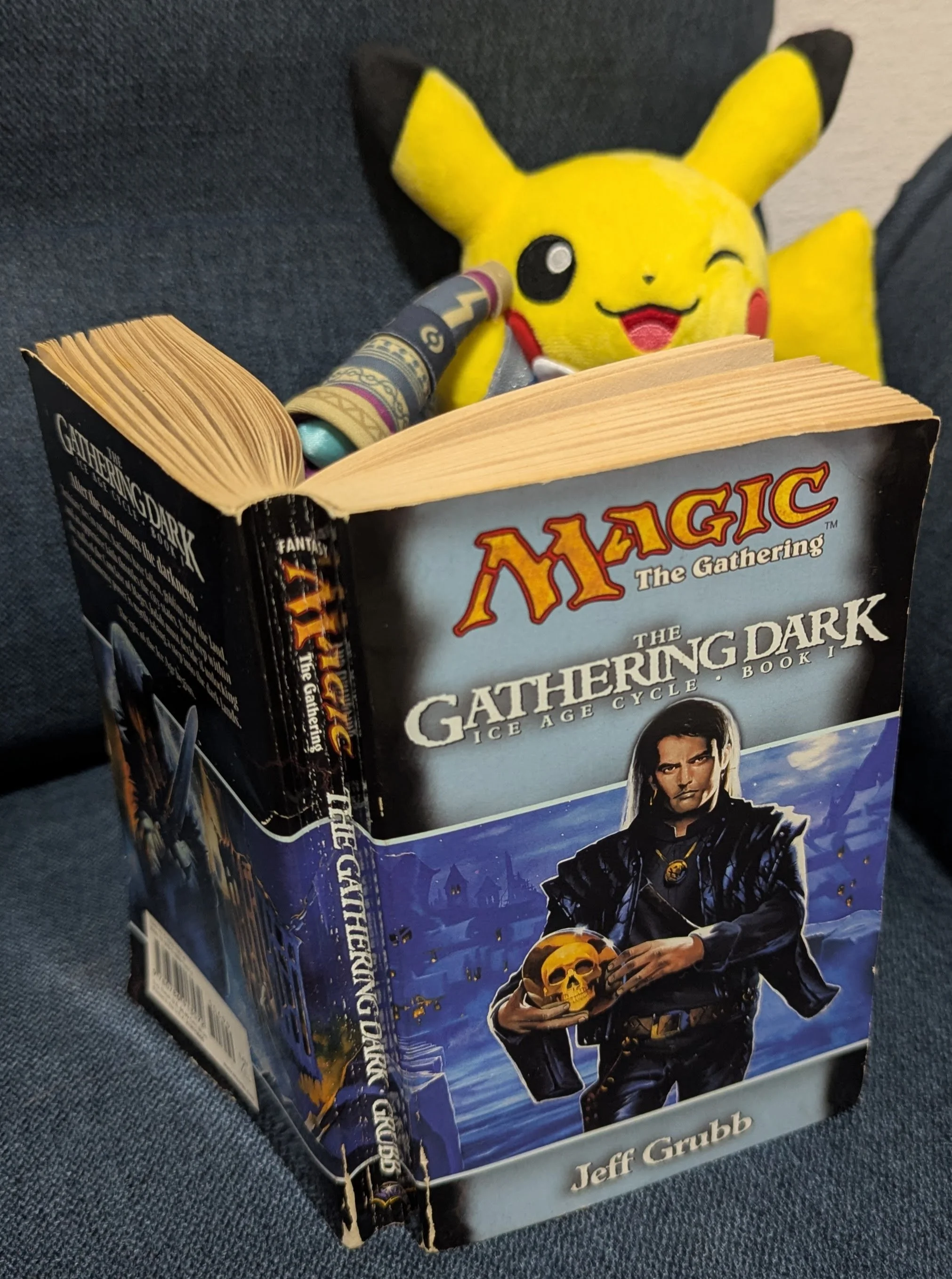
The Gathering Dark (Ice Age Cycle, Book 1) (Part 2 - Spotlight on Theme and Social Commentary)
Hello, all. Welcome back to Dominaria’s Dark Age.
Last week, I spent a lot of time talking about how The Gathering Dark is a simple story that is nonetheless very effective as adapting a card game into an escapist fantasy with a strong vibe. Originally, that was all I wanted to discuss about it. It is a good book that exists without any further context required.
That said, there is something about this story that stayed with me in the decades since I last read it: its theme.
The Gathering Dark emphasizes the value of self-awareness, calling out how easily an ideological blind spot of self-interest can lead to hypocrisy. At a superficial level, the manner in which is does this is not so different from the way that modern Fantasy frequent does this. This story could be used as an honest example of how “old fantasy” has always had social commentary.
At the same time, this honest example demonstrates just how far standards for writing commentary have fallen in the 27 years since its release. I don’t think it’s an exaggeration to say that this is the bare minimum that all Fantasy authors should aspire to, at least if those authors care more about telling a good story than preaching to (or virtue signaling to) the audience. I want to take a moment to explore how this story, while superficially similar to modern ones in the handling of this messaging, actually stands head and shoulders about them in multiple aspects.
We’re going to go through the contrasts first, then we will go on to discuss why the applicable message ultimately packs so much punch.
Light your lamps, everyone. It’s time to venture back into the dark.
STATS
Title: The Gathering Dark
Series: Ice Age Cycle (Book 1)
Author(s): Jeff Grubb
Genre: Epic Fantasy
First Printing: June 1999
Publisher: Wizards of the Coast LLC
Rating: 8/10
SPOILER WARNING
Mild, unmarked spoilers for The Gathering Dark will be provided throughout this review. Heavy spoilers will be confined to clearly labeled sections. I will keep the first paragraph of any given section spoiler-free.
Throughout this review, I will also be providing heavy spoilers for later events within MTG canon. While I will be steering clear of details that would spoil the progression of this book specifically, there is a strong chance that you will figure out certain spoilers if you pay attention to these bits of lore. I’ll confine the heavy spoilers that are relevant to this book into clearly marked sections.
Heavy, unmarked spoilers for previously review Magic: the Gathering tie-in novels may also be provided, regardless of where they fall in the timeline relative to this book. I will also assume that you’ve already read my reviews of those books, though they aren’t essential to understand this one.
REPRESENTATION
Much like the question of whether the Church Of Tal was actually meant as some sort of strawman of Christianity, I think it’s questionable whether what Grubb did in this book was some kind of proto-virtue signal for Representation. This book did come out right 15 years before that sort of thing really picked up steam. Frankly, I also think that this example is so mild that it’s hard to actually call it Representation, for the same reason that one can’t accuse a story of tokenizing certain identities just because it features singular characters with those identities. We should not rob words of their meanings by over-using and abusing them.
That being said, I do think that this example is close enough to Representation and tokenization to be functional for the sake of the argument I’m trying to make. If it isn’t either of those things, that would simply strengthen the point. Also, if a modern author had done what Grubb did here, I would call it out as both Representation and tokenization. I therefore think it’s perfectly reasonable to evaluate the following paragraph as if it were, indeed, a deliberate attempt to Represent via tokenization.
Okay, disclaimer’s done. Let’s look at the passage in question.
Drusilla, according to Shannan, attained the color of her night-black hair through use of certain plants growing in the southern swamp. Dorine was the name of the white-haired woman, and she had a taste for young male servants. So did Lord Dervish, but he had better taste than she did. Jonko, a red mage who was not present at the moment, had a talent for humiliating the staff publicly. Orm, also absent, was said to be wasting away in his study, refusing all meals in a quest for higher consciousness. And Lucan, the fat man whom Jodah had met the day before in the hallway, was by general consensus a blatant backside-kisser.
In an era prior to the entire trad-pub industry (and the wider entertainment media landscape) tripping over itself to virtue signal, this is about as loud as virtue signals got. It’s quite similar to Nick being obviously homosexual in My Big Fat Greek Wedding (released just three years after this book), albeit being only one detail rather than multiple.
Why is this different from what we get now (or, for that matter, what we got in 2018 in A Reaper at the Gates, when a side character having a homosexual crush is just flopped down in front of the audience)?
It’s for the same reason that all of this book's references to MTG work. Grubb didn’t call attention to it. He made it diegetic. Perhaps most importantly of all, he made the reveal itself plot-relevant.
The reason we learn about this Representation is because Shannan (the character delivering the information) is a gossip. He is telling Jodah the secrets of his fellow Conclave wizards. Bringing up the fact that one if the wizards has dalliances with the servants, and those dalliances happen to be homosexual ones, is just one piece of a larger puzzle. It is an unobtrusive part of a moment meant to cement Shannan’s characterization.
This characterization has an impact on the plot. When Jodah needs to learn secrets about Mairsil, he knows to come to the Shannan, the guy who knows everything and is a terrible gossip. Him doing so has an impact on his relation with Mairsil. So, while I don’t think the Representation is plot relevant, the reveal itself is.
The function of this reveal of Representation is not, “Hey! This author has Representation! That means Author Good, Book Good!” The story is coming first. Even if Grubb did intend this as a virtue signal, he did not compromise the audience experience by shoving it in our faces. He managed to have his slice of cake while letting the audience eat the rest without disruption.
AVOIDING ALIENATION
The main reason that The Gathering Dark would be an honest example for “old fantasy” always having the type of social commentary we now see today is because of how is could be superficially read: as a story of an intolerant, conservative religious group persecuting a rainbow-colored coalition who just want to be their true selves.
The reason why it ultimately demonstrates how much social commentary has changed in the last 27 years comes down to what you see if you look behind the superficial.
I can’t rule out the possibility that Grubb was using MTG as a skinsuit to soapbox for his own worldview. The climactic scene where he delivers that applicable theme I love so much does read a bit like a “badass” power fantasy conceived by a hat-tipping Reddit Atheist. And if it didn’t blend so cleanly with the vibes of the setting, it would be really hard to argue that the Church of Tal are anything but strawmen whom Grubb takes potshots at within the chapter epigraphs.
The difference between what Grubb did here and the alienating, preachy commentary so common today is that Grubb is a competent storyteller. He shows self-restraint, and he allows there to be nuance. This means that, even if he was trying to deliver blunt, one-sided criticism, he was able to do so without outright alienating the people he claims need to change. He managed to deliver a story that is applicable, rather than allegorical.
First: yes, the Church are moustache-twirling villains. They seem uncaring to the suffering of common folk, hoard resources for themselves. The highest-ranked Church official we are Shown seems actively amused by his own faith’s hypocrisies (more on that in the section below) and wholly dedicated to asserting the Church’s ideological dominion in spite of those hypocrisies. At the same time, though, they are capable of acknowledging at least some flaws. Primata Delphine gets rebuked for her obsession when she demands resources to hunt Jodah down, specifically being called out for pride and anger. This sort of rebuke isn’t exactly a redeeming quality, but it does show that the Church as a whole is not as blindly, hatefully zealous as their face character might indicate.
Second, Grubb acknowledges that the Church is not the only source of problems in the world. The chapter epigraphs that are used to take potshots at the Church also point out that the wizards they hunted are just as guilty of historical revisionism. There’s also an epigraph that expresses that the decay of Dominarian civilization during this Dark Age was the result of the choices of many individuals. The Church of Tal are the villains in the story of a young wizard, but they are just as much victims of the Brothers’ War as anyone else, and their evils are merely expression of people struggling to find stability to survive in the darkening world.
Third, the only organized faction of wizards Shown in the story as just a villainous as the Church. The Conclave pursues magic for the self-gratification of its members’ desires. Their members indulge in decadent parties while the world outside starves. Their “servants” are really slaves. The narrative explicitly calls all of these things out. And then, of course, there is Mairsil and what he did to the Conclave’s original master, Ith. Too many modern Fantasies would whitewash the Conclave, writing off any flaws as the result of a bad leader and holding the faction as a whole blameless because they are the victims within the power dynamics of the story. (We saw this in The Empyrean, when Violet and her allies were repeatedly given moral blank checks for actions that endanger every innocent life in Navarre, because they are supposedly the heroes standing up for the refugees.) In The Gathering Dark, the wizards themselves are as flawed as the Church, and that is part of the lesson Jodah needs to learn.
Taken all together, the stereotypical portrayal of the Church doesn’t come across as demonizing religious people in the real world. The audience isn’t being told that any systemic dynamic makes a certain group morally unimpeachable. Everyone in this story is flawed. This makes the theme about self-awareness and hypocrisy - which is delivered by the VILLAIN - hit that much harder. While it’s primarily aimed at one faction, it is clearly applicable to everyone. The focus on one faction therefore reads less like Grubb lecturing a specific group of real-world people and more like a natural manifestation of the setting he’s created.
APPLICABILITY (HEAVY SPOILERS)
The theme of the story is crystallized in a fight scene at the climax of the story.
The climax kicks off when Primata Delphine assaults the Conclave with an army of faithful. One thing leads to another, and she ends up in a one-on-one duel with Mairsil in the castle’s dining hall. Delphine calls upon the “miracles” that she and other Church members have used to such devasting effect throughout the story.
Mairsil utterly clowns her. He casual deflects her “miracles” while revealing to her that the clerics of the Church of Tal are, in fact, wizards. He proves this point by narrating to Delphine the process by which she calls upon her miracles - that is to say, how she uses memories of holy places (i.e. which are, within the rules of the magic system, just another form of memories of the land) to call upon white and red mana. This is the Reddit Atheist scene I mentioned earlier. Mairsil destroys Delphine with Facts and Logic at the same time that he unravels her magic, with Delphine unable to put him on the back foot at any point, until he kills her and delivers the punchline to her corpse.
Mairsil kicked the body. “You hate wizards. You never asked me why I hate the Church. I’ll tell you: You’re narrow and dogmatic. And worst of all, you’re amateurs.”
A Subtle Touch
It would be very easy to write this scene off as Grubb demonizing religious people. Lots of other writers in that period took similar tracks - mainly in Science Fiction, but still some in Fantasy. I read enough stories like that in my youth that, by high school, it felt like religion was only brought up in Speculative Fiction (the kind that wasn’t explicitly Christian, at least) to get spat upon. I got pretty sick of it.
And yet, even at the peak of my frustration, I never felt like The Gathering Dark was one of those stories. I never felt alienated. This is where Grubb’s discipline and nuance pays off.
There is the matter of why the Church of Tal are hypocrites. Grubb didn’t build this on any ideological point that translates to the real world. This isn’t like Yarros or Sabaa Tahir whining about immigrants / refugees or like either Davies or Burnett making sexual violence against women the focus. He instead made this about the in-world magic system. Since the magic system of MTG doesn’t apply to our world, the applicable idea becomes untethered from allegory the instant one tries to apply it to the real world.
Then the nuance kicks in. Yes, this line is delivered specifically to the face character of the religious faction, but consider that the Conclave are themselves blind to their own hypocrisy. The narrative calls out crimes that the Conclave chooses to ignore for the sake of their own power, not unlike how the Church of Tal ignores the wars and suffering of its followers for the sake of maintaining its own influence. The Conclave may not be dogmatic, but they are narrowly focused on their own interests, and the childish ways in which we see its members use magic isn’t exactly an improvement over being amateurs in their craft This leaves room for the theme to apply to wizards in general with just a slight change in word choice.
Taken all together, this theme that could have merely been preachy allegory instead became a resonant, applicable idea. Mairsil’s statement stuck with me over the years. I found myself reflecting upon it when interacting with a variety of ideological individuals. It is an idea that it not tethered to any one viewpoint, cleanly applying to multiple situations.
Not Crossing the Line
Grubb didn’t just screech the Message at the audience because the audience deserved to be browbeaten into change. He put in the work to make the core idea one that could be applied beyond the most superficial reading of his work. He didn’t limit his message with simplistic binaries that had to be mapped onto specific real-world groups, and he allowed nuance for the message to apply to all sides in his story.
I don’t think any other modern-day writer we’ve covered on Recent Reads has managed this. A few have delivered themes in applicable ways (Islington and Flanagan spring to mind), and Lee managed to deliver an allegorical idea in a manner that allowed nuance and wasn’t alienating, but I feel like no one else danced this close to allegory before pulling things back.
THE DOWNWARD SLIDE
I just spent a lot of time praising Grubb for his discipline and his nuance. Of course, maybe none of that is deserved.
Maybe this is just what allegory, virtue signaling, and strawmanning looked like prior to the new millennium. Maybe if The Gathering Dark were written today, Grubb would go out of his way to make the rainbow wizards into a morally unimpeachable Representation faction while making Primata Delphine into a gender-swapped stand-in for the current POTUS. It could be that everything I praised is either due to different norms for writers or due to editors drawing harder lines on what was acceptable for messaging.
If that’s the case … it still proves what I’ve been saying about the decline in social commentary.
I really did forget most of this book. I forgot how cartoonishly evil the Church was. I remembered Mairsil as the only bad egg in the Conclave. I thought his big thematic line was applicable purely because the idea itself was applicable, not because the narrative itself supports the applicability of it. Yet, upon rereading it, I did not feel the urge to DNF as I did with Legendborn. I did not feel alienated by allegory that was intended to offend the paying customer because the author found it necessary, timely, and/or relevant to alienate the audience.
Even if we can’t give Grubb himself credit for masterful delivery of a theme in an otherwise simple escapist Fantasy - even if we want to argue that the commentary in this “old fantasy” is spiritually the same as modern Fantasy - then this story is still an inditement on just how far standards have fallen. This is firm proof that “old fantasy” could do this a lot better than most modern Fantasy does now.
Rather than blame audiences for having standards, maybe we should strive to regain what we’ve lost.
THE DEEP FREEZE
After Dominaria’s Dark Age came its Ice Age, the end of which is covered in Book 2 of this cycle, The Eternal Ice. I was able to get hold of a copy of this one at the same time as The Gathering Dark. We will eventually be doing a review of it.
First, though, we’re going to be doing the Masquerade Cycle. As mentioned at the end of the Rath and Storm review, I was able to acquire copies of all three books of this cycle, and we’ll begin reviewing them at the end of September. I hope you’ll join me for this continuation of the Weatherlight Saga.
For now, thank you all for stopping by. Please remember to subscribe and share if you enjoyed what you read here. Take care, everyone, and enjoy the rest of your week.