The Edgelord Opening of Isako (Part 1 - Introduction & The Things That Work)
I respect Fonda Lee as a writer.
While the only book of hers that I’ve read is Jade City, I was extremely impressed by both her passion for the story she was telling and the discipline she invested to tell it well. Her worldbuilding was immersive, her character work was powerful, and her plot (mostly) flowed smoothly to a satisfying resolution. Additionally, as mentioned in my recent criticism of social commentary in modern Fantasy, Jade City is the example I hold up for how it’s possible to have very blunt commentary about current hot-button issues without alienating the audience and while still telling a worthwhile story.
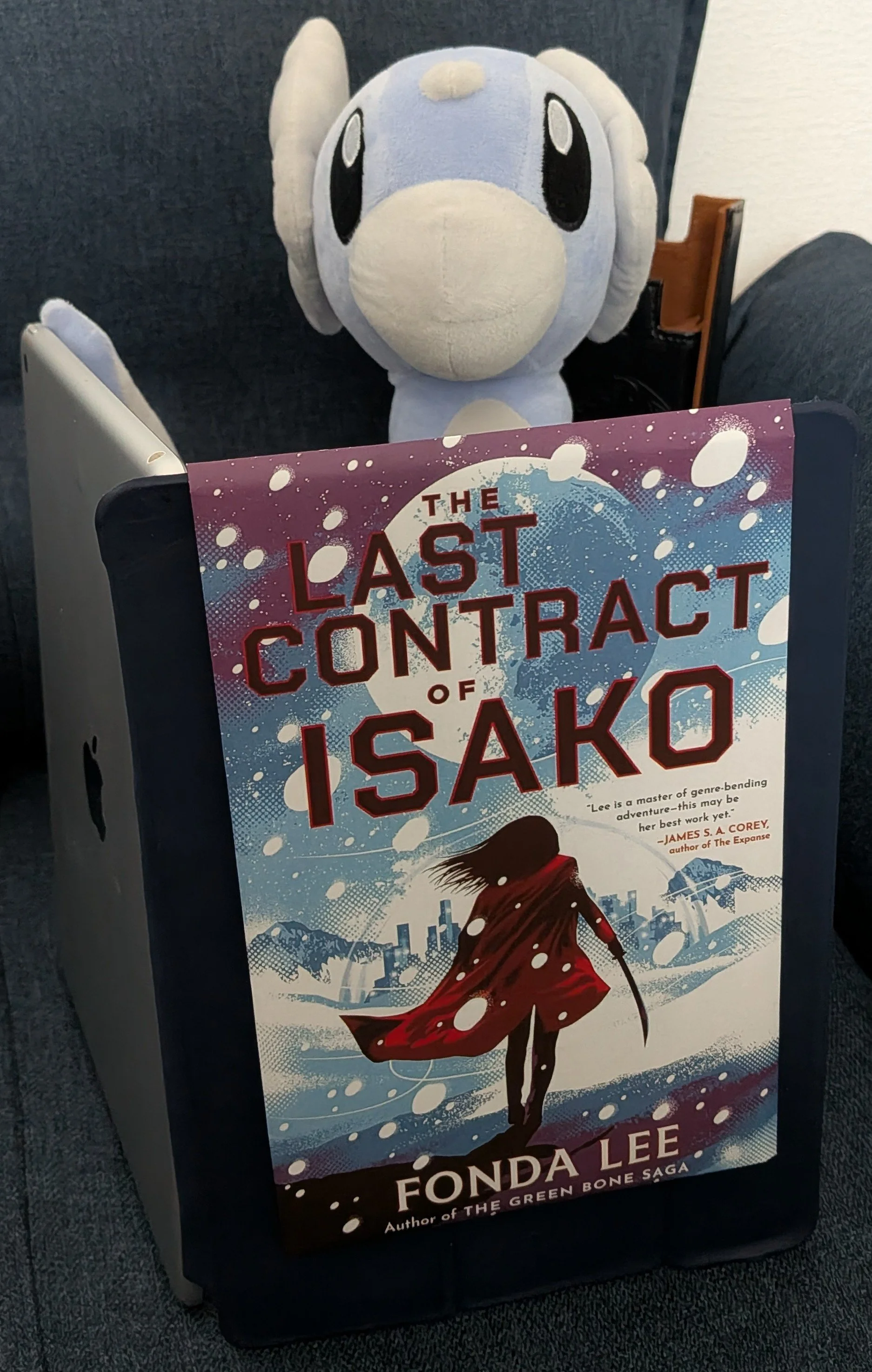
All this is to say that Lee is a writer I look up to and hope to emulate. I was looking forward to reading her latest book, The Last Contract of Isako. And in reading the first three chapters, I saw promising signs that at lead the character work of Jade City was not a fluke. I am sure that, if I get myself to read the rest of the book, I will find a great deal to praise.
… emphasis on “if”, because this opening is drowning me in red flags.
These chapters are, to put it bluntly, try-hard edgelord cringe.
FIRST IMPRESSIONS
Don’t Cut Yourself On All That Edge
The Last Contract of Isako sells itself on a cyberpunk samurai vibe. (Not literal cyberpunk, just the vibe.) I think Lee’s goal within these first three chapters (which introduce the titular character in Chapter 1, lay groundwork for the world in Chapter 2, and then feature the inciting incident in Chapter 3) was to capture the essence of a corporatocratic dystopia on an inhospitable plant.
That’s fine in concept. However, the edgy tone is not meshing with these elements. Instead of getting a story of morally gray characters and hard choices, I get the distinct impression that she wrote a fairly hopeful story, got told by her editor that it wasn’t dark enough, and just started tacking on edge in the same way that she tacked on Anden’s homosexuality in Jade City. At least Anden’s sexual preferences were confined to a few scenes. This sense of dissonance pervades the entire opening.
Further compounding this issue is that, by complete coincidence, I started reading Dan Abnett’s latest Warhammer 40K novel, Hive, just before I started The Last Contract of Isako. The prologue chapter of Hive (“The Hive Opens”) and Chapter 3 of The Last Contract of Isako are the same scene. I don’t just mean in the superficial details - that both scenes feature a banishment from an environmental sealed city onto an inhospitable planet as a form of execution, condemning denizens of the city to die in a manner that is as much about pageantry and the symbolic meaning of that death to those left behind as it is to actually killing the condemned - but also in narrative role. Both scenes serve as a means to feed crucial environmental worldbuilding to the audience; both contribute to the dark vibes. Technically, they are also both inciting incidents, as the execution present in “The Hive Opens” kicks off the storyline of one of Hive’s many POVs. Yet, despite how similar they are, the scene that reads like poorly thought-out edgelord fanfiction is not the one in the Warhammer 40K book.
Obviously, The Last Contract of Isako could get much better from here. These are only the opening chapters. At the same time, though, these are the opening chapters. Their purpose is to set expectations. So when a book written by an established, skilled author starts flinging this many red flags right out the gate, I think it’s worthwhile to pause and discuss why.
Best Foot Forward (?)
We’re going to progress through the review in the following manner:
Today, we’ll go over the first three chapters of The Last Contract of Isako and explain what works (and, thus, preserved enough of my faith in Lee for me to not totally DNF).
Next Sunday, we’ll go over the edgelord cringe, then describe “The Hive Opens” and discuss why that scene works.
Finally, the Sunday after that, we’ll discuss how the effort to be edgy derails the worldbuilding, turning otherwise inconsequential nitpicks into gaping holes that undermine the emotional core of these opening chapters.
Spoiler Warning
I am going to be spoiling the entirety of the first three chapters of The Last Contract of Isako across this mini-series. That said, these aren’t significant spoilers. Setting aside the fact that Chapter 3 only takes us up through the inciting incident, one of the things we are going to touch on when explaining the edgelord cringe is that Lee simultaneously telegraphs the inciting incident and yet fails to properly pay off the thing she’s telegraphing. Nevertheless, these are, technically, spoilers. You have been warned.
I won’t be spoiling anything after Chapter 3, as I have not yet read past that point at the time of writing this post.
THE FIRST THREE CHAPTERS: A CORE OF HUMANITY
What Happens
Chapter 1 follows Isthmus Isako, an atier (a sort of all-purpose executive assistant who serves as both administrator and assassin) delivering termination notices to a pair of her employer’s “wagefolk”. One of these wagefolk tries to kill her, only for her to execute him on the spot. The other, Dew Loren, agrees to resign peacefully in exchange for a compensation package for his family. This is also when we learn that the setting is a space colony on the world of Aquilo, owned by the Starhome Exploration Group corporation.
In Chapter 2, Isako reports back to Forest Greves, a Starhome director who is her employer. We learn more about Isako’s profession, the recent “war” between different divisions of Starhome (split between the “Earth” movement, who want to return to exploring the stars, and the “earth” movement, who want to continue terraforming Aquilo), and that Greves’s faction (“Earth”) lost that war. This is also where we learn (at least through implication - I can’t find a passage that explicitly states this) that Aquilo is cut off from the rest of human civilizatoin.
Chapter 3 reveals that “resignation” is ritual suicide. People fired by Starhome can volunteer to walk out into the frozen wastes of Aquilo to serve as living test subjects for the progress of the terraforming, dying of hypoxia and hypothermia within minutes. Isako is shocked when Greves shows up and resigns as a form of symbolic protest against the new corporate regime. Isako watches him die and wonders what she will do now that she is unemployed.
What Works
There is a human core to the Science Fiction drama in these chapters. Isako has a history with Loren, and she both empathizes with his plight and reminisces with him about their shared history. Her interactions with Greves may be that of an employer and employee, yet the mutual respect between them is palpable. And while the ritual suicide has its problems, you can feel Isako’s dismay, both when Greves shows up without notifying her (meaning she doesn’t have security ready for him) and then when her employer dies.
This was an essential part of what made Jade City work, too. Beneath that Wuxia gangster war was the tale of a family that was just trying to survive. The story survived on its characters. The same seems to apply in this book. Lee is setting Isako up as a character we can be invested in throughout whatever adventures follow the inciting incident.
This is why I’m going to do my best to overcome the cringe and continue this book. It looks like Lee still knows how to write the things that made her debut so great. I want to read more of that.
Also, while this isn’t enough by itself to convince me to read the novel, I have to say that Isako’s profession, the atier, is extremely interesting as a concept for a character. She reminds me of Butler from the Artemis Fowl novels, or at the very least, what Butler could have been in a story that followed Artemis as an adult. This is also one of the few aspects of this corporatocratic setting that I won’t be criticizing in Part 3. It’s a fun idea that works fairly well, at least within these opening chapters.
SHARP EDGES HAVE CONSEQUENCES
Unfortunately, the human core that would otherwise make this a very strong opening is undermined by a forced tone.
Next Sunday, we’ll dive deep into how Lee’s efforts to make this story feel gritty and mature backfire. These efforts feel tacked-on and jarring, as if Lee’s manuscript were handed off to an edgy high schooler who scribbled all over it in Hot Topic’s blackest nail polish. It’s honestly a bit surprising that the tone feels so out-of-place, given how Jade City already had a fairly mature vibe to it.
We’ll get into that next Sunday. Until then, thanks for stopping by. Please remember to subscribe and share if you enjoyed what you read here. Take care, everyone, and have a good week.