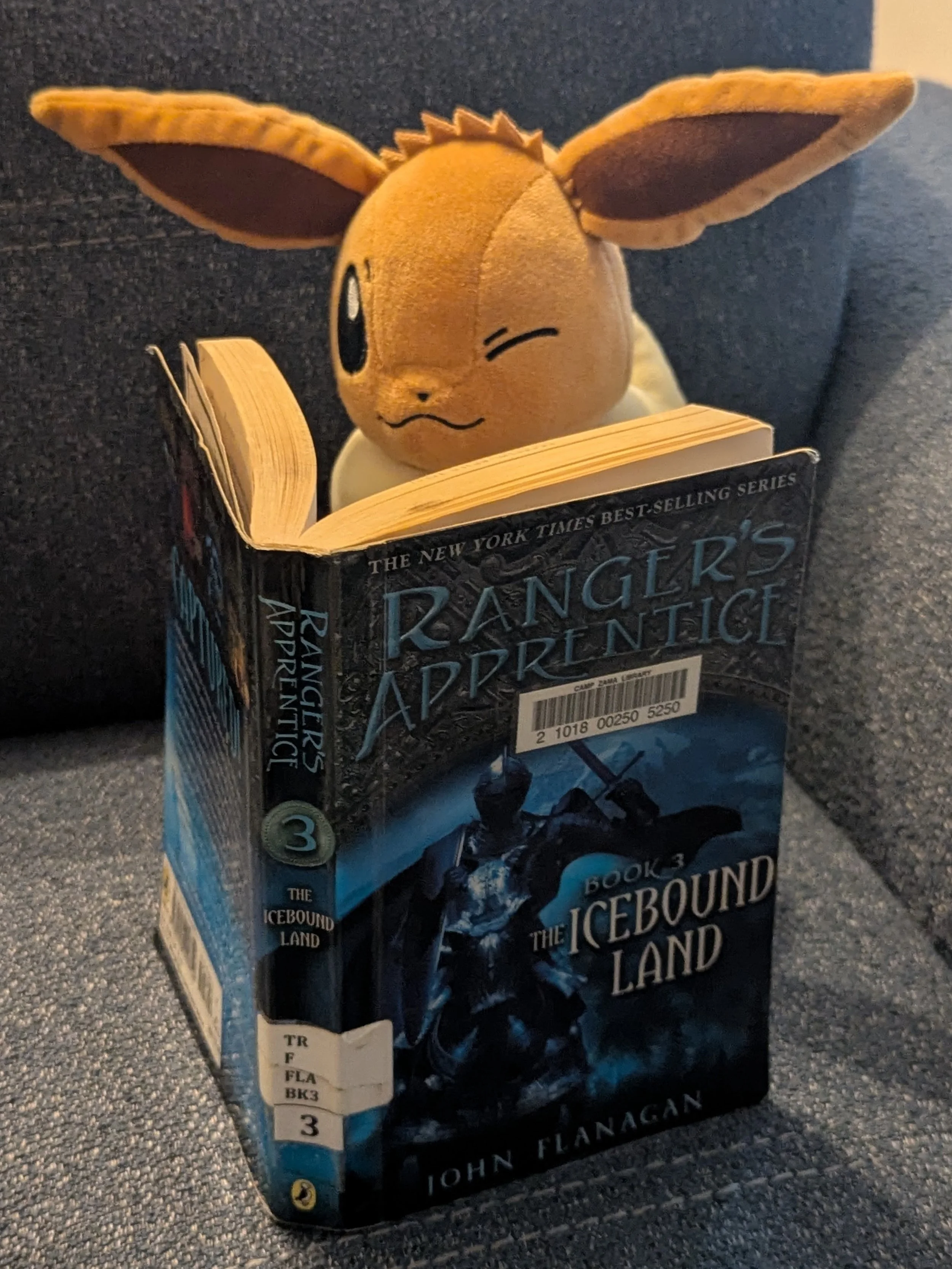
The Icebound Land (The Ranger's Apprentice, Book 3)
Hello, all. Happy Election Day and Culture Day. I hope you’re all ready for another journey into the world of The Ranger’s Apprentice. Since it’s a day of celebration, we’re reviewing the one with hookers and cocaine.
I don’t have nearly as much to say about this book as I did about the previous two. It continues the relatable characterization, easily understood worldbuilding, and fun adventure plots of its predecessors, though admittedly with the same contrivances and lack of thematic depth of The Burning Bridge. It’s a perfectly fine Middle Grade adventure overall.
Really, the thing that stood out to me most about this particular book is how it is defined by being Middle Grade. Despite the lack of thematic depth, the author does engage with or acknowledge some very dark subject matter. This is also a book where the target audience is really reflected in how the characters behave.
Step softly now. It’s time to go hunting.
STATS
Title: The Icebound Land
Series: The Ranger’s Apprentice (Book 3)
Author(s): John Flanagan
Genre: Fantasy (Middle Grade)
First Printing: November 2005
Publisher: Puffin Books
SPOILER WARNING
Mild spoilers for The Icebound Land will be included throughout this review, through I will keep the first paragraph of each section as spoiler-free as possible. Heavy spoilers will be confined to clearly labelled sections.
Unmarked, heavy spoilers for the previous books in The Ranger’s Apprentice series, The Ruins of Gorlan and The Burning Bridge, may be used as necessary to support this review. I will also assume that you have read the review series for those book, though doing so won’t be necessary to understand this review.
PREMISE
From the back of the 2008 American paperback edition, we get:
Captured!
Kidnapped and taken to a frozen land after the fierce battle with Lord Morgarath, Will and Evanlyn are bound for Skandia as captives. Halt has sworn to rescue his young apprentice, and he will do anything to keep his promise - even defy his king. Expelled from the Rangers, Halt is joined by Will’s friend Horace as he travels towards Skandia. On their way, they are challenged again and again by freelance knights - but Horace knows a thing or two about combat. Soon his skills begin to attract the attention of warlords for miles around. But will he and Halt be in time to rescue Will?
Reaction
As promised here, this novel shifts away from Will as the main character. This is mostly Halt and Horace’s adventure. Roughly half of the book does follow along in first Will and than Evanlyn’s POV, exploring their struggle to survive as captives of the Skandians, but the plot only truly advances when it follows Halt and Horace on their journey towards Skandia (not-Skandinavia) through Gallica (not-France).
The only place where I feel the premise is off-base is the last sentence. This story takes place over at least a six month period. The Skandians who have Will and Evanlyn needing to brave the “Summer Squalls” to get to Skandia, and then Halt and Horace can’t even get into Skandia until the following spring because of winter weather blocking the mountain passes. All the tension regarding Will and Evenlyn’s survival instead comes from their efforts to survive the winter.
RATING: 8/10
The Icebound Land is very much a transitional story. It seems to exist less to tell its own narrative than to get the core cast to Skandia for Book 4 of the series (The Battle for Skandia).
That’s not to say it doesn’t tell a good story. Halt and Horace’s adventure is a fine standalone story of traveling through a strange land and confronting a local threat. As for Will and Evanlyn’s story, it starts with Will’s efforts to escape from the Skandians, then transitions to Evanlyn leading the charge on the escape once Will in incapacitated (more on that in a moment). Along the way, the character of Erak (the Skandian Jarl who took Will and Evanlyn captive in the last book) and the culture of the Skandians get explored, again with the clear intent of setting up the next book. All this is perfectly fun as a stepping stone to what comes next.
At the same time, this story is very much a stepping stone. Things feel both unfinished and forgettable. There’s a pervasive sense that The Battle of Skandia is the book that Flanagan actually wanted to write, but he realized that he first needed to rearrange the game board in order for that story to make sense. It’s certainly nice that he’s Showing us the intervening events, rather than Telling us how he rearranged the board at the start of the next book. I just can’t ignore the sense that he really didn’t have to. Unless a certain element we are about to discuss ends up being relevant in the next book, this whole thing could probably have been handled by the sort of series recap exposition that Flanagan already does at the start of these books.
Middle Grade audiences probably won’t notice or mind this, though, which is why I’m still giving this book a high rating. Your Middle Grade reader will probably have a good time reading this.
PLOT, CHARACTER, AND WORLDBUILDING
I’m lumping the three of these in together because I have the same thing to say about all of them: it’s all perfectly fine storytelling, especially for a Middle Grade audience, but you can see the hand of the author at work.
Halt and Horace
When the King of Araluen denies Halt permission to travel to Skandia and rescue Will, Halt … well, to be frank, Halt gets himself canceled, running his mouth in a tavern until he is arrested from treason and banished. Horace, with permission from his Battlemaster, joins Halt in exile. They travel to Gallica and find themselves fighting their way through the ranks of dishonorable knights who hold the roads of that kingdom hostage. Eventually, they attract the personal ire of one of the most powerful lords in the region.
This is a perfectly find standalone adventure. It just doesn’t have any stakes. Once it’s established that Horace and Halt can’t even get into Skandia until the seasons change, the only real threat to them is that they will be killed in their battles against these knights, and the transitional nature of this story makes it very hard to buy the possibility that they will die.
Also … remember, Evanlyn is really Princess Cassandra of Araluen. Does the King of Araluen not want her rescued? Why would he not grant Halt permission to go on this quest, on the condition that the veteran Ranger also rescue her and bring her home? This scenario feels like it’s been arranged just so Horace, specifically, can once again be the one to go on this adventure.
Will and Evanlyn (and Erak) (Heavy Spoilers)
I was not joking about the cocaine.
The first part of this subplot is just the voyage to Skandia. Will, Evanlyn, and the Skandians spend many weeks trapped on an island due to the Summer Squalls, leading to Will plotting an escape attempt that ultimately fails. However, this time endears the pair to Erak, building upon the respect Will earned from the Jarl in the last book.
Once they arrive in Skandia, Erak turns the pair over to his king to serve as slaves. Evanlyn is put to work indoors; Will to put out to work in the cold. To ensure his obedience, the overseers trick Will into addiction to warmweed, a highly addictive narcotic that reduces him to a shambling husk. Seeing Will deteriorating under the influence of the drug, Erak helps Evanlyn rescue Will and flee into the wilderness, where the pair take shelter for the winter and wait out Will’s withdrawal.
Not the worst story … but it is very clearly contrived to keep Will and Evanlyn out of action until Horace and Halt arrive.
To give Flanagan some credit, I think he does a better job of addressing Evanlyn’s true nature in this plotline than in the other one. Evanlyn’s initial escape plan is to reveal her identity once they arrive in Skandia and to get ransomed back to Araluen. That plan goes out the window, though, once it’s revealed that the king of the Skandians has sworn a Vallasvow (a blood oath of extermination) against Araleun’s royalty for the death of his son (which happened off-screen in the last book).
However, the entire addiction plotline relies on a couple of significant contrivances.
First … Erak. Everything involving Erak. He respects these two youths and feels bad that the remainder of their lives will be spent in slavery. The original reason for him going through with it anyway is because selling them is the only way that the adventures in the last book won’t be a huge financial lost. However, once he gets to Skandia, he finds out he and his men will be paid for their efforts anyway. He also finds out (in a bit of obvious foreshadowing for the next book) that the Skandian leadership has an interest in training their own equivalent to the Rangers … and rather than saying, “Hey, one of these captives is himself a Ranger! I should leverage this,” he instead just hands Will over into a situation where he knows the drug addiction thing will probably happen. Then he … feels bad when his bad decision with known consequences has the consequences he knew about?
Second, there’s Will’s character while on the warmweed. He is effectively under the magic spell the whole time. There are no scenes in his POV between him getting hooked on the drug and the last chapter of the book. When that last chapter finally puts us in his POV, it is presented as if he was just blackout drunk for a few months. There’s no transition of him grappling with dependency. He goes from a shambling zombie to a confused teenager with no idea how he ended up in a hunting cabin in the middle of nowhere. I know that actually exploring the impact of drug addiction of the psyche would be a tall order in Middle Grade (and maybe Flanagan will address the matter in the next book), but it feels like Flanagan wasn’t actually interested in exploring the topic. The vibe is that this was all just a means of depriving Will of agency so that he couldn’t get himself and Evanlyn out of Skandia before Halt and Horace arrived.
I do think that Evanlyn’s struggle to escape from the Skandians while taking care of Will is a fine story. You can feel the emotional weight of her dealing with very series struggles. It’s just a shame that the hand of the author is so visible in all of this.
PROSE, CONTENT, AND THE TARGET AUDIENCE
This continues to be a very solid Middle Grade entry. The prose is accessible, the characters’ thoughts and feeling are stated plainly, and mature content is handling in a manner that blunts any excesses and makes it digestible for youths.
Regarding that mature content, this book builds upon the gore-free violence of the past books by introducing brutal medieval executions (the gibbets) and drug-facilitated slavery. I also wasn’t joking about hookers. There is a scene where Horace notices some scantily clad “girls” and Halt makes up a limp excuse about them being couriers, with the narration pointing out that Halt was trying to protect Horace’s innocence.
Respecting the Audience
With regards to this book being Middle Grade, I think there is a discussion to be had about what plot contrivances are acceptable (or, at least forgivable) on account of the target audience.
Kids are not stupid. They may not think things through fully, and usually lack the experience to accurately assess a situation even when they do, but they are capable of figuring things out. That’s why the reference to prostitution within this story is effective. Kids who already understand what prostitutes are will likely recognize what the girls in question are, but the reference is so clean that it should be impossible to guess that’s what’s going on without prior knowledge.
As an extension of this, kids are less likely to recognize when a character is acting in a manner that is illogical or unrealistic for his or her characterization and context. Flanagan plays into this when Evanlyn’s true identity is brought up. When she explains things to Will, she directly acknowledges the illogic of not telling him the truth in the last book, stating that she didn’t want to just be sent home. It’s an appeal to how the target audience might act when presented with an opportunity for an adventure. When I was in the target demographic, I likely would not have thought twice about this.
However … Flanagan has shortened his own leash, so to speak, when it comes to playing into the expectations and thought processes of the target audience.
Ever since The Ruins of Gorlan, this series has given adult responsibilties to the audience surrogate characters and had said characters think through problems as adults would. This is a feature that makes these books more memorable. Will and Horace are not generic Middle Grade Fantasy heroes - they are soldiers being thrown into a war. The narrative may characterize them like elementary school children in their downtime, but when serious matters arise, they act like young adults who have been forced to grow up very quickly.
This means that, while I’m happy to acknowledge that the target audience may not notice these contrivances on a first read, and won’t count is against the book’s rating as strongly as I would for more adult titles, these are still flaws that shouldn’t be condoned outright.
Take Evanlyn’s argument as to why she didn’t reveal her true identity. She is very much in the same boat, in terms of training and responsibility, as Will and Horace. For her to not reveal her identity to them and go home when she knew she could is either a failure in critical thinking that isn’t reflected elsewhere in her characterization or a break in character to service the plot. Likewise, when she tries to argue in this book that Will wouldn’t have found the bridge if she hadn’t come along, Will should have had the ability to call that out. He could absolutely have found and destroyed the bridge on his own if Evanlyn and Horace had just gone back to Araluen and left him to do his job unimpeded.
A similar argument could be made for Erak. Adults in this book may be simplistically characterized, but they are still filling adult roles and doing their best with the information available to them. It therefore doesn’t work to say, “Oh, Erak kept Will’s nature as a Ranger secret because he didn’t think the situation through.” Erak is not an idiot. Once the financial pressure was removed, he had nothing to gain by turning Will over to use as unskilled labor, everything to gain by announcing and taking advantage of Will’s abilities, and a full awareness that this boy he admires will likely be controlled via drug addiction. In a series like The Ranger’s Apprentice, making a decision this dumb just to move the plot forward is hard to miss.
I’m hoping that Flanagan amends this issue in future books. He started this series off on a rather strong note in terms of respecting his audience. Even if he never returns to the deep themes of the original book, it would be nice if he could at least keep the plot and character decisions up to that original standard.
VIKING WARS
The Icebound Bridge isn’t remarkable in and of itself, it’s a decent enough story if you’re looking for something to satisfy your Middle Grade reader, and it works fine as a transition to The Battle for Skandia.
Now, as for The Battle for Skandia, it is a pretty great book. It suffers from the contrivance issues we previously saw in The Burning Bridge, but the overall story is solid. I’ve already read it and drafted the review, which I look forward to sharing with you soon.
… but that’s not actually the next thing within the Ranger’s Apprentice series that we need to talk about.
After reading The Battle of Skandia, I naturally progressed to Book 5, The Sorcerer of the North. Chapters 9 and 10 of that book are, quite frankly, a decision nearly as horrible as Yarros giving Garrick the power to teleport in Onyx Storm. In attempting to establish Will as a moral character, Flanagan assassinates him. What’s worse is that, while covering up this assassination, Flanagan retroactively guts The Icebound Land. I want to discuss the how, the why, and the fallout before we move on with the rest of the series.
That breakdown begins November 23rd (Japanese Labor Day). Until then, thank you all for stopping by. Please remember to subscribe and share if you enjoyed what you read here. Take care, everyone, and enjoy the rest of your week.