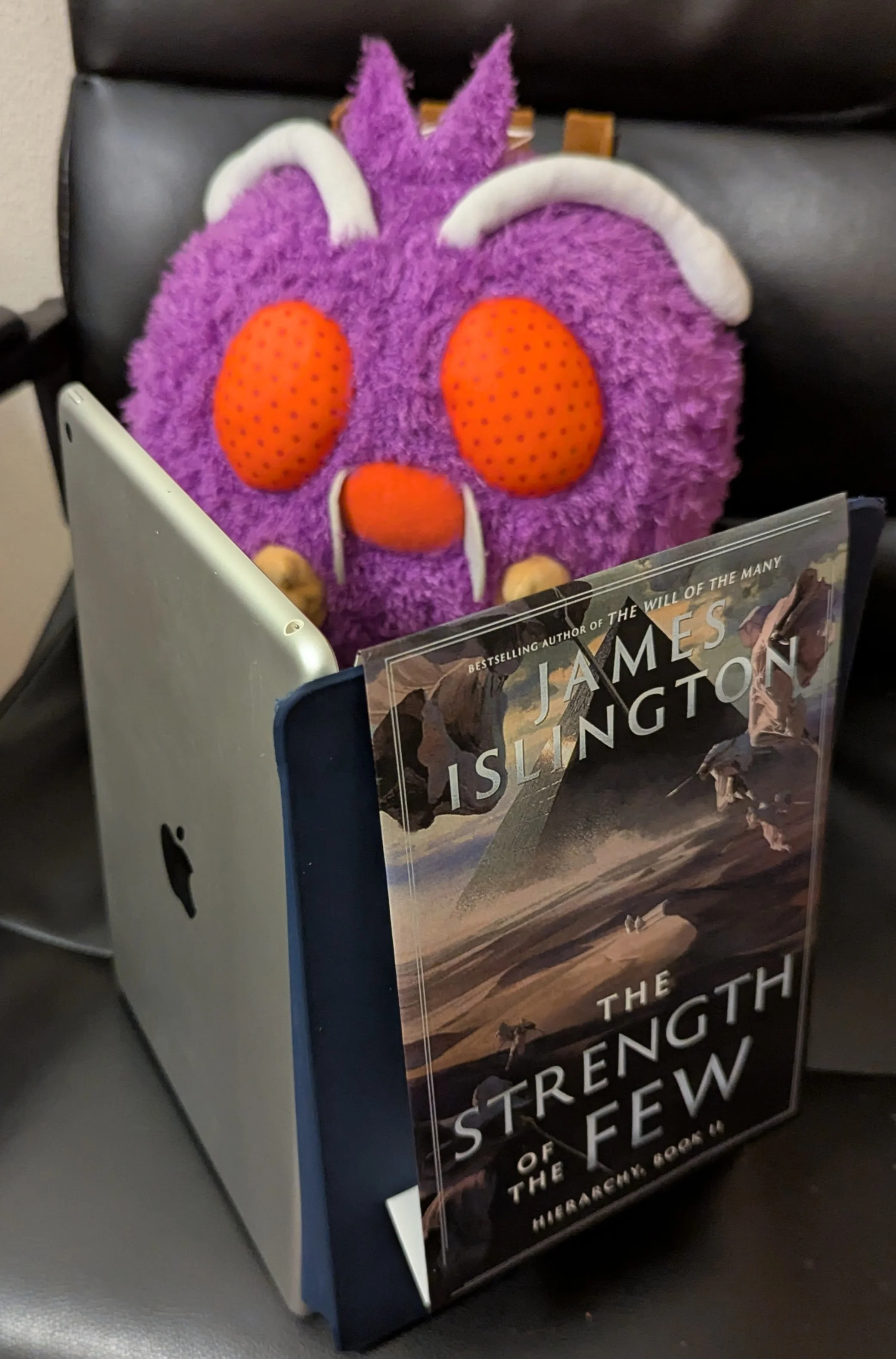
The Strength of the Few (Part 4 - Synchronous)
Hello, all. Welcome to the final part of our deep dive into The Strength of the Few, sequel to The Will of the Many.
This part will focus exclusively on how successfully Islington juggles the multiple POVs, as well as book-spanning issues like the prose and the power fantasy. If you’re looking for analyses of the individual POVs or the big-picture overview, please see the following parts:
With all that out of the way, let’s get into it.
STATS
Title: The Strength of the Few
Series: Hierarchy (Book 2)
Author(s): James Islington
Genre: Fantasy (Epic)
First Printing: November 2025
Publisher: Saga Press (imprint of Simon & Schuster)
Rating: 8.5/10
SPOILER WARNING
Minor, unmarked spoilers for The Strength of the Few will be provided throughout this review. I will keep the first paragraph of each section as spoiler-free as possible. Heavy spoilers will be confined to clearly labeled sections.
Unmarked, heavy spoilers for The Will of the Many will be provided throughout this review. I will also be referencing my review series for that book throughout, though you will not need to have read that previous review to understand this one.
TERMINOLOGY
The titles of this book, its predecessor, and its sequel (the title of which was announced of Islington’s blog in December) will be abbreviated as follows going forward:
The Will of the Many = Many
The Strength of the Few = Few
The Justice of One = One
THE SUM OF ITS PARTS
Individually, I don’t think that any of the POVs are bad stories. They’re good Fantasy fiction. However, each of them is missing parts that were necessary to make them truly great. That sense that content was cut hangs over their narratives, making them feel less like the finely crafted stories we saw in Many and more like hatchet jobs.
The thing is, if Islington did indeed cut content, he had to do so because all three of these books shared a single tome. Many was about 620 pages long; Few is less than 100 pages longer than that. Even if each POV got an equal number of pages, they would each have less than half of the length Many had to work with.
And that’s what so impressive about Many: Islington juggles these three narratives, which have virtually no overlap, quite masterfully.
Pacing & Tension
I’ve commented before about how the Luceum POV has a slow start and a slow middle, while the Obiteum POV has an incredibly slow middle. As for the Res POV, while I haven’t directly commented on the pacing, it really does feel frantic as it zoomed from more plot milestone to the next.
Woven together, though, there’s a great balance to these individual POVs. The Lucuem POV has a slow start? Well, Vis is being hammered with new challenges - and new exposition for the audience - in the other POVs. The Obiteum and Luceum POVs both get slow in the middle? Well, that’s when the Carnifex stuff begins on Res. The Obiteum POV’s climax feels like it flows a little too smoothly, while the Res POV’s climax gets its action out of the way early and shifts to characters talking? Well, the Luceum plot cranks into absolute overdrive in the third act, with twists and complications heaped one atop the other.
Islington used some solid judgment in deciding how he would stich these chapters together. He didn’t commit himself to a rigid formula for when to change between POVs (which is something the second and third books of the Ember Quartet did with its three POVs). He fit the chapters together in a way that felt natural and cohesive, allowing tension to rise and fall and for events to speed up and slow down across the narrative as a whole. Sure, I got annoyed when Vis felt like he wasn’t making progress in the middle part of the Obiteum POV, but I still felt refreshed and ready to go once the POV flipped back to the measured growth of the Luceum POV or the chaos of the Res POV.
Unity
As stated a few times now, after escaping the Gate, the Vis copies have virtually no impact on one another’s stories. The close connection that caused the Res copy of Vis to suffer the injuries of the others fades quickly. For there, all three are independent actors, with only the instinctive transfer of Will techniques providing any connection between them. It’s not until the end that we get
There were two major risks with this. The first is that, if these POVs are wholly independent, then it makes this feel less like one novel and more than three that happen to be squished into the same cover. (This was something I commented upon way back in the review of The Shadow of the Gods.) The second is that Vis needs to learn essential exposition multiple times over, which means the audience has to sit through him learning said exposition.
Independent Trajectories
Islington addresses the problem in two ways. The first is in the establishment of the broader narrative about Ka and the stakes involved in Vis remaining Synchronous. Even if the Res and Luceum copies of Vis aren’t aware of this issue, we the audience are, and that dramatic irony makes their actions feel every bit as significant as the Obiteum copy’s. If nothing else, their deaths (and Vis frequently finds ways to endanger himself) will sabotage the Obiteum copy’s story and doom all three worlds.
Also, when it comes to the finale (I will remain spoiler-free here), Islington neatly ties everything off. While the Res and Luceum copies of Vis do reach the end of their respective adventures, it is the actions of the Obiteum copy that really tip things over the edge. His actions set off a domino effect that smashes into the other POVs, thereby ensuring that all three stories are traveling in the same general direction as the series progresses to One.
Exposition
Islington could have cheated here and had exposition transfer between copies of Vis in the same manner that the Will techniques do. Instead, he has each of the Vis copies earn their exposition at different points in the narrative. For example, take iunctii.
The Obiteum copy is taught about iunctii by Caeror as one of the first lessons about Will on that world. Vis witnesses Caeror creating an iunctus, has the mechanics explained to him, and then is trained in how to manipulate iunctii.
The Res copy is told about iunctii by Emissa when she explains why she tried to kill him in Many.
The Luceum copy is in the dark until late into the narrative, at which point he is taught about iunctii at the same time that he’s apprised of the struggle against Ka.
What’s more, the exposition isn’t just justified - it’s played with. We know Emissa is not lying about iunctii, but Vis does not believe her. Why would he? He doesn’t yet know about the three worlds, and the claim sounds ridiculous. It isn’t until Emissa arranges for him to see an iunctus prisoner whom the Senate is interrogating that he finally accepts the truth.
Islington also doesn’t force us to sit through repeated exposition. Once a concept is explained through dialogue to one copy, he summarizes interactions when the other copies learn the same information, only playing things out when there are character-driven differences to the delivery. This is, again, what happened with the iunctii exposition. Emissa was telling Vis this information as part of her attempt to earn his forgiveness, and for the Luceum copy, the reveal came as part of a twist that Vis and the audience needed to hear an explanation for.
PROSE
Language
I am even less of an expert on the languages of pre-Roman Europe or Egypt than I am on Latin. I can only say that, as far as vibes go, Islington sold me on the idea that these three worlds have mostly distinct linguistic traditions. The only common thread throughout all of them (which allows Vis a means to communicate with locals) is the ancient tongue of Vetusian, which predates the Cataclym and appeared through the ruins he explored in Many.
On the note of languages, while everyone on Obiteum speaks a form of Vetusian, only the druids do on Luceum. Vis therefore has to learn an entire language from scratch. While he does come near-fluent at an incredible rate, we are shown him earning this. Islington structures the dialogue and his interactions with characters to really give us the feel of a man who is starting with the most basic of vocabulary and working his way up to functional communication.
False Cliffhangers
It seems even Islington is not immune to this … but maybe I am being too harsh.
At several points (I didn’t count, but it felt like at least as many as in Onyx Storm), Islington will terminate a chapter at the most arbitrary of points in the middle of a scene. This does superficially feel like an effort to jerk the audience around with a fake cliffhanger. The reason I am hesitant to fully commit to this criticism is that, much like its predecessor, Few makes for rather heavy reading. Even if the chapters aren’t necessarily long, they feel long. It’s entirely possible that, much like was the case in Alchemy of Secrets, Islington had to cut chapters down into chunks that would be more manageable for the audience, and he sometimes had to carve a path through the middle of a scene. This may be less an issue of trying to toy with the audience’s emotions and more one of not writing chapter endings well.
The Amputee
I couldn’t think of a better place to put this, so I’ll just say it here: i think Islington does a good job accounting for Vis’s missing arm.
Turns out, our arms are heavy. Losing one really messes with your balance. The Obitieum copy avoids this thanks to Caeror’s intervention with the Vitaerium, but both the Res and Luceum versions need to adapt to balancing whie not only walking but also fighting.
For the Res copy, this isn’t a huge obstacle. He works out the situation with his prosthetic and otherwise avoids most situations where his missing arm matters. For the Luceum copy, he has to go through a whole arc about being half a man without his arm. This pivots quickly away from the arm itself and into him letting go of his past, with the arm merely being an excuse he uses to hold himself back, but it still becomes a large part of his identity for a good chunk of the story.
POWER FANTASY
Vis in Many felt overpowered. Despite this, the story didn’t feel like a power fantasy. There was a sense of balance. The challenges he faced, the failures he endured, and the constant and very personal dangers hanging over his head made things such that his incredible skills barely allowed him to succeed.
Few is … a little different. Not so much in the Obiteum and Luceum POVs, but there’s a reason why I said the Res POV gets a Batman arc.
Whether because of cut content, how challenges are framed, or simply because of the options opened up to Vis via access to Will (both generally and thought his abilities as someone Synchronous), there are points where the Res copy reads like a bizarre fanfiction of the character from Many.
His Carnifex identity may not have been deliberately crafted, but he’s still effectively keeping a superhero costume under his tunic at all times, complete with a metal mask that covers his face when he is using the arm.
We never see him train with this arm, and we also see how easily he makes a leg brace for himself when his legs are broken, so even if it makes perfect sense within the rules of the world, it still doesn’t feel entirely earned.
Adoption allows him to steal so much power that, at certain points, he rivals the most powerful Will users in the Republic in terms of raw power.
We are explicitly told (not Shown, but in this case, establishing the information is enough to get the vibe) that he is running around the streets of Caten to enact vigilante justice on the mobs that attack Proscribed individuals.
He has an animal companion now.
Oh, that’s right - I didn’t tell you about the animal companion.
Remember Diago? The alupi Vis befriended for a couple scenes in Many? Vis encounters him again when he returns to the Academy to talk with Veridius and poke around some ruins, and in incredibly little time, he trains Diago. Then he just takes this massive predator back to Caten with him. This would be like me going to Indonesia, befriending a Komodo dragon, and bringing it back to Tokyo with the expectation that no one would object … except we’re told that apparently no one objects to this, either. Furthermore, Vis takes Diago along sometimes when he does Carnifex things, commanding Diago so effectively that he might as well have a telepathic bond. I’m not saying this is impossible within the setting. We see druids accompanied by alupi in the Luceum POV, so many Vis being Synchronous makes him close enough to a druid for Diago to instinctively follow him. It’s just that this whole animal companion business reads like an absurd add-on just to make the OP protagonist even cooler.
Now, Vis does get defeated in the climax (see Part 2 for more on that), but it’s by someone who outranks him in the hierarchy of Will users. Introducing an overpowered opponent for the narrative purpose of having someone the protagonist can’t simply defeat with brute force doesn’t negate the power fantasy. It’s an exception that proves the rule.
I don’t think this ever got to a point that it outright damaged the Res POV. It was just incredibly silly. When paired with how this Vis’s character arc for the novel ends, it made this POV feel like it was ghostwritten by an edgy teenager. A Batman arc was the last thing I expected to pop up in this series.
THE FOURTH POWER
I originally thought Hierarchy would be a trilogy. Given what happened with A Light of All That Falls, I was worried that the story as it stood at the end of Many was already too big to reach a satisfying resolution in just three books. It felt like a trilogy was needed just to follow up Many.
Knowing now that this is a quartet - effectively delivering that follow-up trilogy to Many - I feel like the series is on the right track.
The story as it stands could very reasonably be resolved in two more books in the page count range of Many and Few. Each of the Vis POVs has reached the point where they are distinct characters with clear trajectories. New mysteries have been introduced, and they do kick the story in a new direction, but the shift is not as radical as what we got at the end of Many. Two books gives this series a lot of legroom to ensure a solid landing. Islington can spend One to escalate and explore established ideas before delivering a big finale in Book 4.
That's not to say Islington can't possibly mess this up. One could end up feeling as chopped up as Few. Elements introduced or built upon in One could set up Book 4 to be a bloated mess. And, as much as I’d hope Islington learned his lesson from A Light of All That Falls, the fact he appears to have repeated those mistakes in Few shows that he still has room to grow.
Still, for all of my criticism of Few, I am genuinely optimistic for the future of this series.
ONE GRAND STORY
For all my issues with The Strength of the Few, I did truly enjoy it. I wish that more modern Fantasy could live up to this baseline. What Islington accomplished here is incredible. Hopefully, he’ll iron out the various kinks by the time The Justice of One releases in however many years.
Don’t wait until then, though. Read The Will of the Many. Read The Strength of the Few. Let trad pub know that there is still a demand for great Fantasy literature like this. Whether or not that effort is successful, I’m confident that you won’t regret the time you spend exploring these books.
Thank you all for joining me on this latest journey. Please remember to subscribe and share if you enjoyed what you read here. Take care, everyone, and have a good weekend.

Volume I of my first serialized Romantasy novel, A Chime for These Hallowed Bones, is now premiering over in Tales of the Five Worlds!
Kabarāhira is a city of necromancers, and among these necromancers, none are more honorable or respected than Master Japjot Baig. Yadleen has worked under him since she was a girl, learning how commune with bhūtas and how to bind these ancient spirits into wights. Her orderly world is disrupted, however, when a stranger appears with the skeleton of a dishonored woman, demanding that her master fabricate a wight for him.
To protect her master from scandal, Yadleen must take it upon herself to meet this stranger’s demands. Manipulating the dead is within her power, but can honor survive in the face of a man who has none?
Chapters 8 (Parts 1 and 2) and 9 are now available! I hope you’ll join me on this new adventure.