The Strength of the Few (Part 1 - Obiteum)
Hello, all. Welcome to the deep-dive analysis of The Strength of the Few, sequel to The Will of the Many.
This part of the review will analysis specifically the POV set on the world of Obiteum. The reviews of Res and Luceum will come on February 13th and February 20th, followed by a the review of the overarching qualities of the story (theme, prose, and the interaction of the POVs) on March 13th. Please see Part 0 of the this review if you’d just like a high-level overview of the book. If you’d like to see my Spotlight Analysis of Islington’s handling of the expanded magic system, you can find it here.
Let’s dive right in.
STATS
Title: The Strength of the Few
Series: Hierarchy (Book 2)
Author(s): James Islington
Genre: Fantasy (Epic)
First Printing: November 2025
Publisher: Saga Press (imprint of Simon & Schuster)
Rating: 8.5/10
SPOILER WARNING
Minor, unmarked spoilers for The Strength of the Few will be provided throughout this review. I will keep the first paragraph of each section as spoiler-free as possible. Heavy spoilers will be confined to clearly labeled sections.
Unmarked, heavy spoilers for The Will of the Many will be provided throughout this review. I will also be referencing my review series for that book throughout, though you will not need to have read that previous review to understand this one.
TERMINOLOGY
The titles of this book, its predecessor, and its sequel (the title of which was announced of Islington’s blog in December) will be abbreviated as follows:
The Will of the Many = Many
The Strength of the Few = Few
The Justice of One = One
STORY
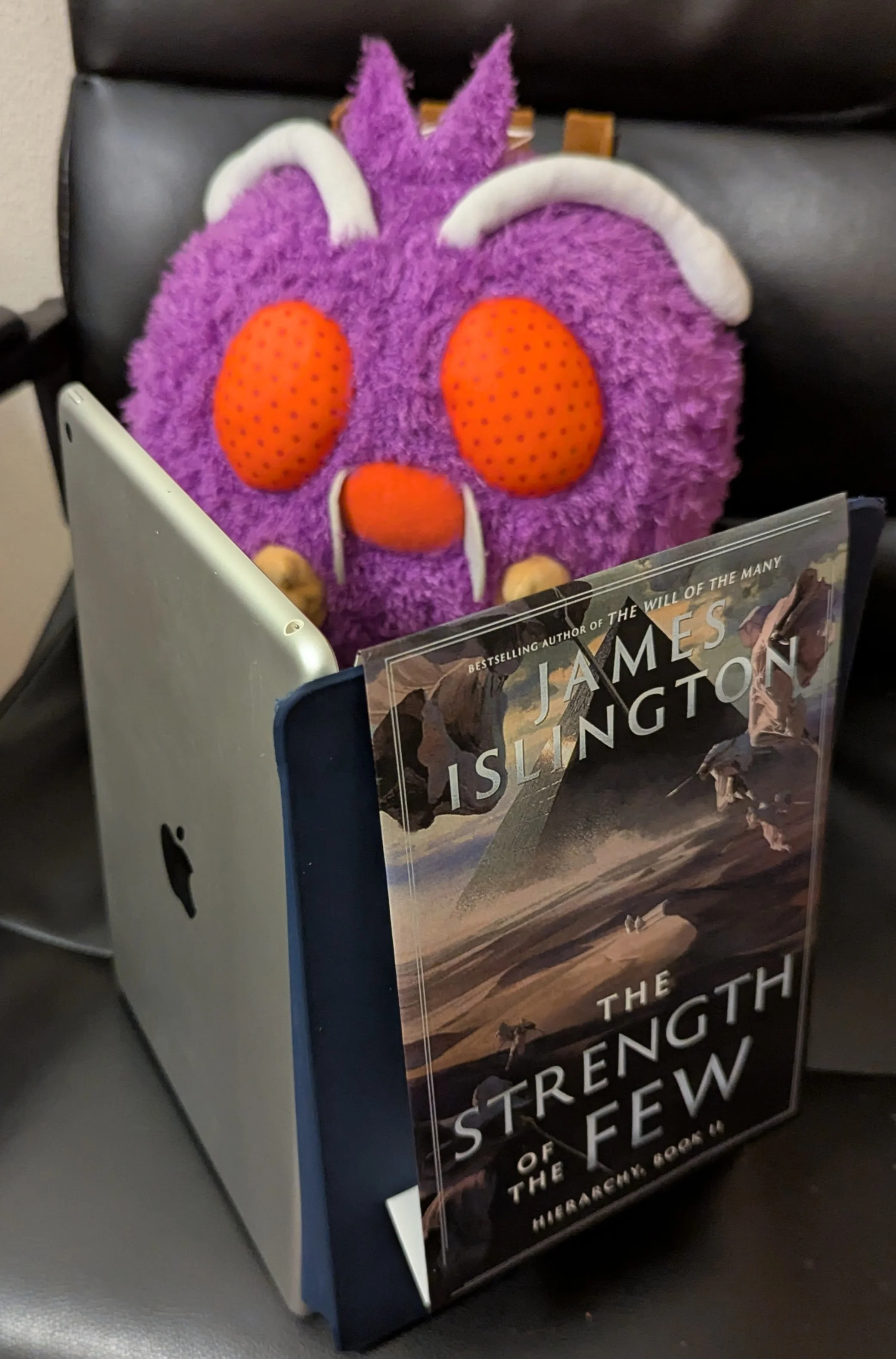
Vis finds himself on the barren, poisoned world of Obiteum (shown on the novel’s cover art). With Caeror acting as his guide and mentor, he is quickly brought up to speed about the sundering of the world into three separate paths, the associated splitting of the powers of Will, and his potential as a Synchronous individual. He is also tasked with assassinating Ka, the only other (known) Synchronous person, an immortal god-king fueled by the Will of unfathomable numbers of iunctii. Working together with Caeror, Vis prepares himself to infiltrate the pyramid-city of Duat, where Ka’s Obiteum copy is believed to reside, and assassinate Ka, thereby preventing the next Cataclysm.
PLOT
This one was a bit of a roller coaster - not because of the plot itself, but because of how it felt within the context of the wider story.
It started with a bang. Right away, Caeror feeds Vis vital exposition that set up this POV to be the most pivotal within the entire book. This is where the action is happening, so to speak. No matter what the copies of Vis on Res and Luceum get up to, this is the one whose actions will dictate the fate of all three worlds.
What’s more, I feel like the start of this POV was paced really well. Islington had to unload a lot of exposition onto the audience to introduce this new world. Vis also has to undergo training to learn to use the Will abilities of Obiteum, practicing with iunctii to learn how to manipulate them the way that Ka does. This is also when Vis begins planning for how he’ll get into Duat and learns about mutalis, a strange energy that will kill anyone who is not Synchronous. Then comes the sequence where Vis gets into Duat (which I won’t spoil here, as it’s a genuinely tense scene that showcases his quick thinking).
The problem is when Vis gets into Duat.
Was There More to This Plotline?
Once Vis gets into Duat, this POV stagnates.
It’s not bad in concept. Aided by an iunctii named Ahmose and, later, an assassin named Netiqret, Vis has to navigate a closed environent where an outsider like him could quickly be identified and executed. The focus of the story becomes finding a way for him to infiltrate the temple where he and Caeror believe Ka’s Obiteum copy resides.
The issue is how slow things become. It felt like I was reading the same chapter over and over again: Vis evades detection with the help of a local, identifies the next checkpoint he has to walk through, and then convinces said local to take things to the next step. No meaningful progress is made from quite a while. When progress does come, it feels like the story is suddenly rushing to get to the climax.
While the other two POVs are where the potential for cut content feels the strongest, I can’t help but wonder if cut content is also the reason why things get so slow and repetitive in Duat. It feels like there should have been an action scene in the middle of that slow part, such as Vis being detected and narrowly evading capture by the Overseers (the iunctii who serve as Duat’s law enforcement and whose consciousnesses are networked into an undead network). Sure, with how high the stakes are set within the city, this is something that would massively complicate the attempt Vis makes to get into the temple, but a couple of added chapters would have provided time to play out those consequences. Without something to liven up the middle portion of this POV, I started to feel bored with this portion of the story.
Then the climax hit.
Leeroy Jenkins (Heavy Spoilers)
As slow as the middle of the story is, the climax is proportionally rushed.
After his failed bid to breach the temple, Vis makes his escape from Duat and returns to the place where he was originally living with Caeror. There is an ancient doorway there that is protected by mutalis. Vis tried to open the door prior to going to Duat. However, he was unable to do it. Mutalis has an (as-yet unexplained) connection to the force used to slaughter tens of thousands of people in the arena scene in Many, and Vis originally PTSD flashes just walking up to the door. Once he returns from Duat, though, he is able to muster the courage to open it.
This felt incredibly unsatisfying. It’s not clear why his experiences in Duat would have prepared him to open the door. He’s had some development in the intervening period, but not the kind that would address his PTSD. It makes it feel like everything in Duat is pointless, since Vis apparently could have opened this door before he went there.
Let’s set that aside, though. Vis walks through the door and discovers a crook and flail. These are weapons that were seemingly designed to be wielded by a Synchronous person, and they give Vis the power to obliterate fortifications and vaporize people in single strikes. Once he’s tested these weapons, he hikes back to Duat and is able to literally blast his way through the gates before storming the temple.
Again, this assault goes incredibly smoothly - almost too smoothly. Vis gets into the temple with virtually no resistance. Once he is there, he quickly reaches Ka’s chamber. Knowing that there are Gleaners (Ka’s elite defenders, also visible on the book’s cover) swarming after him in numbers that even his new weapons can’t defend against, Vis moves in for the kill. The POV ends on the following paragraphs:
There’s a splintering sound at the door. Pieces of wood clattering to stone. The Gleaners are through.
I push the knife into Ka’s heart.
This felt so hollow. I kept waiting for the other shoe to drop - that this wasn’t really Ka, that Vis wouldn’t kill him, that something would intervene to save Ka - but no. The Obiteum POV ends there.
And then, to my surprise, the shoe dropped in the Res POV.
See, in the last chapter of that POV, Ka’s Res copy contacts Vis. He see no further point in hiding, because his Obiteum copy did indeed die at Vis’s hands. Vis won.
That’s when Ka informs Vis that, by doing this, he has doomed everyone to a worse fate than the Cataclysms.
I’ll save the details until Part 2. For now, I’ll just say that the reversal retroactively redeems the climax. We went from a finale that felt far too easy, where Vis’s success felt like a cop-out because he faced no genuine complications, to the revelation that his success may actually have made things infinitely worse.
Final Thoughts on the Plot
The Obiteum POV has a strong opening, a weak middle, and a finale that feels unsatisfying at first but is redeemed when the consequences revealed after the fact. It kicks the series up a notch for One. I just wish that middle were stronger. The way this POV wraps up is good, but not good enough to overlook the fact that most of the Duat chapters could be skipped without missing anything important.
CHARACTER
This POV is driven by the plot, but that’s not to say that the characters are bad. Islington keeps the cast small and developed everyone enough to keep things interesting.
Vis
I don’t have a lot to comment upon for this iteration of Vis. He’s exactly what you’d expect if the character from the middle of Many’s finale got dumped into a post-apocalyptic hellscape and told he needed to kill a god. He makes good use of his quick wits and his newfound abilities with Will to bring him closer to his goals.
On the matter of using Will, the narrative doesn’t take time to reconcile Vis’s previous efforts to avoid Will with his newfound position. I think that’s okay in this circumstance. Vis didn’t have issues with Will in and of itself - it was the system of oppression built on ceding Will that he didn’t want to be a part of. In an environment where he’s merely using his own Will, it makes sense that he wouldn’t need to grapple with the implications.
Caeror
The Obiteum copy of Ulciscor’s brother serves as an upbeat mentor figure to Vis in the early chapters of this POV. He was briefly Synchronous when he was first copied, but with the death of his Res copy, he was no longer able to fulfill his and Veridius’s mission to kill Ka. Knowing that Veridius would try to create more Synchronous individuals by using the Academy’s final tournament as cover, he has waited for years for someone from Res to arrive, using the time until then to learn everything he can about Ka and about Will on this world.
Caeror drops out of the story once Vis goes to Duat, and his fate afterwards is unknown. I feel like the story lost something without him in it, but this was the natural progression for the narrative to take, so I feel like that’s okay.
Ahmose
During Vis’s infiltration of Duat, he saves an iunctus named Ahmose from being converted into a Gleaner. Ahmose helps him to navigate Duat in the early days of Vis’s time there. Vis views him as a friend and aggressively defends him from those who would devalue him as a iunctus.
Ahmose is another reason why I feel this POV may have suffered from cuts. Islington tries to rush the idea that Vis and Ahmose are close friends. Were it not for the precedent for character work set by Many, I think what is on the page is okay; with that precedent, this feels hollow and rushed. There are scenes Islington Tells us about that could have really helped to sell the idea that the pair are close friends.
Netiqret
This character is first mentioned to Vis by Caeror as a freedom fighter who helped an iunctus escape Duat, bringing Caeror information about the city. Vis’s first objective upon arriving in Duat is to find her and secure her assistance. To his dismay, he learns that Netiqret is not, in fact, some sort of rebel leader. She’s an assassin whose profession it is to poison living residents of Duat so that they can be raised as iunctii and enslaved by her clients. Nevertheless, Netiqret is eager to help Vis breach the temple, hoping that his efforts will suit her own objectives.
Netiqret takes over as a mentor for Vis, schooling him as to how he can navigate the city without drawing attention to himself. I also think the mystery of why she wants to overthrow Ka makes her interesting (even if it is somewhat easy to figure out). I just wish she wasn’t associated with that slow middle to the story. I’d have liked to see her and Vis collaborating on more than just the one attempt to enter the temple.
WORLDBUILDING
The Big Picture
I touched on this somewhat during the spotlight on the magic system, but there are some additional details.
The reason that the world was split into three was to fight a war against something known as the Concurrence. Thanks to the repeated Cataclysms, the historical records are vague as to who or what the Concurrence is. However, since Ka is the architect of the repeated Cataclysms, Caeror and Veridius have concluded that he and the Concurrence are the same thing, and that stripping Ka of his Sychronous status will end the Concurrence.
The splitting of three worlds to split the power of Will was meant to ensure that, in at least one reality, the Concurrence is defeated. Vis initially speculates that Res was a world where the Concurrence was defeated, while Obiteum was where the Concurrence was victorious. (Neither he nor Caeror know what’s going on over on Luceum). However, Caeror argues that the Cataclysms are proof that the Concurrence won on all worlds, and that the scars are merely most evidence on Obiteum.
Regarding the Cataclysms, Caeror and Veridius discovered that theynoccur on a 300-year cycle, with the last one being the 10th. The 11th is actually a few years overdue when the story begins. It’s not clear how the Cataclysms came to pass, but it’s implied they have something to due with a giant red orb that’s floating over the Gate on Obiteum.
Obiteum
Regardless of who won the war, it’s hard to deny that the Concurrence utterly dominated on Obiteum.
This world is a toxic desert hellscape. The air is so poisonous that Vis and Caeror can only wear it by wearing Vitaeriums; the water is so acidic that even a light mist of it burns the skin. Caeror and the community of desert outcasts he lives with can only survive because Vitaeriums reduce the amount of food and water a living body requires.
Aside from the outcasts, all living humans on Obitieum live in massive city-pyramids under Ka’s control. These pyramids provide clean air and water, with vast gardens to grow food for the living population. Tens of thousands of iunctii serve as a slave labor force (and that low figure only accounts for the ones the living population are aware of) to support all of the city’s infrastructure.
Culturally, there is a strong Egyptian aesthetic between the desert, the pyramids, and how the clothing. Much like the Roman aesthetic on Res, I wouldn’t call this an immersive cultural experience, but it is enough to be recognizable and to make this world feel distinct from the other two.
Mutalis
Within the story, it is not clear what mutalis is or why only Synchronous individuals can survive contact with it. Even the connection to what Vis experienced at the arena in Many isn’t elaborated upon (though more on that in Part 3). What is shown is that someone who’s Synchronous can manipulate it in some manner, as Ka has multiple security cordons within Duat that are charged with it.
Will
Obiteum is the world of Will-based necromancy. As necromancy in Fantasy goes, I don’t think that what we see here is particularly original, at least not for anyone who’s looked at the Necromancy School of spells on a D&D spell list. It is true to the setting, though, which is what is most important.
Iunctii
Iunctii superficially appear to be alive, betrayed as undead only by their lack of pulse and the ability to survive indefinitely without food, water, or air. It’s not clear how far gone a corpse can be before raising that person becomes impossible. All the examples we are provided with are people who are raised either immediately after their deaths or whose bodies were preserved to prevent decay. An iunctus is kept alive by an imbuement of Will, which both keeps him or her “alive” and allows the owner of that Will to command the iunctus. However, an iunctus can also be raised and sustained by using a Vitaerium, allowing him or her to operate independently (or, at least, until someone trained in the use of Will is able to seize control).
Ka has mastered the modification of iunctii. Duat and the other pyramid cities are controlled by Nomarchs, which I can best describe as undead computers formed by iunctii whose minds have been networked. The Nomarches use Overseers as drones that monitor the population of the cities (both living and dead) and maintain order. They also control the deployment of the Gleaners. This vast network of the dead is linked to Ka’s mind, though because his brain is still human, he delegates daily operation of his empire to Nomarches rather than attempting to micromanage.
Vis’s use of iunctii is far more limited. Within the limits of this book, he is only capable of imbuing two iunctii at the time, can only consciously manipulate one at a time, and has to resort to hijacking existing iunctii rather than creating his own.
Adoption
This is a Will technique that is tied to Obiteum. Caeror learned it from a mentor on Obiteum, and there’s no indication that said mentor was Synchronous. However, it’s only relevant in the other two POVs. I’ll therefore hold off on explaining this one until Part 2.
Instruction Blades
These obsidian swords, first glimpsed in the ruins on Res in Many, are a tool that facilitate the manipulation and command of iunctii. As far as I can tell, the chief advantage of these blades is that anyone can use them, not just someone traded to imbue Will into an iunctus. We see them used multiple times for interrogation.
Vitaerium
This is an element I’m a bit iffy about. The applications of Vitaerium eliminate a lot of obstacles within this narrative. However, I can’t actually identify a point where Islington outright uses them to erase consequences. Everything seems to be handled consistently.
A living person who puts on a Vitaerium will be preserved against harsh environments. This is used to explain how Vis, Caeror, and the outcasts are able to survive outside of the pyramids, as well as justifying the times Vis comes into contact with acidic water. By itself, this application isn’t a huge issue. It closes a potential plot hole. Importantly, Vitaerium doesn’t prevent a person from suffering. Breathing the toxic air or touching the water is still incredibly painful. The acid water is also a risk because the Vitaerium are bound to the wearer by leather straps, so the acid could eat through them and separate the wearer from the Vitaerium before killing the now-unprotected person.
Where things get tricker is with healing. Vitaerium also preserve flesh, which includes closing wounds. It’s implied that, so long as this is done while the body is alive, the person will eventually heal and be able to take the Vitaerium off. I’m pretty sure Vis took off the Vitaerium at some point within the book, and his left arm didn’t turn gangrenous, so it must have healed from the trauma inflicted by the loss of his arm on Luceum. There’s also a point in the book where Vis endures what should have been a fatal wound because he had a Vitaerium, and I don’t recall any reference to him needing to keep wearing the Vitaerium just to survive. This functionally makes Vis immortal while he’s wearing a Vitaerium. However, given that he is still worried about being found out and killed in Duat, it’s possible that either Vitaerium have limits or that he can be incapacitated long enough for the Vitaerium to be taken off him.
Where things get strange is with the dead. It doesn’t appear that a Vitaerium can outright create an iunctus, but it can provide the Will needed to sustain an existing one. We’re Shown that an iunctus’s wounds (if any) will close while wearing a Vitaerium, though the wounds will reopen as soon as it is removed. Importantly, an iunctus with a Vitaerium is still considered dead within the magic system, so Vis cannot remain Synchronous beyond death even if he is raised as an iunctii.
Overall, while Vitaerium have the potential to nullify the risk of death, I think Islington shows enough restraint. Vis is still in danger, even when he has two Vitaerium attached to him. Islington also puts Vis in scenarios where, even with the Vitaerium, he needs to sacrifice to actually benefit from them, such as when he embeds a Vitaerium under his skill so that he can swim in acid without losing it.
Religious Worldbuilding
This is a minor point, but it’s still one worth bringing up.
Vis has thus far not been characterized as a religious person. I can’t recall him expressing an opinion one way or another with regards to the state religion in the Catenan Republic. Coming to another world, one would hardly expect him to embrace the religious beliefs of the locals. He wasn’t raised with these beliefs, an in the case of Ka being the figurehead of the state religion of Duat, he knows Ka isn’t really a god.
Where thing unravel a bit is with Vis’s relationship with Ahmose. Vis apparently convinced him that the Field of Reeds, the afterlife that the people of Obiteum believe in, “is just another of Ka’s lies. A false promise of paradise to coax everyone in line.”
Why would Vis tell his friend this? How does he even know that it’s a false paradise? If he had concrete religious beliefs of his own to counter the existence of the Field of Reeds (or had even been confirmed to be atheistic), fair enough. Without such a trait, though, why wouldn’t he just assume that Ka hijacked an existing belief system?
Much like with the friendship between Vis and Ahmose, I feel like we are missing chapters that could have explored how Vis came to this conclusion and how he convinced Ahmose of it. There was rich opportunity for character work here. As it stands, this reads like Vis jumping to a random conclusion and the narrative just deciding to reward him for that assumption
FAMILIAR PLACES
The POV on Obitium isn’t strong enough to carry the entire book, yet it’s a fine story overall. My main gripe about it boils down to that feeling that content is missing. Hopefully this issue will be address in The Justice of One so that the journey of the Obiteum version of Vis will remain engaging.
On the Friday after next, February 13th, we’ll continue this journey to the original setting of this story, Res. I hope you’ll join me as we explore the original Vis’s dive into the political games of Catenan society.
Thank you all for stopping by. Please remember to subscribe and share if you like what you read here. Take care, everyone, and have a good weekend.

In four days, Volume I of my first serialized Romantasy novel, A Chime for These Hallowed Bones, premieres!
Kabarāhira is a city of necromancers, and among these necromancers, none are more honorable or respected than Master Japjot Baig. Yadleen has worked under him since she was a girl, learning how commune with bhūtas and how to bind these ancient spirits into wights. Her orderly world is disrupted, however, when a stranger appears with the skeleton of a dishonored woman, demanding that her master fabricate a wight for him.
To protect her master from scandal, Yadleen must take it upon herself to meet this stranger’s demands. Manipulating the dead is within her power, but can honor survive in the face of a man who has none?
You can see the full schedule for Volume I here! I hope you’ll join me on this new adventure.