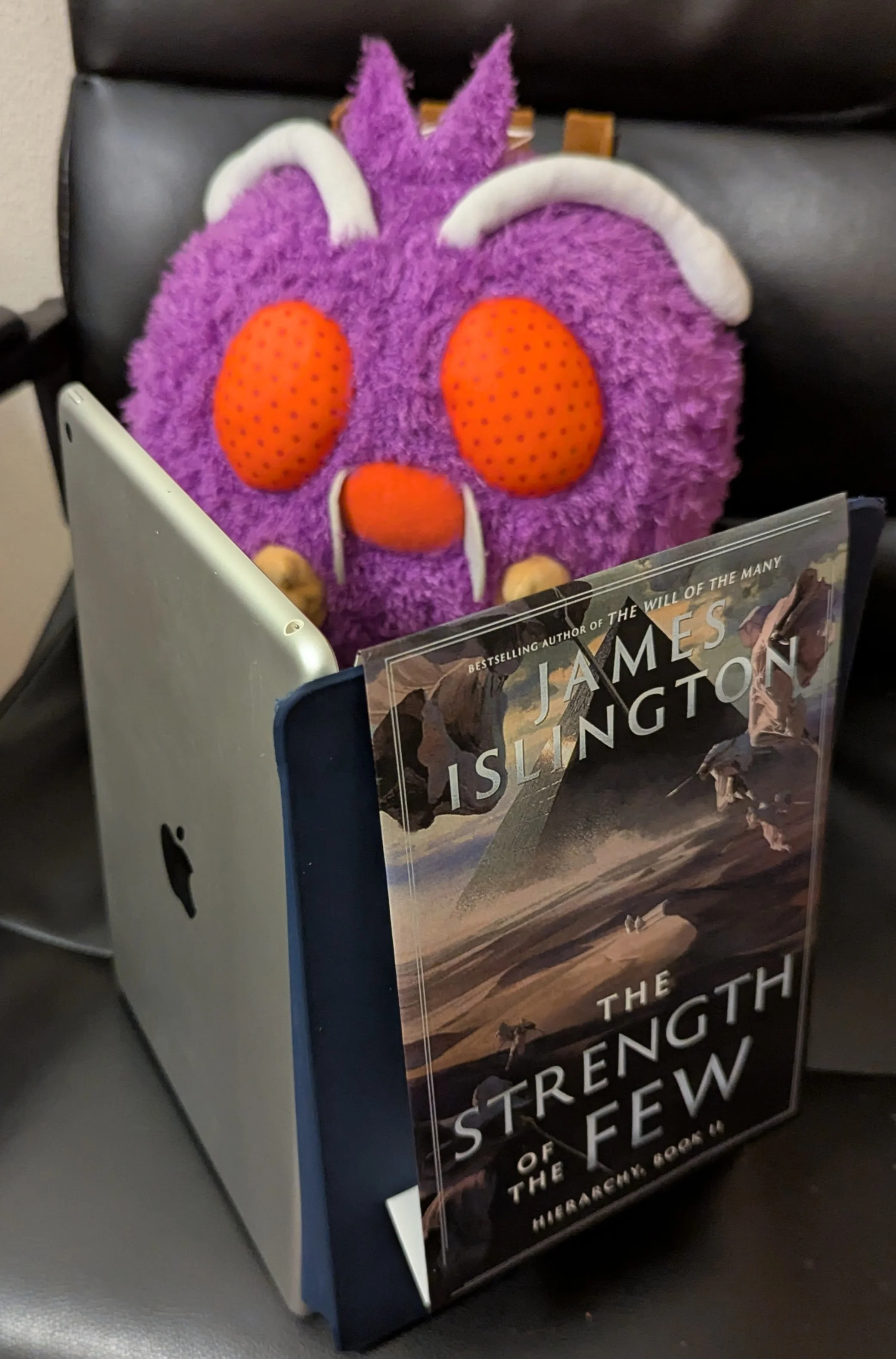
The Strength of the Few (Part 2 - Res)
Hello, all. Welcome to the deep-dive analysis of The Strength of the Few, sequel to The Will of the Many.
This part of the review will focus on the POV set on the world of Res (that is to say, the continuation of the POV see in The Will of the Many). If you’d like my high-level overview of the novel, please see Part 0. The review of the Obiteum POV was covered back in Part 1. If you’re waiting for the review of Luceum, that’s coming on February 20th, followed by a the review of the overarching qualities of the story (theme, prose, and the interaction of the POVs) on March 13th.
Let’s dive right in.
STATS
Title: The Strength of the Few
Series: Hierarchy (Book 2)
Author(s): James Islington
Genre: Fantasy (Epic)
First Printing: November 2025
Publisher: Saga Press (imprint of Simon & Schuster)
Rating: 8.5/10
SPOILER WARNING
Minor, unmarked spoilers for The Strength of the Few will be provided throughout this review. I will keep the first paragraph of each section as spoiler-free as possible. Heavy spoilers will be confined to clearly labeled sections.
Unmarked, heavy spoilers for The Will of the Many will be provided throughout this review. I will also be referencing my review series for that book throughout, though you will not need to have read that previous review to understand this one.
TERMINOLOGY
The titles of this book, its predecessor, and its sequel (the title of which was announced of Islington’s blog in December) will be abbreviated as follows going forward:
The Will of the Many = Many
The Strength of the Few = Few
The Justice of One = One
STORY
In the aftermath of the Anguis attack at the climax of Many, Vis leverages his position as the top Academy graduate of the year to join the Senate. He has given up his dream of fleeing the Catenean Republic in favor of investigating and exposing senators who helped the Anguis execute their attack, thereby getting a measure of revenge for his friend Callidus’s death. However, the Anguis are not done using him for his own ends, and soon Vis finds himself drawn into events that will plunge the Catenean Republic into are bloody civil war.
PLOT
Explaining the Mysteries of the Previous Book
At the end of Many, Veridius tried to explain the truth of what happened to Caeror and what he is really doing in the ancient ruins Vis was trying to investigate. Vis refused to listen to him, seeing him as at least partially responsible for Callidus’s death. Few kicks off with Veridius using Emissa as his messenger to try to get Vis to talk to him. Vis is, understandably, not on board with this, because a timeskip of a few days is not enough to heal the wounds of either Callidus’s death or Emissa’s betrayal.
Across the first half of the book, though, Vis does eventually open up to Emissa, and through her, agrees to meet with Veridius. This leads to him getting answers that bring up on to speed on the same information the Caeror gives to the Obiteum copy of Vis.
Emissa
To recap: in the climax of Many, Emissa demonstrated in front of Vis that she could use Will. While the rules of the Academy did not prohibit students from having the ability to use Will, they did forbid students from having any Will ceded to them while on Academy grounds. This was used for a minor conflict midway through Many, in which Aequa accused Vis of cheating to climb the Academy’s ranks. Emissa than compounded this shock by trying to kill Vis, an act she lamely attempted to justify by claiming it was a mercy killing to spare him from his gangrenous arm.
In the review of Many, I made a big deal about this as one of the major twists of the book. I honestly thought this would drive the narrative forward. Instead, it gets answered fairly early on. In fairness to Islington, the answers to this mystery make perfect sense. They just are anticlimactic.
Emissa was groomed from a young age to become a Synchronous person. Veridius promised her father that he would arrange for her to get into the uppermost ranks of the Academy if she was enrolled in the Academy without going to the Aurora Columnae (something I will explain more below - for now, just know that a person can’t use Will without first completing a ritual at the Columnae). However, her father went behind Veridius’s back and took Emissa to the Columnae anyway as a means to help her cram-study for the Academy. Emissa confessed this to Veridius once she came to the Academy and he explained the full situation with the three worlds and Ka to her. Veridius couldn’t do anyting to reverse this, so he instead took Emissa on an ally to help him arrange for someone else to become Synchronous.
That’s why Emissa could use Will - she’d already been to the Columnae, and Veridius was overlooking the fact she has access to ceded Will. As for why she tried to kill Vis, she mistook him for an iunctus. She thought he was already Ka’s puppet and that it was too late to save him.
It makes sense. This version of Vis doesn’t yet know the relevant exposition, but through his Obiteum copy, the audience does know it. It just felt like a bit of a letdown. I wouldn’t go so far as to say it’s a boring answer, but it does read like Islington originally intended there to be more to Emissa’s betrayal and then backtracked because he changed his mind.
Veridius
Midway through the story, Vis goes back to the Academy to speak to Veridius. At this point, Veridius catches him up on much of the exposition that Caeror gave to the Obitum copy, with just a few added details:
He, Caeror, and Lanistia learned about the three worlds, the Concurrence, and Ka while studying the ancient ruins on the Academy’s island and decided to seize the initiative, creating their own Synchronous person by sending Caeror through the Gate to kill Ka and prevent another Cataclysm.
Lanistia was blinded while disabling a security device that would have killed Caeror’s Res copy. Unfortunately, she failed, and the Res copy died anyway.
Veridius trusted Caeror’s other copies to train any future Synchronous people he created, and thus took over the Academy so that he could keep sending students to the Gate. This is why he wanted Emissa to not use the Columnae - a person who had used the Columnae can’t use the Gate.
Unlike the Emissa reveal, this doens’t feel like a letdown. It’s a natural opening to provide this Vis with exposition and get caught up with his Obiteum copy. My issue is instead that this revelation doesn’t influence Vis’s behavior. He now knows he needs to stay alive to preserve the Synchronous state and give his other copies the chance to kill Ka, but he goes about business as useful. This isn’t his fault (it’s the Anguis’s fault), but it does feel like Islington was skimmed past the opportunity to engage in some meaningful character conflict as Vis had to weight the value of his Synchronous state against the chaos unfolding around him.
PACING AND CUT CONTENT (?)
Whereas the Obiteum POV has a slow middle that made it feel like a lot of content had been cut, this POV has so much happening that it feels like it could have sustained any entire novel the size of Many all on its own. There is so much that we aren’t shown. This creates a series of problems that range from minor annoyances to concerning (but not story-breaking) plot holes.
Politics
At first, it seems like this POV will engage in the same political games that were seen in Many. Vis returns to the Hierachy’s capital city of Caten to immerse himself in the politics of the city. The first handful of chapters cover Vis adapting to this new environment, receiving Will and being tested in his ability to utilize it, and dealing with attempts to undermine his future career, particularly from Amercus Decimus (father of Iro, a student who was a minor antagonist in the last book). He also has to deal with the new demands placed on him by the Anguis to leverage his new position towards their own ends.
This element rapidly fades from the story as the plot progresses. Consequences of these early chapters do play out (more on that shortly), and the Anguis continue to drive the narrative. It’s just the focus pulls back from Vis playing politics and entering what I can only describe as his Batman arc (more on that in Part 4).
What’s frustrating, though, is that the politics are still happening in the background. We get references to them. We just don’t get to see any of it.
The Aurora Columnae
To explain this plot hole, I need to backtrack to some worldbuilding that I skipped over in the review of Many.
The manipulation of Will is not an inherent ability of humans in this setting. Instead, a person must first undergo a ritual at one of the many ancient relics known as Aurora Columnae. Once this ritual is complete, any person can cede exactly one-half of his or her total will to another person (or return that Will) by touching the recipient and verbally consenting to the act.
This was mainly brought up to showcase Vis’s refusal to participate in the Hierarchy’s exploitative system. While citizen of the Hierarchy are not explicitly forced to undergo the ritual at the Columnae, a combination of oppressive laws and extortive practices make life unbearable for any adult who hasn’t ceded. Vis was whipped several times by the matron of the orphanage where he lives because he would not cede his Will (which she would then have sold off to enrich herself).
In this book, Vis has to undergo the ritual. Unlike with his Obiteum self, there is no ignoring the fact that he is betraying his own values by doing this. Vis will not only be partaking of the system, but actively benefitting from it (since his rank in the Academy means he will be leapfrogging all the way to the rank of Sextii). This means he is receiving Will from a pyramid of 63 people - which, counting his own Will and assuming he then cedes to another person, will give him the combined power of 32.5 people.
What this iteration of Vis does not realize is that the Gate also imparts the effects of using the Columnae. This means that, when he does the ritual, nothing happens. This is a problem because, with how things it written, Vis is not the only one to register that the Columnae didn’t do the thing it was supposed to do. It is framed as if everyone witnessing this rite could also tell that Columnae didn’t do the thing.
Immediately after this, Lanistia goes full Order 66 and tries to kill Vis. (This is later explained as a programming implanted into her during the events the blinded her.) And, yes, this would obviously distract people, but why was Vis not brought back to the Columnae to try again? Did everyone just forget that the Columnae didn’t do the thing just because Lanistia started babbling the in-world equivalent of, “Good soldiers follow orders”?
Look, it’s not a huge plot hole in the grand scheme of things. It’s just a glaring one compared to the general quality of this series.
Islington went out of his way to establish that the Columnae did not do the thing it was supposed to. There was a moment of rising tension as people reacted to this strange fact. In fact, it’s what triggered Lanista - swhile we’ll later see a Columnae on Luceum try to kill Vis, it really seems like Lanista doesn’t act until she has time to register that something is wrong, so it doesn’t seem like the Columnae in this instant is what activated her.
Islington has also gone out of his way to set up that the Hierarchy is actively on the lookout for Synchronous people and iunctii, with them interrogating and testing Vis once in Many and again after the incident at the Columnae. While he does explain how Vis gets through the tests, we don’t get anything to explain why Vis wasn’t taken back to the Aurora Columnae to try again (at which point they should surely have registered that the first time was not a fluke). These people are not as incompetent as the leadership of Navarre. They should have caught him.
Maybe there was a proper explanation for this in a chapter that was cut. If so, wonderful. That doesn’t help the fact that it makes no sense in the story that was printed. At best, it means that Islington failed to do adequate continuity edits to compensate for cut content.
The Anguis, Carnifex, and the Civil War (Heavy Spoilers)
The Anguis only call upon Vis once in this book, but it’s in a way that has massive repercussions.
Vis is tasked with working alongside a man named Ostius. We previous saw Ostius in Many - he with the individual who seemed to teleport or turn invisible (though the truth is a lot more wild than that, as we’ll see in Worldbuilding). Ostius promises Vis that, if Vis helps him disrupt a special session of the Senate’s Military faction, he will get Vis a list of every co-conspirator behind the Anguis attack in Many. It’s implied that the reason he wants Vis is because, as a Synchronous person, Vis can use a Will technique known as Adoption (also more on that in Worldbuilding).
As it turns out, Ostius’s mission was to kill these Senators. He wanted Vis to be the murder weapon. That isn’t quite how things turn out, but the end result is still what Ostius wanted: the senators are all dead, Vis is left to flee the scene, and the witnesses who see him (but fail to identify him) spread word of a mysterious assassin called Carnifex.
The assassination of the leaders of Military triggers civil war across the Hierarchy, as contenders for Military leadership vie for control. In the chaos, Vis does his best to protect those closest to him. However, events spiral, leading into the big twist that ends the Res POV.
This portion is where the cut content really becomes obvious. Events are flying by pretty quickly up until the whole Carnifex incident, but afterward, they blast past at disorienting speed. Those of you who read my Jade City review will recall how I said it felt like the third act was missing a big chunk - imagine that happening three times, repeating every time the POV shifts back to Res. Characters and events are introduced and resolved too fast to have any weight. Enough content to fill an entire book flies past in maybe five chapters.
(Also, not to nitpick, but there’s exposition relevant to one instance of the Res POV that doesn’t get delivered until the next POV shift, making the chapters feel out of order despite the fact that they are indeed correctly placed.)
The Enemy of My Enemy (Heavy Spoilers)
I’ve spent a long time complaining about the issues with this POV’s plot, but most of it is an issue of contrast. The plot does hold up. It’s still a compelling story. It just falls short of Many, and that makes minor issues feel far more significant. For most of the POV, the biggest issue is that we are skipping so much content that it affects emotional investment. Things make sense but lack weight.
The finale twist of the POV is where logic is pushed to its absolute breaking point.
Joining the Dark Side
At the start of the climax, Amercus Decimus comes after Vis, seeking vengeance for Iro’s death (the result of Iro suffering horrific injuries during one of the events to sabotage Vis’s career prospects). Using his far superior quantity of Will, he brutalizes Vis and murders Aequa. He then effectively tells Vis, “You can’t do anything to get back at me, I outrank you.”
The death of Aequa makes sense on a consequence of previous events. However, it rings a bit hollow emotionally. We haven’t gotten all that time with Aequa in this story (more on that shortly) and even less with Amercus Decimus. This doesn’t feel like Vis’s nemesis has delivered an emotionally scarring act of vengeance. It feels more like Vis has had credit stolen from him by an unscrupulous boss.
That’s when Vis decides, “Screw it, I’m going to join Ka.”
To be clear: Vis knows that Ka wants to trigger another Cataclysm. He has enough information to conclude that Ka is the true power behind the Hierarchy. His entire thought process is, “Well, if we get Ka on-side, he’ll let me get revenge on all these corrupt politicians who are fighting over and abusing power. The Cataclysm is just something I’ll have to deal with later.”
It’s not impossible to justify this. Vis demonstrated his willingness to pivot on a dime in the name of vengeance when he gave up on fleeing the Hierarchy to avenge Callidus. The problem is that Vis’s close bond with Callidus - for that matter, with Aequa, too - was earned over an entire book. This is so rushed that it strains credulity. We needed more information. We needed to see Vis’s mindset evolve over time, until it actually becomes credible that he’d see the man planning to kill 9 out of 10 people as the lesser of two evils.
The True Darkness
Vis has no idea where Ka is, so he used Will to create a signal that he hopes a Synchronous person will recognize. Sure enough, Ka tracks him down. An iunctus comes to Vis and delivers a message.
Very fortunately for Vis, his Obiteum copy has just killed the Obiteum copy of Ka (see the section of Part 1 regarding the climax of that POV). The main antagonist of this novel has been neutralized as a threat. Ka’s message is effectively a surrender.
Then the series takes the second massive swerve in two books.
Ka is not, in fact, the Concurrence. Oh, he is the man responsible for the Cataclysms, but this is his means of fighting back against the Concurrence. The true Concurrence, while not clearly explained, is implied to be a Nomarch of terrible power. Ka culled the human population by 90% every few centuries as a means to hinder the Concurrence. Now that Ka is no longer Synchronous, there is no longer anyone to stop the Concurrence.
So he just … persuades Vis to take over his job.
This development is quite a lot to swallow. I don’t think it’s necessarily an issue with the reveal itself. Rather, I think the problem is a knock-on effect of Vis’s defection not making sense. If we had enough information to properly contextualize Vis working for the guy who wants to kill everyone, revealing that killing everyone was meant to stop a greater evil and that Vis needs to take over that job would be a much easier to digest.
Oh, and I should probably mention this … as part of accepting this job, Vis is guided by Ka to a vault filled with iunctii. These are effectively political prisoners, kept in storage so that the Hierarchy can extract secrets from them at need. Ka explains to Vis how he can take control of a few inunctii and direct them to awaken their brethren, creating a vast pyramid of Will cessation with Vis at the peak (thus fulfilling the scenario of godlike power we have previous covered). The true shock, though, is that Vis’s mother and older sister, as well as Callidus, are all among the iunctii. Vis’s reunion with these characters is presented as him making peace with his decision to side with Ka (as Ka has effectively restored that most precious things that Vis lost). It’s an ending that does make sense. I just wish we didn’t get this wild serve from Vis to make it possible.
Final Thoughts on the Plot
I don’t think that the Res POV should have been one of three. It really needed to be its own thing for everything to develop naturally. There’s a genuinely interesting story in here, and outside of the Columnae plot hole, I don’t see any elements on the page that don’t work. The issue is that there’s so much off the page that it feels like a hatchet job of a great story, rather than living up to its full potential.
CHARACTER
Vis
This iteration of Vis carries on from the climax of Many. I think his story is well-written overall. Time is spent to confront him betraying his values by integrating into the Hierarchy government in general and into the system of ceding and accepting Will more specifically. While I do have a lot of frustration towards the ending twists, they aren’t a complete betrayal of his character (and, frankly, the information he discovers on the final pages makes perfect sense as something that would let him make peace with his decision). I just wish there was more information to make it feel like a natural transition for him.
Other Characters
Because so much time is given to alternative POVs, the secondary and tertiary characters get next to no development, with their stories becoming secondary to the needs of the wider plot. Islington either relies on the audience knowing who these people are and what they mean to Vis from Many or else introduces new characters who piggyback off of established dynamics (Amercus Decimus continues Iro’s antagonism from Many, Callidus’s father and sister are linked to him, Eidhin’s father was described by Eidhin as part of sharing his backstory with Vis, etc.). I don’t think this is necessarily a problem, especially for a plot-driven narrative. It’s just that it’s hard to emotionally connect with even the returning characters due to the lack of time spent with them.
WORLDBUILDING
Aurora Columnae
Most of what I have to say about these relics was already covered in Plot. The one note I will add is that Islington is implying a potential connection between them and either the Cataclysm or the Concurrence. it is mentioned at a couple points that the glow that the Columnae gives off has been growing brighter in recent years. Given that the Obiteum plotline mentioned the latest Cataclysm is a few years overdue, it’s a bit hard not to think there is a connection.
Will
Mechanics
Now that Vis has access to Will as a tool to solve problems, it is important that the audience understand how utilizes it actually works. This begins with a practical bit of Showing: when Vis accepts Will from the Septii who have volunteered to cede to him, he feels himself grow stronger and more alert. Islington then gives us a scene of Vis undergoing a Will aptitude test, while allows him to explain and demonstrate the various mechanics for using Will for physical enhancements or telekinesis. We also get confirmation that, much like with a one person ceding Will to another and then dying, Will imbued into an object vanishes if the person who imbued it dies.
Adoption
Thanks to Ostius, Vis is introduced to the technique of Adoption. This is actually a technique from Obiteum (Caerror introduces it to Vis as an explanation for how iunctii can continue to function without the constant input of the people whose Will raised them.) Basically, it is possible to steal Will that is imbued into an object, regardless of whose Will it is. Vis can absorb this imbued Will into his body to apply as he chooses. This doesn’t completely wrestle this Will away from the person who imbued it - in fact, if the person who imbued the object dies, Vis loses that Will - but it does mean that Vis can empower himself and deny power to others by ripping the Will out of objects his opponents have imbued.
The Prosthetic Arm
Those of you who read about the Carnifex development may be wondering how no one caught Vis. This is one of the copies who only has one arm. This is explicitly acknowledged in the narrative that makes him stand out. He even has fans who start wearing their tunics with the left sleeve hanging empty to show their solidarity with him.
Well … Vis makes a new arm.
Early in the book, Vis enlists Eidhin’s help in getting access to a forge, where he fashions a “hundred iron triangles” that are each imbued with a little of his Will during the forging process. He can use his Will to telekinetically manipulate them into various shapes. Usually, he wears them beneath his shirt as body armor, but while on his mission for Ostius, he fashions them into the outline of a prosthetic arm, using the leftover triangles to make a mask. I can’t recall him actually using this arm to fight or do any complex tasks, but while covered by a sleeve, it is convincing enough for people to mistake it for a natural arm.
This arm is one of things we’ll need to talk about in Part 4, when I break down the power fantasy. For now, I’ll just say that this arm does make mechanical sense within the rules for using Will. Vis had neither the knowledge nor the tools to make something with a lot of mechanical parts, but a telekinetically controlled shell that takes the shape of an arm (or whatever else he can assemble from the triangles) fits within the world.
Planeswalker
As it turns out, Ostius does not have the ability to turn in invisible. His power is, technically, plane shifting. Ostius possesses the ability to move himself between Res and Luceum at will, bringing others with him (at least two living creatures or one iunctus). He has to arrive at the analogous point on Luceum from which he departed Res (and vice versa). This still grants him incredible ability as an infiltrator. For example, he can break into a secure building on Res by simply shifting to Luceum, walking to a point that aligns with the inside of the building, and shifting back to Res.
How does this work? Why does this work? Outside of hints that it has some connection to mutalis (there’s a “thrum” when he uses the power, the same sensation associated with both objects protected by mutalis and the arena attack in Many), we are giving nothing to explain this power. It is explicitly acknowledged as something out of the ordinary.
Also, one detail that this ability does not explain is Ostius explaining Adoption to Vis. As far as is established in this book, Ostius cannot go to Obiteum. How did he ever learn about Adoption, then? Maybe he was Synchronous at some point in the past, learned the technique, and then lost his Synchronous state, but that still leaves the question of why he can only teleport to two worlds and not all three.
Warfare
I love how Islington thought through the implications of civil war within the Catenean Republic.
This is a world where armies are filled with supersoldiers, fueled by the willpower of dozens or hundreds (even thousands, for the highest-ranked officers) of people to grant themselves incredible strength, durability, endurance, and focus. That sounds epic, but really think about it. What would be the most effective way to fight this army?
If you said “the mass murder of civilians and prisoners who are ceding will to enemy soldiers”, congratulations! You get a gold start.
Some of this killing is state sanctioned. Thousands of people who made the mistake of being in the pyramid of an enemy combatant are imprisoned in Sappers, funneling every drop of available Will to whichever team controls the prison … until a pivotal moment during a battle, when they are to executed en masse to disorient and weakening the enemy army army. Proscription lists are issued to the general public, placing a bounty on any Octavii not important enough to imprison, thereby encouraging absolute anarchy as mobs murder the people on the list in hopes of claiming their material wealth. We’re shown what Caten looks like in the lead-up to the battle, and it sounds like its in a constant state of being ransacked by a barbarian horde.
This is incredibly dark. It’s not given much focus, relegated to discussions between characters and fights that are referenced but not shown. It’s also something that shows just how deeply Islington understands his own setting. Sure, the fact he has Transvects doing aerial bombing raids with Will-powered artillery shells and air-dropping soldiers into Caten is cool, but the fact that he considered these underhanded tactics and the consequences of unleashing them really makes this setting feel alive.
INTO THE WILD
Overall, the Res POV’s greatest enemy is length. Whether or not it is truly the case that Islington wrote more for this plot line had then cut it, there simply aren’t enough pages given to properly tell the story he wants to tell. There are compelling elements that needed more time. Without that time, they ended up feeling hollow and rushed.
This is a problem that continues into the Luceum POV. There, however, it’s not an issue of plot. It’s one of character. We’ll explore this more on February 27th.
Thank you all for joining me today. Please remember to subscribe and share if you enjoyed what you read here. Take care, everyone, and have a good weekend.

Volume I of my first serialized Romantasy novel, A Chime for These Hallowed Bones, is now premiering over in Tales of the Five Worlds!
Kabarāhira is a city of necromancers, and among these necromancers, none are more honorable or respected than Master Japjot Baig. Yadleen has worked under him since she was a girl, learning how commune with bhūtas and how to bind these ancient spirits into wights. Her orderly world is disrupted, however, when a stranger appears with the skeleton of a dishonored woman, demanding that her master fabricate a wight for him.
To protect her master from scandal, Yadleen must take it upon herself to meet this stranger’s demands. Manipulating the dead is within her power, but can honor survive in the face of a man who has none?
Chapter 3, Parts 1 and 2, is now available! I hope you’ll join me on this new adventure.