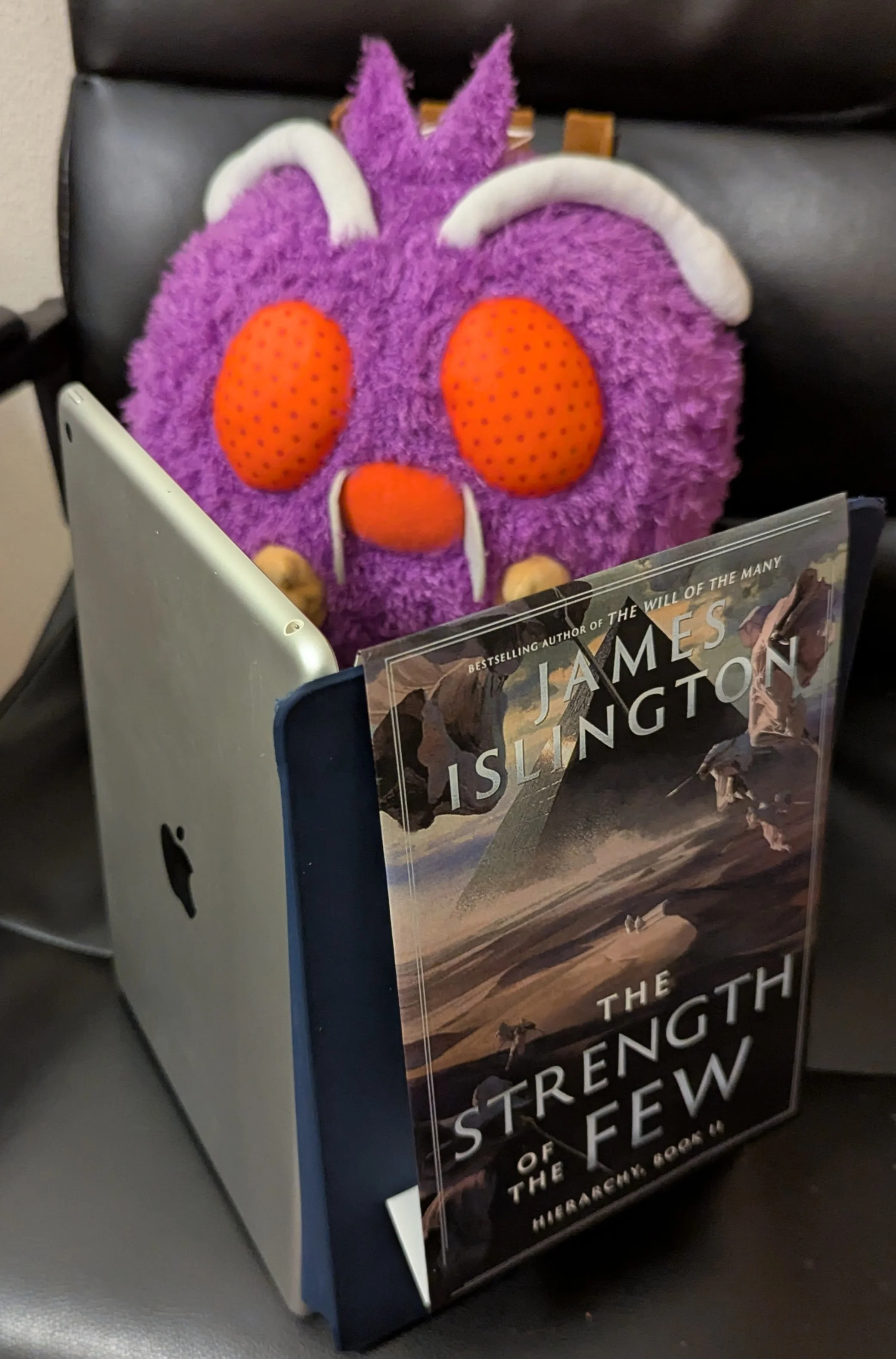
The Strength of the Few (Part 3 - Luceum)
Hello, all. Welcome to the deep-dive analysis of The Strength of the Few, sequel to The Will of the Many.
This part of the review will analyze the final POV of the story, the one set on the world of Luceum (the one in which Vis had his left arm torn off in epilogue of The Will of the Many). Please see the previous parts if you’d like to read any of the following:
The review of the overarching qualities of the story like theme, prose, and the interaction of the POVs is coming on March 13th.
Let’s dive right in.
STATS
Title: The Strength of the Few
Series: Hierarchy (Book 2)
Author(s): James Islington
Genre: Fantasy (Epic)
First Printing: November 2025
Publisher: Saga Press (imprint of Simon & Schuster)
Rating: 8.5/10
SPOILER WARNING
Minor, unmarked spoilers for The Strength of the Few will be provided throughout this review. I will keep the first paragraph of each section as spoiler-free as possible. Heavy spoilers will be confined to clearly labeled sections.
Unmarked, heavy spoilers for The Will of the Many will be provided throughout this review. I will also be referencing my review series for that book throughout, though you will not need to have read that previous review to understand this one.
TERMINOLOGY
The titles of this book, its predecessor, and its sequel (the title of which was announced of Islington’s blog in December) will be abbreviated as follows going forward:
The Will of the Many = Many
The Strength of the Few = Few
The Justice of One = One
STORY
The Luceum copy of Vis finds himself on a world inhabited by vaguely Celtic tribes, where Will use is the province of druids. Without a mentor or even an understanding of the language - and, in fact, not even realizing that he is on a different world - he is forced to find his own path. This leads to him being ensnared in the political machinations of druids and kings and forces him to come into his own as a warrior.
PLOT
Slow Burn
It’s hard to go into great detail about the plot of this POV because, in all honesty, the plot of this specific POV isn’t all that important. Most of the tension that hangs over this POV is actually a function of the Obiteum POV - that is to say, the only significant stakes here are that this Vis will be killed, thereby stripping his other copies of Synchronous status, thereby keeping the Vis on Obiteum from killing Ka. Vis isn’t even aware of these stakes until about two-thirds of the way into this POV.
That’s not to say there isn’t a story here. A lot is going on:
Vis evades detection by forces who would kill him for being Synchronous (not that he understands that this is their motivation)
He proves himself to one of the local kings and being sent to train with the king’s warriors (a fact lampshaded by Vis himself as “another gods-damned school”)
He eventually is identified as a potential candidate to join the druids and is taken to be tested.being identified as a potential candidate to join the druids.
It’s just that it isn’t clear how any of this is important to the wider Cataclysm narrative, so these details feel less important than anything going on in the other two POVs.
The Unexpected Mentor (Heavy Spoilers)
At a couple points in the narrative, Vis senses a mysterious presence, leading him to investigate a potential threat. The second time this happens, Vis spots a mysterious druid (or, at least, a man wearing a druid’s robe). The third time, the druid lets Vis get close enough for them to speak.
It’s his father.
No, his father is not alive. This isn’t a retcon of the previous book, which stated that Vis’s entire family was dead. Instead, his father is an iunctus sustained by a Vitaerium (much like Ahmose). The Hierarchy originally preserved him so that they could interrogate him with an Instruction Blade. He was rescued by Ostius, originally to help the Anguis get leverage against Vis, but later to keep Vis’s Luceum copy alive.
Vis’s father quickly brings up to speed on everything the other two copies of Vis know, as well as explaining that the reason the Hierarchy conquered their kingdom was that he had learned about the Cataclysms and discovered a mutalis weapon that could be used against Caten (the weapon that would be used in the Anguis arena attack in Many).
Aside from being the mouthpiece of vital exposition, Vis’s father makes a heroic sacrifice near the end of the book. When Vis is fatally stabbed and thrown into a lake, his father dives into the lake and gives Vis his Vitaerium, stabilizing Vis before death at the cost of his own undead existence.
The Synchronous Problem (Heavy Spoilers)
During the Spotlight Analysis of the magic system, I pointed out to potential issues of Vis’s knowledge of Will techniques transferring between copies. This plotline is where those issues comes into play.
After being identified as a potential candidate for the druids, Vis has to undergo a trial that ends in him touching an Aurora Columnae. The Columnae flags him as Synchornous and unleashes a pair of Will-imbued statues on him. Vis is only able to survive this through instinctive knowledge of both Adoption and the techniques needed to control an existing iunctii. By combining these , he seizes control of one of the statues, uses it to destroy the other, then carry him to safety. This is also where he acquires a silver arm, which his enthralled statue tears off its companion for him to present as proof of his success.
Latter, before Vis is “killed” and thrown into the lake, the silver arm is bound to the stump of Vis’s amputated arm as a final insult. This is what drags his body underwater after he is mortally wounded. When his father makes the sacrifice play to save him, Vis is overwhelmed with grief … and then, to his shock, discovers that the silver arm is now under his control. He has instinctively accessed the same techniques that the Res copy learned to make his own prosthetic, only this arm is indisputably functional (as he is able to use it in combat when he escapes the lake).
To summarize what I said in the spotlight, this comes dangerously close to being unearned power. The moment only works because the strangeness is acknowledged and because it is technically a payoff for the other copies of Vis, saving the life of their Luceum copy through their efforts.
Caeror (Heavy Spoilers)
Thus far, we’ve only established what happened to Caeror on Res (dead) and Obiteum (alive at the start of the story, fate unknown once Vis goes to Duat). The Luceum copy hasn’t been touched upon, because for most of the book, his fate is unknown.
The answers finally come in the falling action of the Luceum POV. Throughout the book, Vis has heard about a leader among the druids who is trying to have him killed, in addition to breaking druidic traditions by allying with one of the kings of this setting. This antagonistic druid surrenders after Vis seemingly rises from the dead and emerges from the lake. As it so happens, this is the Luceum copy of Caeror. He has come forth to try to warn Vis that one of his other copies has “made a terrible mistake”. (Because it’s not 100% clear how the timelines of the POVs line up, it’s vague as to whether he means the Obiteum copy, who had just killed Ka, or the Res copy, who had just decided to join forces with Ka and would become Ka’s replacement in the next POV chapter.) Vis promises to hear Caeror out eventually, but not right away, much like the Res refused to hear Veridius out at the end of Many (and he even uses the same phrasing).
This reveal ends an air of uncertainty to the ending of the Res POV. Has that Vis unleashed a greater evil onto the three worlds? Or is the copy on Res about to become the new evil? It’s a mystery that I can only hope will be explored in One.
CHARACTER
Vis (Heavy Spoilers)
Adrift in this strange world, Vis finds what he spent all of Many seeking: peace and safety.
Those of you who read Many (or my review) will recall that Vis’s personal motivation was always to escape the Hierarchy. He wanted to both be free of further threats on his life and to avoid the entire system of ceding Will. On Luceum, with no mentor to inform him of the greater conflict, thinking that he is lost in some distant corner of his own world, Vis is handed the very thing he desires. Yes, there are people trying to kill him, but after faking his death, he is able to find safety on a farm. Even later, when he gets pulled into the politics of the world and is sent to train a warrior, he finds comradery with his fellow trainees that he never truly felt at the Academy.
Perhaps the most important detail about this, though is that Vis reveals the truth about his identity to these new companions. He had been using his true name, Diago, since arriving on this world (seeing no point in maintaining the “Vis” charade when there was no hint of the Hierarchy anywhere). However, he also tells these companions about his backstory as Prince of Sus, as well as everything he survived in Many. Their acceptance fully establishes his sense of peace.
Meeting with his father gives Vis a sense of closure from the invasion. Losing his father for a second time - with the knowledge that this death with stick, based on what his father told him - also re-severs his bonds to his homeland. At the end of the story, Vis effectively declares himself a citizen of Luceum, in terms that make it clear he sees this place as his home and not merely a place that he as a copy is trapped within.
This character journey is ultimately what makes the Luceum subplot so satisfying. Obiteum Vis doesn’t change throughout his subplot, and Res Vis is taking a dark turn, but Luceum Vis has gotten his happy ending, even if he had to endure additional suffering to attain it. We are both seeing the fulfilment of the originally established character arc and seeing his transformation into the most distinct of the three.
The Supporting Cast
… at least, I should be able to say that.
The problem with the character arc I just described is that it leans on the connections Vis forges with characters on Luceum. This is fine for his time on the farm, as the plot slows down and takes time to explore his dynamic with the family who shelters him. The same can be said of his interactions with his mentor figure (I will remain spoiler-free here) - it’s built on a dynamic that was built up over two books. The problem comes at the middle, with his dynamic with his fellow warrior trainees.
Vis’s companions are not developed. Outside of Tara, who is the leader of the group and being set up as a potential love interest for Vis in One, their traits and backstories are interchangeable. We don’t get to see most of his time with them. As a result, the idea that he has this immensely cathartic moment of revealing his true self to them, something he never could do on Res (and something the Res copy still doesn’t do, at least within the limits of this book), doesn’t have any emotional weight. This doesn’t feel earned.
This lack of time also undermines his dynamic with the other characters. Yes, he finds peace with those farmers, but once he leave the farm, he doesn’t see them again until the very end of the book. The relationship with his mentor is likewise brief. Maybe Islington intended these relationships to be like stepping stones for Vis’s growth, but in practice, he’s losing connections as fast he makes makes them.
The Hatchet Job
Out of the three POVs, the Luceum is the one where my theory that Islington cut content is the least obvious. The plot runs just fine, even if it is slow and disconnected from the rest of the narrative at the start. It’s the character work where the potential damage of cut chapters becomes visible, and even then, only be implication.
Vis’s close companions, who facilitate a pivotal stage in his character journey, are accessories. This is so far below what we know Islington is capable of. I praised Islington for avoiding this sort of problem in Many. So the only way I can make sense of him suddenly writing secondary characters with less depth than he previously showed us for tertiary characters is to compare it to the other two POVs. And since both of those stories feel like chunks are missing, I’m assuming that this is also the case in the Luceum POV.
The point in the narrative when Vis would have needed to have these scenes with his companions comes in the middle, when the pace of both this POV and the book as a whole is slow. It’s also around when the Obiteum plot slows to a crawl. It wouldn’t shock me if Islington felt like this was where he had to make cuts to help the book’s overall pacing. He certainly did tighten things up to a brisk pace. I’m just not certain if the tradeoff was worth it, or at the very least, if he couldn’t have saved at least one or two additional chapters for this POV to make the character dynamics more meaningful.
WORLDBUILDING
Luceum
Much like the general Egyptian aesthetic of Obiteum, the vibe of Luceum is vaguely Celtic. The world is mostly given over to wilderness, inhabited by small clans. A settlement of 800 people is considered a huge city. A small number of kings each control their own lands and vie for the rank of High King. There’s a significant emphasis on honor that spills into the ethos of the warriors.
The use of Will is very limited in this world. There’s no technology fueled by Will. Instead, Will use is limited to the druids (spiritual teachers, organized into an group known as the Grove) and groups of warriors with innate talent of the nasceann.
An interesting detail that is mentioned in passing but not explained until the very end if the emphasis on physical perfection for the rulers. The character of Tara was the daughter of the king Vis pledges his loyalty to, but she lost her right to the throne when he face was scarred. This ties back into an ancient tradition that is designed to prevent Synchronous people from taking control of any of the clans. The Gate on Luceum is protected only by a locked door that won’t open unless the person inside the gate accepts a form of physical disfigurement - this is why Vis’s left arm was torn off when he tried to leave the Gate in the epilogue of the last book. The disfigurement ensures that any copy coming out of the Gate will, at the very least, be marked as unworthy to rule.
Will
As stated above, Will is not limited purely to the druids. Many warriors can also use it. The specifics are vague, but there’s an Aurora Columnae in a place called Fornax, and the druids take potential warriors there to be tested, so it’s implied that this is at least what unlocks the Will powers.
As for what Will does … it really is not clear. Based upon phenomena we see that are not explained by Vis accessing the Will powers of either Rest or Obiteum, I think it involves the transmission of information (or, for a more fantastical flavor, communion with spirits and animals).
At various points since using the Gate, all of the Vis copies have had moments where they could sense Will around them, particularly Will imbued into objects. The Luceum copy of Vis is able to use this to identify weapons made for warriors with the nasceann, and Tara claims this is a trait that also serves as a mark for the nasceann.
It would explain why the druids (and the Res copy of Vis) can command alupi.
The existence of the Nomarchs on Obiteum isn’t fully explained by Ka sitting at the top of a pyramid of ceding iunctii he raised. The iunctii in the Nomarch networks communicate directly with each other without disturbing Ka. If he has access to a Will technique that transmit information, that would explain this.
One of the druids Vis works with goes into some sort of trance to search for threats in their area.
Early in the Luceum plot, Vis seems to channel the spirit of a dead nasceann warrior, who both empowers him in a duel and speaks through his mouth.
In the climax of the Luceum POV, Vis is contacted by the spirit of the druid who died during the book, who in turn implies that there’s some sort of afterlife realm that contains the spirits of druids.
The Luceum copy of Vis is being set up to train as a druid in One, so I’m expecting all of this to be explained in greater detail then.
SYNCHRONIZED
If I were the rate the Luceum POV in isolation - for that matter, the Luceum or Res POVs, too - I would don’t think I’d give any of them higher than a 7, or maybe a 7.5 at a stretch. They’re good stories. They just aren’t great ones on their own. Each has some fundamental flaw that holds them back.
Together, these stories synergize into something far greater than any one of them. Islington takes three narratives with very little crossover and elements that need to be repeated for the story to work and weaves them together in a manner that feels cohesive. There are still some problems to be discussed, to be sure, but the whole is still quite solid. On March 13th, we’ll discuss why this is the case.
Thank you all for joining me today. Please remember to subscribe and share if you enjoy what you read here. Take care, everyone and have a good weekend.

Volume I of my first serialized Romantasy novel, A Chime for These Hallowed Bones, is now premiering over in Tales of the Five Worlds!
Kabarāhira is a city of necromancers, and among these necromancers, none are more honorable or respected than Master Japjot Baig. Yadleen has worked under him since she was a girl, learning how commune with bhūtas and how to bind these ancient spirits into wights. Her orderly world is disrupted, however, when a stranger appears with the skeleton of a dishonored woman, demanding that her master fabricate a wight for him.
To protect her master from scandal, Yadleen must take it upon herself to meet this stranger’s demands. Manipulating the dead is within her power, but can honor survive in the face of a man who has none?
Chapter 6 (Parts 1 and 2) is now available! I hope you’ll join me on this new adventure.