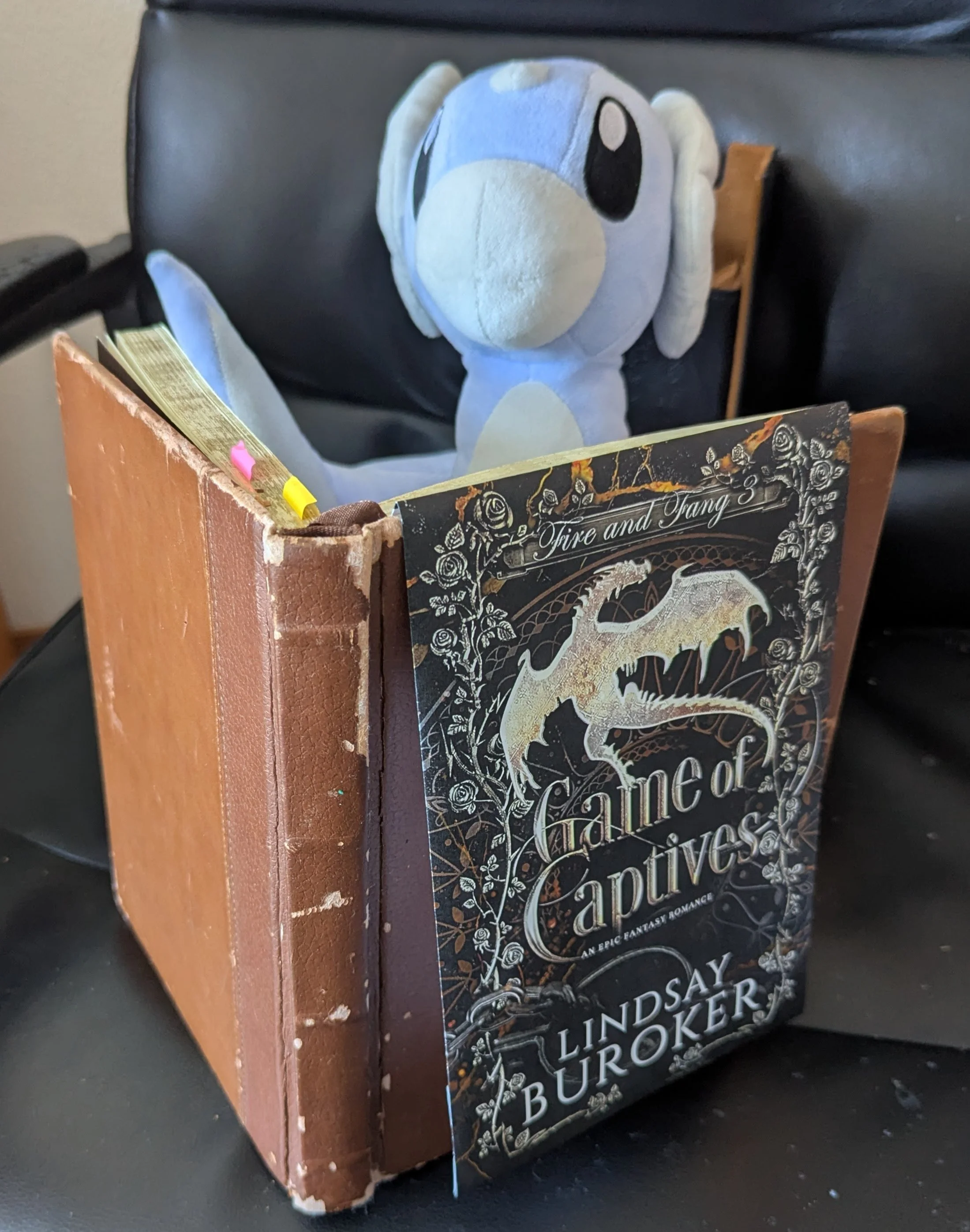
Game of Captives (Part 4 - Worldbuilding & Romance)
Hello, all. I hope your week is going well. Thank you for joining me as we continue our exploration of the third Fire and Fang book, Game of Captives.
This part of the review is just going to discuss the worldbuilding and how well the romance within the story works. If you’d like just an overview or analyses of the plot or main characters, please see the previous parts.
If you’re all caught up (or don’t care about that), let’s fly.
STATS
Title: Game of Captives
Series: Fire and Fang (Book 3)
Author(s): Lindsay Buroker
Genre: Fantasy (Romantasy)
First Printing: February 2026
Publisher: Self-published to Amazon
Rating: 5/10
SPOILER WARNING
Mild spoilers for Game of Captives will be included throughout this review, through I will keep the first paragraph of each section as spoiler-free as possible. Heavy spoilers will be confined to clearly labelled sections.
Heavy, unmarked spoilers for the previous two books in the series, Sky Shielder and Red Dragon, will be provided throughout this review. I’m also going to assume that you’ve already read the reviews for those books, though it isn’t necessary to do so to understand this review.
WORLDBIULDING
Not Breaking the Wheel
Buroker continues to operate with the lore she established all the way back in the first book, with only minor additions that don’t fundamentally reshape the lore.
The Weapons Platform
This was technically introduced in the climax of Red Dragon, but it plays a far larger narrative role here.
The weapons platform, as it is called throughout the book, is a device found within the storm god’s laboratory. It can only be activated and operated by someone with a moon-mark. It had four “posts”, one at each corner of the platform, that function like magical cannons, launching projectiles that home in on the operator’s intended target and can deal lethal wounds to even dragons. It appears to be made of marble, but it is effectively indestructible, able to survive explosions, dragon fire, and being dropped from immense heights with no discernable damage. Its only two limits are:
Its effective range appears to be limited to about 5 miles.
It has a limited reservoir of power stored within it.
The latter limitation ends up not mattering within the story. Syla doesn’t observe a drop on the reservoir of power while using it, implying the power is effectively limitless as far as her needs are concerned; she wants to ration the power, but this ends up not affecting when she actually uses it. However, the range limit is a major issue. It keeps Syla from single-handedly liberating Harvest Island, which is longer than five miles, and it means she has to transport the platform between islands to follow the shifting battlefronts.
While the weapons platform does have a radical impact on the plot (after all, Vorik spends a lot of effort trying to knock it out of commission), I don’t think it dramatically changes the world. It is a relic of the gods, and given how much focus the shielders have gotten in the story thus far, relics of the gods that provide an edge against the dragons are nothing new. This slides neatly into an existing paradigm.
Hydra Scale Powder
In a similar manner to the weapons platform, this magical substance was recovered from the storm god’s laboratory, has a radical influence on the plot, and yet doesn’t ultimately shake up the worldbuilding status quo. It is a truth serum. Syla is tempted to use it to interrogate Vorik, and the stormers want to use their own supply to interrogate Syla (and the moon-marked heir on Bogberry Island) about the remaining shielder locations. Given that the last book introduced a petrified bulb that is needed to build a new shielder, a magical truth serum isn’t much of a stretch.
Trial by Combat
I can’t actually remember if the concept of stormer chieftains claiming authority through ritual combat was established in the previous books. However, it does fit with what was previously introduced for stormer culture.
Telepathy
Mated bonds and telepathy linked to being a dragon rider are overused tropes by now. It shouldn’t come as a surprise that Buroker toys with them in her version of a dragon rider Romantasy. However, the manner in which she does so shows that she has actually put some thought into them.
Thus far in the series, riders are able to communicate telepathically with their own dragons, while dragons can communicate with each other or with any human they choose. However, riders aren’t able to communicate directly.
Here, though, it is established that a bonded rider might receive enhanced telepathy as one of the magical perks bestowed by his or her dragon. Jhiton displays the ability to not only communicate directly with other riders but also the ability to eavesdrop on telepathic conversations. It’s further suspected by the other characters that he can read minds, though I don’t think this was confirmed.
Broadening this bit of the lore allowed Buroker to slide mated bonds (or, more specifically, mated bond telepathy) into her story in a natural way. There’s a scene where Syla tries to silently warn Vorik of an impending threat. He manages to avoid it at the last second. Then, in Vorik’s POV, it is confirmed that he couldn’t hear Syla, but he did feel a sense of warning. Given that Syla is growing in power, it’s entirely possible that she may unlock telepathy similar to Jhiton’s in the last book, allowing the standard mated bond telepathy to be incorporated into the story.
The Shield Retcons (?)
Buroker introduces some rather complex lore for the interaction between dragons and the shields.
Red Dragon had Wreylith bond with Syla because the dragon wanted exclusive hunting rights on the lands inside the shields. It was established that only a dragon bonded to a moon-marked heir can pass through the shields, and even then, only while the heir in question is present (either riding the dragon or inside the perimeter of that specific shield. This means that, when Syla leaves Castle Island, Wreylith also has to leave.
However, twice within this book, Buroker needs to separate Syla from Wreylith. She does this by playing with the rules of the shield.
When Syla and Wreylith first arrive on Bogberry, Wreylith is unable to pass through the barrier despite Syla being with her.
Later, Syla leaves Bogberry ahead of Wreylith, and Wreylith ends up imprisoned within the shield.
The second of these instances makes an amount of sense. It clarifies that the shield is just a barrier against the dragons, not some sort of repulsion field that makes its area a no-go zone for dragons. That first one, though, feels contrived. I also suspect that it contradicts that free novella that Buroker put out with Sky Shielder. I still haven’t read that novella, but Buroker ends up feeding us an explanation that makes it sound like there’s a plot hole between the novella and the novels.
I believe, Wreylith spoke into Syla’s mind from afar, her telepathic voice faint, that Queen Erasbella may have spoken a prayer to the gods or made a formal invitation while near the barrier the first time we flew to an island together. After that, it wasn’t necessary, so that is why I’d forgotten, but I had to be welcomed the first time.
How come you didn’t need to be welcomed to Castle island?
…
Perhaps because it is your home and that barrier knows you well.
That’s not the original Castle Island barrier though. We just replaced it.
I am uncertain, then, but perhaps, crafted by the gods, the artifacts are ken to more than a mere human can understand.
What Buroker is doing here is calling attention to the fact that this problem should have happened when Syla first returned to Castle Island at the end of Red Dragon. Since it didn’t, locking Wreylith out of Bogberry now spawned a plot hole.
I don’t think her chosen patch for this plot hole is a particularly good one. The hoops that are being jumped through on the page makes it seem like Buroker herself isn’t that convinced. Still, I think this works better that similar patches that Yarros applied within The Empyrean.
The gods in this world aren’t proper characters, but we understand their motivations to some extent. The storm god turned the planet into a Death World with his experiments, so the other three gods built machines to aid humanity by shutting out dragons, the foul weather, and other evils wrought by the storm god. The fact they thought to make an exception for dragons bonded to moon-marked heirs implies that they at least considered that contingency. We also saw in the last book that the storm god’s laboratory had automated defenses with a level of intelligence to them, so the gods clearly are willing to use some sort of magical A.I. to govern their creations. This convoluted explanation for seemingly contradictory situations does seem to reflect a bunch of conditional addendums being tagged onto an initial mandate.
Wreylith’s explanation for not considering this contradiction herself does fit her character. She is a rather aloof dragon with very little patience for humans. It makes sense for her to not pay much attention to something that doesn’t have obvious relevance to her ability to fulfill her own desires, such as a rider praying while she flies.
In other words, I don’t think Buroker is lying to patch up a plot hole. I just think it’s clumsily delivered. Frankly, with how little impact the first separation has on the plot, I feel like Buroker should have cut it out entirely. The second instance stands on its own without any added explanation being required.
Geopolitics
Buroker partially addressed some of the concerns I had with the geopolitics of Red Dragon. Her solutions aren’t perfect, and they do raise more questions. Still, the state of the stormer conflict at the end of Game of Captives makes a whole lot more sense than at the end of the previous book. Let’s rattle through these solutions quickly.
The reason Jhiton told Vorik to collect shielder components, rather than destroying them, is because his long-term plan is to re-install shielders on the islands after the stormers take over. He’s fully aware of how important the shielders are to preserving the abundance of the islands, specifically calling out how the dragons are already overhunting Harvest Island. Knocking out the shielders is purely about forcing the Garden Kingdom’s surrender.
Throughout the book, Harvest Island is referred to as a base for the dragons. The implication is that the dragons on Harvest Island are a lot more dangerous that a similar force of dragons that has to fly from one of the continents. I don’t think this actually changes the logistics of the conflict - flying that extra distance was never previously presented as an obstacle - but it does make sense as a psychological factor that would bolster the stormers and scare the gardeners.
The stormers do have capable warriors even outside of the dragon riders, along with a navy (or, at least, a pirate flotilla) to deploy those soldiers. They at least have the strength to conduct large-scale raids inside the shields. If they know where a shielder is, that means they can launch an invasion to destroy that shielder, at which point dragons can swoop in to secure victory. Much like the Harvest Island situation, I don’t think this is a perfect fix. After all, the previous books made it seem like the dragons were the stormers’ only military option. Seems like these fleets of raiders should have come up earlier. Still, this does at least explain why the stormers were suddenly so cocky when they’d only taken a single island. Their morale was boosted, encouraging them to attempt something that was previously possible but perhaps seemed too risky to attempt.
ROMANCE
I want to start with the good here before I go into the criticisms.
Emotional Turmoil
Buroker builds upon the improvements made in Red Dragon. This time, both Syla and Vorik need to deal with the emotional struggle between feelings and duty. What’s more, this struggle has a much more significant impact here than it did during the fetch quest. There’s no inevitable outcome, nor are there loopholes for Vorik to work against Syla while pretending that’s not what he’s doing. Whether it’s one of them needing to imprison and interrogate the other or a battle over the fate of the weapons platform, Syla and Vorik find themselves struggling to satisfy duty without going against their own emotions.
Still Just Sex
As part of the emotional turmoil, Buroker tries to implement the idea that Vorik and Syla are coming to accept the depth of their feelings for each other. They actually confess their love for each other before the end of the book. She’s clearly setting them up to openly display their love in the last book of the series, no longer worrying about what their allies and subordinates thinks of the relationship.
And that would be great … if there was more to this relationship but sex, mistrust, and seduction.
Let’s really think about this. Outside of the sex, what is this relationship built on? The few days they spent together in Sky Shielder, when Syla knew the whole time that Vorik was trying to seduce her? The single conversation they were able to share at the diplomatic meeting prior to the inciting incident of Red Dragon, wherein they discussed juggling and Syla’s bad eyesight? Vorik robbing her of the shielder compoenents?
And for that matter, the sex doesn’t even make sense as a foundation for their relationship, even if that is actually the reasoning. See, Vorik being Vorik, I could buy that he’d be head over heels for Syla after she seduced him in Sky Shielder, but that doesn’t work for Syla. Let’s do a quick head count of all the sex scenes before her love declaration.
Sky Shielder
Syla is aware that Vorik is using sex to get her to lower her guard so he can destroy another shielder.
Syla seduces Vorik to ensure that she can recover the Harvest Island shielder.
Red Dragon
Vorik initiates a sexual encounter.
Drug-induced group sex.
Game of Captives
Syla has sex with Vorik when she’s supposed to be interrogating him, then is angry and betrayed after the fact when she realizes that he was using sex to distract her.
Syla tries to seduce Vorik to escape captivity.
In other words, out of the six sexual encounters prior to the declaration, only one would have seemed like an emotionally positive moment to Syla.
Bear in mind that this series thus far has covered only a handful of weeks - two months, at most. Syla has spent no more than two weeks of that time interacting with Vorik in any capacity. Again, most of that would have been with him as her adversary.
As a result, there’s no weight to them declaring their love for each other. The emotional turmoil makes sense even if this couple are only sexually attracted to each other. It’s just that, if this verbal assertion of a deep, genuine commitment is meant to be at all deep or genuine, it is severely lacking in necessary substance.
Feels a Bit Incestuous
Much like in Sky Shielder, Buroker plays with Paring the Spares by building on the attraction between Fel and Aunt Tibby. It’s here, though, that her replacing Tibby with Teyla in the last book backfires.
Fel just had sex with one of Tibby’s close relatives. Teyla is not Tibby’s daughter (though I had to check the text very closely to be sure of this), yet they are still about as far from each other as Syla is from them. This means that Fel is being passed around between the women in Syla’s family. It feels very weird.
This weirdness has me wondering just how far Buroker got into planning Red Dragon before she rotated Tibby out of the fetch quest in favor of Teyla. If Tibby had been the one to have sex with Fel, this awkwardness would not be present.
NO, REALLY, ARE WE MEANT TO TAKE THIS SERIOUSLY?
Game of Captives is an improvement on its predecessors in most respects. I’ve certainly had a lot to say in the course of criticizing it, but that’s more a matter of the issues in question requiring elaboration than because of the damage they inflicted on objective, literary quality. Next Wednesday, though, we will get into the real problem within the text: prose, and by extension, tone.
This series continues to derive its stakes from rather heavy subject matter: the extinction or enslavement of a civilization at the hands of marauding hordes. Character motivations are driven by these stakes, and we are repeatedly reminded of both the motivations and the stakes behind them. One would think that that would make for story that takes itself seriously. Unfortunately, due to the heavy use of quippy humor and banter, it feels like the dialogue is beating the audience over the head with the exact opposite idea. It’s as if the prose is actively arguing that we shouldn’t be taking any of this seriously. As a a result, moments that should have been emotionally powerful ended up feeling limp.
We’ll get into that on April 29th. Until then, thank you all for stopping by. Please remember to subscribe and share if you enjoyed what you read here. Take care, everyone, and have a good week.
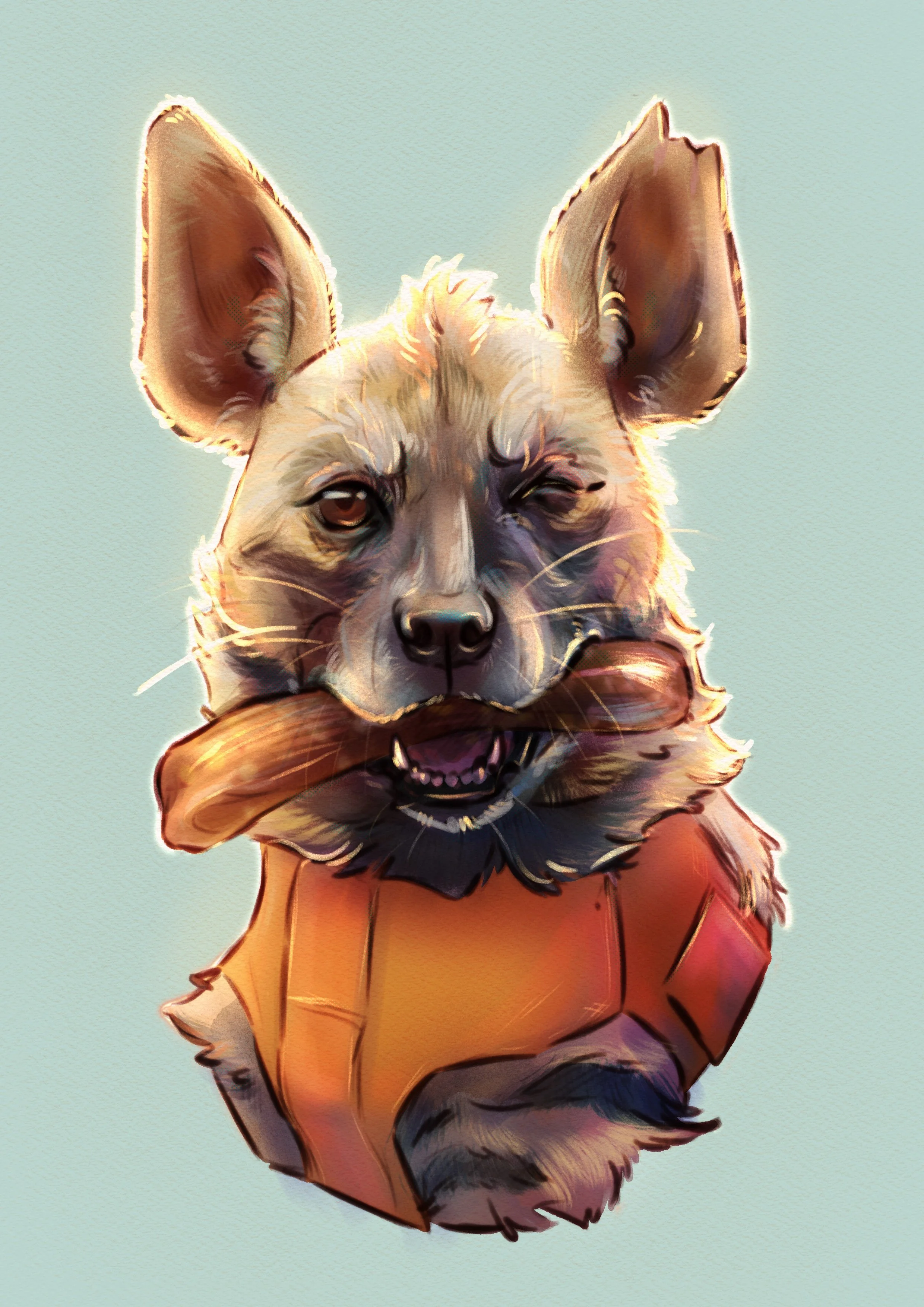
Looking for a story about the goodest of good boys? “Honor to the Good Boy”, a free short story inspired by Saint Guinefort’s legend, is now available!
Mehdi likes scavenging with a human pack, even if they have poor noses and aren’t very bright. What more could a hyena want, when he earns sausages every time he finds funny herbs and powders? But when Mehdi catches the scent of a god of chaos, he has to make a hard choice to save his humans.
I hope you’ll join me as we follow this hero as he does his duty for his friends and his goddess - and, of course, all the sausages he could ever hope for.