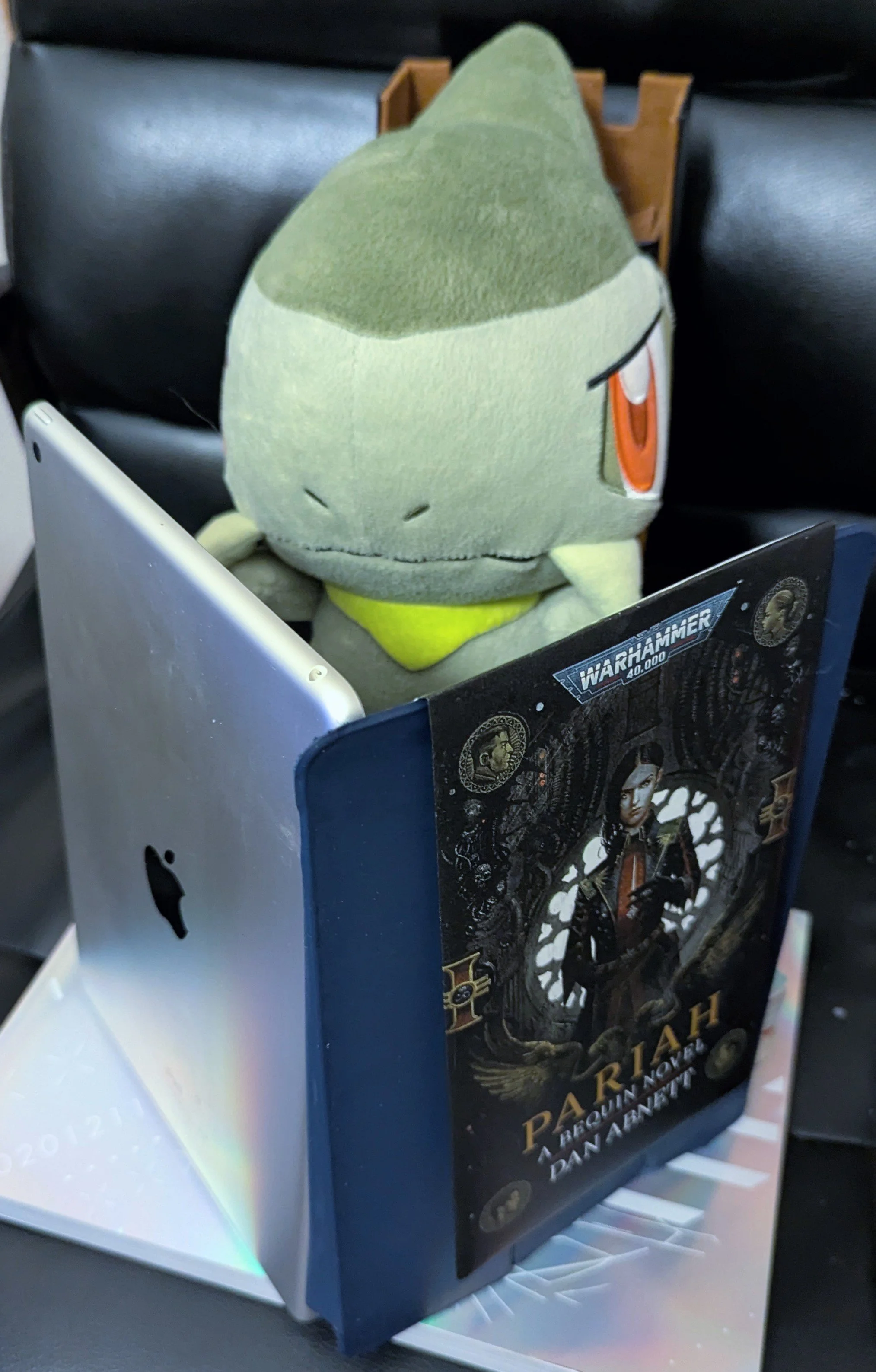
Pariah (The Bequin Trilogy, Book 1) (Part 1 - Overview)
Hello, all. Thank you for joining me for another jaunt into the grim darkness of the 41st Millennium.
Pariah is the first book in the Bequin Trilogy. However, unlike the Eisenhorn and Ravenor trilogies, this trilogy is still in progress. The second book, Penitent, has been out for a few years; the third book, which will reportedly bear the title of Pandaemonium, is apparently on an indefinite hold, by order of Games Workshop. Any further exploration of Warhammer 40K will therefore need to go in another direction for the time being (and indeed, the next Warhammer 40K review after this one will actually be Dan Abnett’s Titanicus, with Penitent coming after that).
Up front, I will say that I’m quite excited to continue this trilogy. I am writing this review immediately after finishing Pariah (before reading Penitent). What we got in Pariah is an honestly refreshing story. It’s not perfect, but there are strong positives here that are worth exploring.
All right, that’s enough to get us started. Let’s turn off our limiters and purge some heretics.
STATS
Title: Pariah
Series: The Bequin Trilogy, Book 1
Author(s): Dan Abnett
Genre: Science Fiction (Space Opera)
First Printing: 2012
Publisher: Black Library (Games Workshop Publishing)
SPOILER WARNING
Both minor and heavy spoilers for Pariah will be provided throughout this review. I will try to keep the first paragraph of each section as spoiler-free as possible and will confine heavy spoilers to clearly labeled sections. There won’t be any spoilers for the sequel, Penitent, which I chose not to read until I finished reviewing Pariah.
Heavy, unmarked spoilers will be provided for any and all of the Eisenhorn and Ravenor content we’ve covered thus far.
TERMINOLOGY
The Alizebeth Bequin in the story is not the same woman from Eisenhorn’s novels. This Bequin is her daughter (or, at least, a person engineered from the original Bequin’s genetic material). Within the narrative itself, Abnett establishes distance between the two characters as early as Chapter 1, with Bequin operating by the “affectionate contraction” of “Beta”. I’ll therefore be referring to this character as “Beta” throughout this review, while her mother will be referred to as “Alizebeth”.
TIMELINE
The events of Pariah take place in 500.M41. This is 25 years after the events of The Magos (475.M41), 30 years after the events of “Perihelion” (470.M41), and 96 years after the main events of Ravenor Rogue.
Also - and I don’t consider this next part to be a spoiler, as it is spelled out in the book’s premise - we actually have a date of birth of Beta, plus the dates when Eisenhorn and Ravenor arrive on the world of Sancour to prepare for their roles within the narrative. Per the timeline at the back of Eisenhorn - The Omnibus:
477 - Beta Bequin “born”, Sancour, Angelus Subsector
Circa 480 - Eisenhorn arrives on Sancour. Medea begins watching Beta
Circa 495 - Ravenor arrives on Sancour
Circa 500 - Pariah
STRUCTURE
This will be a 5-part review, divided up as follows:
Part 1 (Today)
Premise
Rating
Content Warning
Prose & Genre
Part 2 (April 24th)
Plot
Part 3 (May 1st)
Character
Worldbuilding
Part 4 (May 8th)
Series
Part 5 (May 15th)
Spotlight on Fanservice
PREMISE
Once again looking at Amazon’s Kindle e-book product page, we find:
Book 1 in the Bequin series
In the city of Queen Mab, nothing is quite as it seems. Pariah, spy, and Inquisitorial agent, Alizebeth Bequin is all of these things and yet none of them. An enigma, even to herself, she is caught up in a mystery that will take her into unimaginable peril…
READ IT BECAUSE
It's an intriguing and evocative story that shows characters you know and love through new (yet strangely familiar) eyes, forging a stunning mystery that will leave you astonished.
THE STORY
In the city of Queen Mab, nothing is quite as it seems. Pariah, spy, and Inquisitorial agent, Alizebeth Bequin is all of these things and yet none of them. An enigma, even to herself, she is caught between Inquisitors Gregor Eisenhorn and Gideon Ravenor, former allies now enemies who are playing a shadow game against a mysterious and deadly foe. Coveted by the Archenemy, pursued by the Inquisition, Bequin becomes embroiled in a dark plot of which she knows not her role or purpose. Helped by a disparate group of allies, she must unravel the secrets of her life and past if she is to survive a coming battle in which the line between friends and foes is fatally blurred.
Reaction
This premise actually downplays the depth of the mystery in this story. Despite being name-dropped here, the involvement of Eisenhorn and Ravenor is not spelled out for most of the story. Bequin herself does not recognize them, and we are operating within her limited POV. People who have read the past books (or, at least, have read Ravenor’s books and The Magos) will recognize who the pair are, but newcoming will be as much in the dark as Bequin herself.
RATING: 9/10
As someone who read the Eisenhorn and Ravenor trilogies, this book was a welcome surprise for me. Abnett has really upped his game as a writer over the years. While I feel like the books of those previous trilogies ranged from decent to great, Pariah takes things to a new level.
First, there’s the matter of narrative voice and genre. Abnett has managed to give his protagonists different voices in the past: Eisenhorn’s and Ravenor’s 1st-person POVs are distinctly different, and while all of the 3rd Person POV scenes in Ravenor’s books read similarly, the 3rd Person POV scenes in The Magos has their own voice (particularly Drusher’s scenes). However, they all still felt similar enough to recognizably be Inquisition stories set in the Science Fiction setting that is Warhammer 40K. Pariah instead reads like a Dark Fantasy that just happens to coexist in the same setting, written as a first-person account by someone who is trained specifically to be an infiltrator and observer rather than an agent of the Inquisition. It’s almost hard to believe that it was written by the same author as the previous trilogies.
There is also the handling of the mystery. Again, the mysteries in past books were fine for what they were, but Abnett has upped his game here. While there is one twist that comes completely out of left field, the majority of the twists and turns in this story feel properly earned and built up. Also, as mentioned above, Abnett manages to turn even the inclusion of legacy characters into a mystery. I might have recognized who these people were and been able to see some of the answers in advance, but it always felt earned, rather than Abnett leaning on memberberries to make this story work.
Lastly, there is the handling of those legacy elements. Abnett struck the perfect balance when it comes to fanservice. Pariah is a story that stands on its own merits and can welcome new readers into the Warhammer mythos, yet it is also a satisfying legacy sequel that rewards readers of the Eisenhorn and Ravenor trilogies. He does this so successfully that we need to do a spotlight analysis just to explore how well he handled things.
There is, however, one think that keeps this story from sticking the landing: the ending. This book reads like Part 1 of a much longer story, with the break coming at an arbitrary point. It’s just not a satisfying resolution. If this book had be written deliberately as a duology, with Penitent coming out a few months after it, that might be forgivable, but as it stands, Pariah stumbles at the end.
CONTENT WARNING
This is a Warhammer 40K story, so there is abundant violence, gore, and horrifying imagery, as well as references to substance abuse and sexual assault. Much like in the Ravenor stories, this is all executed so tastefully and effectively that it enhances the narrative, rather than feeling like something obtrusive. If you really can’t stomach the mere mention of these elements in a story, you may want to avoid this book, but otherwise, I feel like most readers shouldn’t have any problem digesting this content.
PROSE & GENRE
I’m lumping these two elements together because the effect of narrative voice in this story is just that powerful.
Much like the Eisenhorn Trilogy, this book is told as a 1st Person account that is recorded by Beta. This is explicitly acknowledged within the text itself, with Beta stating that she’s protecting the contents of the account by writing it in an old language that she knows few people will be able to read. This choice puts narrative voice under a spotlight. Not only are we inside the POV character’s head, but the framing device explicitly acknowledges that this is a reflection of how the main character perceives the world. So if Beta comes across sounding like Eisenhorn or Ravenor, that’s a lot less forgivable than, say, the same narrative voice appearing across the 3rd Person POVs of Harlon Nayl, Carl Thonius, and Kara Swole.
Abnett really hit things out of the park here. Beta’s voice clearly establishes her as someone trained her whole life to be both observant and perception. He repurposes the vivid scene describes from Ravenor into soliloquies about the city of Queen Mab and the institutions of the Imperium. The mannerisms and vices of other characters are dissected for potential weaknesses. Whenever Beta draws connections or solves a mystery, it always feels earned, as we can see how she has strung together seemingly disparate pieces of information. Furthermore, the way Beta thinks about the different false identities she adopts, effectively describing herself in the third person when reflecting on some frustrating obstacle posed by staying in character, really shows her dedication to her craft.
Beyond establishing Beta as a distinct entity from the inquisitors we’ve followed thus far, this narrative voice has an interesting knock-on effect on genre.
This is still Warhammer 40K, of course. It’s still a grimdark Space Opera (at least, that’s how I classify it - I’m not sure what the more appropriate label would be). Anyone familiar with Warhammer 40K will easily recognize various worldbuilding details that flag this as a work of Science Fiction in a familiar setting.
There’s just something about Beta’s POV that gives everything a fresh coat of paint. This story has an ethereal quality to it that makes it feel more like the Dark Fantasy that just happens to have guns in it. Part of this can be chalked up to the fact that the story is set in a single city on a world that has a strong Renaissance vibe to it (though the Internet tells me that this city is indeed a hive city, so the vibe is just a vibe rather than a reflection of the predominant tech level), but the rest falls upon how Beta describes the world. She manages to make even the familiar things feel strange and new. One moment that stands out to me is a scene where a Traitor Space Marine is introduced, but he’s described in a manner that feels more like a purely magical creature (not even in the sense of a Warhammer 40K dæmon - more like a Fae Shadow Daddy from a Romantasy who got dropped into a story where he can be properly acknowledged as a villain).
The book itself provides a perfect metaphor for this. There’s a character in the story who possesses a pane of glass that is corrupted by Chaos, allowing whomever looks through it to glimpse the influence of the Warp on the world. In the same way, Bequin’s narrative voice acts as a glass to Warhammer 40K, providing a perspective disconnected from that of past POV characters.
To cap this off - while I do like Beta’s narrative voice, I don’t think it should be the norm for Warhammer 40K. If the entire setting were framed like this, it would lose its identity. Exceptions to the norm within an established franchise work best as seasoning. Through this unusual POV, it makes Beta’s story feel like something special while still existing in continuity with other Warhammer 40K stories.
PLOTS WITHIN PLOTS
Next Friday, April 24th, we’ll dive deeper into Pariah with an analysis of the plot. There is good and bad here. Abnett does a wonderful job at creating a mystery of circumstances, with Beta struggling to keep afloat as multiple factions conspire around her. However, this is also where we’re going to get into the book’s awkward non-ending. I hope you’ll all join me as the investigation continues.
Thank you all for stopping by. Please remember to subscribe and share if you enjoy what you read here. Take care, everyone, and have a good weekend.

Looking for more stories like Pariah? Check out my free novella, The Unbottled Idol, available over in Tales of the Five Worlds!
Mohsen Yavari's task within the Imperial Inquisition of the Kimian Empire is simple: monitor the gods' activities in the mortal world. However, when a diplomat is killed by a goddess, a maverick inquisitor recruits him for her investigation. Their search for answers will lay bare sinister truths, with a child’s soul hanging in the balance.
Join me on this adventure of intrigue, martial arts, and divine assassination!