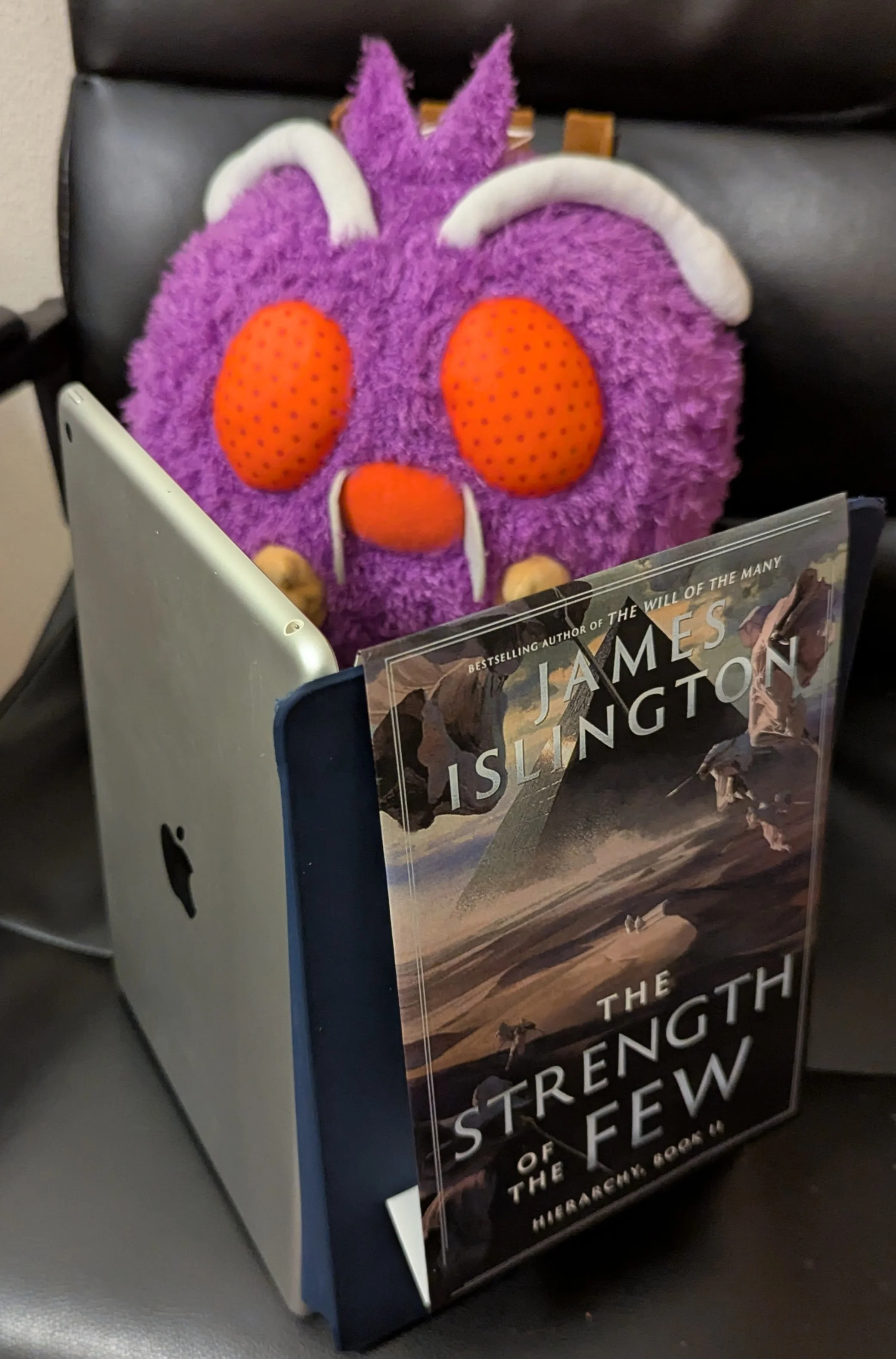
The Strength of the Few (Part 0 - Overview)
Hello, all. Welcome to this Sunday review, as well as our first look into The Strength of the Few, sequel to The Will of the Many.
As promised back in that previous review series, this book will also be getting a deep dive analysis. We will be exploring all the things it does right. This time, we will also be exploring the ways in which it falls short of its predecessor. While The Strength of the Few is a book that I very much enjoyed and do feel is genuinely great Fantasy literature, it is not quite as good as The Will of the Many. I think the reason why is something we can all learn from.
That series will run across Fridays in January, February, and March. I currently have 4 parts planned. For both practical reasons and for theming, I’m going to break these parts down as follows.
Part 1 (January 30th) - Obiteum
Part 2 (February 13th) - Res
Part 3 (February 27th) - Luceum
Part 4 (March 13th) - Synchronous (including Prose, Theme & Series Trajectory)
Also, it appears we now have confirmation that this series, Hierarchy, will be a quartet. When I went to Amazon to extract text for the Premise, the marketing fluff at the top describes this book as “Book two of the Hierarchy quartet”. I’ll discuss the implications of this in Part 4.
All right, enough burying the lead. Let's get into the Overview.
STATS
Title: The Strength of the Few
Series: Hierarchy (Book 2)
Author(s): James Islington
Genre: Fantasy (Epic)
First Printing: November 2025
Publisher: Saga Press (imprint of Simon & Schuster)
SPOILER WARNING
Minor, unmarked spoilers for The Strength of the Few will be provided throughout this review. I will keep the first paragraph of each section as spoiler-free as possible. Heavy spoilers will be confined to clearly labeled sections.
Unmarked, heavy spoilers for The Will of the Many will be provided throughout this review. I will also be referencing my review series for that book throughout, though you will not need to have read that previous review to understand this one.
TERMINOLOGY
The titles of both this book and its predecessor will be abbreviated as follows going forward:
The Will of the Many = Many
The Strength of the Few = Few
PREMISE
From the Amazon product page:
OMNE TRIUM PERFECTUM
The Hierarchy still call me Vis Telimus. Still hail me as Catenicus. They still, as one, believe they know who I am.
But with all that has happened—with what I fear is coming—I am not sure it matters anymore.
I am no longer one. I won the Iudicium, and lost everything—and now, impossibly, the ancient device beyond the Labyrinth has replicated me across three separate worlds. A different version of myself in each of Obiteum, Luceum, and Res. Three different bodies, three different lives. I have to hide; fight; play politics. I have to train; trust; lie. I have to kill; heal; prove myself again, and again, and again.
I am loved, and hated, and entirely alone.
Above all, though, I need to find answers before it’s too late. To understand the nature of what has happened to me, and why.
I need to find a way to stop the coming Cataclysm, because if all I have learned is true, I may be the only one who can.
Reaction
This is on-point, and it spells out the main gimmick of this story: that this series has effectively become three entwined stories. Vis is now three different POV characters, one on each world, each one with the same starting point (which we saw at the end of The Will of the Many) but progressing on independent trajectories through very different circumstances. This is both a strength of the book and, I feel, the source of its greatest flaws.
RATING: 8.5 / 10
Judging this book purely by what’s on the page, this is easily a 9.5, if not a 10.
The only thing that's missing from this book that was in the original is the political intrigue of Vis working to climb his way up the social latter of the Academy. Since this is a natural progression of the story - Vis in now out of school, after all - it’s a regretable loss, but not a deal-breaker. There’s still a level of intrigue, of plotting and plans and betrayals. It just takes a new form.
Beyond that, the worldbuilding is still strong. The characters are still strong. If there are plot holes, they’re not so large as to be evident on a first read. When one considers that Islington has to do all these things three times over, with each POV having its own worldbuilding, characters, and plot, weaving them together so that the introduction (and re-introduction) of concepts flows together into one cohesive whole, it’s honestly remarkable. This book should be another 10/10.
… the problem is what's NOT on the page.
Back when A Light of All that Falls released, Islington admitted to cutting an entire subplot due to the book running too long. This is why that book is missing several key secondary characters and why there’s a twist in the final battle that feels like a Deus Ex Machina. Islington needed to make cuts, and incising an entire subplot that is geographically separated from the main characters was a clean way to achieve that goal without undermining the whole book.
I can’t help but wonder if Islington was forced to make these same cuts for Few. There are moments where key bits of plot or character progression are founded on things we are Told about but not Shown. The issue is that Vis is our only POV. He experienced these things. There isn’t an excuse within the narrative itself for us to not be Shown those things. As a result, there are important milestones n Few that just don’t have the impact Islington intended. These moments do rationally fit the story being told. They’re not ass-pulls founded in aftshadowing. Characters are behaving consistently and acting on information that was well-established in advance. It’s just there’s only a fraction of the emotional weight that should exist, because we didn’t experience these things with Vis.
So, while I do think this is still a pretty great book, and I do recommend it to anyone who likes the sort of sweeping epic that was set up in Many, I simply can’t hold it up to the same level as its predecessor.
STORY
This next part will be an overview of the individual plotlines if Few, featuring only mild spoilers. Each section will sum of the strengths and flaws that we’ll explore more when the deep-dive analysis begins.
Obiteum
This is the Vis who was greeted by Caeror in the finale of Many. He finds himself on a poisoned world that feels like a fantastical version of ancient Egypt (frankly, not all that different from Amonkhet, for those of you familiar with Magic: the Gathering lore), where Will is used to manipulate the boundaries of life and death rather than granting superhuman abilities. From the very start of the story, he is given the objective of killing Ka, a man who possesses godlike levels of Will and is responsible for the Cataclysms (that’s right, the Cataclysm referenced in the previous book was merely the 10th in a regular cycle, and the 11th is overdue). This Vis’s story is all about his efforts to get close to and assassinate this ancient foe.
This POV started off as the most interesting and engaging. However, the pacing slowed to an utter crawl in the middle of the book, and then the climax flew by so smoothly that it made the middle part feel unnecessary. I’m not sure if Islington either didn’t have enough content to actually fill in this subplot or if, in culling the length of the book, he just oversimplified it.
Res
This is the “original” Vis, living on the world that we came to know in Many. We follow him as he adapts to life after the Academy and begins his investigation into the senators responsible for facilitating the Anguis attack in the climax of the previous book. We also see how the Hierarchy begins to spiral into chaos as the political fallout from that attack destabilizes the government.
While every chapter of this POV was enjoyable, the plot here really feels like a casualty of cuts. A lot happens to this Vis during the time period covered by the story (several months, if not a full year), yet outside of the first few months, the events just strobe past. It makes the pivotal decision he commits to in the finale very hard to accept. I can’t say it’s character assassination, as it’s not impossible to fill in the blanks for how he got to this point, but the audience really shouldn’t need to fill in so much for the end of a story to make sense.
Luceum
The story of this Vis is the best in the entire book. He finds himself alone in a verdant world that is occupied entirely by vaguely Celtic tribes and ends up getting sucked into the political machinations of the druids, not realizing until late in the POV that he’s actually on another world. He gradually adapts to the culture and finds the peaceful life he was chasing at the start of Many. Eventually, this life comes under threat, and he has to embrace the Will techniques of the druids (which appears to take the form of channeling spirits of the dead - no, this isn’t explained, though we get hints that the next book will explain things) to help save his home.
I was underwhelmed by this POV at first. With everything the other two versions of Vis faced right out the gate, it felt like this one was just cooling his heels and waiting to get sucked back into the larger narrative. However, it’s interesting to see how this Vis develops over time. My only outstanding complaint by the time we get to the ending is that it feels like a lot of key character development is missing. Vis builds bonds with all of these new characters in scenes we don’t get to see, and we’re just supposed to accept that he has this closeness to them that he didn’t even feel with his friends at the Academy. It makes sense in-context. It just feels emotionally hollow.
Synchronous
Despite my issues with the individual POVs, Islington does mesh them into a cohesive whole. Each version of Vis is a distinct character by the end of the story, and whether they are aware of it or not, their actions are setting off consequences that affect their counterparts. I’m genuinely interested to see how Islington juggles these three in the next book. Hopefully, there won’t be this same sense of things being missing as we go forward into Book 3.
CONTENT WARNING
Much like its predecessor, Few features a significant amount of violence and gore. In addition to fighting, there’s also an added body horror element with all the things done to corpses on Obiteum. We get to see the horror of the Sappers again, not to mention multiple instances of people melting in an acid river.
Gruesome as this all is, there is still a sense of intention to it. Islington doesn’t spray these things onto the page for a vibe. These are applied deliberately and effectively to generate tension and stakes, as well as to lend a sense of consequence to the decisions made by the characters.
A FEW MORE THINGS TO SAY
The Strength of the Few does not reach the heights that its predecessor did, yet it is still great. There are many positive examples to be taken from it. As for its negatives, I think they are also worth exploring. Not every example of imperfect writing comes from bad books. It’s worth reflecting on why these flaws are flaws and why the story still manages to stand strong in spite of them.
As you might have guessed from my Story breakdown, I feel the most effective means to analyze this book will be to look at each of the POVs as if it were its own isolated entity, analyzing Plot, Character, and Worldbuilding for just that POV. The final part of the review will then assess how these three POVs function when combined into a cohesive whole, as well as touching upon qualities that are spread across the entire narrative (prose, theme, implications for the ongoing series, etc).
We’ve got a few other things on the schedule between now and then, but I won’t keep you waiting for too long. The deep-dive analysis will kick off with Part 1, the review of the Obiteum POV, on January 30th, 2026. I hope you’ll join me for it.
Thank you all for stopping by. Please remember to subscribe and share if you enjoyed what you read here. Take care, everyone, and have a great week.