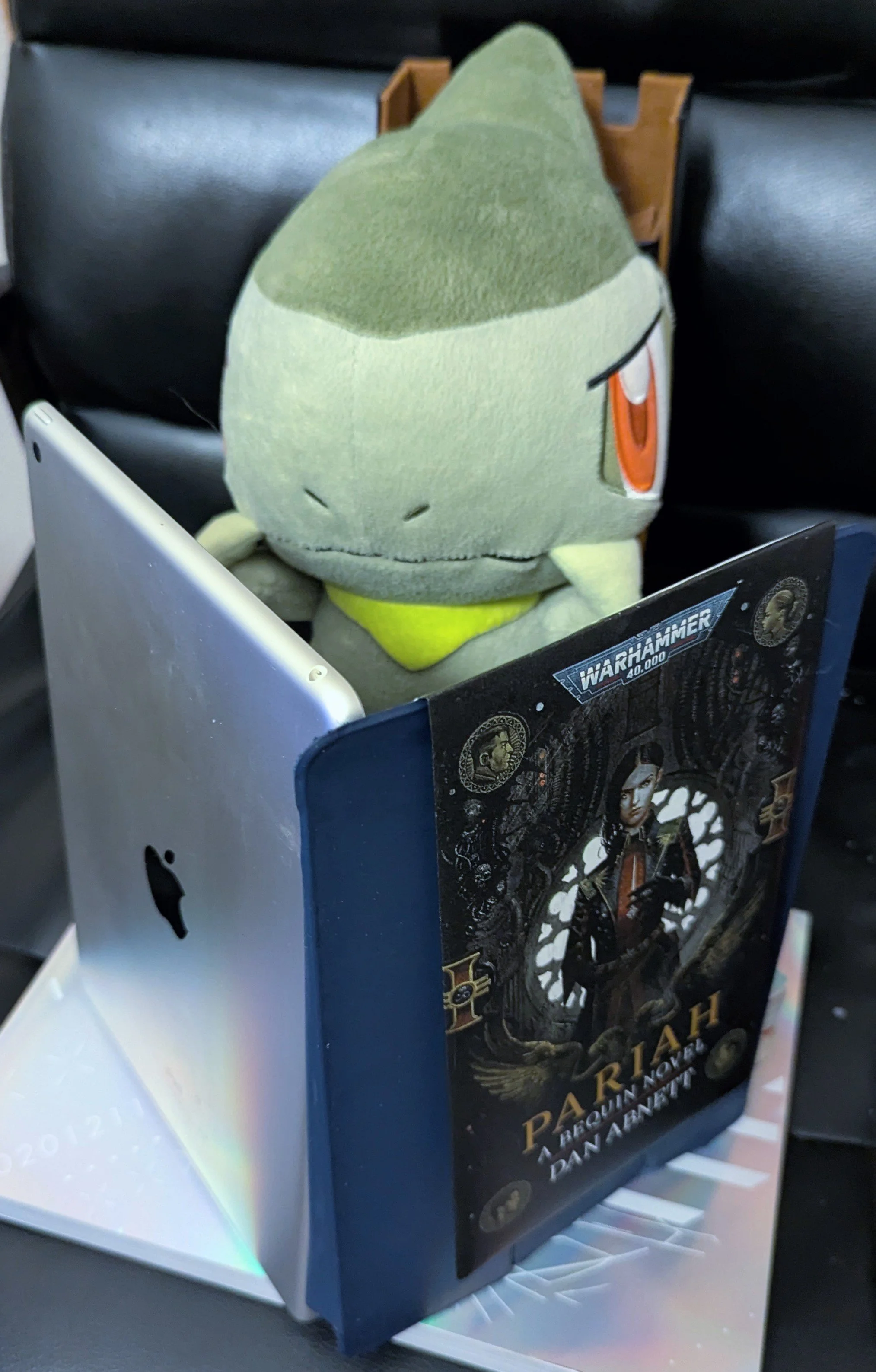
Pariah (The Bequin Trilogy, Book 1) (Part 2 - Plot)
Hello, all. Welcome back to the ongoing investigation into Pariah, Book 1 of the Bequin Trilogy.
If you’re looking for a general overview of the book’s quality and a discussion of the prose and genre, please see Part 1. If you’re looking for the dissections of the character, worldbuilding, series history, and fanservice, those are coming in the week’s ahead.
Limiters off, everyone. It’s time to dig into heresy.
STATS
Title: Pariah
Series: The Bequin Trilogy, Book 1
Author(s): Dan Abnett
Genre: Science Fiction (Space Opera)
First Printing: 2012
Publisher: Black Library (Games Workshop Publishing)
Rating: 9/10
SPOILER WARNING
Both minor and heavy spoilers for Pariah will be provided throughout this review. I will try to keep the first paragraph of each section as spoiler-free as possible and will confine heavy spoilers to clearly labeled sections. There won’t be any spoilers for the sequel, Penitent, which I chose not to read until I finished reviewing Pariah.
Heavy, unmarked spoilers will be provided for any and all of the Eisenhorn and Ravenor content we’ve covered thus far.
TERMINOLOGY
The Alizebeth Bequin in the story is not the same woman from Eisenhorn’s novels. This Bequin is her daughter (or, at least, a person engineered from the original Bequin’s genetic material). Within the narrative itself, Abnett establishes distance between the two characters as early as Chapter 1, with Bequin operating by the “affectionate contraction” of “Beta”. I’ll therefore be referring to this character as “Beta” throughout this review, while her mother will be referred to as “Alizebeth”.
PLOT
While Pariah is a mystery, it’s one more in the vein of Hereticus than any of the other Eisenhorn or Ravenor stories. This isn’t an investigation where she is attempting to track down a target. It is a story of survival, with Beta being thrown into a chaotic situation and trying to make sense of things as she struggles to survive.
The Dark Plot
We are introduced to Beta when she is in her early twenties, and learn about her life in the Maze Undue, an Inquisition training facility that trains blanks to serve as undercover operatives. The inciting incident of the story, which occurs early on, is Beta intervening when an assassin tries to kill one of her instructors, with the assassin name-dropping the Cognitae before he dies. When the story properly kicks off after a one-year timeskip, Beta is assigned to an investigation and very quickly figures out that the Cognitae are involved, much to the dismay of her superiors.
Before the investigation can really build momentum, though, the Maze Undue is assaulted by unknown foes (whom she reasonably assumes to be Cognitae operatives, though readers familiar with the Eisenhorn and Ravenor books will be several steps ahead of her). Beta is forced to flee. From that point onward, she attempts to go to ground by re-adopting false identities from past missions (standard procedure for Maze Undue operatives in crisis). She then has to avoid capture by various factions while piecing together the truth.
This struggle to survive and make sense of things is the core of the novel’s narrative. I think Abnett does a good job with it. Even as someone with information that Beta doesn’t, I still felt a palpable sense of danger for Bequin. There are layers to the schemes in play in this story.
The Five Factions (Heavy Spoilers)
Let’s get into these layers, shall we?
The Cognitae
As will surprise no one who has read any Ravenor story and/or The Magos, the Maze Undue is not an Inquisition facility. It’s a Cognitae facility masquerading as an Inquisition facility, taking advantage of the relatively quiet world of Sancour to hide in plain sight.
The reason they are doing this is to produce “graels”. From what I understand (and I may be a bit mixed up on the specifics), “graels” are blanks who serve as vessels for some kind of Warp entity. I think these entities are the artificial dæmon bodies that were revealed in The Magos. (As we saw with “Thorn Wishes Talon”, Abnett has no scruples about writing stories to patch up past holes in his writing. I think it’s reasonable to conclude that he wrote The Magos in part to explain what exactly is getting shoved into graels.)
The Cognitae are not defeated in this story. The Maze Undue is destroyed, but the Yellow King (who is repeatedly referenced) survives. One of the reasons multiple parties are trying to get their hands on Beta is because the combination of her blank status and her Cognitae training makes her incredibly valuable for their various schemes.
The (Real) Inquisition
This one is effectively two factions.
After The Magos, Eisenhorn and his retinue made their way to Sancour, prompted by his vision from the climax of that book. He and his team have effectively been staked out on Sancour for most of Beta’s life, hoping to use her as a means to get close to the Yellow King so Eisenhorn can finally get rid of this threat to the Imperium.
Ravenor’s objectives are murkier. Eisenhorn thinks that Ravenor merely came to destroy the Maze Undue, but Ravenor claims he’s really there to hunt Eisenhorn. Apparently, the Imperium has reason to believe that Eisenhorn is the Yellow King. This would explain why Ravenor is in the field again, despite what we are shown in “Perihelion”: now he has an actionable threat that would lead him to finally face his old mentor, despite refusing to hunt Eisenhorn nearly a century earlier. This mostly makes sense, except I’m not sure why Ravenor would destroy the Maze Undue if he’s here hunting Eisenhorn. I know he’s smart enough to know that doing this would immediately expose his presence to his old master, and no matter what Eisenhorn may think about Ravenor being too Puritanical, we know Ravenor is willing to let certain evils slide in the name of taking out a particularly dangeous foe.
In any case, I like the way the Inquisition contribute to the plot. Beta has no idea who Eisenhorn, Ravenor, or either of their respective revenues are. Her encounters with them range from fighting people she believes to be elite Cognitae operatives and being unnerved because the grizzled old man is staring at her funny. When the truth is revealed, Beta very quickly becomes torn between these two inquisitors and is forced to take sides in a feud she has very little understanding of.
The Black Market Broker
Before the raid that destroys the Maze Undue, Beta is investigating an antiques broker that is allegedly dealing in heretical artifacts. After the raid, she learns that not only is this true, but they are also aware of the Cognitae and eager to get their hands on a grael candidate. They make two major attempts to capture her.
It turns out that these brokers are working for Sancour’s Ecclesiarchy, who are trying to develop their own Enuncia lexicon. Their hope is that a blank will be able to speak the words safely. The real twist, though, is that these church officials are working with …
Word Bearers.
That’s right, there are Chaos Space Marines in this story. They are relatively minor antagonists in this book. Still, I would not be surprised if more Word Bearers showed up in future books.
Glaw
There is a member of the Glaw family on Sancour, and Beta’s misadventures lead her into this person’s clutches.
This twist is … well, frankly, it’s very on-brand for the Glaws. It comes out of nowhere, and the plot just has to change trajectory to account for it. The only part that isn’t a shock is that the Glaw in question is “allied” with her own Traitor Space Marine, this one being from the Emperor’s Children.
I did not like the Glaw reveal in and of itself. That said, I think the reveal itself wasn’t the point. Abnett used Glaw to introduce a minor antagonist (the Traitor Space Marine) who is pivotal to the closest thing this book has to a climax (more on that in a moment). Aside from this utilitarian function, this additional antagonist was effective at upping the stakes. Whatever the Cognitae are doing with the graels, it is so big that it isn’t just between them and the Inquisition anymore. Multiple Chaos factions are getting involved and are prepared to fight each other to get their hands on a grael.
Final Thoughts on Factions
The number of factions within this story makes things rather complicated. I do think Abnett is successful with applying them overall. Sure, none of the factions get all that much depth, but with the exception of the Ecclesiarchy and the Word Bearers (who get a lengthy scene exploring their experiments with Enuncia), Abnett has past history that he can build on with all of them. He can get away with just laying out objectives and trusting the audience to understand why the various parties would want to pursue those objectives.
The Ending (Heavy Spoilers)
The way Pariah ends genuinely had me scratching my head. It’s also the reason I initially assumed Pariah and Penintent were originally one book that had to be split into a duology.
After the fall of the Maze Undue, Beta’s primary objective is to reconnect with any survivors of the assault. A Curst (a penitent person who atones for his crimes by accepting any and all requests made of him) finds her early on. He tells her that he represents one of her superiors with the Maze and has been sent to collect her. Most of the book is Beta being delayed from this rendezvous by either people capturing her or her refusing to go until she saves another survivor from the Maze.
It isn’t until late in the story, when Beta finally has a sit-down conversation with Eisenhorn and agrees to help him take down the Cognitae, that she finally complies with the request. The Curst escorts her to the rendezvous point. On the way, they are attacked by that Traitor Marine from the Emperor’s Children and are saved by one of Eisenhorn’s operatives. When they finally reach the rendezvous, there is this buildup of tension as they wait for the Cognitae to arrive.
Instrad, Ravenor shows up. Turns out he was using the Curst as a means to discretely contact Beta. He warns Beta that her options are either to help him take down Eisenhorn or else be imprisoned. He locks her up while she deliberates her options.
So, at this point, I’m thinking there’s still an encounter with either Eisenhorn or Cognitae ahead. Beta will either agree to help Ravenor or else escape, and we’d then get either the fallout of her turning on Eisenhorn or the reunion with the Cognitaie that was originally promised.
Then Cherubael shows up and busts Beta out.
And the book just … ends.
Huh?
And that’s when I realized that the fight between Eisenhorn’s operative and the Traitor Marine was supposed to be the climax of the book. A fight between a character who was set up but not explored and the least impactful antagonist in the book is our big finish. Even the Traitor Word Bearers would have made for a better finale than this guy, as at least they had showed up in one might scene and were the endpoint of events set in motion from the beginning of the book.
I’m not saying this ending couldn't have worked. It really could have. It’s just Abnett went out of his way to established an expectation of a reunion with the Cognitae, pulled the rug out, and then ended the story before things could resolve. This would be like if Rogue One cut to credits when the Scarif shield gate closed and didn't show us how the heroes were going to solve the problem. What could have been a great twist ends up as an unsatisfying anticlimax.
Here’s where the duology theory comes in: this would be understandable of Abnett had written one long book and chopped it in half to make a cliffhanger. It wouldn’t excuse anything, but it would at least make sense. Now that I better understand the release schedule of this trilogy, I’m pretty sure this ending was Abnett’s plan the whole time. I’m really baffled that he thought this would be the high note, especially since he could have instead had a better version of the same ending earlier on, when the first encounter of the Emperor’s Children Marine being the climax, followed by Eisenhorn recruting Beta. This was, the end of the story would be Beta making a choice, rather than just being a passenger.
FRIENDS OLD AND NEW
Next Friday, May 1st, we’ll continue this analysis with a dissection of the characters and worldbuilding. There is a lot to praise here. Beta is a compelling and enjoyable protagonist, and the rest of the cast range from functional to great. As for the worldbuilding, while there are a few details that concern me, nothing outright breaks the narrative, and it’s possible they will be redeemed in future installments of the series.
Thanks for stopping by. Please remember to subscribe and share if you enjoy what you’ve read here. Take care, everyone, and have a good weekend.

Volume I of my first serialized Romantasy novel, A Chime for These Hallowed Bones, is now available!
Kabarāhira is a city of necromancers, and among these necromancers, none are more honorable or respected than Master Japjot Baig. Yadleen has worked under him since she was a girl, learning how commune with bhūtas and how to bind these ancient spirits into wights. Her orderly world is disrupted, however, when a stranger appears with the skeleton of a dishonored woman, demanding that her master fabricate a wight for him.
To protect her master from scandal, Yadleen must take it upon herself to meet this stranger’s demands. Manipulating the dead is within her power, but can honor survive in the face of a man who has none?
Come for slow-burn tension, and Enemies-to-Lovers dynamic, and bone-based engineering! I hope to see you there. Volume II is in development!