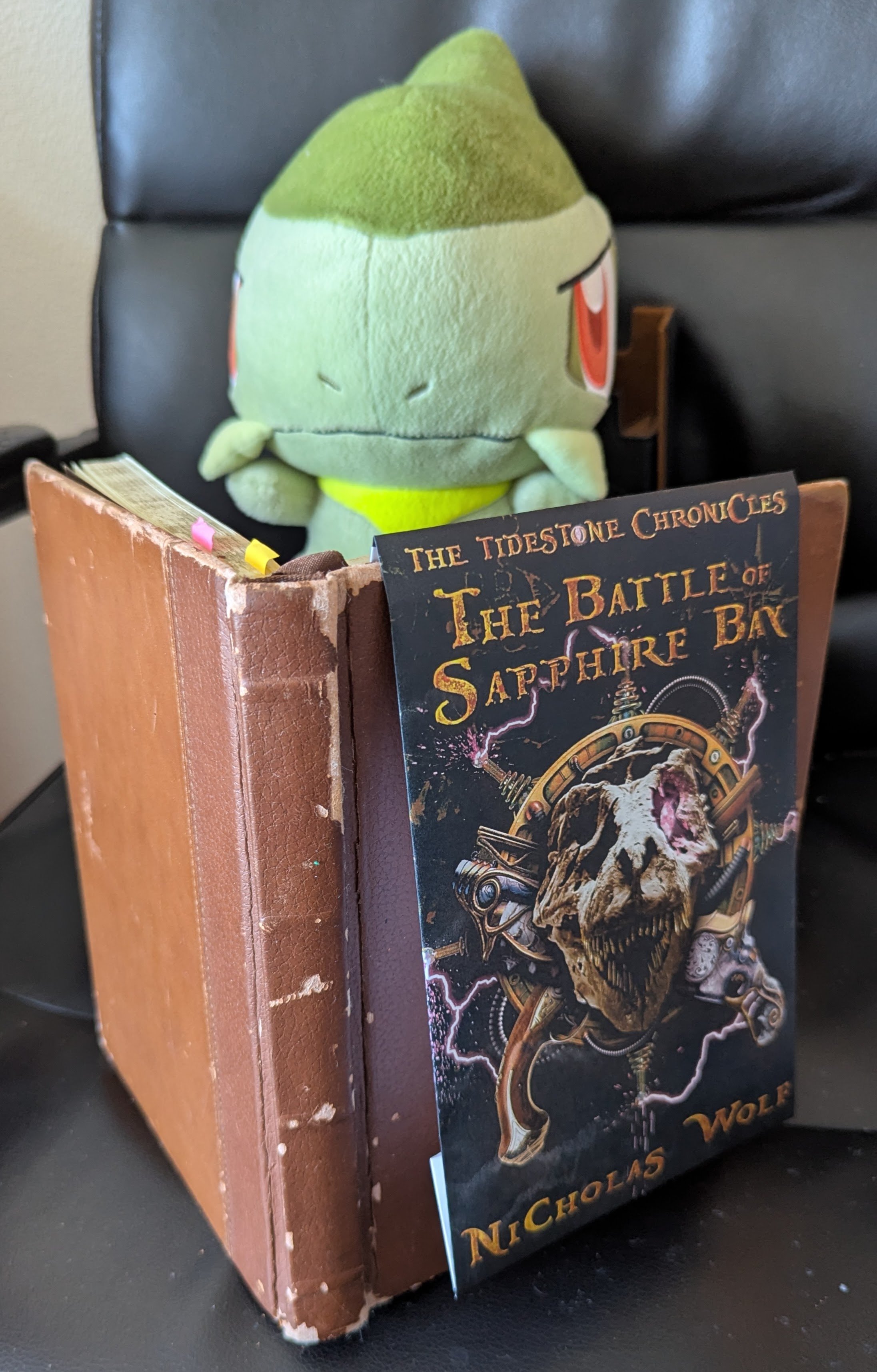
The Battle of Sapphire Bay (The Tidestone Chronicles, Book 2) (Part 2 - Plot)
Hello, everyone. Welcome back to our ongoing voyage through The Battle of Sapphire Bay, Book 2 of The Tidestone Chronicles.
Last week, we looked at how Wolf crafted a narrative around flashbacks. This week, we’ll move on to other aspects of the plot. This discussion of the worldbuilding and characters will come next Friday. If you just want a high-level overview of the Book, please see Part 0.
Power up the tidestone core. It’s time to take flight.
STATS
Title: The Battle of Sapphire Bay
Series: The Tidestone Chronicles (Book 2)
Author(s): Nicholas Wolf
Genre: Epic Fantasy
First Printing: April 28th, 2026
Publisher: Self-published to Amazon
Rating: 8.5/10
SPOILER WARNING
Mild, unmarked spoilers for The Battle of Sapphire Bay will be provided throughout this review. Heavy spoilers will be confined to clearly labeled sections. I will keep the first paragraph of any given section spoiler-free.
Heavy, unmarked spoilers of the previous book, Beyond the Crimson Mists, will be included throughout this review. I will also assume that you have read my review of that book, but doing so is not necessary to appreciate this review.
TERMINOLOGY
As in the last book, I’m not going to use Wolf’s names for certain fantasy races in this setting. I’ll instead be referring to these races by the archetypal fantasy races that they are appear to be derived from:
Atantyans = elves
roqlyudi =dwarves
nurians = humans
I will refer to the waraabei by their proper name. While they may be derivatives of gnolls, gnolls are a creation of D&D, so changing the name was likely necessary to avoid legal issues.
PLOT
The plot continues to be the weak point of this series … but in this case, I must emphasize that this is a relative metric.
The plot of The Battle of Sapphire Bay is far better than its precessor. We’re already gone over how Wolf told an effective and engaging story built around delivering flashbscks to the audience. As for the other items we have to discuss, they are mostly functional. I think the flaws that exist are worth discussing, but they are not as dire as what we have seen in other texts.
The Ending (Heavy Spoilers)
The titular battle occupies the last third of the story. It’s a three-way conflict between the Sanctuary (really, just Hawk and whatever local wildlife stumble into the fight), the fleet under Lord Croft’s command, and a horde of fish monsters known as the amademoni The battle itself is fine. The situation evolves in logic ways, and elements that were previously set up get paid off.
All of the issues I have with this book’s plot are tied into the ending. I'll discuss the other tissues shortly. For now, I just want to talk about the abruptness of the cliffhanger that the book ends on.
The big takeaway from Hawk’s delve into flashbacks is that Malychai is the former emperor of the elves. The fall of the elves’ civilization came when, in response to the harvest of tidestone beginning to run dry, Malychai turned to a man named Caiphys, who had learned that sacrificing the lives of priestesses would increase the harvests once more. When Malychai would not agree to a mass sacrifice that would kill all remaining priestesses, Caiphys overthrew him. Malychai established the Sanctuary and havens like it to try to shelter those priestesses that remain. Nyomi is now the only surviving member of the priestesses’ bloodline.
The stakes here are clear. Caiphys hired Rak-Tak to hunt Nyomi in the last book so that he could finish the sacrifices he had started. The amademoni are an army to aid him in overrunning the surface world. He appears to be doing all this at the behest of some greater, supernatural evil. Nyomi must be kept out of his hands and kept alive, or this evil will destroy the world.
Well, in the finale, Caiphys gets Nyomi. The end of the battle sees his army defeated, but the Sanctuary is breached. Caiphys is able to just fly in, kill Malychai, and take Nyomi, while Hawk is helpless to stop him.
“Hawk!” she cried as she reached out her hand for me.
I dived, reaching to grab Nyomi’s outstretched hand.
But my hand closed on air. I was too late.
Nyomi rose helplessly into the sky, floating beside the warped Caiphys as though trapped in his unholy orbit. In the dark, distant waters of Sapphire Bay, the waves parted. A vessel surfaced, the same predatory submersible I’d seen destroy the Indomitable. Caiphys’ dais drifted towards it, taking Nyomi with him.
“No!” I screamed into the darkness of Sapphire Bay. “Nyomi!”
And with that, the book ends.
No seriously. Those were the last lines in the book.
This ending makes sense. It is the payoff of everything set up thus far. A clear trajectory is set for Book 3. Hawk knows where Caiphys will go next, and as far as the audience is aware, his airship is either skyworthy or soon will be. This works as a cliffhanger.
My issue is that the book just stops. There is no resolution or natural endpoint. A cliffhanger does not justify a story slamming into a wall. Even Yarros understood this. Yes, the cliffhangers with which her books end are lazy, but the way they are written makes the final lines feel like a natural endpoint to the story being told. They don’t read like the last page was simply deleted.
Beyond the Crimson Mists had an abrupt ending, too, but that abruptness was fully justified. Hawk was falling to his death. He hit the water. He passed out. Even so, we got a single paragraph of falling action to make the cliffhanger feel like a natural endpoint.
The Endless Sea rushed up to meet me. Bones broke as I hit the water. There was pain at first, too terrible to describe, that bled away to stunned numbness. That probably cut my chances of being able to swim to shore to zero.
At least the water is pleasant outside the Mists. I’d have hated to be boiled alive before I had a chance to drown.
I sank like a stone. I didn’t know if there was an afterlife awaiting me, but if there was, well, I knew I was probably bound for the Depths. Had I been the optimistic sort, I’d have hoped saving Nyomi might’ve helped to balance the scales of my misspent life, but given that I was still sinking, my destination seemed clear.
As the light faded, the water moved around me. Darkness overtook me as I realized I was no longer sinking.
I realize this is a small thing to focus on, especially when the ending otherwise works very well. It just feels needlessly awkward to had a story stop by slamming into a wall.
Autopilot Action
Beyond the Crimson Mists had an issue with the action feeling obligatory and controlled by the plot, rather than feeling like part of s natural chain of events created or resolved by character choice. Wolf corrects that issue in The Battle of Sapphire Bay. The tension never feels manufactured or tacked on to satisfy some sort of formula; most of the time. Any time Hawk escapes a situation via something other than his own wits, the escape is both justified by past setup and limited by consequences that make it easy to understand why this same solution can’t invalidate all other problems.
Take, for instance, Nyomi’s powers. We already knew she could summon tidestones. In the beginning of this book, we learn she is also able to move the moons, thereby unleashing massive tidal forces (which is how she saved Hawk in the final paragraph of the last book). This should be absurd Deus ex Machina nonsense to rival any power in The Empyrean. Wolf tempers this by the extraordinary cost involved. Putting Nyomi on the cusp of death in this book doesn’t just bench her - it establishes that, while Nyomi probably could magic up a solution to any problem, it’s not a good idea for Hawk to count on that if he wants to keep her alive.
That being said … something still felt a little off as I read through the final battle. I couldn’t help but notice that Hawk isn’t so much winning or surviving these fights as he is being steered through them by the plot.
I think this was most evident in the showdown with Urthanq. It’s an incredibly tense encounter. Without getting into any significant spoilers, the golem gets its hands in ancient elf tech, rendering it functionally invulnerable to anything Hawk can throw at it. We are Shown that it can now tank hits from a fairly powerful man's weapon, thanks in part to some kind of energy shield that now protects it. Despite this energy shield, Hawk shoots out Urthanq’s eye with a pistol, allowing the scene to continue when it would otherwise instantly end with Hawk getting incinerated. Plus, in the buildup to this fight, Urthanq twists Hawk’s arm into transferring the magic of the airship’s activation key to it, and yet after the fight, the fact that Hawk did so ignored. This is important because the events after the fight could not happen unless Hawk could still pilot the airship.
(The key thing is not a plot hole. As far as I can tell, multiple people can be bound to the key at once. My point is that this seemed like it should have altered the direction of the plot, and was played as such in the moment to drive up tension, only for it not to matter.)
The same happens in the titular battle. This combat evolves, which is good, yet some of the evolutions feel like they take place simply to jack of tension. For example, there’s a point where a monster that’s effectively a Tyrannosaur shows up with its hatchlings, and these wild carnivores decide to make a suicide charge into the ranks of amademoni. This is fine as a payoff (these monsters were introduced much earlier in the book). However, it’s quickly revealed that they are there to play into the Worf Effect, serving as targets to be disintegrated when a kraken with a massive cannon on its back rocks up to the battle. The whole exchange could be cut out wholesale without damaging the narrative, and it only seems to be here for the same of a reversal.
Then the ending happens. I will remain spoiler-free here; just know that it seemed like the story was over, so the introduction of the element needed for the cliffhanger felt arbitrarily timed just to get an emotion punch out of it.
I realize I’m being vague with this criticism. I’m certainly not saying the action is terrible. It’s good overall, and as stated above, Wolf fixed the big issue from the previous book. What I’m saying is that, as the climax continued, I found myself wondering, “Do I really need to be here for this?” It felt like there was a lot of action that only got included to make the ending action-packed, rather than because it served the story to have all of these altercations.
Urthanq (Heavy Spoilers)
What Wolf does with Urthanq in this book works well as a continuation of the character from the previous book. I don’t think it’s badly written. If anything, I daresay it’s very efficient storytelling that takes advantage of the head start granted by this book being a sequel.
That said, I don't personally like it. And since the premise (which I didn’t actually read until after I’d finished the book) promises the story that I wish this had been, I think it's worth at least acknowledging how it doesn't quite live up to its potential.
To quickly recap Urthanq’s status at the beginning of this book: the final fight of Beyond the Crimson Mists saw the golem taken out by a device Rak-Tak threw at it. Hawk assumed at the time that the golem was manabroke, and therefore effectively dead. The Battle of Sapphire Bay reveals this is not the case. Urthanq is severely damaged, but Malychai and Davyd are laboring to repair it. Hawk suspects they are doing this so that they can keep Urthanq as additional security for the Sanctuary, but he’s in no position to stop them, merely warning them of Urthanq’s murderous disposition.
After that, Urthanq appears three times:
When the golem is first reactivated, it tries to kill Hawk, only for Dayvd to shut it down.
The second time, it is back to its usually surly self. It helps Hawk defend the Sanctuary from waraabei and to repair the airship (showing off some of the elvish upgrades it has already received in the process). During this period, it is extremely fixated on repairing the airship, and it comes very close to killing Hawk accidentally in combat.
Once upgraded, Urthanq kills Dayvd and reveals that it really had “died” at the end of the last book. The damage it suffered effectively reset its programming. This removed the effects that forced it to obey Hawk and kept it from killing him. It sadistically toys with Hawk and Nyomi and extorts the airship key out of Hawk before the final confrontation (in which Hawk shoots out its eye, then Nyomi uses magic to manabreak its core, properly killing the golem).
The progression of events makes sense. The twist of Urthanq feinging obedience makes sense. The confrontation works as a resolution of Hawk’s dynamic with the golem from the previous book.
Unfortunatelty, Urthanq’s involvement in the story ends up being narratively pointless.
The golem was dead at the end of the last book. It is dead again at the end of this one. Surrendering the airship key to it means nothing. Neither Hawk nor Nyomi die in the final fight with the golem; for that matter, all the killing the golem does in this book is overwrriten by the involvement of a Tyrannosaur, from which Hawk and Urthanq retreat. The airship repairs that the golem assist with are also augmented by Hawk using elf tech given to him by Davyd, so again, his contribution there means nothing.
That leaves … a collapsed tunnel. Urthanq’s efforts to kill Hawk and Nyomi destroy the back door of the Sanctuary, requring the pair to walk out the front. This leads to Hawk’s final showdown with Lord Croft and the latter scenes of the battle. Sure, this is something in terms of narrative contribution, but nothing about it is inherently linked to Urthanq as a character. It could very easily be written out.
The one aspect of Urthanq’s return that could have paid off in a meaningful way is something suggested in the premise:
Urthanq, the bloodthirsty war golem Hawk once trusted with his life, now shows chilling signs of independent sentience… or perhaps its clockwork mind has been claimed by another.
While never explicitly stated, it is heavily implied in the showdown with Urthanq that it has somehow been corrupted or co-opted by the same evil the Caiphys serves. Maybe that is with Wolf intended. The issue is that Urthanq is now very, very dead. This idea is unlikely to get any further exploration.
On a final analysis, Urthanq probably should have stayed dead. My guess is that Wolf really liked the character and wanted to give it a proper showdown against Hawk to tie off their relationship. Alternatively, maybe Urthanq was baked into whatever outline he’d planned for this story, only for the narrative to drift and make the golem irrelevant. Given that the premise hints at something more, it wouldn’t shock me if the original plan was for Urthanq to betray Hawk at the end of the battle, only for Wolf to rotate it out of the role in favor of giving Caiphys more presence in the story.
I do like Urthanq. I do love that it and Hawk got to have a final battle. It’s not a bad showdown, all things considered. It just would have been nice if the golem had a great impact on the narrative before being killed off in such a final manner.
HEART OF GOLD
While I’m sure the appeal of this series for many people is the swashbuckling adventure, it’s characters that is the foundation of this story. Next Friday, August 28th, we’ll wrap up this analysis by discussing Hawk, Malychai, and the other people who propel this story forward. We’ll also take time to discuss the worldbuilding. Wolf didn’t reinvent the wheel with this setting, yet it’s the mastery with which he uses these elements to tell a thematic story and further enhance the characters that truly makes his worldbuilding shine.
Thank you all for joining me today. Please remember to subscribe and share if you enjoyed what you read here. Take care, everyone, and enjoy the rest of your week.