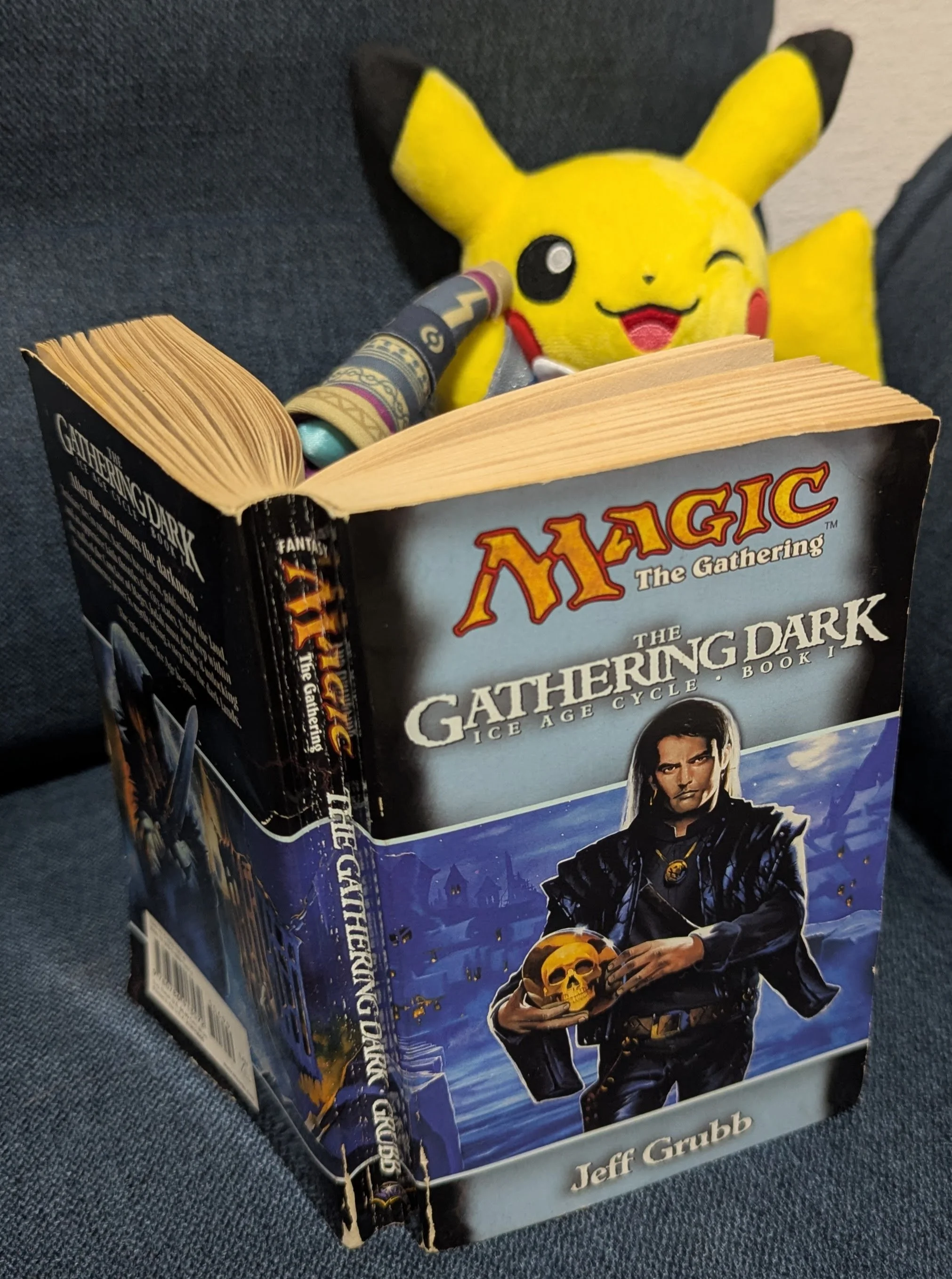
The Gathering Dark (Ice Age Cycle, Book 1) (Part 1 - Review)
Hello, all. Welcome to Dominaria’s Dark Age.
Of all the the Magic: the Gathering tie-in novels that Wizards of the Coast could choose to convert to e-book format, I am shocked that The Gathering Dark was not one of them. I’m sure there was a financial reason for this. Literarily, though, this is one of the stronger entries within the MTG catalog. It (and its sequels) are also the origin of characters who play dramatic roles in the stories of more recent MTG sets. I’m not going to pretend that this story is the precursor to The Will of the Many, but it is one that takes a very simple idea and transforms it into an enjoyable adventure. What’s more, it manages - either by design of the author, or simply the editorial standards of the time - to set an good example of what theme and social commentary in Fantasy used to be like, and what it could be again if authors are willing to make the effort.
Light your lamps, everyone. It’s time to venture into the dark.
STATS
Title: The Gathering Dark
Series: Ice Age Cycle (Book 1)
Author(s): Jeff Grubb
Genre: Epic Fantasy
First Printing: June 1999
Publisher: Wizards of the Coast LLC
SPOILER WARNING
Mild, unmarked spoilers for The Gathering Dark will be provided throughout this review. Heavy spoilers will be confined to clearly labeled sections. I will keep the first paragraph of any given section spoiler-free.
Throughout this review, I will also be providing heavy spoilers for later events within MTG canon. While I will be steering clear of details that would spoil the progression of this book specifically, there is a strong chance that you will figure out certain spoilers if you pay attention to these bits of lore. I’ll confine the heavy spoilers that are relevant to this book into clearly marked sections.
Heavy, unmarked spoilers for previously reviewed Magic: the Gathering tie-in novels may also be provided, regardless of where they fall in the timeline relative to this book. I will also assume that you’ve already read my reviews of those books, though they aren’t essential to understand this one.
STRUCTURE
This review will be split across two parts.
Part 1 (Today)
Premise
Timeline
Rating
Content Warning
Plot & Character
Worldbuilding
Part 2 (Wednesday, August 19th)
Spotlight on Theme & Social Commentary
PREMISE
Per the back cover of my mass market paperback copy (which, judging by the advertisements in the back, was printed in 2006), we get:
After the war comes the darkness.
Terisiare lies in ruins. Nations have fallen, goblins raid the land, and an oppressive faith throttles the city-states. Now deep within the walls of the Conclave of Mages, Jadah must decide if unlocking his own immese power is worth taking a step into the dark lands.
The epic of the Ice Age begins.
Reaction
This is a weird one to assess for me personally. In my recollections of this book, I remembered it exactly as it is described here. However, the structure of the second paragraph reflects how these ideas are spread through the story. The first half of this book involves Jodah dealing with the first three sentences of that paragraph, until he arrives at the Conclave. Then the back half is him studying magic at the enclave.
Still - technically, this premise is on-point. And the fact that, nearly 20 years after last reading it, I remembered the book exactly as it is described here says a lot about the structure of the plot. It could be said this premise is emotionally true.
TIMELINE
Once more, the MTG Wiki timeline swoops in to enlighten us.
The Gathering Dark is set in 430 AR. This is in the middle of the events of the flashback plot of Planeswalker, taking place 20 years before Urza finishes working on the dragon engine he will later use to invade Phyrexia (an assault that will be delayed for another 200 years, until 650 AR).
In terms of the set it adapts, The Gathering Dark is an adaptation of MTG’s fourth expansion, The Dark, released in August 1994.
RATING: 8/10
This book had no business being as good as it is.
The Gathering Dark is a cash grab to exploit a Magic: the Gathering set released five years earlier, a set that had already been made irrelevant in terms is story impact and power creep by the time this book released. For all the memes about Disney Star Wars making spin-offs from spin-offs, at least those spin-offs make a modicum of internal sense. This book is instead the embodiment of, “No one asked for this.”. Grubb could have half-assed this book the way Yarros does The Empyrean, and no one would have cared.
Instead, Grubb did the work. He delivered a simple story of a young man coming of age in a cold, darkening world. He masterful captured the vibe of a fantastical Dark Age, and he translated the mechanics of the MTG card game into an interesting and narratively coherent magic system. Perhaps most interesting of all, he did all of this and managed to deliver an impactful theme in the side.
CONTENT WARNING
While The Gathering Dark features a great deal of violence, a lot of it is of the magical, fantastical variety. There are only a few moments that could loosely be considered horrifying imagery. Sex is referenced in the most vague of terms that boil down to, “Young man finds a woman attractive.” Execution by burning at the stake and crossbow firing squad are mentioned but not shown. In fact, the only element of this book that is anything close to harrowing is a battle scene, where the focus is less on the gore and more on the fear and chaos. Again, as with the Artifacts Cycle books, I read this for the first time when I was 12, and looking back at it, I see nothing about this story to make me too young back then to be reading it.
PLOT & CHARACTER
The characters in The Gathering Dark are very simple, and we don’t get to know them all that well. Even Jodah, who is the main character and our POV for most of the story, is effectively a blank slate for the audience to project themselves onto. This is perfectly functional for the story being told; it also means that there’s not a lot to say about the characters outside of their role in the story.
For the first half of the book, Jodah is a wizard on the run. Since the Brothers’ War, the world has be struggling to slow its decline, and magic is blamed for most of the worsening problems (which is technically true, though Urza and Mishra were artificers, not wizards). This has made any practitioners of magic into pariahs, with the Church of Tal aggressively hunting them. Jodah spends this half of the story evading capture, surviving the plagues and war of this darkening world, and seeking whatever mentorship in magic that he can. The main antagonist for this half is Primata Delphine, a zealous member of the Church with a particularly passionate hatred of wizards and a personal hatred of Jodah specifically (since he has humiliated her by evading her grasp).
In the second half of the book, thanks to the intervention of the Rag Man (an undead creature created by the wizard Ith, who serves as Jodah’s guardian angel for the first half of the story), Jodah finds himself at the gates of the Conclave, a secret and decadent society of wizards led by the charismatic yet unstable Mairsil. Jodah is able to study magic in safety, but is drawn into both Mairsil’s machinations and the plans of Ith. It all leads of to a climactic battle when Primata Delphine locates the Conclave and rallies a Church army to assail it.
Like I said, a very simple story (which is why I didn’t bother labeling this section with heavy spoilers, despite describing the bulk of the plot). This is a very simple, fun, escapist Fantasy. It’s as much about enjoying the ride as it is about exploring the …
WORLDBUILDING
Vibes
Grubb really puts in the work to infuse the popular conception of real-world Europe’s Dark Ages into this book. We are shown a world in decay, with small powers fighting over scraps, disease and prejudice running rampant, and the only entity capable of holding everyone together and working across political lines is more interested in persecuting those it sees as evil and securing its own power and influence. The impending Dominarian Ice Age also makes things literally darker, with clouds, storms, and fog being the most common weather and sunny days being see as rare events.
Is this an accurate summation of the Dark Ages as a whole? No, but that’s not the point. This story isn’t trying to be some deep reflection upon our own history. It’s taking the popular conception that has built up in the Western consciousness since the Renaissance and translating it into a gripping setting. It’s about as beholden to reality as Warhammer 40K. And, ultimately, the vibes pay off. This book manages to feel dark and gritty without needing to shower the audience in profanities and gore.
Also, on the matter of the Church of Tal specifically, I think Grubb found a happy medium here. He could have made them into a strawman to criticize religion, Christianity, or Catholicism specifically. Some of the commentary in his epigraphs does at least open the possibility that some criticism was intended. However, in practice, what’s on the page is nothing so hostile or alienating. The Church is ultimately a stereotype translated into a straightforward faction of antagonists. He even balances it out by showing that wizards aren’t necessarily better, with the Conclave hoarding their gifts for their own indulgence and enslaving failed initiates rather than actually trying to help the world with their powers. The result is that the Church feels like a natural extension of a stylized world that maybe reflects the authors specific views. It’s part of the vibe if the setting. This means that, even if Grubb was trying to strawman Christianity to browbeat the audience, he made the Church of Tal so diegetic as to not be offensive.
Game Mechanics
This might just be my favorite aspect of the whole book.
A lot of time is spend on Jodah learning how to use magic - which, since this book is a tie-in for MTG, means translating the rules of a trading card game into diegetic aspects of the world. A lot of time is spent on Jodah’s experience with developing and calling upon memories of the land (playing and tapping Land cards) to generate mana for his spells. The five colors are explored as philosophical concepts (in addition to the obvious game application), and the five biomes (Basic Land types) needed to generate those colors of man's are clearly identified. Jodah finds himself unable to cast certain spells because the mana he’s wielding is the wrong color (which is a core aspect of paying mana costs). The story even folds in mana burn as a danger of using magic (for those of you who actually remember when mana burn was part of the rules of the game).
This never read like fanservice. Yes, as a player, I understood exactly what these different elements reflected, but the story didn’t lean on knowledge of game rules to prop itself up. Grubb treated these rules as a system that had to work entirely within the context of the story.
Fanservice
On that note, the book does have a lot of fanservice. It just never feels as forced as, say, the many references in Rath and Storm. The Maze of Ith is just an incomplete construction project, Barl’s Cage is never called that by name, and the cameo by Tivadar of Thorn is framed as Jodah using his charm to make friends with a random guard rather than a ham-fisted introduction of an in-world historic figure. Even the chapter dedicated to the Fountain of Youth (which is really important to Jodah becoming the Archmage Eternal) isn't really about the Fountain itself: it’s a montage of Jodah’s brief stint as a soldier, told through flashbacks as he stumbles upon the ruin where the Fountain is hidden.
In fact, out of the entire book, the only references that feel a bit forced and lean on external material are the ones to Grubb’s own work. It is stated that the castle occupied by the Conclave was originally the monastery for the Brotherhood of Gix. It’s strongly implied that the chasm beneath it is somehow linked to Phyrexia. Also, Jodah is a descendent of Jarsyl, meaning he’s also a descendent of Urza (or maybe Mishra, is one wants lean into the uncertain parentage of Urza’s wife's son - not sure if that ever got a canon answer). While these references are brought up organically, Grubb gives them an amount of weight that does makes it seem like The Brothers’ War was required reading for this book. Still, this is very minor, and it’s possible I’m only sensitive to it because I recognized them as deliberate references.
SOMETHING TO SAY
The Gathering Dark is a fun story that keeps things simple and yet delivers dividends. I think it is a great shame that Wizards of the Coast did not include it in the catalog of titles to make the jump to e-book format. Hopefully, if enough pressure can be applied to convince the trad-pub industry to revise their priorities, WotC will see the benefit of making this backlog title more widely available.
Aside from its objective merits as a story on its own, there is also the matter of how The Gathering Dark handles theme. This story teeters on the edge of blunt allegory. However, Grubb manages to walk a thin line and deliver an applicable theme instead. This story is a fantastic example of what messaging in Fantasy once was not so long ago. Next Wednesday, we’ll dig a little deeper into why that is.
Thank you all for joining this week. Please remember to subscribe and share if you enjoyed what you read here. Take care, everyone, and enjoy the rest of your week.