Prophecy (Masquerade Cycle, Book 3)
Hello, all. Welcome back to our exploration of MTG tie-in fiction, for the final book of the Masquerade Cycle.
While the crew of the Weatherlight had their adventures on Mercadia, and while Crovax and Ertai grasped for power on Rath, things were not quiet back on Dominaria. A couple of the heroes we got to know in Time Streams and Bloodlines had their own war to fight on the eve of the Phyrexian Invasion.
I distinctly remember hating this book the one time I read it back in middle school. It was simply depressing. I’m not even talking grimdark - it was just miserable. Not helping matters is that, despite being marketed on its connection to characters from the Artifacts Cycle, they only occupy a subplot. This is indeed an adaptation of the MTG set of the same name, but it’s certainly one where the author pushed things as far as he could with creative liberties.
Upon a reread, I have to say that my opinion of this book has changed drastically. It’s not bad. It’s not great, and I feel it stumbles at the end, but it’s honestly a solid bit of escapism that stands on its own without relying on investment in MTG as a whole.
Sound the horns. We’re going to war.
STATS
Title: Prophecy
Series: Masquerade Cycle (Book 3)
Author(s): Vance Moore
Genre: Epic Fantasy
First Printing: June 2000
Publisher: Wizards of the Coast LLC
SPOILER WARNING
Mild, unmarked spoilers for Prophecy will be provided throughout this review. Heavy spoilers will be confined to clearly labeled sections. I will keep the first paragraph of any given section spoiler-free.
Throughout this review, I will also be providing heavy spoilers for later events within MTG canon. While I will be steering clear of details that would spoil the progression of this book specifically, there is a strong chance that you will figure out certain spoilers if you pay attention to these bits of lore. I’ll confine the heavy spoilers that are relevant to this book into clearly marked sections.
Heavy, unmarked spoilers for previously reviewed Magic: the Gathering tie-in novels may also be provided, regardless of where they fall in the timeline relative to this book. I will also assume that you’ve already read my reviews of those books, though they aren’t essential to understand this one.
PREMISE
Per the back cover of my mass market paperback copy, we get:
War in Jamuraa!
The Keldons have landed in the north. The Jamuraan League of City-States has put together a ragtag defense and enlisted the help of the planeswalker, Teferi. But even a planeswalker cannot by himself hold back the might of Keld.
Reaction
I have no doubt that this is the story that Moore was commission to right. Technically speaking, this premise is present. There is a subplot, mostly told through the POV of Barrin, in which Teferi’s allies rally together to hold back the Keldon hordes.
The bulk of the book is actually about a guy named Haddad.
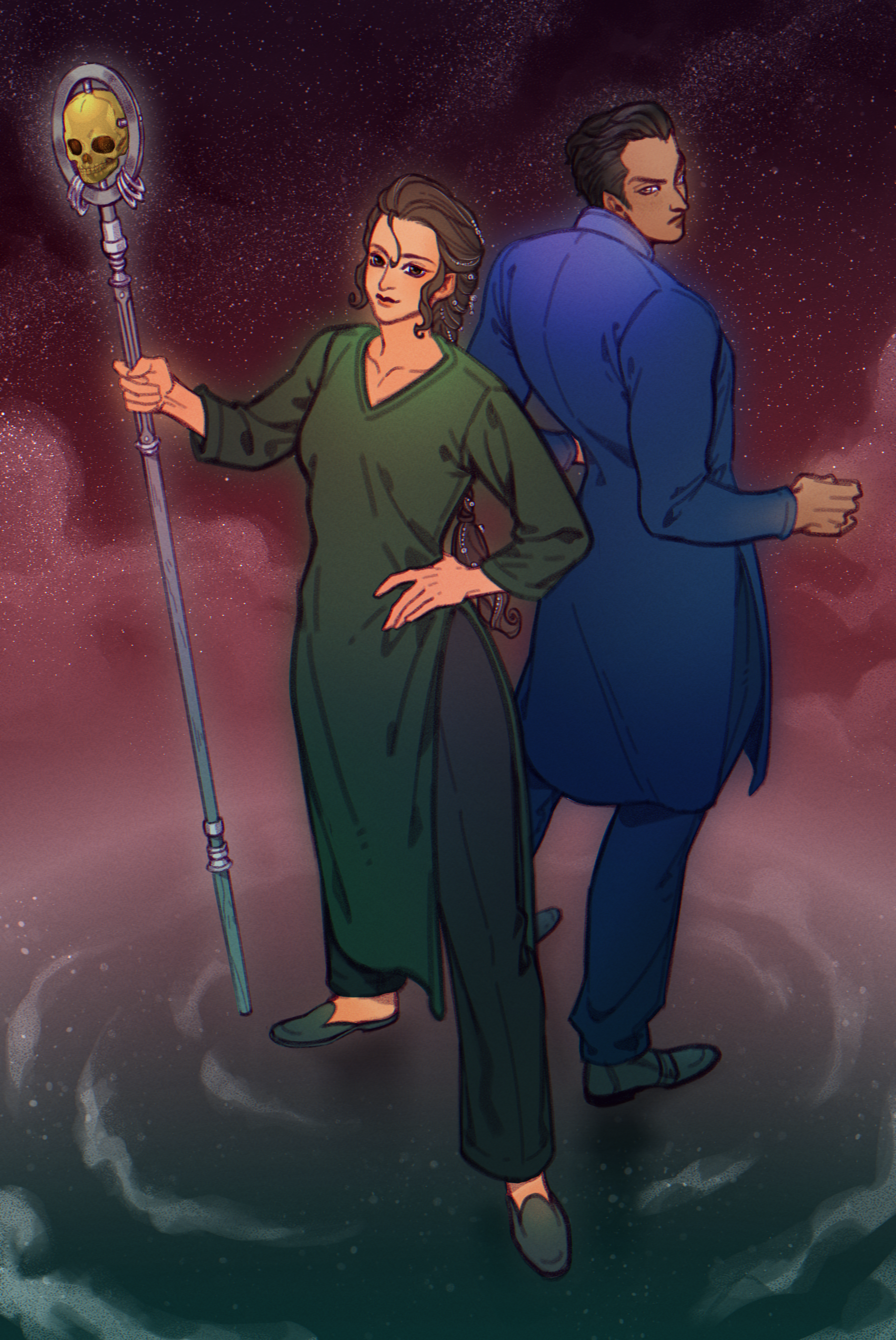
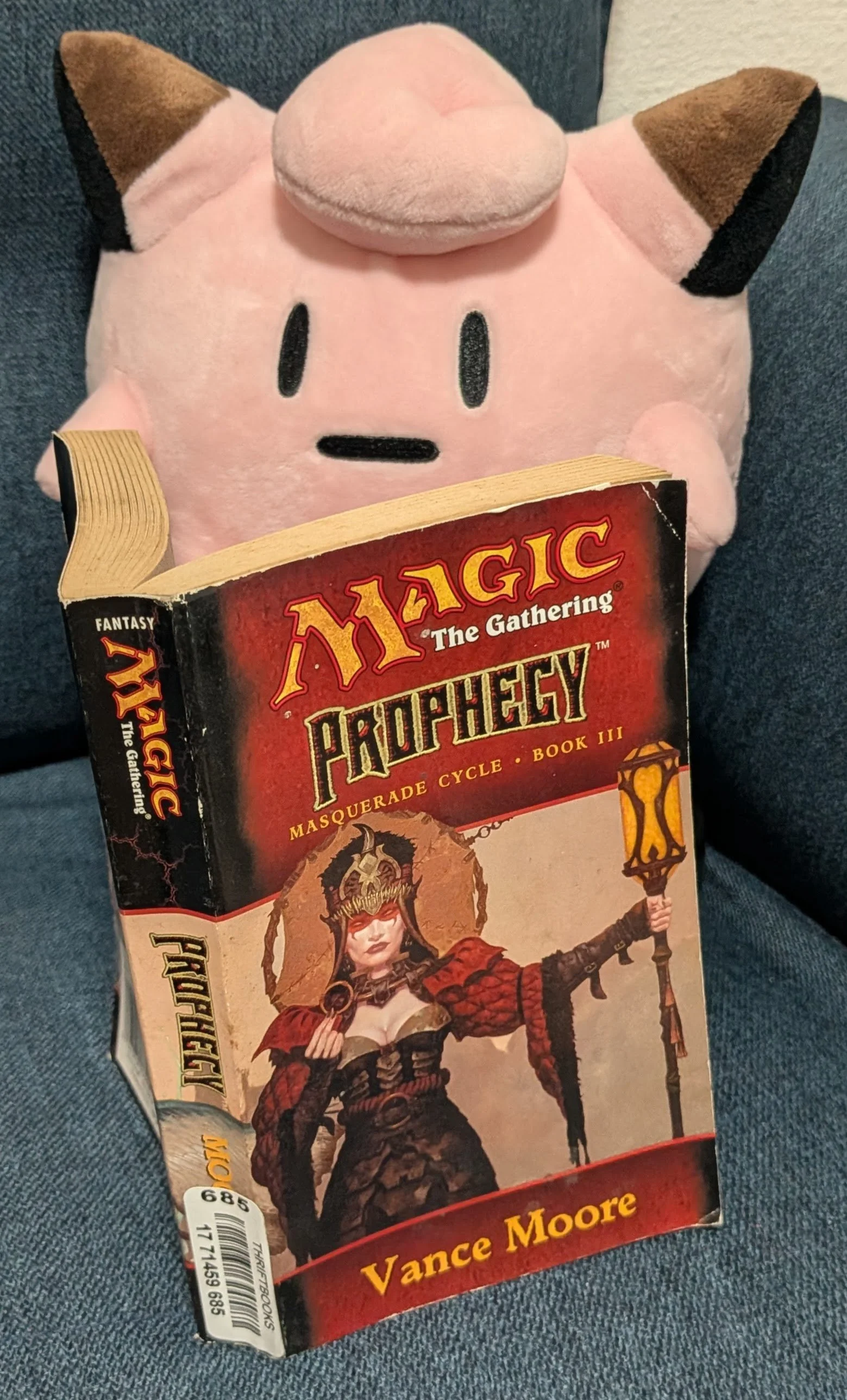
Haddadd is a Jamuraan soldier. More specifically, he’s a combat engineer, maintaining the constructs that fill the bulk of Jamuraa’s militaries. Early in the war, he is taken captive by the Keldons, enslaved, and assigned to serve Latulla, a high-ranked Keldon artificer and zealot who is driving this invasion forward. (She’s the lady shown on the front cover). The book is his perspective of the war, dragged along at Latulla’s heels as she pursues various objectives.
This is certainly a depressing story. Haddad is a character with zero agency, being dragged from one miserable situation to the next. That being said, it’s an engaging one. Moore takes the Keldons, a faction that are set up as archetypal Fantasy barbarians in Bloodlines, and explores them in even greater depth than we got in Bloodlines.
Bringing things back to the premise: if you want the story that is actually described on the back of this book, I think you will be disappointed. If you are open to a slower story that explores the villains without doing the Disneyfied retelling-the-villain’s-story bit, I think you might enjoy this.
TIMELINE
According to the MTG Wiki timeline, the events of Prophecy are confined to 4205 AR. I have no trouble believing that these events are happening at the same time as Mercadian Masques. Multiple timeskips of a month or more are mentioned.
This set adapts the events of the 20th MTG expansion, which shares the same name.
RATING: 6.5/10
Prophecy doesn’t seem like it should work. In a series of tie-in novels built around epic heroes and struggles, a tale following around a background extra with no agency really doesn’t seem that interesting. That being said, I think that Moore took what he’d been given to work with a delivered a really satisfying story with it.
As mentioned above, Haddad’s story may not be epic or triumphant, but it is interesting. We are getting to see the Keldons from an angle that wouldn’t normally be the main focus of the story, learning about their culture and meeting interesting characters produced by that culture. Plus, while Haddad lacks agency, it’s not like he sits around doing nothing. He is constantly looking for opportunities to escape. There’s palpable tension, the fear that he will either be caught and punished for these efforts or simply brutalized by the Keldons for failing in his daily duties.
On Barrin and Teferi’s side of things, there’s a sense of genuine stakes and weight. The story may not give us much reason to care about Jamuraa specifically, but because of Haddad’s experiences, there’s emotional investment in their victory simply so that the rest of Jamuraa doesn’t need to suffer the way Haddad does. This allows Moore to focus their chapters almost entirely on battles that would otherwise be pure spectacle.
Also, hats off Moore for how he handled fanservice. He acknowledges the looming Phyrexian invasion without allowing it to distract from the story he’s telling. Additionally, he successfully integrated some key lore from the MTG expansion without it feeling forced.
Initially, I wanted to get this story a much higher rating. The ending spoiled that. It’s not a bad ending, but I get the distinct impression Moore was rushing to get in under a maximum page count. Haddad’s ending works fine, but the ending of Barrin’s plot and the setup for Invasion end up feeling unearned.
CONTENT WARNING
Prophecies deals with a pretty brutally and bloody war. Keldons are not nice people, and the Jamuraans unleash some very nasty weapons to oppose them. The violence is generally unpleasant, the slavery scenes are miserable, and - while it is not explored - the Keldon practice of taking women captive to breed the next generation is certainly a dark element. Still, nothing here is all that remarkable in light of the rest of the Masquerade Cycle.
PLOT & CHARACTER (Heavy Spoilers)
Much like in Nemesis, I lump these together because the things I have to say about one allow apply to the other.
Haddad and His Plotline
Haddad’s plotline should be incredibly frustrating. He thinks a lot about escaping, but his plans never quite seem to get off the ground. This makes him a character with almost no agency. At the same time, though, his story is an interesting exploration of not only his captors but also the psychological effects of his captivity upon him.
The reason this story is so depressing starts with the futility of Haddad’s efforts to escape and ends with his death. He doesn’t even get a death that impacts the plot: he just gets blasted by Latulla with pain-inducing magic when he tries to make a break for it during the climax, and then his organs are shredded when a mage on Barrin’s side tries to save him.
Still, Haddad’s story is engaging overall. He’s a sympathetic character, and worry for his welfare provides plenty of tension. My only meaningful criticism of his story in particular is that Moore doesn’t actually Show slavery to be all that terrible. Sure, we see bad stuff in the beginning, so he’s not just relying on the principle of the matter, but for the bulk of the book, Haddad just comes across like a guy working a bad 9 to 5. I got to the end of this book and realized that a lot of the brutality I semi-remembered was actually me remembering scenes from Timothy Zahn’s Dragon and Slave, a book that much more effectively showcases how miserable slavery can be. (All this can be excused as Moore not wanting to disrupt the escapism by wallowing in misery, of course, but he kept Telling us how horrible things were, so the lack of Showing does dampen the impact somewhat.)
Barrin, Teferi, and the War Plotline
This plotline works pretty well prior to the climax. The knowledge that more people might share in Haddad’s fate grants stakes to battles that would otherwise be meaningless noise.
I was pleasantly surprised with how Barrin was used. He’s not much of a character, just a generic wizard who came to lend a hand, yet his authority and his magic provide a diegetic means for Moore to describe skirmishes and entire battles in a near-omnipotent POV.
I’m a little more mixed about how his wife Rayne was used. I knew Rayne was going to die in this story. Aside from the fact I re-read Invasion before rereading this one, and thus knew Barrin’s characterization (such that it is) in that book is colored by her death in this one, her death was rather hilariously telegraphed by this overwrought line in her introduction scene.
He felt younger as he looked at her. Appearing only in her thirties, Barrin wondered at the decades of love they had shared and the centuries that would be theirs.
Rayne ends up surviving a couple battles throughout the story, and then she dies to … dumb luck She just happens to be in the vicinity of the only fanservice character who didn’t feel earned. Barrins rampage after she dies feels earned, but the death itself feels forced.
The biggest issue with this subplot, though, is the man named in the premise: Teferi. He is barely in this story. He’s helping to organize the alliance against Keld, taking full advantage of his planeswalking to coordinate offensives, and he also gets two scenes where he applies his immense magical power to devastating effect, but we’re not given a good reason as to why he doesn’t do more. This is, by itself, a contrivance, but then the epilogue makes a big deal about how Teferi has been deeply impacted by this conflict and has committed himself to defending his homeland his way rather than Urza’s way. That simply is not earned. If anything, given how Urza’s involvement in this conflict was to deny Teferi military resources to win the battle more decisively, one would think Teferi would emerge from this conflict with the desire to become some sort of brutal yet efficient wizard-tyrant, rather than moping in his “palace” because he killed a lot of people in wartime. (This gets even sillier in Invasion, why it’s revealed this this epilogue is setting up his plan to phase Zhalfir and Shiv out of reality.)
WORLDBUILDING
Keldons
While it’s not explicitly stated, the Keldons we meet in Prophecy are implied to be directly impacted by the eugenics experiments Gatha subjected them to during the events of Bloodlines. Some of the Keldon mythology seems to be references Gatha’s earliest successes, and the Keldons are described in a way that makes it seem like his enhancements have spread through the general Keldon population. On the flip side of this, the Keldons are not suffering a fertility crisis. It’s mentioned that infant mortality is incredibly high. What’s more, the Keldons are now wholly dependent on captured foreign women to breed. This can be partially chalked up to the culture encouraging Keldon women not to bother with reproducing, yet at the same time, it’s hard to ignore that this strategy is also forcing a lot of fresh genetic material into the Keldon population. Seems like the two issues may be connected.
Also, I think the Keldon’s reason for invading is rather clever: they want oil. The Keldons involved in this war believe that Jamuraa is the originally Keldon homeland, and “tufa”, a substance that can refined into a potent and very flammable magical fuel, is supposedly the blood of their ancestors. A lot of the Keldon efforts are focused on finding places from which they can extract this oil and use it in their war machines, even as the Jamuraans are doing the exact same thing for their war machines.
Fanservice
Phyrexians
Not going to lie - I thought the big twist about tufa is that it is actually glistening oil, and that there would be this big twist that revealed that certain Keldons had been corrupted into Phyrexians. Again, I was confusing books. That is not what happens.
The actual Phyrexian involvement in this story is in the form of plagues. In the back half of this story, a plague begins to spread across Jamuraa. The Jamuraans blame the Keldons, only for later Haddad POV scenes to reveal that the Keldons thing it’s a Jamuraan weapon. it’s not until nearly the end of the climax that we get the reveal that the spores responsible for spreading this plague are “part organic material and part machine”. Even then, it’s not explicitly acknowledged as a Phyrexian weapon.
I think that handling the Phyrexians this way was the right call. If they had played a bigger role in the story, then making the plague more important and putting more emphasis on the reveal would have made sense. For the version of the story we got, the plague works as a mystery to encourage readers to continue onward to Invasion without distracting from the conflict at hand.
Spellshapers
In the Nemesis MTG expansion, there is a cycle of five Legendary Creatures with the Spellshaper subtype, one for each color. Latulla is the red one. Whether because of a WotC mandate or because he thought these were just interesting characters to explore, Moore made sure to make the other four into important secondary characters. Out of these four, Jolrael (green), Mageta (white), and Alexi (blue) are all allied with the Jamuraan League. The black one, Greel, serves the Keldons.
Most of of these characters feel like organic inclusions in the narrative. Greel does not. He’s introduced in the last third of the book, with Haddad witnessing his frightening ascension and how he becomes one of Latulla’s favored allies. The issue is, he’s implied to be this huge threat (perhaps even a Phyrexian), only to not matter at all. He happens to bump into Rayne and kill her. That’s it. It’s not clear exactly what Barrin does to him (or if he was even properly finished off), only that he vanishes from the story in a shower of gore when Barrin nukes him with magic. I suppose that, given what Barrin does in Invasion, we can indirectly blame Greel for the annihilation of Tolaria, but that does make him any more relevant to the book in which he actually appears.
Greel aside, I do think that the spellshapers are handled well. This was a good application of prominent characters from the card game without overwhelming the narrative.
VICTORY (?)
Prophecy ends the Masquerade Cycle on a high note. It’s far from a perfect story. Still, after the whirlwind that is Mercadian Masques and the fumble of Nemesis, I think this one struck just the right balance between plot and character. it delivers good, escapist narrative, albeit a dark one.
Next up in the MTG novel chronology is …
…
… oh. The Invasion Cycle.
The Artifacts Cycle and Rath and Storm were Phase I and II of the Weatherlight Saga (it’s up to you which is which, since they released at the same time). The Masquerade Cycle is Phase III. In this analogy, that would make the Invasion Cycle the combination of Infinity War and Endgame. Rather appropriately, it depicts one massive war that is Yawgmoth’s endgame.
It does not stick the landing. At all.
To be fair to J. Robert King, who wrote all four books of the Invasion Cycle (there are only three official books, but The Thran is considered a prequel to them), he had to take a series written by many other authors and deliver a satisfying finale. The effort was there. It’s just done very messily. Originally, I’d hoped that maybe it only seemed messy because I’d skipped the Masquerade Cycle. That hope did not pan out. If anything, reading the Masquerade Cycle retroactively opened cans of worm (or, I suppose, made me aware of the worms that had been on the floor all along). The only issue with the Invasion Cycle that was fixed by doubling back is that Barrin’s behavior in Invasion suddenly makes a lot more sense when you realize his wife might not have died if Urza hadn’t denied him and Teferi vital reinforcement here in Prophecy.
Originally, I was going to review this one the same way as the Artifacts cycle, spacing it out over months while doing other books in between. I actually drafted the review for unofficial Book 0 of the Invasion Cycle, The Thran, and then started working on the review for Invasion. However, I chose to read Planeshift before I started on the Invasion review. What I found convinced me that I just needed to buckle down and rattle through this whole series rapid-fire, the same way we did for the Masquerade Cycle. The reviews for the individual books will be longer (and thus, broken up into multiple parts), and we’ll have a handful of spotlight analyses before it’s all said and done. It’s going to be a pretty big project.
Consequently, I need time for it to cook, as well as space in my schedule to slot it in. You’re probably not going to see it until January, at the earliest. Thank you all for your patience.
If you’re looking for more stories of magic and intrigue in the interim, A Chime for These Hallowed Bones. Chapter 1 through Chapter 11 Part 1 are now posted. Join in for the ongoing adventure!
Thank you all for your continued patience and support. Please remember to subscribe and share if you enjoyed what you read here. Take care, everyone, and enjoy the rest of your week.