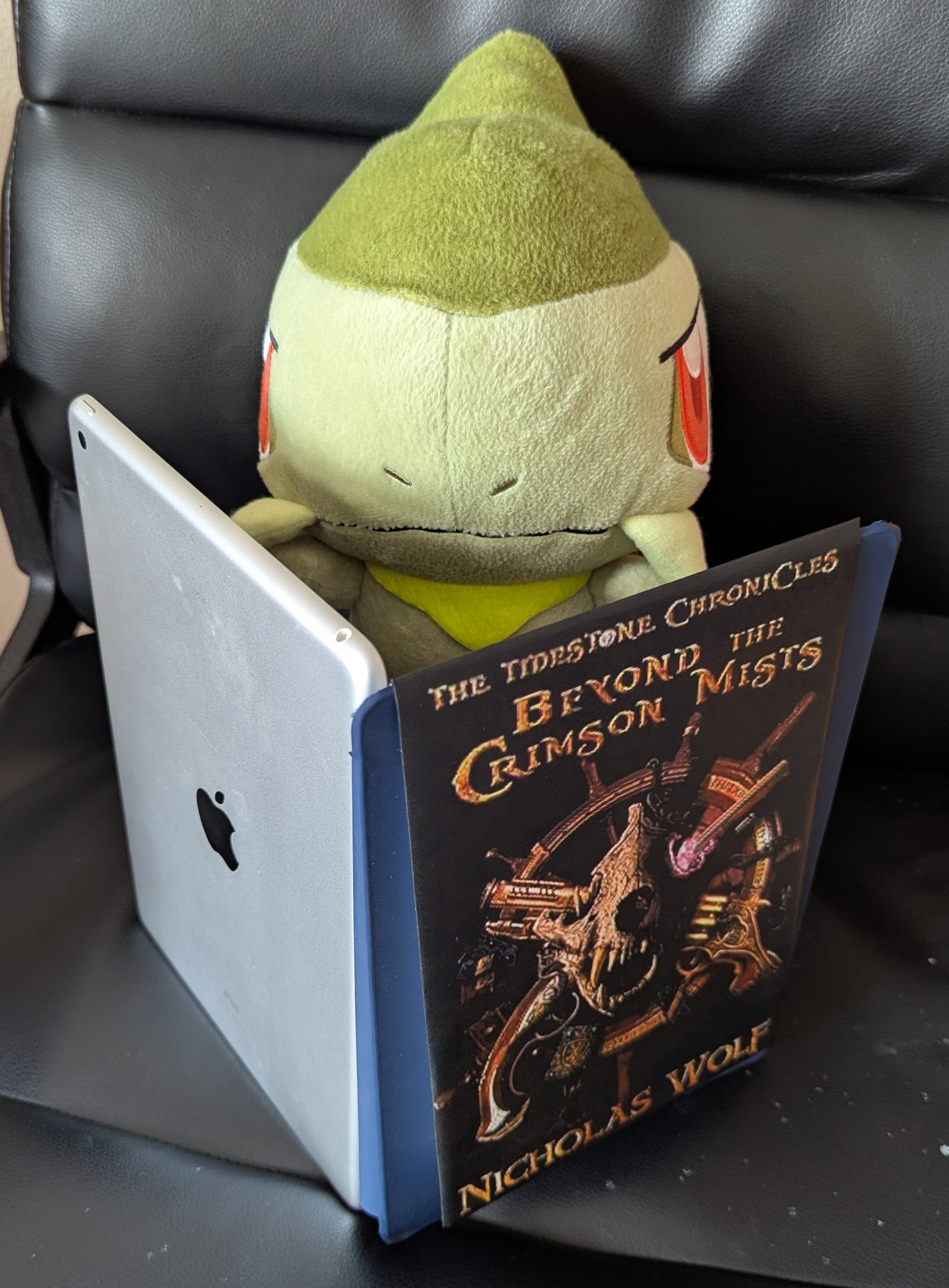
Beyond the Crimson Mists (The Tidestone Chronicles, Book 1)
Merry Christmas, all.
I learned of this book through Fandom Pulse … sort of. I saw a post of Twitter advertising that the author, Nicholas Wolf, had been interviewed by Fandom Pulse. At the time, I wasn’t interested in the article, but the preview told me that Wolf had also done some writing for Black Library and that the article was about the challenges of being a Christian author in the modern media landscape. Those elements intrigued me enough to look Wolf up for myself and to buy this book.
Off the bat, I will note that despite the article in question, this book is not Christian Literature. At most, this is a Fantasy that enshrines values Christians will agree with. It is closer to Lord of the Rings than it is to anything in Narnia.
AUTHOR
Nicholas Wolf is indeed a writer who has done a lot of work for Warhammer. Most of his work for Black Library appears to be either novellas or short stories, often included in anthologies. At least according to Amazon, the only works of his that aren’t some form of Warhammer content are The Tidestone Chronicles and a story in Shoot the Devil 3: Militia of Martyrs. According to his Twitter (or, at least, a rather convincing fake account - one can never tell these days), he also does (or, at least, used to do) freelance illustration work.
What I find most fascinating about Wolf is that there is a very obvious pattern to his work. This man writes grimdark. He writes horror. He writes tales of hardened warriors shooting unambiguously evil entities in the face.
Beyond the Crimson Mists is none of these things. Oh, it’s got plenty of dark elements, and we’ll get to those, but it reads more like a more classical heroic adventure whose characters have been defined by tragedy and are now working to prevent more tragedy. It reminds me of Fullmetal Alchemist in that regard. Maybe Wolf was doing this deliberately, or maybe this is what his non-horror works are normally like when stripped of the trappings of their grimdark settings. Having not read his other works, I can’t say for certain either way.
STATS
Title: Beyond the Crimson Mists
Series: The Tidestone Chronicles (Book 1)
Author(s): Nicholas Wolf
Genre: Epic Fantasy
First Printing: February 2024
Publisher: Immortal Works LLC
SPOILER WARNING
Mild, unmarked spoilers for Beyond the Crimson Mists will be provided throughout this review. Heavy spoilers will be confined to clearly labeled sections. I will keep the first paragraph of any given section spoiler-free.
TERMINOLOGY
Wolf populated this world with his fantastical races of his own creation - or, at least, archetypical races with unique names. We have:
Atantyans. While this race and their homeland, Atlantyoc, is an obvious homage to Atlantis, complete with their advanced civilization being swallowed by the sea, it quickly becomes apparent that they are elves, right down to being extremely long-lived (if not immortal) and having pointed ears
roqlyudi. These are a race of stout, bearded people who have skin like stone, a love of treasure, and a talent for crafting automatons. Given the lack of mention of pointed ears, I think we can rule out the idea that a roqlyud is a gnome, which leaves them as one of the more tech-minded incarnations of dwarves.
waraabei. There are described as rather ugly dog-people. However, judging by an image used as the banner on Nichoals Wolf’s Twitter profile at the time I drafted this review, I think it’s reasonable that he intends them to be read as hyena-people but didn’t want to outright say “hyena”. I supposed one could argue that this makes the waraabei the equivalent to gnolls, but that race is so closely tied to D&D that the name likely had to be changed for copyright reasons.
nurians. This race is never clearly described as having any special traits, serving instead as a baseline from which the other races are described. They are almost certainly humans.
Since I’m sure I’m going to misspell most of these names going forward, I will only be referring to waraabei by their proper name. Atlantyans, roqlyudi, and nurians shall respectively be referred to as elves, dwarves, and humans.
STRUCTURE
Today we’ll be covering the following.
Premise
Rating
Series
Content Warning
Plot
Character
Worldbuilding
PREMISE
The Amazon product page for the e-book was missing when I drafted this, so we’ll be going with the premise from the paperback version.
With mythical Atlantyoc sunk to the bottom of the Endless Sea, the only way for the peoples of Myr to harvest more precious tidestone is to wait for the enigmatic Five Moons to align. It’s only happened 152 times since the Maelstrom, but each time it’s triggered a world war, as the dying kingdoms of Myr desperately launch their fleets and armies to claim the priceless stones, without which their societies will collapse into darkness once more.
Hawthorne “Hawk” Hawkins, conscripted into the 152nd Tidestone War, lost everything fighting for the callous Lord Croft. With nothing left of his home, he escapes Croftland in a stolen tidestone airship, the Suncatcher, and flees for the pirate port of Janga Bay to start anew. But the life of a pirate and smuggler proves far harder than he’d imagined, and within a New Moon Hawk finds himself broke, haunted by regret from the family he couldn’t save, and the Suncatcher’s tidestone core nearly spent. After an errant tavern brawl lands Hawk deeply indebted to a local crime lord, and squarely in the sights of the murderous waraabei pirate Rak-Tak, Hawk has no choice but to accept a cryptic contract to transport a mysterious girl to a place beyond the volcanic Crimson Mists, a journey no one has ever returned from alive. Chased by Rak-Tak’s murderous crew and darker forces beyond his comprehension, and aided only by his unhelpfully bloodthirsty war golem Urthanq, Hawk finds himself drawn into a desperate struggle that could hold the fate of Myr in the balance, for there is far more to this enigmatic young girl than meets the eye...
Reaction
This is an example of a premise that misplaces its focus. Everything stated is correct (though I didn’t really get the impression that Oleg was really a “local crime lord”, just a very tough bartender with friends in low places). It’s just that the adventure, while certainly present, isn’t really what the story is about.
RATING: 8 / 10
Beyond the Crimson Mists is a wonderful character study that takes the character of the young yet cynical rogue motivated entirely by money and uses the adventure thrust upon him to explore how and why he became that way.
Hawk is not a particularly complicated character. He’s a deserter who drinks heavily to cope with his trauma, yet has a heart of gold beneath the surface. Before the end of Chapter 5, before the narrative proper can even get started, we understand that the greatest trauma in his life has something to do with him losing his younger sister during the recent war that he fought in. Getting a mission to transport a young girl is obviously going to push his buttons and lay bare his pain.
However, in execution, Hawk’s story is compelling. Through a series of pivotal character decisions in the story’s present and well-timed flashbacks to relay Hawk’s past, we experience his anguish. We walk through his regrets. We come to understand and empathize with him, rather than merely acknowledging him.
The only reason I don’t rate this book higher is that Wolf had room to take things further. The adventure in which this character study is wrapped is a bit bland and predictable. Books like Jade City demonstrate that one need not chose between deep, nuanced characters and gripping external conflicts. Still, what we got here is fantastic. I would highly recommend this book.
SERIES
Wolf has indicated on Twitter that there will be at least two additional entries to The Tidestone Chronicles. Book 2, titled The Battle of Sapphire Bay, is supposed to release sometime around when this review if published, and I’m hoping to review it in March. At this time, it’s not clear what the status is on Book 3, through as of April 7th, Wolf claimed to be working on Book 3. It’s interesting to note while Beyond the Crimson Mists was published traditionally (Immortal Works is a small press operating out of Utah, not a business entity owned by the author), Wolf stated on May 7th that he would self-publish these two remaining entries. Given the timing, my assumption is that he is jumping onboard the self-publishing movement.
This raises an interesting question: will the quality of later books hold up to the original? How much of an influence did an editor or editors associated with Immortal Works have upon Beyond the Crimson Mists? Will Wolf be able to pick up the slack himself or else hire good editors to help him make up for any lost feedback?
Setting that matter aside, I do think that Beyond the Crimson Mists is effective as an opener of a series. Much like Way of the Wolf did for Magnetic Magic, most of the book is dedicated to setting up the remainder of the series, yet there is enough story here for the book to stand on its own. This is looking like it will be a very episodic series. I do think that Beyond the Crimson Mists did a better job in telling its own story than Way of the Wolf did, though it’s hard whether that’s due to the story being better told or Wolf having fewer dynamics and plot hooks that he needed to prepare.
CONTENT WARNING
Violence & Gore
This is a story about smugglers and pirates, so naturally, there is lots of gritty, bloody violence. It’s honestly not any worse than what we saw in The Will of the Many, and it likewise never feels excessive.
PTSD & Alcoholism
Hawk is deeply traumatized by both the things he saw in war prior to his desertion and the death of his sister in particular. He drinks an alcohol called “gryg” as a coping mechanism. This is a pivotal part of his character from the opening chapters onwards, and he never actually gets past it. At most, he finds a new sense of purpose and manages to cope with shortages of alcohol.
I’m not an expert in either PTSD or alcoholism. Still, I feel like what was presented in the page was tastefully done. Wolf never overdoes the PTSD. As for the alcoholism, he takes the time to explore the nuances. Hawk isn’t a parody of the film version of Haymitch Abernathy. Through his 1st Person POV, we experience his swings into an out of sobriety, how much he is defined by his dependence on alcohol, and moments where he laments that dependence. There are a few moments where Hawk debating whether to drink gryg in one situation or another feels like it is being played for comedy, yet even then, the humor comes from Hawk arguing with himself, rather than because we are supposed to laugh at the man suffering from a crippling dependency.
PLOT
This is by far the weakest aspect of narrative, particularly in its handling of the many action scenes.
While the action scenes themselves are written well enough, they do not feel like consequential, relevant pieces of the narrative. It is a mixture of the problems we saw in The Demon’s Eye and A Master of Djinn. These scenes feel obligatory, as if Wolf did not trust the narrative to hold the audience’s interest without routine peril and gunfire. At the same time, there’s never a sense that any of the core cast are actually in danger. There are consequences to these scenes, yet said consequences feel like they only exist because the plot demand that they do, rather than the plot flowing naturally form the consequences.
This issue was bad enough that I checked out of the final action scene. There's an extended action sequence that feels like the climax of the book, with only the promise of one last scene of peril ahead … yet then I looked down and saw that the book still had 90% of its length left. When the true climax arrived, I was disinterested, as I didn’t seriously think that this last-minute sequence would matter to the narrative. Wolf does redeem this true climax with a solid ending, yet the whole climax should have been engaging, not the last few pages.
Also, while this book is mostly decent about setup and foreshadowing, arguably the most important character conflict in the book is set up one chapter before it happens. The way Wolf sets it up is by teasing this conflict, having Hawk defuse the situation with a trick that he knows will only work a limited number of times, and then have the conflict appear in the very next chapter, with no further prompting, only this time the trick fails. It makes it seem like the trick was a pointless fakeout.
Outside of these flaws, I don't have a lot to say about the plot. It is a simple romp between action scenes as Hawk gets the job and then tries to fulfill it.
CHARACTER
Captain Hawthorne “Hawk” Hawkins
Hawk is the 1st-Person POV throughout this narrative. He is, as we’ve covered thus far, a young and down-on-his luck scoundrel who deals with his trauma through copious drinking. Beneath his selfish and self-destructive exterior is a heart of gold that restrains him from directly harming others and makes him protective of girls.
Beyond the Crimson Mists is ultimately about Hawk, rather than the adventure. It was very important for Wolf to get this character right. I’d say that he succeeded. Hawk is a very likeable and sympathetic character, even in his most self-destructive moments.
While we get a lot about Hawk’s backstory via the flashbacks, more is less only as vague, hand-waved descriptions. We know that the is a deserter who stole his airship when he deserted, but not the specifics. The same can be said about his ownership of his only crew member, the war golem Urthanq, along with various anecdotes about past adventures that he uses to introduce situations that he’s familiar with. I don’t feel like a deeper dive into these things is necessary, I suspect that we may get flashbacks to provide more detailed accounts of these events in future books in the series.
Urthanq
At some unspecified point in the past, Hawk stole Urthanq from a pirate captain and had the golem “soul-bound” to him. This makes protecting Hawk’s “wellbeing” one of the golem’s Motive Tenants. This forces Urthanq to be loyal to Hawk, though this does not make it a blind follower whom Hawk can order around. Urthanq can challenge or undermine Hawk any time it decides that Hawk’s actions threatens its own well-being (something that Hawk's nature ensures to be a frequent occurrence). The war golem also prefers violent solutions to problems, forcing Hawk to give very specific orders and run interference during discussions with other people to prevent Urthanq from killing anyone within reach.
Urthanq serves two purposes within the story. The first is as a source of dry comedy, though since that comedy is limited to Urthanq reminding Hawk that it is a machine, this outstays its welcome pretty quickly. The other is to be the devil on Hawk’s shoulder. Urthanq has no morality whatsoever, see Hawk’s survival as a numbers game, and it will readily urge Hawk to steal and murder in the name of avoiding danger and acquiring money as efficiently as possible. The impact of this is somewhat muffled by the fact Hawk usually decides he is not going to do the thing Urthanq recommends before Urthanq recommends it. However, Urthanq is still effective in this role because of its ability to go against Hawk’s wishes in the name of preserving Hawk’s wellbeing. It takes internal temptations and manifests them as an external threat, forcing Hawk to actively oppose these things rather than passively deciding to not do them.
Nyomi (Heavy Spoilers)
The “mysterious”, “enigmatic young girl” promised in the premise, Nyomi mostly functions as a plot device. While she does have her own identity in the form of her somber, precocious characterization, her actual role in the story is to help Hawk process the death of his younger sister and find purpose in his life again by putting her wellbeing and the promise to take her to safety above his own needs.
I don’t think that this is necessarily a problem, given that this book is ultimately about Hawk’s personal journey. One thing that does bother me a bit, though, is that Nyomi’s characterization shifts dramatically for the climax.
For most of the book, Nyomi wears a hood. The reason why becomes clear when Hawk makes a pitstop on an island to gather supplies: she’s an elf. She takes her hood down, exposing her pointed ears, and uses elf magic to summon a tidestone (more on that shortly) from the ocean. She does this as a way to thank Hawk for the kindness he’d shown her, building off an early moment when he mentioned that one of his weapons needed a new tidestone.
This is a very dumb decision of Nyomi’s part. Even if she thought she could get away with using elf magic to summon a tidestone (i.e. maybe she thought she could just pretend to have found it on the beach, since the established mechanic for tidestones is that they get washed up during certain time periods), why did she pull down her hood? She had to know Hawk and Urthanq would return from foraging at any moment, and Urthanq has already expressed a willingness to kill her to simplify Hawk’s life.
This is easy enough to rationalize, though: Nyomi is a child. A preteen, at the oldest. If teaching elementary school has taught me anything, it’s that even brilliant children in that age bracket can overlook very obvious things. I can accept that she might think she was safe to pull her hood down for a few minutes.
However … then the climax rolls around, and Nyomi suddenly sounds like Leia from the Obi-Wan Kenobi TV show (that is to say, she sounds like a thirty-something man in a child’s body). Aside from the voice issue, she also becomes far more assertive and adaptive, whereas before she was always hiding behind adult characters when stressful situations arose.
This latter characterization is also explained. Despite looking like a child, Nyomi is at least thirty years old (with the implication being that elves age much slower).
The question becomes: which is it? Is Nyomi childlike, or is she an adult is a little girl’s body? If this were a simple matter of her having the knowledge of an adult with the maturity of a child, that would be fine, but what we get on the page are two distinct characterizations without a clear reason why both exist. Was Nyomi just pretending to be a helpless child when Urthanq threatened to smash Hawk into the floor to get to and kill her?
This issue isn't huge in the grand scheme of things. It is just very hard to ignore. I really don't know when to expect from Nyomi when the sequel rolls around.
WORLDBUILDING
Just a quick refresh of what we were told in the premise:
With mythical Atlantyoc sunk to the bottom of the Endless Sea, the only way for the peoples of Myr to harvest more precious tidestone is to wait for the enigmatic Five Moons to align. It’s only happened 152 times since the Maelstrom, but each time it’s triggered a world war, as the dying kingdoms of Myr desperately launch their fleets and armies to claim the priceless stones, without which their societies will collapse into darkness once more.
Tidestone
These are effectively mana crystals, and they are what drive the technological magic system of the setting. These are used to fuel everything from lanterns to energy weapons to the engine of Hawk’s airship. Every tidestone has a finite amount of energy before it “manabreaks”, spontaneously burning out and rendering whatever it is powering useless. This can be mitigated to some extent by keeping the tidestones near “leylines”, but this outcome is inevitable. Further aggravating the finite nature of the tidestones is their rarity: once per generation, they wash out of the sea and onto the beaches of Myr, triggering a Tidestone War as the different nations battle over these new tidestone supplies.
Tidestones are an essential component of this story, despite not directly driving the plot. The threat of manabreak is established early on, and while we don’t see it happen again, Wolf doesn't abuse it to the point that it becomes an empty threat. The worldbuilding also enshrines the idea that these are a finite resource that people are desperate for. There is all manner of defunct technology scattered about because people can no longer afford to waste tidestone on it. My personal example is the cart we see in a flashback to Will’s life on his family farm, which used to be a self-propelled vehicle but that manabroke before Will was born.
Atlantyoc
The ancient civilization of the elves is a blatant Atlantis expy. Still, it is at least effective in that role. At a few points in the story, Hawk encounters intact elf temples that hint at a deeper mystery to be unraveled as the series progresses. There are also cases where he encounters tidestone technology that is visibly different from the tidestone tech he is used to, implying that it may be salvaged Atlantyan tech.
One detail worth noting is that the origin story of the waraabei is that they were originally a slave race of the elves. I suspect this is a detail that will get more exploration as the series progresses.
ONWARD TO SAPPHIRE BAY
Beyond the Crimson Mists is a great start for The Tidestone Chronicles. While it has its weak points, the overall quality of its character study makes it worthwhile. I highly recommend it if you are into Epic Fantasy with scoundrels or nautical themed.
On that note, we will be reviewing The Battle of Sapphire Bay. As stated in the winter schedule announcement, my goal is to do that review on March 27th, but that’s going to be subject to when the book actually releases. We’ll see how the schedule evolves as we go forward.
Whatever you’re here for, thanks for stopping by. Please remember to subscribe for the newsletter if you’d like a weekly e-mail update with the latest post links, and share this review with others if you enjoyed it. Until next time, take care, and have a good week.