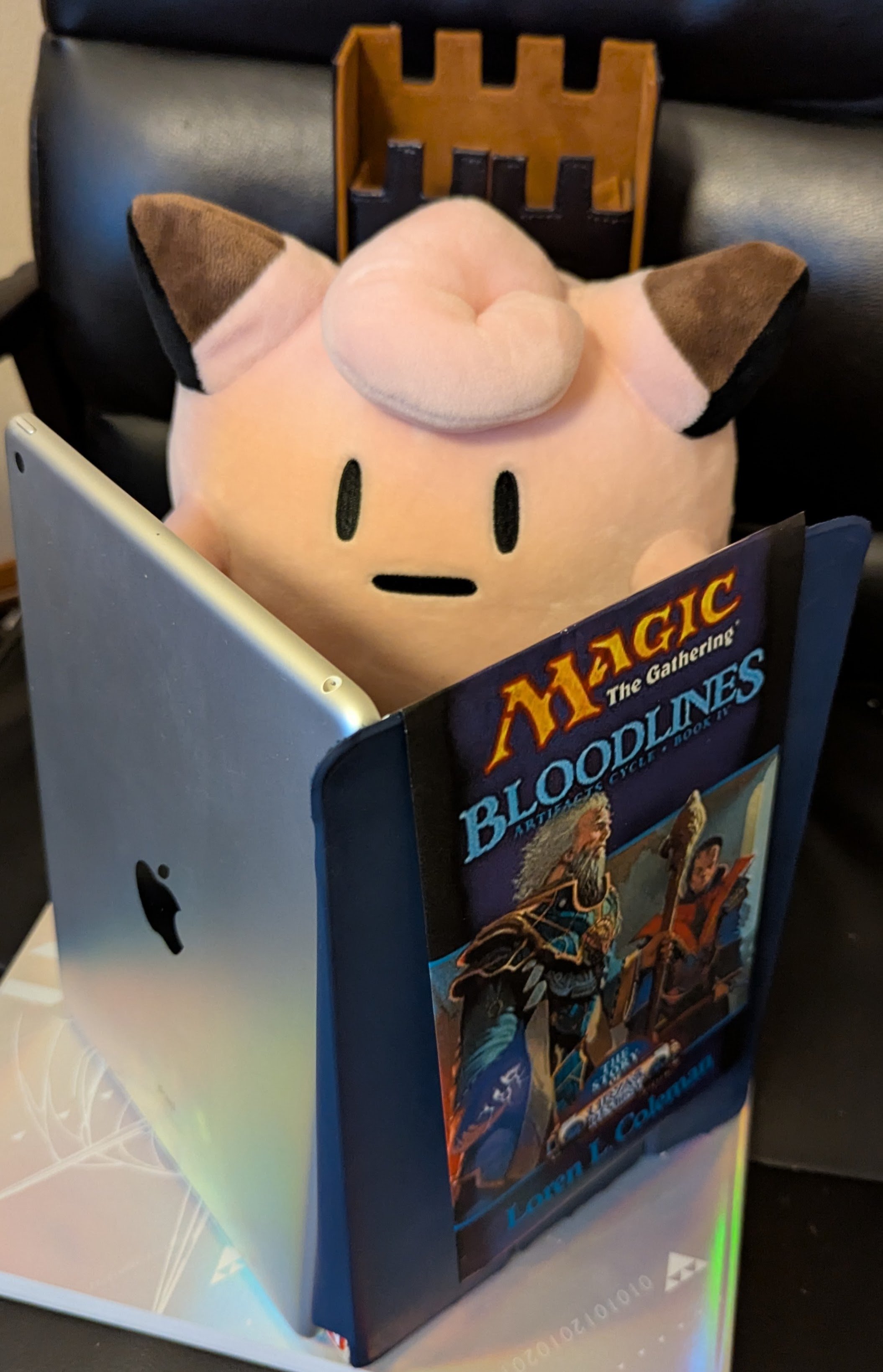
Bloodlines (The Artifacts Cycle, Book 4) (Part 2 - Worldbuilding & Character)
Welcome back, everyone, for the final entry in the exploration of the Artifacts Cycle tie-in novels for Magic: the Gathering (MTG).
This is Part 2 of the Bloodlines review series. Please see Part 1 if you’d just like the overview, including the rating and context about where this book fits into the wider MTG timeline. We’ll wrap this up next week with Part 3, dissecting the plot and theme.
Let’s go for a ‘walk.
STATS
Title: Bloodlines
Series: The Artifacts Cycle (Book 4)
Author(s): Loren L. Coleman
Genre: Epic Fantasy
First Printing: August 1999
Publisher: Wizards of the Coast LLC
Rating: 6.5 / 10
SPOILER WARNING
Mild, unmarked spoilers for Bloodlines will be provided throughout this review. Heavy spoilers will be confined to clearly labeled sections. I will keep the first paragraph of any given section spoiler-free.
Throughout this review, I will also be providing heavy spoilers for later events within MTG canon. While I will be steering clear of details that would spoil the progression of this book specifically, there is a strong chance that you will figure out certain spoilers if you pay attention to these bits of lore. I’ll confine the heavy spoilers that are relevant to this book into clearly marked sections.
Heavy, unmarked spoilers for The Brothers’ War, Planeswalker, and Time Streams will be provided throughout this review. I will also assume that you’ve already read my reviews of those books, though they aren’t essential to understand this one.
WORLDBUILDING
(Phyrexian) Eugenics
The Bloodlines Project takes two forms:
The engineering of the Methathran, a race of humanoid constructs (supposedly - the novel teases that they are more than that, but never explores it) to serve a supersoldiers to fill Dominaria’s armies.
The engineered bloodlines that produce the heir to the Legacy (i.e. Gerrard Capashen).
We are not give a lot of specifics on this.
We know the time distortions are being used.
Fast-time zones being utilized to breed and evolve the Methathran.
Slow-time zones allow those managing both aspects of the project to manage generations the way we might bake cakes.
An element that is referenced, but never adequately explained, are Eugenics Matricies.
We are told that these are ancient Thran artifacts that facilitate gene editing.
We never see these, and it is only ever referenced singularly, but there have to be at least two two the story to work.
We know these Matricies can apply edits both pre- and post-conception.
In fairness, the specifics are not overly important to the plot, but they do play into the theme and a character conflict we’ll get into below.
An important detail to this engineering, though, is that Urza is producing human-Phyrexian hybrids. He is cutting Phyreixan generic material into the bloodlines so that the people produced will have an instinctive understanding of Phyrexian thinking and vulnerabilities and the willpower to stand up to the worst Phyrexian horrors.
The effects of this aren’t obvious to non-Phyrexians. However, as the story progresses, the fact Phyrexians recognize something familiar in these people becomes a plot point. The Phyreixans launch assaults on both Benalia and Keld just to exterminate these individuals.
Mana Affinities
An interesting detail that is somewhat explored in this book is the link between living beings and the five colors of mana.
For those who aren’t aware: within the MTG card game, “spell” cards (Artifacts, Creatures, Enchantments, Instants, Planeswalkers, and Sorceries) all have colors designated by the mana needed to play them. Flametongue Kavu uses red mana, so it is red. Obelisk Spider uses black and green mana, so it is both black and green. This may not mean much for fantastical creatures like dragons, but when it comes to humans (and other near-human sapient characters), it raises the question: what does it really mean? Why is Gerrard Capashen played with white mana? Why are elves usually played with green mana? What does it mean for Sarkhan Vol, who by this point has had cards that cover every color except white? This is some weird magical precursor to the factions in Divergent, where only the Divergents have more than one personality trait?
This book explains that no, this is not the case. People are connected to all five colors, but depending on where they are from, they simply have a natural affinity for a certain color. So, for example, Barrin is not associated with blue because he can’t use the other colors - he’s associated with blue because of his scholarly nature and because he spends so much time in a place that is strongly tied to blue mana.
And while this may seem like a minor worldbulding quirk, this has massive implications for the Bloodlines Project. When Urza cuts Phyrexian genetic material into people, he’s not doing Borg nonsense to turn people into human-machine hybrids. He is bestowing upon them an affinity for black mana, one that manifests in the same form as the Phyrexians’ own affinity for black mana. It’s a spiritual, empathetic connection that he’s binding into people, one the influences them when they encounter Phyrexians but is otherwise subsumed by their natural affinity. Hence, while Gerrard Capashen may has a special connection to black mana, he is still a white-aligned creature, as his family spent generations in a place with strong affinities for white mana.
What I’m getting at here is that, with a rather small detail, Coleman managed to both address a potential issue where game mechanics meet narrative while also clarifying the true purpose of the Bloodlines
Urza’s Power Level
This problem is not handled as well as in Time Streams. Urza endures multiple assassination attempts in this story at the hands of Phyrexian negators (sometimes operating alone and other times in teams). While Coleman does a good job of accounting for his immorality, with the Phyrexians unleashing various esoteric weapons designed to either compromise his regenerative abilities or otherwise keep him from fighting, she never really accounts for his mana supply, nor does she account for his ability to simply planeswalk out of danger. Every time Urza was presented as being up against the wall, I found myself asking, “Why doesn’t he just planeswalk away?” and, “Why doesn’t he instantly annihilate these lone assailants?”
Rath & Planeshifting
This is both one of the more interesting ideas of the story and one of the more problematic.
For those not aware, Rath is an artificial plane being prepared as a mass trooper conveyance. Imagine if D-Day was executed by creating a life-sized replica of the beaches of Normandy, staging Allied troopers along that beach, and then folding the fabric of space-time so that the replica and the real beaches occupied the same space, allowing the Allies to simply blink into existence inside the German lines - that’s what Rath is. The Phryexians do have access to portal technology, but Rath enables them to safely stage and then instantly deploy thousands of troops, without the defenders of Dominaria being able to do anything about it.
All this is well and good. That’s the entire point of Planeshift - it’s the Phyrexians executing this D-Day after probing Dominaria’s defenses in Invasion. We also get to see the Phyrexians test this mechanism, using Rath to deploy small strike teams into Dominaria and to snatch up slaves.
The problem here is something that’d been nagging at me throughout Planeswalker and Time Streams: what, exactly, makes the later story of Phyrexian invasion so special?
In this book, the planeshifting is used for more than tests. It’s used to prosecute genocidal wars in both Benalia and Keld to wipe out Urza’s bloodlines. When combined with the portal technology, it seems like the Phyrexians don’t have any problem invading Dominaria. And while K’rrick in Time Streams had the benefit of centuries in a fast-time zone, he build up his Phyrexian army starting with nothing but a small handful of negators and access to extremely poor resources. So how come the Phyrexians are sitting back and allowing Urza to gird the plane they want to conquer for war?
CHARACTER
Most of what I have to say about character needs to be kept to the analysis of plot. Unlike with Time Streams, where it was a fairly straightforward plot that needed its character arcs to give it emotional resonance, the limited character work of Bloodlines really leans on the progression of the plot to make much sense. However, are a few odds and ends that don’t quite fit into the plot analysis and that we should really cover in advance of the discussion of the theme.
What have we become?! (Part 1)
Coleman tries to generate character conflict around the moral horror of the Bloodlines Project. Centuries upon centuries of eugenics work, building armies of slave soldiers and twisting the fates of generations of people who won’t even live long enough to see the invasion they’re helping to prepare for … We’re meant to think it enacts a severe psychological toll on Barrin and the various scholars working at Tolaria. We’re meant to see the activities of Gatha, a wizard who leaves Tolaria to do his own indepedent eugenics work, as something sinister that is only tolerated for the greater good.
And I’m sorry, this just doesn’t work.
There was the potential for this to work. In early chapters, when the Metathran were in focus, we got glimpses of genetic disorders they were suffering due to mishandling of their modifications, including a complete severing of them from all five colors of mana. The problem is, once Gatha leaves the school, anything evidence that Tolaria is doing anything dubious disappears with it. The story doesn’t even engage with the idea that the Metathran are slave soldiers, despite that being brought up as a potential conflict in Chapter 1. It’s not even like Gatha is doing anything all that morally dubious. Yes, he’s experimenting on slaves, and there’s mention that his failed experiments turn people into warped mutants, but it’s not like we’re shown any of that.
What really is bizarre to me, though, is that Barrin has an existential crisis every time he learns that Urza has another bloodline running somewhere in the world. Neither he nor the audience has any reason to believe Urza is hurting anyone. There’s no reference to him using a Eugenic Matrix on someone without consent, and the one time we see him arrange a marriage, all the parties involved consent to it (even if he has to bribe some people).
So outside of the word “eugenics” being used, what is the actual issue the Barrin has here? Why is the audience supposed to be horrified?
I’m not against Coleman engaging with these ideas. It’s just that more needs to be said than, “Eugenics bad.” When Catherine Halsey had doubts about the SPARTAN-II program, we at least saw the abuses inflicted on children and saw the devastating fallout of the enhancement surgeries. Bear in mind that The Fall of Reach accomplished this while never practically demonstrating the insurgency the Spartans were meant to fight. It was all a suggestion. Whereas here, we get multiple demonstrations of how horrific a Phyrexian victory would be.
So when Barrin and other characters wring their hands over the evil Urza is asking them to commit, it just doesn’t stick. It just seems like hollow melodrama.
Karn’s Identity
Karn has a really weird arc in this book.
Early on in the book, it’s established that Karn’s perfect recall, courtesy of him being a living machine, is starting to negatively impact him. He can’t heal from loss the way humans can. This is something that was actually set up in Time Streams, with Barrin even explicitly telling Karn that he and Urza would eventually work out a solution to the problem.
The solution implemented is to “cap” Karn’s memory at twenty years, after which his memories fade.
When this is first described, it makes sense. He’s allowed to keep his perfect recall in the short-term, but over time, his memory fades the way a normal human’s would. Seems sensible, right?
Except, no. That’s not how it works at all. Karn loses ALL memories after twenty years. Urza has to visit him every decade or so to give him a debriefing and remind him of important events of his past. Characters who live for centuries even remark on how, every time Karn goes away and revisits a generation later, they need to rebuild their relationship with him from scratch.
This is just so bizarre and counterproductive. Even if we accept as face value that there’s no other way to deal with Karn’s memory - that he has to either have perfect recall or forget everyone outside of that recall envelope - why set the limit to twenty years when Urza’s plans span centuries? Urza acknowledges that the twenty-year limit was an arbitrary one to suit his needs. I did a little math based on references to time skips within the story. “Book I” of this story ends in the year 3571 AR Based upon the confirmable time skips, this happens 52 years after Gatha leaves Tolaria, which happens in the same chapter that Karn’s memory is capped. This means that Karn operated just fine from his creation in 3307 AR until … 3519 AR. Two hundred years. So why would Urza not at least cap Karn’s memory at a round century so Karn could carry knowledge over between generations?
And the thing is, for as much as I’ve complained … none of this matters to the story. The only thing affected by Karn forgetting things is that Coleman shoots herself in the foot on the theme statement. So all this focus is put on Karn’s memory being capped for no narrative gains.
I think the real reason that this was done was to retcon Karn. He is a key character in the Weatherlight Saga, including the anthology novel Rath and Storm, which released a year before this book. I think Coleman was told to stick in an explanation for why Karn can’t simply feed the crew of the Weatherlight massive amounts of lore about Urza and the Phyrexians, despite being part of Urza’s plans for eight centuries. We’re seeing the hand of the author - or, rather, the hand of Wizards of the Coast - at play here.
Mana Affinities
I mostly like the mana affinities detail. As the novel progresses, it’s rewarding to see how generations of Capashens grow more and more adept at killing Phyrexians as their affinity for the Phyrexian’s brand of black mana increases. That said, near the end of the book, things get wonky.
See, in the eleventh hour, Coleman retcons some characters are being part of an early incarnation of the Bloodlines Project. This reveal is meant to contextualize some odd moments of behavior. The idea is that these individuals are unstable, their affinity for black mana warping their minds and personalities.
Much like with the moral horror at eugenics, this is a neat idea, but it’s just not earned. It feels like a flash in the pan for last-second drama.
TYING THINGS UP
Bloodlines doesn’t have perfect foundations, but it does have a lot of potential to support an interesting story. Coleman does lay out a generational story with a lot of moving parts. The result is a story that ends up feeling unimportant to the wider MTG timeline yet, thanks to a unifying theme, does feel at least a little satisfying in its own right. We’ll get into this more in Part 3, coming next Friday.
Thanks for stopping by today. Please remember to subscribe and share if you enjoy what you read here. Take care, everyone, and have a good weekend.