The Elf Tangent (Part 4 - Prose, Tone & Theme)
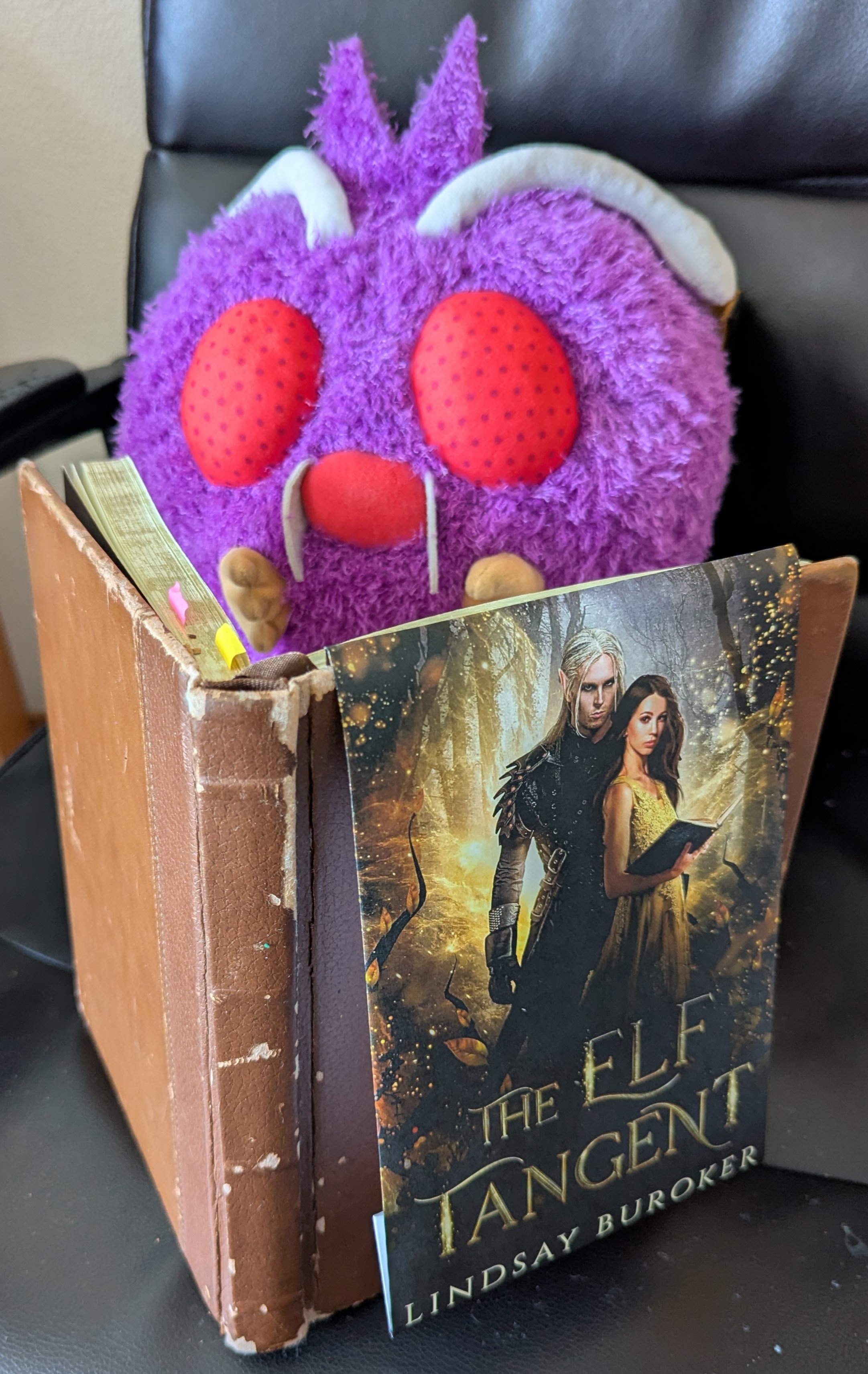
Hello, all. Welcome to the conclusion of the review for Lindsay Buroker’s clean Romantasy, The Elf Tangent.
This part will focus just on the prose, tone, and theme - things I am mainly bringing up to compare to writing I have criticized in the past (or will be criticizing in the near future). You can find an overview of the book in Part 1, a discussion of the plot in Part 2, and the analysis of the worldbuilding, characters, and romance in Part 3.
Let’s get right into it.
STATS
Title: The Elf Tangent
Series: N/A
Author(s): Lindsay Buroker
Genre: Fantasy (Romantasy)
First Printing: March 2022
Publisher: Self-published to Amazon
Rating: 6/10
SPOILER WARNING
Mild spoilers for The Elf Tangent will be included throughout this review, through I will keep the first paragraph of each section as spoiler-free as possible. Heavy spoilers will be confined to clearly labelled sections.
Heavy, unmarked spoilers for the other Romantasy series by Buroker that we’ve previously covered, Fire and Fang, may also be provided as necessary for comparative analysis.
PROSE
The prose of The Elf Tangent is much the same as in Fire and Fang. There's a lot of quippy dialogue and repeated information. Words choices in the narrative descriptions and the character voices feel very modern.
That being said, there are a few notable differences. First and foremost, the quipping is far more restrained. It’s really just Aldari doing it. As far as I can remember, all of her quips were directed towards either Theli or the Captain. This humor therefore felt like a natural extension of her characterization, rather than something forced. Additionally, much like with Scarlet repeating information in Caravel, Aldari’s repetition comes across like she is anxious, or at the very least, overwhelmed by her situation and struggling to process everything being throw at her.
TONE
The Elf Tangent is consistently maintains the same lighthearted, slightly humorous tone that marked the more lighthearted moments of Fire and Fang. In this case, I think that is works. It works very well, actually.
Superficially, the stakes of this book and that series seem very similar. Both follow a princess trying to protect her kingdom from the looming threat if a violent invasion. Both feature desperate quests to defeat an existential threat. Yet it’s the details where things differ. The Elf Tangent doesn't open with Aldari’s entire family being killed. The invading force wants to turn her people into taxpayers, not slaves exposed to a Death World’s climate. Even the magical threat that collapsed the civilization of the elves is contained, so if Aldari fails, the worst they face is the continuation of a slow decline that they’re already managing fairly well.
All this is to say that, while the stakes of Fire and Fang demand that the story be taken seriously, The Elf Tangent doesn’t. This is like comparing the Peter Jackson Lord of the Rings films to the recent Dungeons & Dragons movie. There’s enough room to laugh here.
There’s also the execution of the humor to consider. Aldari quips to defuse tension, yes, but not in situations where things are truly dire. The quips themselves also don't clash with the situations. A lot of them focus on the Aldari’s love of math, and that topic rarely comes up outside of quiet moments.
I think The Elf Tangent is an important reminder that lighthearted books with lots of quippy humor are not inherently bad. The humor in Fire and Fang is only a problem because it is a story that needs to be taken seriously to work and because the humor is oversaturated. With lower stakes and more moderation, I’d have a lot less to criticize on that front. Here, things are more relaxed. There’s breathing room to have this sort of fun.
THEME
I don’t think that The Elf Tangent has any intentional themes, social commentary, allegory, or the like. However, I think it is still worth analyzing through that lens because of the next review - or, rather, editorial interlude - that I have in the pipeline.
At the end of July, we’ll begin a multi-part series about why social commentary has become such a bane to Fantasy fiction in recent years. Two of the points that are going to be brought up are going to be:
Oversaturation. A message can be hammered into the audience’s faces so many times, across so many contemporary works, that it loses any weight and just becomes annoying.
Specificity. A message can be so tied to contemporary context that it disrupts immersion and/or creates a situation where the story only works if you are aware of the context and agree with the message.
At three points in The Elf Tangent, Buroker brings up ideas that push both of these limits I don’t think she went so far as to damage the story in the way that modern social commentary already does. Still, these inclusions did affect immersion. I think it’s important to discuss why they could have potentially damaged the story and how Buroker managed to avoid overstepping completely.
Feminism
The two points we have to cover here touch upon both specificity and oversaturation.
Sexual Morality
The fact Aldari needs to remain a virgin for her marriage is one of the bits of information that gets repeated throughout the story. For the most part, there’s not much to comment on here. Then, just before the 60% mark, as Aldari is feeling hyper-aware that only some bedsheets separate her from the Captain’s naked body, Buroker delivers this passage.
As Theli kept pointing out, Aldari couldn’t forget that her marriage was contingent on Xerik getting a virgin. She might think that was stupid and shouldn’t matter, but it was what her father had agreed to. And she’d agreed to it too. At the time, she’d been largely indifferent to men and sex and hadn’t thought anything of waiting until marriage.
Yes, I said Buroker delivered this, not Aldari, because Aldari should know exactly why it is not stupid and why it matters.
This is a world of patriarchal political power structures, wherein power is handed down from fathers to sons (or else passed laterally to the next closest male in the hierarchal order). This sort of thing leads to wars and power grabs being justified over the legitimacy of heirs. The paternity of a royal child must therefore be unimpeachable. No matter how Aldari feels about this system (more on that in a moment), she must understand that her children via her political marriage will be heirs to her husband's kingdom, not hers, so their paternity cannot be in doubt.
At the same time, there is no evidence of any technology (or magic, for that matter) to confirm paternity. This means the only effective means to ensure that a man's wife’s children are also his children - and, thus, that her sons are his legitimate heirs - is to limit opportunities for his wife to have sex with other men. Of course, the man can’t control who his wife had sex with before they were married. The only insurance he has that his wife was not pregnant already when they married is if she is a virgin, something that people of this era could reasonably verify via the presence of an intact hymen. (Obviously, this was not foolproof, but there weren't a lot of better alternatives.)
Aldari is supposed to be smart enough to understand all of this. This line dismissing the value of a woman being a virgin until marriage is out of character for her. Buroker is turning to the audience to make a direct statement about sexual morality.
This is a touch of modernity that is not uncommon in modern fiction (oversaturation) and is very much about modern sexual values and the ongoing discussion about virginity before marriage (specificity). What pulls it back from the brink is the same characterization that was failed by Aldari thinking along these lines.
At the time, she’d been largely indifferent to men and sex and hadn’t thought anything of waiting until marriage. That had been before—
“Tell him,” Hawk repeated, “that if he’s not nice, I’ll come to his kingdom and kill him.” His eyes were closed, but he smiled and shifted his arm to pat her on the thigh. “Don’t let him not be nice, Aldari. You’re too good for someone who doesn’t treat you well.”
I think it is reasonable to conclude that, in this moment, Aldari’s attraction to the Captain is compromising her rational judgment. The break in character is justified as an intrusive thought. Aldari does actually understand why remaining a virgin matters. With temptation suddenly thrust upon her, she simply finds that she does not care.
Am I giving Buroker too much credit here? Maybe. The wording of Aldari’s dismissal of common sense makes it sound like she might always have held this view. Still, it’s enough to pull this bit of commentary back over the line.
Down with the Patriarchy
On the note of Aldari’s feelings about the patriarchal system, Buroker delivers this line about 75% through the book.
“Since our people only allow male rulers—” even though Aldari had never longed for her father’s throne, she couldn’t help but roll her eyes at that, “—he’s the heir, and he spends a lot of time evading his tutors as well.”
By Buroker’s own admission, Aldari does not even want to be the heir. This line was Buroker telling her audience that she holds modern attitudes about patriarchal systems. This is another idea that has been hammered on pretty heavily in modern Fantasy (oversaturation), and modern waves if feminism still play this sort of thing (specificity). That said, there are two reasons I find this less objectionable than the previous point we covered.
First, while it is out of character for Aldari to care about the throne, she has an established reason to be irritated by patriarchy in general. Her intellgience and all her counsel on how to save her kingdom have been ignored precisely because she is a woman in a patriarchal system. So, while I don’t think Buroker was intentionally trying to anchor this interjection in character, that is indeed how to worked out.
Second, while this line does lean into contemporary issues, it does so with a very uncontroversial line. Sure, modern feminism leans into these ideas, but people who have settled in after previous waves of feminism already accept the general premise. Something this worn-in doesn’t really have any impact anymore as a statement to the audience.
Save the Whales
Now, let’s talk about the idea that is the actual reason I wanted to talk about themes.
The protection of whales from the whaling industry is an idea that has sunk to the bottom of the barrel for environmental messaging. It’s become just a tired cliché that James Cameron put it into two Avatar films. The Western world to which this message is espoused has agreed with this message and moved on. I doubt most people born from the 90s onwards truly understand why environmentalists needed to make a fuss about it in the first place, other than that South Park episode where the joke was that Japan blamed whales and dolphins for dropping the atomic bombs.
Whale meat was actually a pretty big deal for a bunch of countries in the early to mid 20th Century, including during the reconstruction era after WWII. Additionally, while whale oil is less effective as fuel than petroleum-based products, it’s apparently still a decent lubricant. Couple that with modern ships capable of hunting whales in previously inaccessible waters, and there was a genuine fear that whales would be overfished into extinction.
Is the general public still aware of this? I supposed people who were alive in the 1980s, when this cause peaked, might remember. Speaking as someone born after that time, I had to go out of my way to look this up.
The reason I bring all this up is that Aldari’s kingdom has only one meaningful industry: whaling. The elves don’t like human whaling, seeing it as excessive and wasteful. Aldari, who wants her people to diversify their economy anyway, wishes there was an alternative resource to whale oil that could compel her people to chose a less environmentally damaging path. The Captain points out that there are trees in the elves’ realm that produce “root pitch”, a substance that “burns better and longer than whale oil”. The implication is that, if theae two came together, they child save the whales.
This is … well, more than a little oversimplistic, not to mention economically suicidal. Aldari’s plan to save her people's economy is to devalue their one source of income with a resource that belongs to another kingdom (i.e. her people would not profit from it). Not to mention, there’s still the matter of whale meat and machine lubricant - this world is advanced enough to have steam engines on the. Can the “gunk” that is root pitch be processed into lube?
Setting that aside, though, Buroker is playing with both a worn-out cliché (oversaturation) that points to a very recent social cause (specificity). Normally, I’d say this is way too blunt. What saves it is time.
The peak of anti-whaling activism was about four decades ago. Sure, folks like Greenpeace are still pushing hard for a total purge of the practice, but for most people, the goal has been acheived. People have moved on. These days, Save the Whales is more of a symbol of environmentalism in general than it is an active cause.
Buroker isn't plugging something controversial to shove commentary in our faces. She is taking a more general, resonant idea and making it just specific enough for us to understand the substance. Whaling could have been replaced with deforestation, industrial smog, industrial runoff, or any other general concepts that would allow the audience to grasp what’s happening in the story without preaching to them. What Buroker was actually doing - and here, I will definitely give her credit - was giving substance to the idea of the two halves of a romantic pairing finding common ground despite their different backgrounds. She was serving the story, rather than throwing in commentary.
Final Thoughts on Theme
I know I went all-in on dissecting Buroker’s commentary here, yet my ultimate point is that what she does is nothing compared to the off-putting cacophony that echoes through so much modern Fantasy, especially trad-pub Fantasy. I don’t feel the urge to DNF her books that way I did with the book we’ll talk about later this month. There is a difference between having ideas that disrupt immersion but as justified within the narrative and messages that are bashed into the audience’s faces with no reprieve, subtlety, or nuance.
OFF ON A TANGENT
The Elf Tangent was a fun little standalone adventure that I recommend if you’re looming for something simple or just want a sample of Buroker’s style before jumping into one of her series. It’s a lighthearted read that's good overall. In an era when slop gets promoted as the pinnacle of Romantasy, a Romantasy written by an author committed to delivering a decent story is something we need more of.
Speaking of Buroker and Romantasy: Clutch and Claw. I’ve finished reading it, and I’ve drafted the review. Due to other stuff I have scheduled, I’m tentatively aiming to kick the review off in late August. Thank you all for your patience.
Thank you all for joining me for this latest review series. Please remember to subscribe and share if you enjoyed what you read here. Take care, everyone, and enjoy the rest of your week.