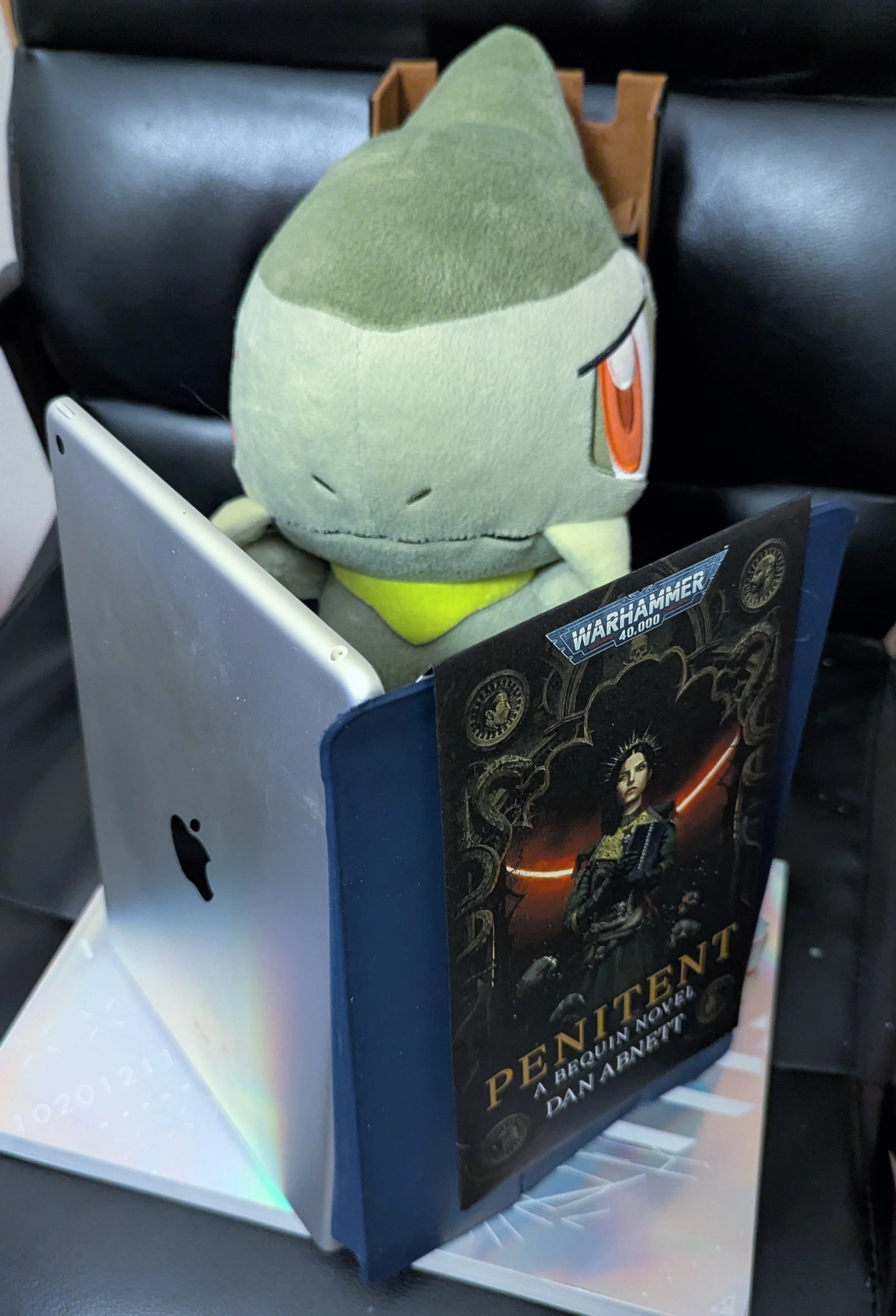
Penitent (The Bequin Trilogy, Book 2) (Part 4 - Worldbuilding and Fanservice)
Hello, all. Welcome back for another delve into the grim darkness of the 41st Millennium.
Today, we wrap up the review of Penitent by looking at the worldbuilding and the handling of fanservice. Please see the previous three parts if you’d like to read the overview or the analyses of plot and character.
Limiters off, everyone. There are heretics to hunt.
STATS
Title: Penitent
Series: The Bequin Trilogy, Book 2
Author(s): Dan Abnett
Genre: Science Fiction (Space Opera)
First Printing: February 2021
Publisher: Black Library (Games Workshop Publishing)
Rating: 8/10
SPOILERS
Throughout this review, there will be mild, unmarked spoilers for the events of Penitent. I will keep the first paragraph of each section as spoiler-free as possible. Heavy spoilers will be confined to clearly marked sections.
There will be heavy, unmarked spoilers throughout the review for the events of all the Inquisitor content we have previously reviewed thus far, including the Eisenhorn and Ravenor novels, their associated short stories, and Pariah.
TERMINOLOGY
The Alizebeth Bequin in the story is not the same woman from Eisenhorn’s novels. This Bequin is her daughter (or, at least, a person engineered from the original Bequin’s genetic material). Within the narrative itself, Abnett establishes distance between the two characters as early as Chapter 1, with Bequin operating by the “affectionate contraction” of “Beta”. I’ll therefore be referring to this character as “Beta” throughout this review, while her mother will be referred to as “Alizebeth”.
WORLDBUILDING
In most respects, Abnett keeps the worldbuilding simple. Very few new ideas are introduced within Penitent. He mostly confines him to building up and expanding upon ideas that he previously established in Pariah, that were introduced in other Inquisitor novels, or that rests comfortably within the realm of established Warhammer 40K lore. I’d argue that there’s really only one wholly new idea introduced.
That being said, I think it’s probably safe to say that, even if everything around the Yellow King wasn’t already adequate reasons for Games Workshop to potentially put the series on hold, the rest of the worldbuilding would be.
Queen Mab
In most respects, Queen Mab is the same city as in the previous book. What Abnett lays on in this book is information to reconcile the Renaissance vibe he gave in Pariah with the wider lore about this being a hive city. An abandoned spaceport that are “more than half a kilometre” tall “towered” above the surrounding cityscape. The outlying villages around Queen Mab are build among the ruins of disused industrial areas and warehouses that are being reclaimed by the wilderness. Eisenhorn and Ravenor eat hole up in enormous mansions in densely packed urban areas - yet the mansions themselves are described at the scale that makes them sound more like mansions as we might understand such structures, rather than the city-sized palaces that exist on other worlds in Warhammer 40K. When Beta ventures down into Queen Mab’s undercity, it is described in terms of medieval ruins buried under the foundations of generations of rebuilding, rather than a vast, industrial underhive.
Collectively, this paints a picture of a world that either has hive structures rising out of a dense but still lower-tech cityscape or else a hive that has decays into a state more fitting of a Feudal World due to years of neglect by the wider Imperium. I think it’s both a good balance of ideas within the lore and a good way to achieve the vibe of these stories without fully committing to a story on a Feudal World.
Extimate Spaces
As mentioned in the plot analysis, one of the main objectives for Beta and the inquisitors is to find a way into the Yellow King’s extimate realm, known as the City of Dust. Abnett doesn’t really go into how extimate spaces work - for better and for worse. Yes, it does mean he’s not overcomplicating things or creating plot holes, but it also means that if you don’t already understand the basics of these spaces, you won’t understand them any better after reading Penitent. I only really understand what’s going on because I read The Magos.
One new development with extimate weapons is a weapon known as a “blinkblade”. This a weapon that is sheathed in an extimate space and can be summoned to the wielder with a thought. It’s used for a really cool action moment, but otherwise doesn’t contribute to much to the story. It’s just a logical progression of the concept (though we never get an explanation as to how Beta is able to use one despite being a blank).
Graels
Graels serve a much larger role as antagonists in this book, appearing in two action scenes and being stated as the adversary in another scene that happens outside of Beta’s view. This extra page time allows a much better picture of their capabilities. What we see isn’t unlike what we’ve seen in the Eisenhorn novels for encounters with dæmonhosts in the other Inquisitor novels: the ability to ignore or rapidly heal from any non-psychic wound, immerse strength, the ability to generate immense heat (while also causing the frost effect consistently seen with psyker power usage), etc. Abnett isn’t reinventing the wheel her.
At the same time, though, he doesn’t actually explain what graels are, either. We get a description of how they are created, involving a blank consuming some Chaos artifact, but nothing about why blanks are used for this process or anything else about how graels work. In fact, much like with the workings of extimate spaces, I only understood what was going on because graels had been explained in detail back in The Magos.
Enuncia
Despite all the focus put on Eununcia throughout the Ravenor books The Magos, and Pariah, it continues to have a minimal role within this story. I don’t think that’s necessarily a bad thing. Enuncia is the kind of thing that has the potential to really flip the table within the Warhammer 40K universe - it’s just that powerful and that easy to wield (provided one knows the vocabulary).
… however … once more … you need to have read The Magos to understand the role of Enuncia in this story.
See, something that’s acknowledged within the text is Eisenhorn’s absolute control over Cherubael. There’s none of the effort to scheme or backstab that we saw in Hereticus. Granted, we did see Eisenhorn use Cherubael without any issues in “Thorn Wishes Talon”, but (A) Cherubael was acting in the background throughout that story and (B) nothing relevant to Cherubael was presented through Eisenhorn’s POV. He might well have been struggling to keep Cherubael on leash.
Eisenhorn’s absolute control in the Bequin books is attributed to … his experiences in The Magos. That’s when he was exposed to a great deal of Enuncia vocabulary and briefly operated the Loom. So the implication is that Enuncia is what allows him to utterly dominate Cherubael.
Patch Jobs
I feel like I need to write a whole separate post to dissect Abnett’s habit of using stories to retcon and repair issues in earlier stories. For now, I’ll just say that I find it incredibly frustrating that someone needs to read The Magos - a book that is not in this trilogy, that Abnett himself states that he wrote while working through writer’s block for Penitent - in order to fully appreciate what’s going on here. Would it have been so hard to just summarize and reiterate key exposition? I’m not saying that the lore of this book is impossible to understand if you haven’t read The Magos, but it’s really not a good sign that I found myself thinking, “Wow, I’m really glad I read the supplemental material in advance.”
The Immaterial College (Heavy Spoilers)
For all of my complaints about the worldbuilding in Penitent, there is really only one thing that feels genuinely problematic: the Immaterial College.
The Immaterial College is an alliance containing Traitor Astartes. Nothing wrong there: alliances between Chaos warbands is nothing new, and the Yellow King is being built up as a threat that would convince the Chaos-aligned Space Marines to unite against it. So when a Thousand Son, a Night Lord, and an Iron Warrior all show up to fight graels together, that is not a shock. We already knew the Word Bearers, Emperor’s Children, and Alpha Legion were taking this threat seriously. A team-up between other Traitors is not a stretch.
The problem is that the Immaterial College also contains Loyalist Astartes. The squad that shows up to fight the graels also includes a Dark Angel, a Raven Guard, and an Iron Hand. Beta takes time within the narration to call out that these are supposed to be loyalists. And yet here they are, fighting alongside the Traitors. There’s friction and infighting between them, sure, but not anything worse than what one might expect to see between two chapters of Loyaltist Marines with wildly different philosophies.
It’s not like it would be impossible to justify this. Maybe all these Loyalists are renegades? Individual Space Marines who, much like Eisenhorn, chose to embrace dark powers in the name of defending the Imperium? That’s possible … except then there’s the problem of the Night Lord telling Beta this:
‘There were more once,’ he hissed. ‘Time, and war with the Tyrant, take their toll. Few of us remain, but our bond is ancient. It was born from the ashes of Isstvan.’
Isstvan, for those not aware, was the battle that really kicked off the Horus Heresy, the war in the 31st Millennium that properly transformed the Warhammer 40K galaxy into the cesspool it is in the modern timeline. The Traitors announced their true allegiance by arranging for Loyalist forces with them to lead a planetary invasion, then unleashing planet-killer weapons to try to exterminate those Loyaltists in one clean sweep. We are meant to think that this was the moment that these mingled band of Traitors and Loyalists formed their little cabal? And what, exactly, have they been doing for ten millennia? Given the identity revealed for the Yellow King at the end of this book (I will remain spoiler-free here), the King wasn’t a threat back when the College formed. What convinced these Space Marines to join forces, then?
A quick Google search tells me that the College exists only in the Bequin Trilogy. People are questioning if it is even canon. I can’t blame them. This is another element that reads like fan fiction rather than something the exists naturally within the world.
FANSERVICE
Pariah was a book that honored and fulfilled its role as a legacy sequel while also serving as an on-ramp for those new to the Inquisition novels or Warhammer 40K as a whole. You didn’t need to understand the wider context to appreciate and enjoy the moments that referenced older content. At the same time, it respected the legacy material in a manner that would be satisfying for fans of that material.
I don’t feel like the same can be said for Penitent. You really do need to have read books outside of this trilogy to properly understand what’s going on. We’ve covered this in part with the frustrating fact that The Magos is required readying to fully appreciate this book. Then there’s the Immaterial College, which spits out the names of old Space Marine legions so rapid-fire that you really need to understand who they are in advance for the moment to have any weight. Even lore that does get adequate explanation for the story at hand, such as the Red Thirst, the Lost Primarchs, and psyk-out grenades, it fed to the audience so quickly that it’s impossible to develop an emotional attachment to it. I only connected with these ideas because I already knew enough about them to care.
The antagonism between Eisenhorn and Ravenor does get explored. The issue with that one is that it’s rushed, not that there’s not enough context for us to care. Even then, though, the very fact it is rushed gets us to the same point. This relationship isn’t something that a new reader will be able appreciate on a first read and then gain a deeper appreciation for once they’d explored the wider mythos. You need that exposure to the wider mythos for the appreciation to come in the first place.
That’s not to say that this makes the book unreadable if you aren’t already aware of the broader lore of Warhammer 40K. Rather, the issue is that this no longer reads like a book that’s friendly to newcomers. Penitent is simply in the same boat as so many other books within this mythos. It takes for granted that the audience will already understand the background. That’s not an unfair assumption. It’s just one that feels like a step backwards from what the story was previously. I would not be surprised if there were people who liked Pariah but gave up on Penitent because it read like they were being gatekept midway through a trilogy.
FLAWED, BUT STILL INCORRUPTIBLE
Penitent is a story that falls far short of its predecessor. I don’t think it’s a bad book. I honestly feel it’s a pretty good book, especially if you are already a fan of Warhammer 40K in general or of the Inquisitor novels specifically.
What frustrates me about this book is that, much like The Strength of the Few, this book is a step backwards from its predecessor. It’s hard to say how much of this is due to the author and how much of its is due to some oversight by the publisher. Whatever the reason, this book could have been much more than it ended up being. I’d still recommend it, but with the caveat that you manage your expectations.
With all that being said, I am still looking forward to Pandæmonium, if and when it ever releases. In the interim, we’ll turn our attention to other aspects of the Warhammer 40K setting. I hope you’ll join me in September as we turn out attention from stories to the Inquisition to those of the Adeptus Assassinorum (and, unexpectedly, the Imperial Knights as well). It’s time for us to read Assassinorum: Kingmaker.
Thank you all for stopping by. Please remember to subscribe and share if you enjoyed what you read here. Take care, everyone, and have a good weekend.