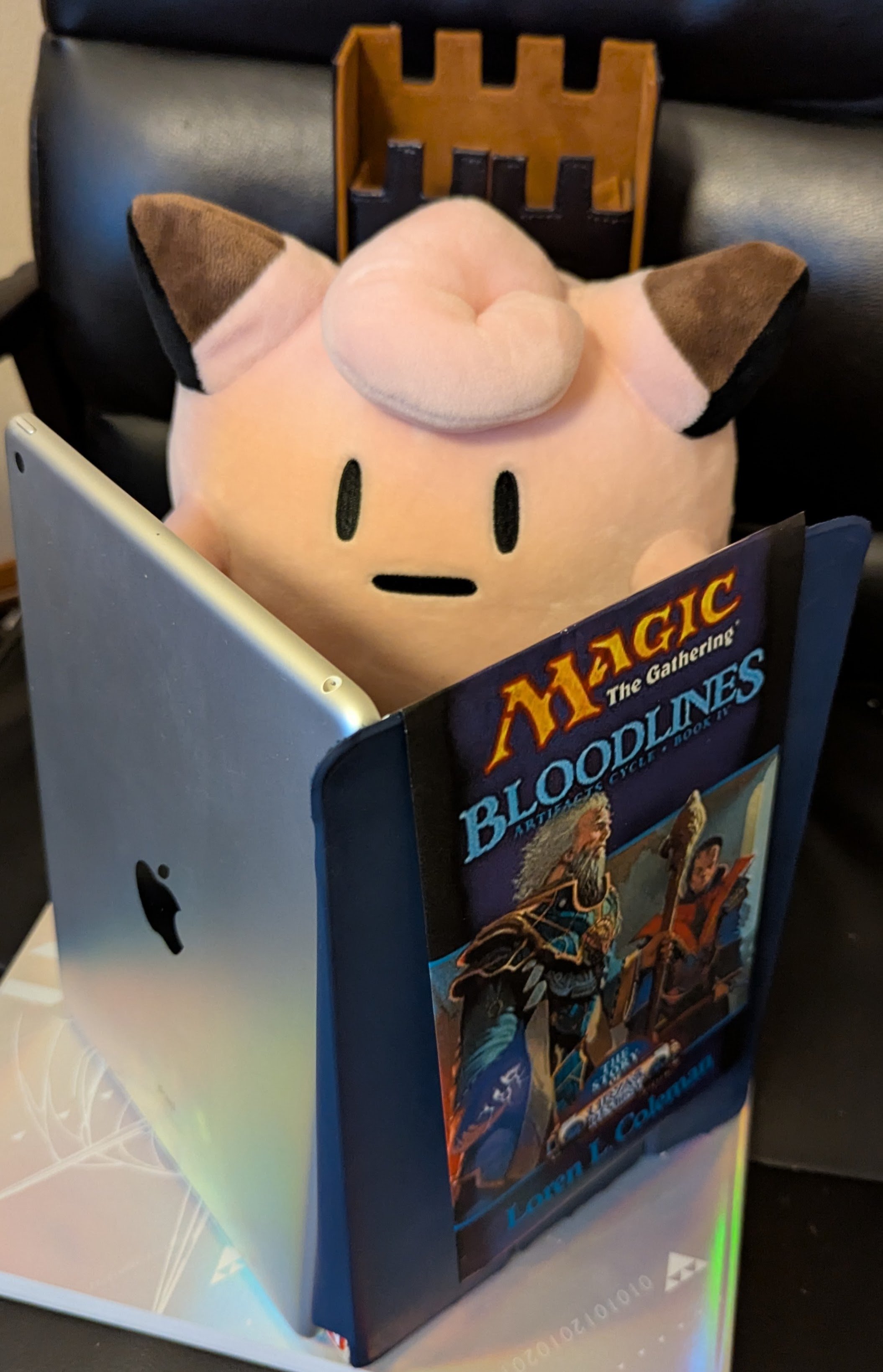
Bloodlines (The Artifacts Cycle, Book 4) (Part 1 - Overview)
Welcome back, everyone, for the final entry in the exploration of the Artifacts Cycle tie-in novels for Magic: the Gathering (MTG).
Before we dive into this book, I’d just like to note that the mass market paperback of this book is currently valued well over $700 dollars on Amazon. I remember being able to buy this book for less than $15 at Barnes & Noble when I was in elementary school. I’m sure there’s a commentary to be made here about the impact of books being taken out of print. (That’s not what we’re here for, of course. I just think the fact people can resell mass market tie-in fiction at more than a 4500% markup is absolutely wild.)
Please feel free to check the previous reviews if you need a refresher. Otherwise, let’s go for a ‘walk.
STATS
Title: Bloodlines
Series: The Artifacts Cycle (Book 4)
Author(s): Loren L. Coleman
Genre: Epic Fantasy
First Printing: August 1999
Publisher: Wizards of the Coast LLC
SPOILER WARNING
Mild, unmarked spoilers for Bloodlines will be provided throughout this review. Heavy spoilers will be confined to clearly labeled sections. I will keep the first paragraph of any given section spoiler-free.
Throughout this review, I will also be providing heavy spoilers for later events within MTG canon. While I will be steering clear of details that would spoil the progression of this book specifically, there is a strong chance that you will figure out certain spoilers if you pay attention to these bits of lore. I’ll confine the heavy spoilers that are relevant to this book into clearly marked sections.
Heavy, unmarked spoilers for The Brothers’ War, Planeswalker, and Time Streams will be provided throughout this review. I will also assume that you’ve already read my reviews of those books, though they aren’t essential to understand this one.
STRUCTURE
This review will cover a total of 3 parts.
Part 1 (Today)
Premise
Timeline
Rating
Content Warning
Part 2 (June 5th)
Worldbuilding
Character
Part 3 (June 12th)
Plot
Theme
PREMISE
Per the e-book product page on Amazon, we get:
Blood has been spilled. Battle lines have been drawn. Time is getting short as Tolaria races to find the one who will wield the power of the Legacy. Deep in the inner circle, the dark lord Yawgmoth sends out an edict: Kill Urza Planeswalker. From the bloodlines of the Benalish plains, a hero is born.
Reaction
This is another premise that’s so incredibly vague that it was probably written before the book was.
Now, to be fair, the few concrete bits of information here are accurate. The book is all about the Bloodlines Project, which is Urza’s attempts to apply eugenics over the course of centuries to create the human component of the Legacy (an effort that will ultimately end in the birth of Gerrard Capashen, hero of the whole Weatherlight Saga, of which the Artifacts Cycle covers just one year out of four years of storytelling). There is also an edict from Yawgmoth to kill Urza, but this ultimatley ends up as a background motivation to color the interactions of Phyrexian characters.
TIMELINE
Rather helpfully, this story returns to providing us with context on the passage of time by listing the years spans by each of its three parts (Books I - III). Book I begins in 3385 AR, while Book III ends in 4169 AR. The prologue of the book takes place six months after the end of Time Streams, so that chapter would have to take place in either 3360 AR ot 3361 AR.
This tie-in novel is for Urza’s Destiny, the 17th MTG expansion set, released in June 1999.
RATING: 6.5/10
This book was a very weird one to rate.
Much like Time Streams, Bloodlines suffers from rather spotty character work. Some of this is the same issue of Telling instead of Showing that we saw in the previous books. A larger part of it, though, is a function of the time scale of the story. While there is a core cast of characters who is able to live the full eight centuries of the story (Karn and Urza are immortal, Barrin and others have access to slow time, etc.), a lot of the heavy lifting is done via vignettes featuring a rotating cast of characters are may be several generations removed from the characters in the previous vignettes. I think the only characters in this entire book who are fully fleshed out are the two antagonists who serve as the face of the Phyrexian threat in this story.
Offsetting this character work, though, is the plot. There is an interesting story here. We get to see the ripple effects of the Bloodlines Project on the populations of Keld and Benalia over the course of centuries. We also get to see the Phyrexians slowly begin to realize this threat and mobilize against it.
… but the thing about this plot is that it ultimately doesn’t amount to anything. Sure, this is interesting backstory that is relevant to the ultimate conclusion of the Weatherlight Saga (which ends in Apocalypse, a book I do intend to review at some point in the future), but despite the importance of this backstory, this novel is not weighty enough to be required reading. It ultimately amounts to an entire book of filler.
What ultimately convinced me to give this book a 6.5 was the epilogue. Coleman tries to tie a neat thematic bow onto the story. It’s not executed very well. It’s delivered in a way that makes me think it’s supposed to have an emotional punch that simply wasn’t earned. Still, it did make me reflect back across all those character vignettes and think, “Huh, I guess it all really does tie together.” This story doesn’t offer much to drive the narrative of MTG forward, but there is something admirable about how all the little vignettes weave together. It’s enough for me to say that it’s a good book, even if I wouldn’t outright recommend it.
CONTENT WARNING
There’s some very weightless Fantasy violence and gore in this story. That’s the worst of it. I think Coleman thought the eugenics element would be more triggering for people, as there are a handful of scenes of people grappling with the moral horror of the Bloodlines Project, yet it’s very much a a vague “principle of the matter” situation. A pre-teen could swallow this without any issues.
AFFINITIES AND QUANDRIES
Thus far, we’ve only covered the big-picture overview of this book. Apologies - I know this one was on the shorter side. The analyses we cover in Parts 2 and 3 will be up the usual standard.
Next Friday, we’ll properly get into the weeds by breaking down the worldbuilding and the characterization. This is a book that juggles a lot of interesting ideas. Some of these are explored to an interesting degree. Otherwise, however, end up feeling superficial and shallow, and the emotional moments that need to be built upon them end up feeling hollow.
Thank you all for being here today. Please remember to subscribe and share if you enjoyed what you read here. Take care, everyone, and have a good weekend.