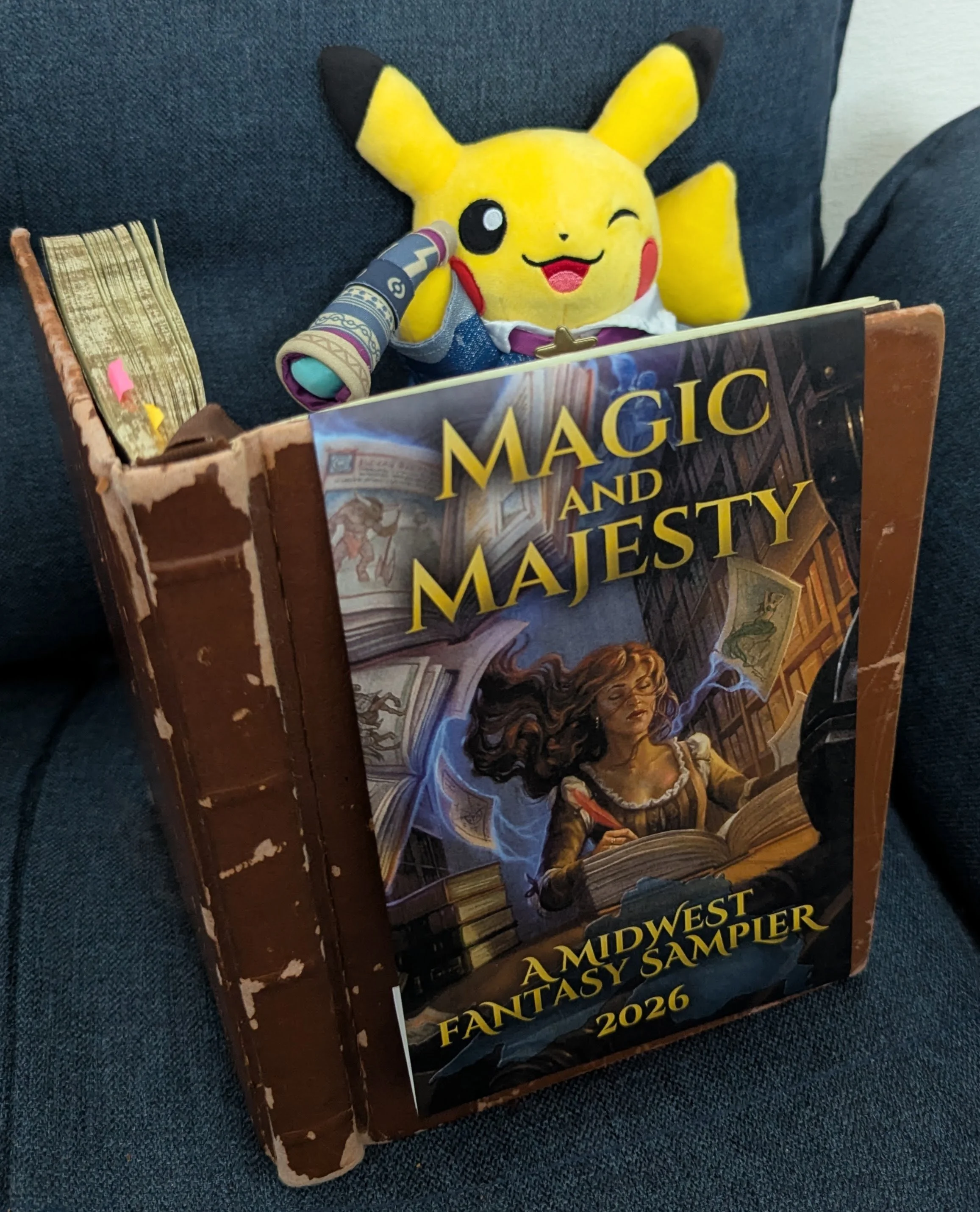
Magic and Majesty: A Midwest Fantasy Sampler 2026 (Part 4)
Hello, all. Happy Independence Day. Welcome back for the conclusion of the ARC copy review of Magic and Majesty.
Today, we’ll be looking at the final two stories of the anthology.
“The Gryphon Key” (Enchantress Rising series), by E. A. Burnett
“The Harrowing of Nerikan” (ODE: The Scion of Nerikan novel), by Richard Sweitzer
Let’s get right into it.
ANTHOLOGY STATS
Title: Magic and Majesty: A Midwest Fantasy Sampler 2026
Series: Midwest Fantasy Sampler, Book 2
Author(s): Various, curated by Justin Rose
Genre: Fantasy (various)
First Printing: June 10th, 2026
Publisher: Self-published to Amazon
Overall Rating: 8/10
SPOILER WARNING
Mild, unmarked spoilers for all stories in the anthology will be provided throughout this review. Additionally, the Story section of each review will feature heavy spoilers. I will keep the first paragraph of any given section, including the Story sections, spoiler-free.
“THE GRYPHON KEY”
Stats
Series: Enchantress Rising
Author(s): E. A. Burnett
Story
Innocent, victimized woman decides to murder rapist, wife-beating husband while avoiding all accountability at every stage of the process.
This very simple concept is explored in detail over multiple chapters. We are first exposed to the traumatized state of Immennia (the Main Character), see how another character tempts her into murdering her husband, and then watch her fail to kill him the next time her comes to rape her. When she finds out her husband will become the king, she commits to killing him for the Greater Good and murders him without remorse.
Oh, there’s also some magic stuff about her being able to telepathically communicate with frogs, she uses her husband’s pet gryphons as her murder weapon, and she outright hates her son for being a grown man instead of a cute little boy.
Rating: 9/10
This story struck a nerve. It offended and enraged me. In fact, to use the terminology of the story itself, my feelings towards this vile, vomitous excuse for literature could be neatly summed up as “righteous hatred.”
So when I tell you that it is the best-written story in this anthology, and one of the best-written stories we’ve yet covered on this site, I want you to understand that it is the objective truth.
The only reason I don’t rate it 10/10 is that the climax only happens because of a plot hole. Not a big plot hole, mind, but still one that is impossible to ignore. Beyond this, the story is crafted incredibly well.
Self-Indulgence Without Sacrificing Story
Much like “Fate of the Nightbloom”, “The Gryphon Key” derives its substance from outrage bait. I’m sure Burnett would prefer that it be interpreted as the triumphant story of a victim of domestic and sexual abuse reclaiming her agency. What oozed across my screen instead reads like a deranged power fantasy cooked up by a woman who wants to murder her ex-husband and steal his money she can retire in luxury and explore polyamory.
Everything is amplified to the point that it’s clear we aren’t meant to think, only feel. The narrative twists and turns to ensure that Immennia is always the victim and never needs to be held accountable by the story or the audience, to the point that every stage of the murder, from conception to final execution, is either partially carried out by another party or else the result of her hand being forced. It is every bit as indulgent as Yarros’s power fantasy screeds in The Empyrean. It’s “Fate of the Nightbloom”, dialed up to over 9000.
And yet, despite the hand of the author at work, this story holds together.
The reason why outrage bait and unhinged power fantasy in stories like The Empyrean and “Fate of the Nightbloom" fall flat is because the Main Character’s emotions smash headlong into the realities of her situation. The authors write their plot and world in such a way that, even when seen through the lens of an unreliable narrator, there is a clear disconnect between what we are Shown and the interpretation the story insists upon. This undermines the intended framing. For example, it’s a little hard to accept the Main Character is a “rational woman” chosen for her “intelligence” when these assertions are rooted in insane leaps of logic that tear open plot holes as the reality of the story warps to try to match those leaps. To take “Fate of the Nightbloom” as another example, Vashira’s insistence that she doesn’t want to murder someone is undermined by her pulling a knife and threatening to disfigure that same person earlier in the story, then readily deciding to kill that same person that next time she encounters him.
“The Gryphon Key” has no reality beyond Immennia’s emotions. There are no themes being asserted, no virtues being attributed, and not even some wider narrative that her actions are meant to play into. This entire story is myopically focused on Immennia’s trauma and how she processes her emotions about her abusive husband. Therefore, even when she makes or justifies a decision based upon dubious logic, it reads like a natural exploration of character, rather than the author trying to force an interpretation of events that doesn’t fit. It doesn’t matter whether Immennia is an unambiguous hero, unambiguous villain, or something more complicated. The story works equally well either way. This allows the power fantasy blends into a character study. I’m only able to call out what it is because it fits a familiar pattern.
The long and short of it is: if Yarros wrote her power fantasy the way Burnett wrote this story, that power fantasy would be a boon to The Empyrean instead of the rot at its core.
Villain in Her Son’s Story
Two things can be true at once.
A character can be the victim of horrific abuse. Her thinking can be warped by trauma. Influences and circumstances can lead to this victim committing heinous actions and insisting that they are necessary, regardless of whether that is objectively true.
This same character can also be a selfish, hateful, and outright vile person who demonizes her own child for the sins of his father and jumps at the chance justify burning that now-unwanted child out of her life.
Immennia’s son, Scipio, is not his father. He doesn’t beat her. He doesn’t rape her. In fact, it’s heavily implied that he has no idea that any abuse at all takes place, thinking Immennia lives separately from his father and returned to her parents’ house because the two just didn’t get along. It’s further implied that Immennia knows this fact and is actively withholding the information from him. And yet, Immennia hates him, actively drawing a line between her son, the sweet preadolescent child, and Scipio, who she deems as heartless and tainted by his father.
Don’t get me wrong, Scipio is not a nice person. Still, a character looking down his nose at commoners and doing his job as a bodyguard is nowhere near comparable to the man who spends Chapter 4 assaulting and trying to rape the main character.
Immennia refuses to acknowledge the difference. She keeps hammering on how corrupted Scipio is. When she even gets a hint that he has committed a murder of his own, she jumps at the excuse to brand him as “lost to redemption” (whereas her own premeditated murder is “righteous”). Bonus points for the fact that the line Immennia draws between her son and Scipio makes it clear she wanted him when he was a cute, fawning child, as if he stopped having value because he grew up as something other than her blind follower.
But hey - all of this would be fine if the story acknowledged this. It never does. The closest it comes in Immennia referring to the loss of her love for her son as being her husband’s fault. This isn’t framed as a bitter lament against the ripple effects of trauma, though. It reads like Immennia is mad that her husband stole her toy (an impression is made worse by the reveal that Immennia sterilized herself after Scipio’s birth to deny her husband any more children) or wants to punish her child for not taking her side in this schism (when, again, she knows Scipio does not know about the abuse or rape).
I think what particularly angers me about this is that, at the end of the story, Burnett had the perfect opportunity to acknowledge what Immennia had done without actually condemning her. Scipio calls Immennia out. He accuses her of abandoning him with her husband when she went to live with her parents. She left him to struggle and survive without her. It is implied that her husband was also abusing Scipio. All Immennia had to do here was admit that, overwhelmed by her trauma, she didn’t notice that her son to become a victim as well (notice my phrasing here - she didn’t even have to accept blame, just admit that he was also a victim) and offer him a chance to mend the gap between them.
Instead, she just doubles down on Scipio being irredeemable and cuts him out of her life. The message is clear. We, the audience, are not supposed to hold Immennia at all accountable for how she failed her son. Nothing even tangential blame, a mere admission of cause and effect, can be laid at her feet.
And when added into the power fantasy … not only is this a deranged fantasy of a woman who wants to kill her ex-husband to finance her retirement plans and sexual experiments, it’s also a fantasy of a mother demonizing her children so that she feels justified in abandoning them.
Either Burnett is a genius author capable of capturing genuine evil born out of trauma, or I am very happy to have an entire ocean of distance between myself and her.
Which brings me to the divide between my rating and my feelings about this story: none of what I just said detracts from the quality of the writing.
It does not matter whether the reader views Immennia is an empowered woman casting off the shackles of marriage and motherhood to pursue her own indulgences or a Chaos-corrupted maniac who is the villain in her child’s story. “The Gryphon Key” works equally well either way. By writing a story so tightly focused on Immennia’s emotions, regardless of the wider context, Burnett delivered an unflinching character study of a human being. Hero or villain, Immennia is first and foremost a protagonist in a terrible situation. She is flawed, yes, but that doesn’t mean she is badly written.
Final Thoughts on “The Gryphon Key”
I’ve spread a lot of time talking about just the character work or the unfortunate knock-on effects of the Main Character’s choices. How does this story work as sampler?
Honestly? It’s a strong foot forward.
Even if we don’t separate Art from Artist, even if we assume that Burnett fails to see the holes in this power fantasy, the fact remains that she managed to deliver some compelling character work here. It bodes extremely well for what she might do with a full novel or series of novels. It reminds me strongly of the Hostage of the Empire series, where each of the multiple POVs were the heroes of their respective stories, even if they came across as villains from the other characters’ POVs.
At most, the only thing I’d worry about is if Burnett’s novels are more plot-focused. That would increase the risk that the intended interpretation of the characters clashes with their personal circumstances. Even this is only a possibility. There’s no evidence that Burnett won’t rein things in a bit when she has to actually take the context in which her characters exist into account.
“THE HARROWING OF NERIKAN”
Stats
Series: ODE: The Scion of Nerikan
Author(s): Richard Sweitzer
Story
A band of disgraced guards enter an underground complex that once served as a home to magical creatures, led by a witch-girl who has promised them magical power.
Most of the story is told in expositional backstory about how these guards were dishonorably discharged after failing to detain another witch. The present plotline is just the current witch leading them through some empty rooms. When she finally leads them into a room filled with cages, she convinces them to enter the cages so that they can absorb magic from the bones in the cages. It turns out that this was a trap. The witch steals the magic from one of the guards, who developed a magical gift she desired, and leaves the rest of the guards to die.
Rating: 3/10
This story feels like an afterthought, and not just because it’s an anticlimactic follow-up to the brilliant character work of “The Gryphon Key”.
Nearly all of this story is Told. If we had been Shown the backstory about the guards, I think it could have been decent. As it is, we are given a few quiet scenes of wandering through rooms while the POV insists that this was a bad idea, and then the story just ends.
I assume this events that led to these guards being discharged are covered in the novel ODE: The Scion of Nerikan. Maybe this story is satisfying bonus content for people who read that book. As an introduction to that story, though, it’s very bland. There are no memorable characters, and the … twist … at the end doesn’t have the buildup needed to earn its payoff.
RETROSPECTIVE
While this review series may make it seem like there are more negatives than positives in the 2026 edition of Magic and Majesty, I do believe that this anthology has succeeded in its stated purpose.
Across these ten stories, we've been exposed to a wide variety of different worlds and stories. There are multiple opportunities to find the sort of setting or vibe that you personally enjoy and to take a chance on the author and series being represented. It is an important reminder that, while trad-pub Fantasy may be drowning in Romantasy and ideological slop, variety and potential for greatness still thrive within the indie sphere.
Thank you all for joining me on this journey. Please subscribe and share if you enjoyed what you read here. Take care, everyone, and have a good week.