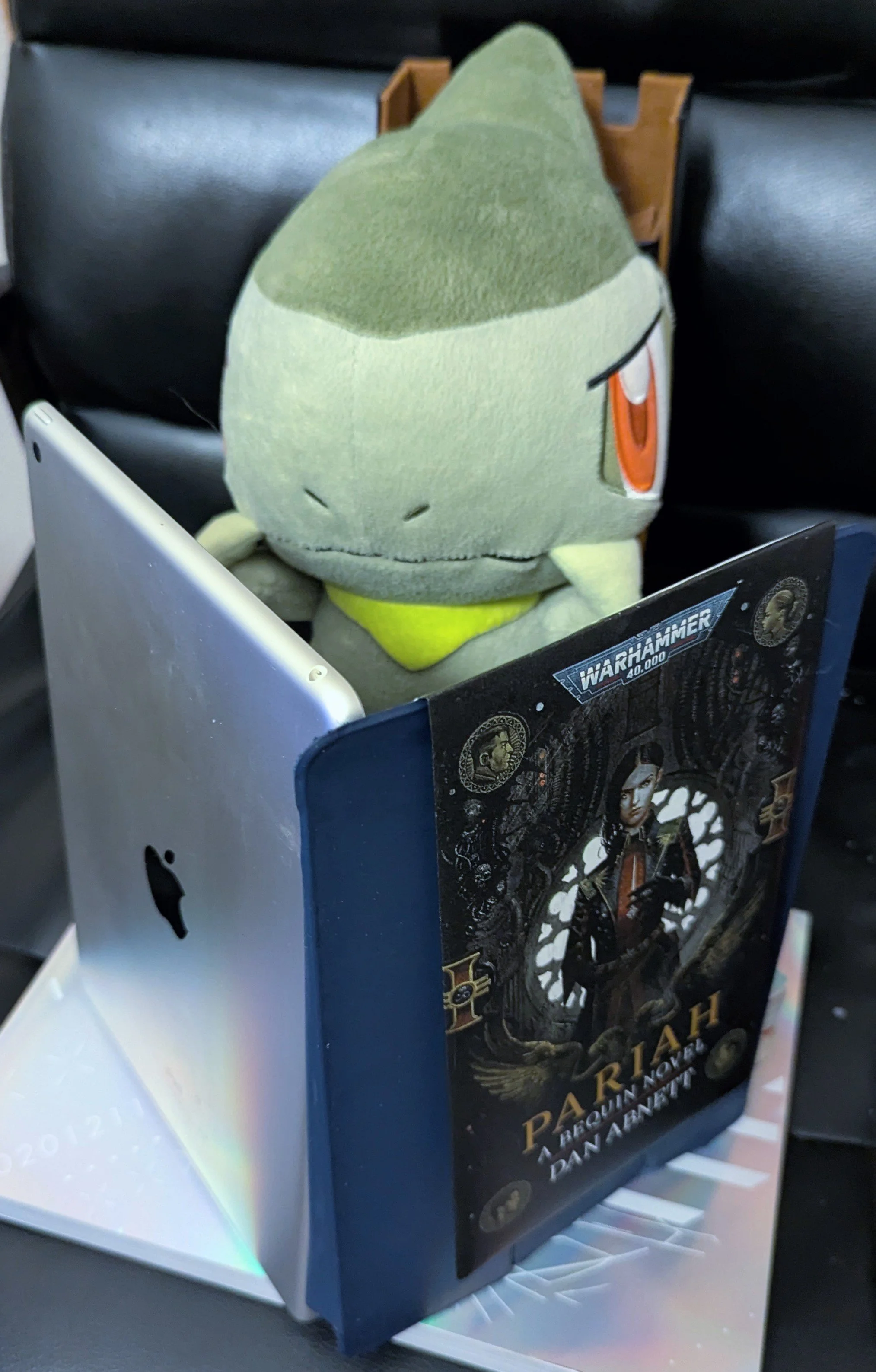
Pariah (The Bequin Trilogy, Book 1) (Part 5 - Spotlight on Fanservice)
Welcome, everyone, to the conclusion of the Pariah review series.
If you haven’t already, you may want to consult at least Part 1 of this series, which provides an overview of the book and explores the prose. You can also learn more about various other aspects of the narrative in Part 2, Part 3, and Part 4. Reading the previous parts isn’t necessary to understand this one, but it may give you a greater appreciation for the impact that the things we’re about to cover have on the novel.
Limiters off, everyone. There’s one last mystery to expose to the light.
STATS
Title: Pariah
Series: The Bequin Trilogy, Book 1
Author(s): Dan Abnett
Genre: Science Fiction (Space Opera)
First Printing: 2012
Publisher: Black Library (Games Workshop Publishing)
Rating: 9/10
SPOILER WARNING
Unlike with the previous sections, there will be heavy, unmarked spoilers for Pariah throughout this part of the review. I also won’t be making my usual effort to keep spoilers out of the first paragraph of each section. There won’t be any spoilers for the sequel, Penitent, which I chose not to read until I finished reviewing Pariah.
Heavy, unmarked spoilers will be provided for any and all of the Eisenhorn and Ravenor content we’ve covered thus far.
TERMINOLOGY
The Alizebeth Bequin in the story is not the same woman from Eisenhorn’s novels. This Bequin is her daughter (or, at least, a person engineered from the original Bequin’s genetic material). Within the narrative itself, Abnett establishes distance between the two characters as early as Chapter 1, with Bequin operating by the “affectionate contraction” of “Beta”. I’ll therefore be referring to this character as “Beta” throughout this review, while her mother will be referred to as “Alizebeth”.
SPOTLIGHT ON FANSERVICE
The Bequin Trilogy has a massive amount of baggage linked to previous stories.
The same could be said of the Ravenor Trilogy, but that was a very different story from this one. There was a sense of natural transition from Eisenhorn’s story to Ravenor’s.
Ravenor was still alive after the events of the Eisenhorn Trilogy. While his development from a victim in Malleus to the literal Man in the Chair in Hereticus happened outside of the readers’ view, the only major development from Hereticus to Ravenor was the start of his feud with Molotch.
Ravenor’s backstory as Eisenhorn’s former interrogator is something he remembers and that defines him.
Furthermore, for all the differences between Eisenhorn and Ravenor, both their stories are fairly straightforward narratives about inquisitors battling against Chaos.
As a result of these these factors, Ravenor could reference or bring back elements from the Eisenhorn Trilogy without it feeling forced. Harlon Nayl and Kara Swole more or less walking out of Hereticus and into Ravenor without any issues. Other elements that transferred over made sense in terms of the logistics of the setting. Of course both Eisenhorn and Ravenor are going to retain blanks on their retinues and favor rogue traders as their Uber drivers - these are obvious assets to an inquisitor, and Ravenor would have learned their value while working with Eisenhorn.
Pariah is a very different beast.
Continuity is broken. Even if audience members didn’t know already that Alizebeth was dead, even if they didn’t read the Magos and know Beta is her “daughter”, the opening of the story makes it clear that Beta only ever remembers living on Sancour and being trained at the Maze Undue. Her story is a hard reset, rather than picking thinks up right where the last trilogy left off.
As an extension of these, Beta has no memory of characters from past books.
Beta is a trainee in an “Inquisition” facility in one city on one planet, and this is all she’s ever known. She’s also being conditioned to engage with problems in a very different manner than either of the full-fledged inquisitors.
Taken all together, this just isn’t a story where a legacy character can just swagger onto stage or a past event can be name-dropped casually. Beta needs to be reintroduced to all this knowledge the reader possesses already. A legacy character is a stranger to her. Events from past books are a mystery. In any given scene, there’s a very good chance the audience will know more about what’s going on than she does, as we have context she simply doesn’t.
This means that Abnett put Pariah in a precarious situation when he decided to make Eisenhorn and Ravenor into two of the story’s factions. He is making legacy characters a driver behind what is effectively a brand new character’s narrative. There was a substantial risk of this story becoming a mess of memberberries and other fan service, one that can’t stand on its own merits, or else that had a lot of references that were ultimately irrelevant to the story being told.
What he managed to deliver is honestly impressive. He didn’t just write a story that stood on its own and made the legacy references relevant. Pariah is a story that reads like a natural entry point into the wider Inquisitory mythos for new readers while also respecting the emotional weight these events should hold for readers of those past books.
The Mystery Builds
The handling of legacy elements begins in the inciting incident, when Beta helps one of her instructors at the Maze kill (what she believes to be) a Cognitae assassin. She tries to interrogate the assassin while he is bleeding out, only getting one word, “Cognitae,” from him. She also goes through his clothes and finds documentation identifying him as an inquisitor …
… it’s Interrogator Voriet, a member of Eisenhorn’s retinue from The Magos whom I neglected to mention in that review.
As someone who has read The Magos, I immediately started putting two and two together. Clearly, the Maze is a Cognitae facility, and Voriet was killed in the line of duty. However, that’s not how the story itself handles it. Beta has no idea who Voriet is. The story doesn’t linger on him. Instead, focus is put on the fact that Beta now believes the Cognitae are trying to breach the Maze and that they can successfully disguise themselves as Inquisition personnel. This is handled so convincingly that I found myself questioning whether I had things wrong - the Ravenor Trilogy showed us that the Cognitae are willing and able to masquerade as inquisitors if it serves their ends, so there was every possibility that Voriet had been killed previously and had his identity stolen by the Cognitae.
This small name-drop therefore adds to the mystery. If you are new to this series, then Beta has just encountered an outsider whom is masquerading as Inquisition. The Cognitae are introduced as an amorphous enemy capable of infiltrating the Inquisition itself. If you are familiar with the Cognitae in general and Voriet specifically, there’s instead the tantalizing question of where exactly the Cognitae come into things and whether the dead man really was Voriet.
The Assault
Both Ravenor and Patience Kys appear during the assault on the Maze. Patience is originally introduced as an unknown psyker disguised as a nun, whom Beta catches sneaking about the Maze in the dead of night. Ravenor doesn’t arrive until midway through the assault, personally breaching one of the Maze’s entrances and coming face-to-face with Beta.
This is the point where the story properly diverges for people who have read the Ravenor Trilogy (or Hereticus) versus newcomers to the series. Patience’s name is dropped early in the assault, and Ravenor’s chair is recognizable. For new readers, the former is easy to miss, while the latter is framed simply as the introduction of a faceless antagonist. These are merely competent threats to establish the threat level posed by Beta’s foes. For the rest of us, these reveals are when pieces click into place and it becomes impossible to ignore that the Maze is a Cognitae facility.
That said, having these legacy characters pop up in the assault is a bit tacked-on. It doesn’t feel particularly meaningful to the narrative. Patience could have been any psyker with telekinetic abilities, and Ravenor could be replaced by an ogryn or servitor and get the same effect. Abnett realized he needed to do more for the inclusion of legacy characters here to be really meaningful.
So he has Beta kill Patience.
Now, obviously, Patience is not dead. Beta sends her falling to her apparent death, but it’s revealed later that Ravenor was able to telekinetically catch Patience. From Beta’s perspective, though, this is treated very seriously. Patience is her first kill. She holds on to one of Patience’s kineblades as a trophy to help her remember this important moment in her career. Once more, this is something that works in isolation, but it runs so much deeper for people who understand who Patience is. Not only is Beta on the wrong side of this conflict, but now she has killed a character that many of us will at least have positive feelings about. Her allegiance to the Cognitae, however, unintentional, has now harmed the audience. It lends a ponderous weight to her actions as the story continues.
Initial Reunion
The moment when Eisenhorn enters Beta’s story had the potential to go south. This is a moment with immense emotional weight for Eisenhorn (and, by extension, audience members who knows his history with Alizebeth) but zero weight for Beta. A balance needed to be maintained for the story to work.
Abnett handled this masterfully. By taking advantage of Beta’s observant nature, he acknowledged the weight of this moment while keeping Beta as an outsider. I’m not going to share the whole scene, but I will share enough of Eisenhorn’s introduction to illustrate this point.
I looked around. A man had sat down in the pews across the aisle, almost level with me. He had a large, powerful build, and was dressed in black. He was not a young man: his scalp was bald, and his craggy face showed the signs of old scars, but his bearing was noble and his demeanour grave. There was a power to him. I imagined he was a high-ranking veteran officer of the guard, a general. He had that air. His long, heavy coat was black, but it was shot through with green thread and had an elegant golden trim. He sat stiffly, as if he was somehow crippled, or his body was surgically braced.
As I looked at him, he looked at me. It was the oddest thing. He reacted, yet he did not react. His expression did not in any way change to show surprise or interest or contempt or any other thing. But his eyes showed me something. He was astonished by me. It was recognition, and there was genuine pain in that recognition. He was quite taken aback by the sight of me.
I did not think this was a usual thing. It was not the look, say, of a lascivious older man who might spy a young girl who takes his fancy and gazes upon her. This was the look a man might have upon being reunited, unexpectedly, with a long-lost sibling, or a father might have upon seeing a child he believed dead. It was the look of a person who remembers a loved one long lost.
He stared at me. He could not help it. I went to look away, because it was uncomfortable, and at the same moment he managed to wrench his gaze aside, realising that he was staring. He did not get up and approach me, nor did he go away. I was aware that I kept looking at him.
I imagined scenarios. If he was a veteran general of the Emperor’s Guard, perhaps I reminded him of the girl he’d left behind, or a long-dead wife, or a favourite trooper lost on the line.
So much is acknowledged / introduced in this moment. If you know of their shared history, then everything shared here makes perfect sense, and it’s palpable just how strong Eisenhorn’s feelings for Alizebeth continue to be more than a century after her death. When seen through fresh eyes, though, this is just Beta being observant. She’s drawing conclusions that make sense for her to draw (and, because of her training, they aren’t too far off the mark).
This carries on. In the action scene that features that fight between Eisenhorn and a Word Bearer, Beta is seeing him in action for the first time. Legacy readers will understand how he’s able to hold his own (even if outright victory is very silly) while new readers can be in Beta’s shoes and share in her fear and awe.
Also, on a related note, the same action scene reintroduces Harlon Nayl. He tries to convince Beta to trust him and leave the area with him. Beta reacts in a completely reasonable way: she leaves him to die. Legacy readers recognize him, but from her perspective, he is just another stranger trying to abscond with her.
Somehow, Glaw Returned
While I feel like Glaw and the Emperor’s Chlidren were tacked not this story, Abnett deserves credit for how he handled them.
Much like with Eisenhorn, Beta has zero history with these antagonists. Only people who are read the Eisenhorn Trilogy (or, at the very least, Xenos) will have kind of reaction to this reveal. Abnett understood that.
‘Is your family’s real name… Chase?’ I asked. ‘Are you Lilean Chase?’
She looked genuinely surprised.
‘No, no!’ she laughed. ‘I am not her. You have made a mistake.’
‘Then who are you?’
She looked into my eyes again. ‘My family name is Glaw,’ she said.
I was disappointed. I had never heard the name before.
I should be annoyed by this. Abnett is lampshading the discrepancy between the experience of legacy readers and new readers, and you all know I’m not a fan of lampshading to sweep problems under the rug. The thing is, in this case, Abnett isn’t sweeping the problem under the rug. He’s acknowledging that the name means nothing to Beta and giving her a reaction to it that is true to her own experiences, the same as when she reacted to Voriet, Patience, Ravenor, Eisenhorn, and Nayl. This works as an emotional beat (disappointment) within Beta’s own story.
The Proper Reunions
Beta’s proper reintroductions to Eisenhorn and Ravenor (i.e. not crashing into them in the middle of an action scene) are less remarkable than the other fanservice moments, yet I still feel they are handled effectively.
Eisenhorn’s comes first. Medea Bentacore (who, as I mentioned in the character analysis, had spent two decades disguised as a nun in order to watch over Beta in childhood) approaches Beta as a trusted friend and convinces her to come back to Eisenhorn’s base of operations. From there, everything is explained to Beta. She learns about what Alizebeth meant to Eisenhorn and the members of the retinue and is caught up on the wider conspiracy she is a part of.
Ravenor’s reintroduction follows a similar vein, though it is less emotional. This makes sense. Ravenor may have worked with Alizebeth, and he took care of her body while it was in stasis, but he didn’t have the same deep history as Eisenhorn’s team. The only member of his retinue with any personal connection to Beta was Kara Swole, and unless I’m misremembering Hereticus, it wasn’t a particularly close working relationship. The histories are acknowledged, and the narrative moves forward.
Final Thoughts on Fanservice
Out of all of the strengths of Pariah, I feel that the handling of fanservice is its more admirable quality. Abnett found the perfect balance. This is a story that words as both a sequel series and a new introduction to the series, that rewards legacy readers without denying new readers a satisfying experience. I feel like this should be the gold standard that all new entries within a larger mythos should strive for.
PENANCE
Pariah is a refreshing book that I highly recommend to newcomers to Warhammer 40K, newcomers to Abnett’s Inquisitor novels, and anyone familiar with the Eisenhorn or Ravenor trilogies. It is an engaging read in isolation and deeply respectful of its predecessors when taken in context. I’m eager to dive into the sequel, Penitent.
However, as started way back at the start, Penitent will not be our next Warhammer 40K review. That position then goes to Titanicus. The review series for that book will kick off next month on June 5th. After that, we’ll wrap up the Artifacts Cycle with Bloodlines, and then we’ll start the review of Penitent on July 17th.
Thank you all for joining me on this investigation. Please remember to subscribe and share if you enjoy what you read here. Take care, everyone, and have a good weekend.