Runebreaker (Part 8 - Characters: Kairos)
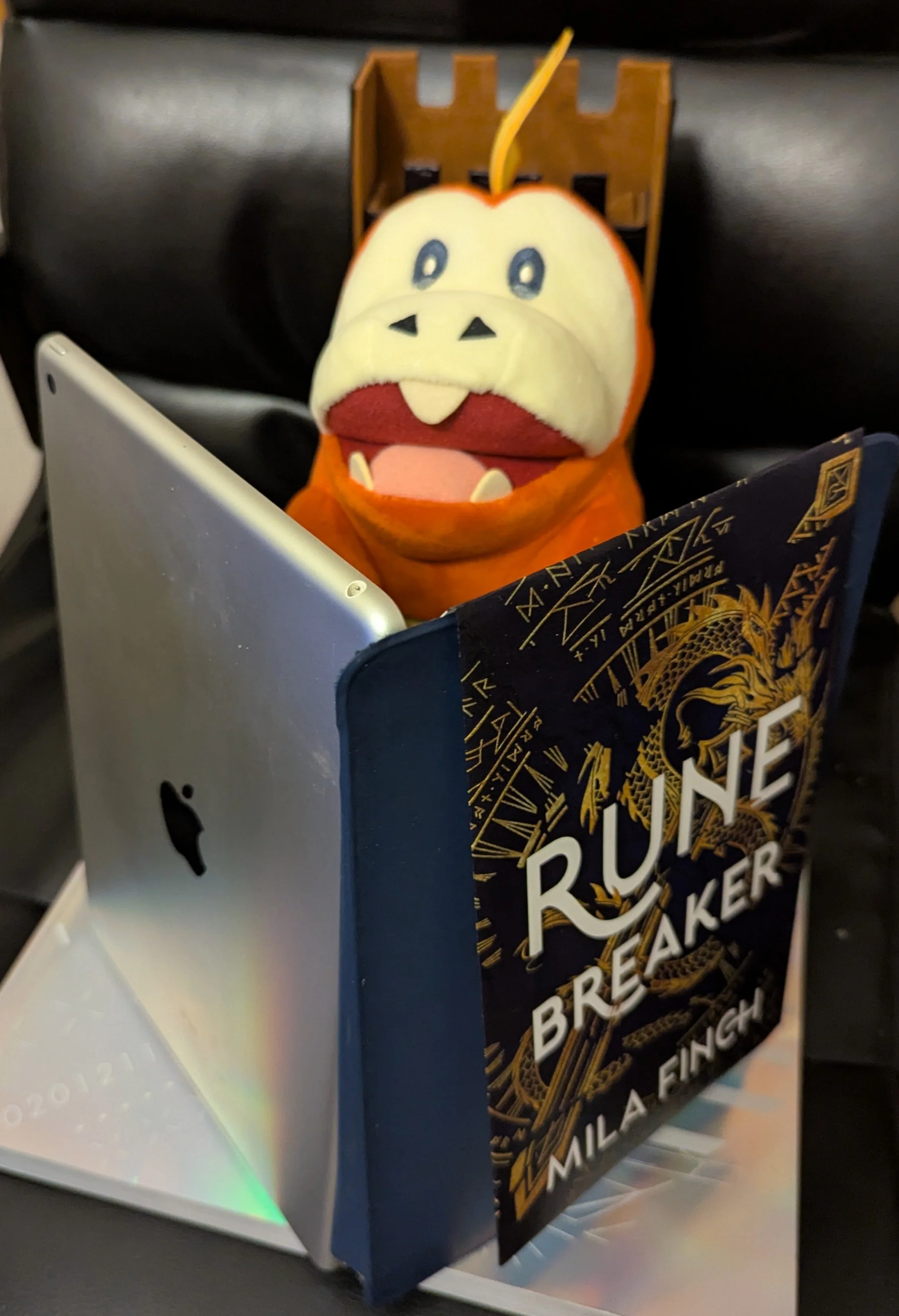
Hello, all. Welcome back to the review of Runebreaker, an indie Romantasy by Mila Finch.
As covered in the introduction of Part 6, this book only has three characters that are worth discussing: Aelie, Kairos, and Vaeris. We covered Aelie already during Part 6 and Part 7. Now, it’s time to look at the book’s Bad Boy Love Interest.
Let’s break some bonds.
STATS
Title: Runebreaker
Series: [Untitled Trilogy] (Book 1)
Author(s): Mila Finch
Genre: Fantasy (Romantasy)
First Printing: January 2026
Publisher: Self-published to Amazon
Rating: 0.5/10
SPOILER WARNING
Throughout this review, there will be mild, unmarked spoilers for Runebreaker. I will do my best to keep the first paragraph of each section as spoiler-free as possible. Heavy spoilers will be confined to clearly marked sections.
CHARACTERS (continued)
Kairos
Much like Aelie, Kairos is a shell of the character with no substance beyond tropes and cliché. He is a Bad Boy Love Interest, through and through. He’s also a good example of the Shadow Daddy (also seen with Xaden in The Empyrean), with the only significant deviation being that he controls mists instead of shadows (which is why I’ve referred to him as a Mist Daddy a couple of times). Since the mists end up doing the same sorts of things we see Xaden do with his shadows, this difference is purely aesthetic.
Also like Aelie, this fact did not have to break the book. A perfectly good story can still be written even when the Love Interest is written to check a box.
Which brings us to the third way that Kairos is like Aelie: Finch couldn’t commit to an interpretation of him. The way we are supposed to interpret him swerves depending upon the emotions of the moment. This introduces contradictory ideas that undermine the character.
The Victim
At the start of the story, Kairos is a slave of the royal family of Skaldir. They control him by using a rune on one of his gauntlets. They have also augmented his already-impressive abilities by binding a spirit into his flesh to fuel more powerful runes (i.e. bloodbending). The combination.of these two factors allows the royals to use Kairos as their official executioner. He is the deliverer of their ultimate sanction upon criminals and other threats to Skalgard. He is also used in the Rite, slaughtering both criminals guilty of capital offenses and the volunteers.
We’re given backstory for how Kairos ended up in this situation after he brings Aelie back to Sanguir. A century before the start of the story, there was a war between Skaldir and Sanguir. Sanguir lost the conflict. In order to spare his forces from execution, Kairos surrendered himself to Skalgard in their place.
Let’s be perfectly clear about this: with how things are presented within the narrative, Kairos’s submission to the royal family of Skaldir was the only concession Sanguir had to make in this treaty. Freeing him broke the treaty. We don’t know for certain what Kairos thought the royal family would ask him to do once he was sworn to serve them, but given that the power of oaths is common knowledge, he must have realized that submitting to their authority would force him to do things he otherwise wouldn't want to do.
This means that when Kairos manipulates Aelie into freeing him, he is not breaking free of unjust oppression. He is devaluing his original sacrifice. He just decides, “Screw peace, I’m ready for another war,” without any consultation with his own people (a fact that is called out in the narrative, only for him to brush it off). We’re told that there were attempts to free him over the years, but that’s not the same as assessing the condition and mood of his kingdom before dragging them into a conflict to punish Skalir for … accepting the terms of a peace treaty.
I’m going to come back to this at the end.
So Many Edges
Like other Shadow Daddies, Kairos is absurdly anti-social and violent. He flexes his power to kill, brutalize, or simply intimidate on a whim, even when dealing with people who are his allies or loyal servants. Even Daylen was more mentally sound than this edgelord.
Here’s the problem: Finch also needed Kairos to have a soft center. Aelie needs to be able to find the good inside him … while still seeing him as a “beast”. The results of trying to have things both ways are laughable at best and self-defeating at worst.
Let’s start with the laughable. When Aelie frees Kairos, his first action is to slaughter the king and queen of Skaldir, along with every member of the nobility within reach. It’s a gory scene. In the midst of the blood and slaughter, Finch takes a moment to call attention to the fact that Kairos is allowing the children of those nobles to escape his wrath. This is probably supposed to make us think that Kairos spares the innocent, but if so, it’s absurd. Those children will, at best, be severely traumatized by the deaths of the family members he just murdered in front of them, to say nothing of what will happen to them when the power vacuum he’s created leads others to steal the wealth and position of their families away from them. Kairos’s ‘mercy’ ends up feeling less like genuine principles and more like an excuse for his bloodlust.
Next, the self-defeating. After an entire book of seeing Kairos’s callous attitude towards killing, his lack of regard for the lives of the allies he might drag into a war, and the way he bullies those loyal to him, he shows Aelie a journal. We are meant to believe that he regretted every single execution he enacted while bound by his oath, and he recorded the identities of every person he killed. Aelie is going through this book, reflecting on all of her friends, neighbors, and loved ones at his hands. She is feeling “a spasm of pain with the names [she] recognized”. And then, in the midst of these painful reminders of her supposed loved ones, she thinks:
The more pages I thumbed through, the more I admired him.
After spending an entire book trying to make Kairos sexy via an element of danger, via an utter contempt for the value of life, Finch decides that the middle of a scene that hammers in just how many people he’s taken from Aelie is the perfect time to pivot and drill in the idea that Kairos was never a monster, that him being a killer was the fault of Skaldir’s king, and that he actually “hated cruety.’
“I surrendered myself for peace, and they made me a butcher.”
My chest tightened until it hurt.
“The king wanted me to feel every death,” he whispered. “He wanted me ashamed and broken.”
“It didn’t work. This is proof of that.”
I closed the book carefully and pressed it to my heart. I pictured him alone in some dark corner, writing as an act of penance, and it hollowed my insides.
This is just so stupid. I get that the appeal of the Shadow Daddy is that there’s more to him than just brutal violence, but the execution here is so backwards. Finch has gone out of her way to make Kairos appealing because he is a butcher. Now she’s trying to back out of the consequences of that. Aelie isn’t really having sex with a monster, you see - all the things that made him sexy were never his fault to begin with!
Even The Empyrean did this better. Yes, Xaden being the most extreme example of a faction of “egotistical assholes” opened up a lot of problems, but his edge didn’t clash with his softer elements. All of his aggression, all of his rage, was directed towards finishing the fight his father started. This means he is committed to (or, at least, consistently pays lip service to) protecting the innocent. It means to supports and looks after the children of the officers who served under his father. Depending on which retcon one goes with, his relationship with Violet starts either with him expanding his sphere of protection to a woman he finds attractive or with him protecting the daughter of the rider who showed mercy to the children he needed to protect. Xaden is a Shadow Daddy whose violence and his softness are all about protecting the people he believes deserve protection. As much as he represents a failure of writing, he’s more believable and consistent than Kairos is.
Protagonist-Centered Morality
About halfway through the book, Aelie learns where Kairos’s bloodbending powers come from. Apparently, the king of Skaldir wanted to test out a rune, so he used Kairos as a guinea pig.
I’m just going to quote the page in question.
“The High Cleric carved every line. Took hours. When he finished, he fused the rune with a spirit. It…didn’t want to be trapped in flesh. Fought the whole way in.”
“Gods.”
“Felt like something was ripping my insides apart. Wrapping around my bones.” He smiled wryly. “I spent three days in a cell losing my mind.”
My hands shook. I pressed them flat on the table.
“Eventually, I stopped fighting,” he said quietly.
My mouth dropped open. “That’s torture. They bound something inside you against your will!”
He shrugged. “It’s done.”
“Does it control you?”
“No, it’s not like that. We’re merged. What I want, it wants. It just makes me better at certain things.”
“Like?”
His smile darkened. “In battle, I’m more vicious. I don’t tire, slow down, or stop until everything’s dead. In the bedroom, it’s the same. More stamina, intensity, more…pleasure.”
I couldn’t look away.
His gaze caressed my naked skin. “It amplifies what’s already there.”
My face flushed. “But I’m still in control,” he added.
A spirit bound by a rune. Feeding on rage and lust. It seemed like a tale meant to frighten children.
Aelie then proceeds to offer to break the rune, thereby freeing Kairos from the spirit’s influence, and Kairos refuses.
Okay. Let’s roll through the bullet points.
With how is is described here, the spirit is as much a victim here as Kairos, but only Kairos’s suffering is acknowledged.
Kairos refusing this chance to break the rune and free said spirit means that he can no longer argue he’s the victim here. He is the jailor of a spirit that has no say in this matter and didn’t want to be jailed in the first place.
By Kairos’s own admission, the spirit only amplifies what’s already there, and he is the one in control. This kicks the legs out of his later assertion that he was “made” into a butcher. He was always a butcher, and the king just helped him express that.
The focus swerves to how this makes Kairos more sexual, thereby doubling down on him being attractive because he is a butcher.
If this story held any sort of moral through line, then being freed from this spirit should have been a priority. There could have been an entire character arc around Kairos learning to trust Aelie, learning to accept that he doesn’t need the spirit, and letting her release it from him. I hope that, as the series progresses, Finch does indeed go that direction.
However, this book lacks the through line. So we’re expected to swivel from, “Oh no, Kairos is a victim,” to, “Yay! Kairos is empowered,” with zero change in the variables present.
Avoiding Accountability
I think there is a fourth way that Kairos mirrors Aelie: a desire to avoid accountability.
Kairos is not, by any means, the most morally compromised character we’ve reviewed. However, most of the characters worse than him (not all, but most) either didn’t play the victim or else lived in a setting where good people doing horrible things is part and parcel. The ones whose accountability was acknowledged, yet tried to avoid it, were condemned.
Consider Carl Thonius from the Ravenor trilogy. Getting possessed by Slyte was 100% Carl’s fault. He allowed his addictions to lead him into using flects, and that opened a conduit to the Warp through which Slyte could enter him. After, he knew what duty demanded of him - seeking the God-Emperor’s mercy at the barrel of a bolt pistol - but he refused, seeking to instead control the power of the dæmon. This ended in a horrific fate for him. No matter how fond Ravenor was of Carl, he didn’t mince words when condemning his late interrogator. No one was to blame for Carl’s fate but Carl.
This example may seem like a stretch. After all, when did Kairos consent to be an executioner? When he he consent to become something analogous to a dæmonhost?
When he swore the oath, of course.
This is how deals with the fae work. Kairos offered himself up to Skaldir as a trophy. He agreed to submit to the will of the king as part of a deal that he knew full well could be perpetual.
“It was a faerie deal. As long as I was chained, King Vaeron and his armies couldn’t set foot across our borders.”
If Kairos had been kidnapped in a time of peace and forced into the deal, that would have been one thing. If he had surrendered his life, agreeing to his execution or imprisonment in a cell in the name of peace, and then was forced into the oath of servitude under duress, that would have been another. Neither are the case. Kairos understood that he was becoming a slave to guarantee the survival of his realm. He agreed to do what was asked of him, whether that was enacting the laws of his new masters or submitting to a medical procedure.
By the rules of the setting that Finch chose to establish, Kairos is not a victim on any count. He is 100% to blame for every bad thing the king ordered him to do, because he consented to it. This isn’t a beast who’s beautiful on the inside. This is a violent man who saw an opportunity to get out of a debt he agreed to paid, then decided that this self-imposed debt was an excuse to murder a bunch of people and restart a war.
How sexy and romantic.
Final Thoughts on Kairos
Kairos is a good example of what I mean when I say this book failed to meet me on its own terms. In concept, the idea of a Shadow Daddy whose edges were imposed on him by an outside force, who is not a monster on the inside, has potential. In execution, Kairos is a contradictory mess held together by Protagonist-Centered Morality. The blood on his hands is wiped away by the Main Character for no other reason than to provide Finch with an escape hatch from the uncomfortable questions of Aelie actually being in a relationship with a violent sociopath.
I’m sure there are plenty of readers who enjoy him. I just question how many enjoy him because of his actual writing, rather than because of cliché and pornography.
Acknowledgement of the Age Gap
This last point is not what I’d consider to be an objective literary criticism. I just find it funny.
This romance obviously has an age gap. Aelie is twenty-five, while Kairos is “over a thousand years” old. This sort of thing is pretty typical for Romantasy featuring fae, vampires, and the like, so I don’t think it’s worth commenting upon in isolation.
What I do find funny is that there is a chapter where Finch opens with a quasi-flashback, describing the first time Aelie ever saw Kairos execute someone … when she was a child.
…
This isn’t grooming, as Kairos was neither aware of nor influencing Aelie at this point. I just find it funny that Finch went out of her way to explicitly spell out that this age gap quite literally makes Aelie a child next to Kairos.
THE ONE GOOD CHARACTER
Both the Main Character and the Love Interest are corrosive to the story. Which begs the question: are there any characters who do work?
Sort of.
Finch goes out of her way to demonize Vaeris. By the time she properly establishes him as a villain, it’s hard to take him seriously. All that demonization has robbed him of credibility. He’s still functional, but only barely.
Yet, at the same time, Vaeris is the most compelling character in the book. I don’t know if it’s because of Author’s Assumption or because Finch was so desperate to punch him down that she ended up redeeming him, but either way, Vaeris ended up being the most nuanced and interesting character in the book. He may be a villain, but he’s the only character whose relatability goes deeper than a cliché.
We’ll dive into this on Sunday, May 17th. Until then, thank you all for stopping by. Please remember to subscribe and share if you liked what you read here. Take care, everyone, and enjoy the rest of your week.