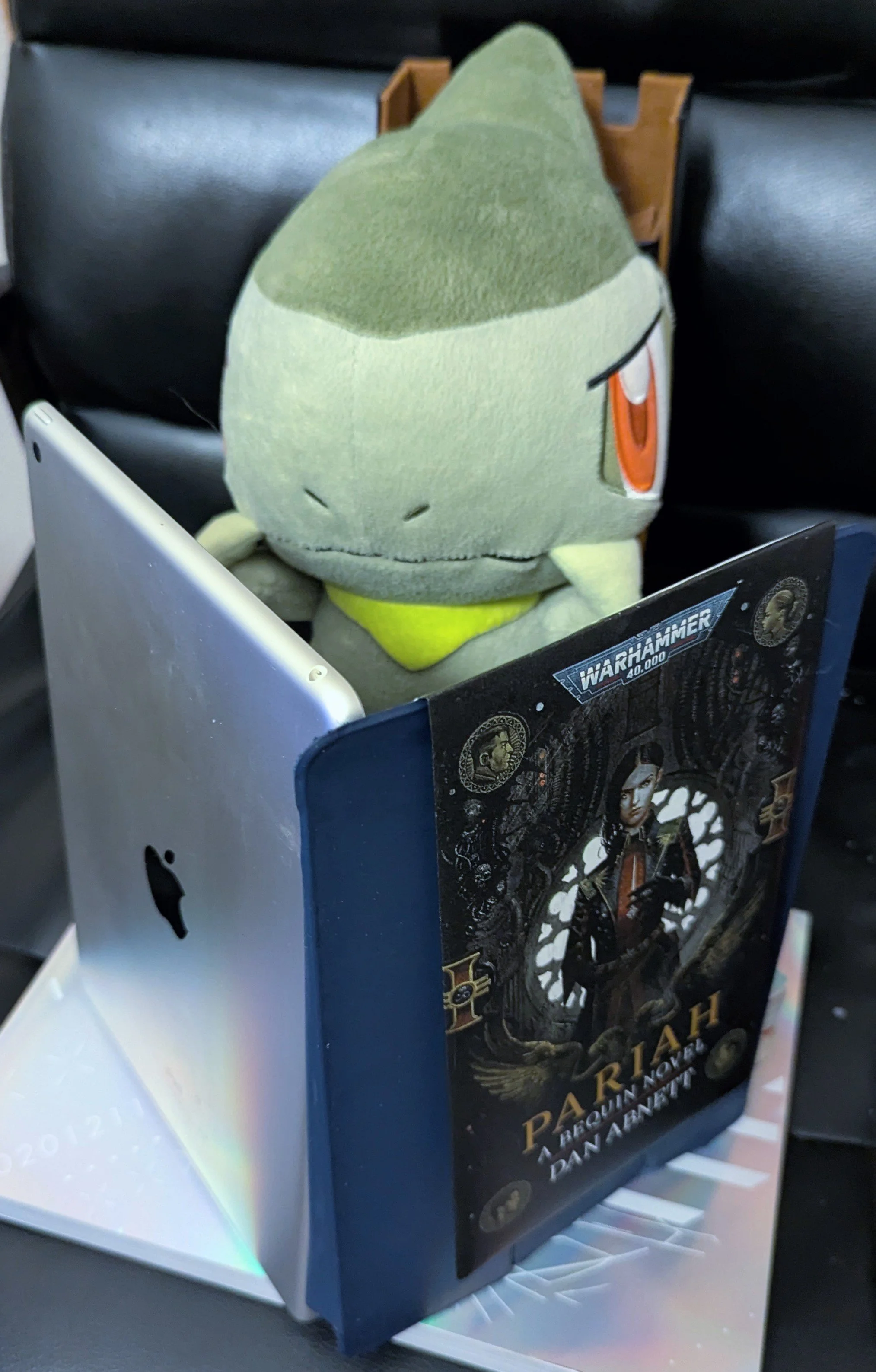
Pariah (The Bequin Trilogy, Book 1) (Part 3 - Character & Worldbuilding)
Welcome back, everyone, to the ongoing analysis of Pariah, Book 1 of the Bequin Trilogy.
If you haven’t already, I encourage you to check out Part 1, as that provides an overview of the book’s qualities and explores the impact of the prose on the narrative. You can also check out Part 2 if you’re looking for a breakdown of the plot. Dissections of this trilogy’s history and the handling of fanservice are coming soon.
Limiters off, everyone. There are heretics afoot.
STATS
Title: Pariah
Series: The Bequin Trilogy, Book 1
Author(s): Dan Abnett
Genre: Science Fiction (Space Opera)
First Printing: 2012
Publisher: Black Library (Games Workshop Publishing)
Rating: 9/10
SPOILER WARNING
Both minor and heavy spoilers for Pariah will be provided throughout this review. I will try to keep the first paragraph of each section as spoiler-free as possible and will confine heavy spoilers to clearly labeled sections. There won’t be any spoilers for the sequel, Penitent, which I chose not to read until I finished reviewing Pariah.
Heavy, unmarked spoilers will be provided for any and all of the Eisenhorn and Ravenor content we’ve covered thus far.
TERMINOLOGY
The Alizebeth Bequin in the story is not the same woman from Eisenhorn’s novels. This Bequin is her daughter (or, at least, a person engineered from the original Bequin’s genetic material). Within the narrative itself, Abnett establishes distance between the two characters as early as Chapter 1, with Bequin operating by the “affectionate contraction” of “Beta”. I’ll therefore be referring to this character as “Beta” throughout this review, while her mother will be referred to as “Alizebeth”.
CHARACTER
Beta Bequin
Beta is, quite frankly, another overpowered character in the same vein as Vis from the Hierarchy Quartet. She is hyper-intelligent hyper-observant, and hyper-competent in the arts of combat and deception. Her pariah gene gives her an edge that is every bit as potent as being Synchronous, with the added benefit that she can selectively activate it with the aid of a limiter cuff.
At the same time, though, nearly all of these things are justified by her background. The abilities that can’t be argued as earned via her upbringing create narrative problems for her rather than automatically solving them. She makes mistakes with meaningful consequences for her. She is genuinely likeable and charming, rather than everyone else auromatically either liking her or being a villain. Her narrative voice is enjoyable to read.
All this is to say that Bequin is another good example of the right way to write an overpowered main character. If Violet Sorrengail were written this way, I’d have far fewer complaints about the Empyrean.
Judika Sowl (Heavy Spoilers)
A fellow blank who graduated from the Maze Undue a few years ahead of Beta, Judika is introduced shortly before the assault that destroys the Maze. Beta is told that he has now achieved the rank of Interrogator (the Inquisition’s equivalent to an apprentice, serving as a second-in command to an inquisitor and being on-track for promotion to full Inquisitor status). We learn via exposited backstory that Beta used to have a crush on him, though with how it’s framed, Abnett isn’t pushing him as a love interest.
This is a good thing, because Judika is not as pleasant as Beta remembers. He is snide and belittling to her. His physical health also deteriorates rapidly after the attack on the Maze, for reasons she can’t figure out.
Judika works fine as a character, but his chief contributions are both to move the narrative forward:
When Beta associates the brokers she’s investigating and the attack on the Maze with the Cognitae, he gyrates between patronizing scorn and treating the mere mention of “Cognitae“ as if it is a taboo word. This helps foreshadow the reveal that the Maze was actually a Cognitae operation.
He’s meant to introduce what the Cognitae’s long-term plans for Bequin are, since he already is functioning as a grael and suffering some side effects from it.
The Curst (Renner Lightburn)
The Curst is not much of a character. He’s more of a worldbuilding concept with narrative purpose. When he’s introduced, we learn that Curst are a local tradition of penitents, use forsake their identities and live in service and utter poverty. Their effort to atone for past sins by taking on the burdens of others is so extreme that they will commit murders and other dark deeds to keep others from being burdened with those sins.
The one we meet in this story isn’t on anywhere nearly that dark a mission, though. His objective (as he understands it) is to help Beta rendezvous with the survivors of the Maze. There’s also a minor mystery as Beta tries to puzzle out what he did to become a Curst, but this ends up not being narratively relevant to this story.
Overall, this is a functional character. I just don’t have much to say beyond that.
Eisenhorn & Ravenor
Eisenhorn and Ravenor in this book are exactly the people you’d expect them to be. From what I can tell by the timeline, Eisenhorn came straight here from the events of The Magos, so he hasn’t has a lot of opportunities to grow after Drusher reintroduced him to the Power of Friendship. As for Ravenor, it seems like he is only back in the field because new evidence has finally pushed him to hunt Eisenhorn, so it’s not a surprise that he’s a cynical and weary of Eisenhorn’s heretical actions as he was in “Perihelion”. Their reunions with Beta are something I’ll discuss while talking about fanservice.
Just one thing to note here: Eisenhorn swordfights a Word Bearer and wins. This is a little hard to believe. Yes, Eisenhorn is this badass inquisitor wielding dæmonic powers, bolstered by augmetics, and carrying that psychic blade that he’s had since Hereticus, but a Word Bearer is still an Adeptus Astartes, and beyond the usual nonsense that Chaos Space Marines get, this one is specifically from the Traitor Legion that uses magic. I’m not saying Eisenhorn couldn’t hold his own here, but the fact he outright wins is a bit silly.
The Retinues
Between Eisenhorn and Ravenor, this book collectively brings back Harlon Nayl, Medea Bentacore, Interrogator Voriet, Cherubael, Patience Kys, and Kara Swole. We are back to the Eisenhorn era in terms of their writing. These are background characters filling narrative roles. I think that’s appropriate, though. Beta does not know these people, outside of Medea (who - and this isn’t really a spoiler, since it doesn’t affect the trajectory of the plot at all - was disguised as a nun as the convent where the Maze gets its orphans from, and thus is the closest thing Beta has to a mother figure in her childhood). Of course a 1st Person POV story from her perspective is not going to go deep into their characters.
That said, given where Ravenor Rogue left off, I feel a bit awkward about Kara’s involvement here. I think it makes perfect sense for her to still be working with Ravenor. Despite my frustrations about how her character was assassinated in that last book, I also think it makes sense for Ravenor specifically to forgive her and give her another chance. It’s just that her arc in that series ended on such a heavy note that it’s more than a little jarring to just see her in the field. I feel like there’s a short story or novella needed to explore the personal fallout that trilogy had on her before she can just go back to work.
WORLDBUILDING
Place
The entire book is set in and around Queen Mab, a hive city on the Civilized World of Sancour. (I say “Civilized World”, but I haven’t found any official classification. I just assume it’s not a Hive World because the lands outside the Hive City haven't been shown to be a toxic waste.) The main claim to fame for the world and Queen Mab is its association with various crusades that pass through the area. Entire streets are considered holy ground because a saint walked there, and the city’s grand cathedral is a pilgrimage site. Despite the average tech level in Queen Mab being roughly on par with most other worlds shown in Abnett’s novels, it is described in a manner that makes it feel much more like a Fantasy location, right down to the heavy emphasis on swords over more modern weapons (despite more modern weapons being available).
There is something very off about Sancour and Queen Mab when it comes to Warp nonsense and Chaos. The extra dimensional spaces seen in The Magos also appear here. There apparently an entire twin city to Queen Mab enclosed in one of these spaces, though the audience is not given a chance to see it in this book. It’s implied that the Yellow King is either based on Sancour or, at the very least, deeply invested in it.
Outside of these setting details that contribute to the ethereal vibe of the story, there’s nothing particularly remarkable about this location. Abnett continues to do a good job of vividly setting scenes and creating the vibe of a place that, while different from our own world, still has people going about their lives.
The Maze Undue (Heavy Spoilers)
The Maze Undue - which, as Beta figures out prior to the events of the story, is a “corruption of the Old Fran prhase maison dieu, or ‘house of god’” - is introduced as an Inquisition training facility. It’s basically the House of Black and White from A Song of Ice and Fire, albeit purely focused on training its students in disguise and deception instead of murder (though they are all trained to be masters of combat). The blanks are trained by the Maze to completely vanish into a fabricated identity so that they can observe or steal from a target.
Now, anyone who has read The Magos will almost certainly realize that this is a Cognitae facility even before the Cognitae are mentioned (more on that when we talk about fanservice). They aren’t just training masters of disguise, or detectives, or even assassins. For that matter, even if you’ve read Ravenor Rogue, it’s pretty obvious. The way Beta observes situations reads very similarly to the way Molotch did in his introductory chapter in that book. This isn’t necessarily an issue, mind, just something that will make this book read differently depending on who picks it up.
Why is the Cognitae doing this? Well, as we covered in the plot breakdown, it’s about making “graels”. They are using blanks as physical vessels to contain Warp entities (which I assume are actually the synthetic dæmon bodies being fabricated in The Magos). I’m not exactly sure why a blank would be a suitable vessel for such an entity, given the whole point of a blank is to be completely disconnected from the Warp, but I’m willing to give Abnett time to explain this.
Here’s the big question, though: does it makes sense for the Cognitae to go about it in this way? That is to say, to pretend to be an Inquisition facility?
I’m of two minds on this. Yes, it makes sense as a means to fool Imperium institutions If Sancour is a world where the Inquisition has minimal presence (or else where local Inquisition personnel have been subverted by the Cognitae), then pretending to be with the Inquisition would open up a lot of doors with very little risk. However, this also opens the door for Maze students to grow loyal to the Imperium and then immediately betray the Cognitae when the truth is revealed to them (which, you know, is exactly what happens with Beta). Why not raise the students to be loyal to the Cognitae, even if the public face is that of an Inquisition training school?
As with the mechanics of the graels, I’m willing to give Abnett the benefit of the doubt on this. Maybe the idea is that the entity implanted into the grael overwrites the grael’s initial personality, just like how Carl’s personality was warped by Slyte until he finally gave in and released the dæmon. That could justify a shift in loyalties. It’s just that, for now, this feels like the Maze pretends to be an Inquisition facility purely to fool the audience. We are in Beta’s 1st Person POV, so the most realistic way for her not to mention that the Maze is a Cognitae facility right out the gate is if she herself doesn’t know. That’s fine when the reason she doesn’t know makes sense. Here, that reason feels very forced.
Enuncia
This book establishes, via a very literal demonstration, that a blank can use Enuncia, even while their powers are functioning. Blanks are actually much more suited for using the language than other humans, not suffering the physical side effects that mere exposure to Enuncia can cause to normal people. That said, they aren’t completely immune to the effects. Beta still bleeds from the mouth when she speaks even a single word of Enuncia with deliberate intent to evoke power, and her mind struggles to retain the knowledge under normal conditions.
I’m on the fence about this reveal. I think it speaks volumes about the power of Enuncia. The demonstration, in and of itself, also makes sense in-world, since the ability to use Enuncia with fewer side effects makes blanks incredibly desirable for anyone seeking to research the language. That said, this sort of power creep could go very poorly if Abnett (and future writers who use Enuncia) aren’t careful about it.
TIMING
Next Friday, May 8th, we’re going to dial back the analysis a bit to discover the meta of this series. The Bequin Trilogy is now roughly 14 years old, and yet still isn’t finished. I think the reasons why are rather enlightening, both for the trilogy itself and other works Abnett has written in recent years.
Thanks for stopping by. Please remember to subscribe and share if you enjoyed what you read here. Take care, everyone, and have a good weekend.