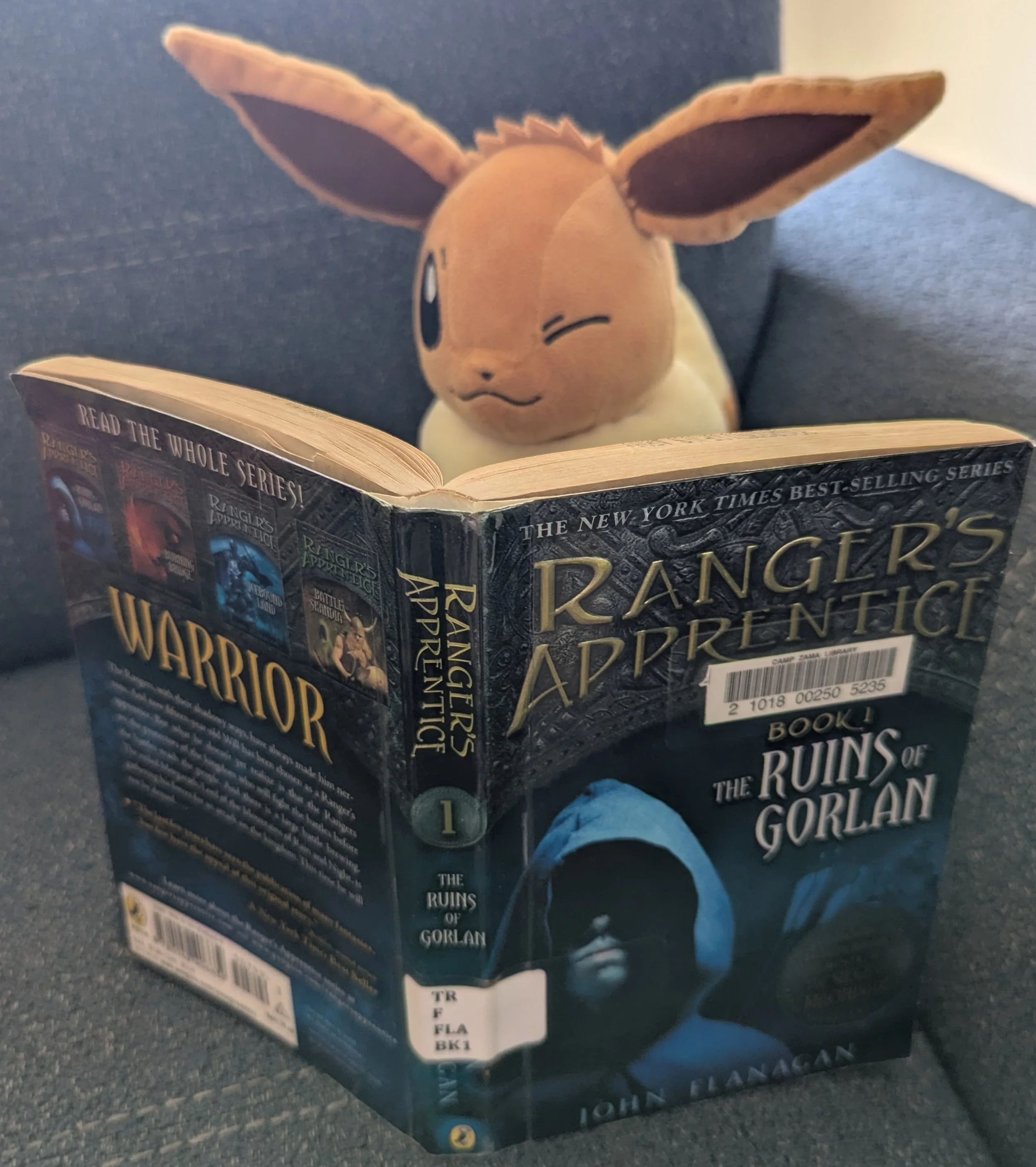
The Ruins of Gorlan (The Ranger's Apprentice, Book 1) (Part 1 - Overview & Theme)
Hello, all. I hope you are having a good week.
I recently gained access to an English language library. While it is not a particularly large library, is does have a good selection of popular titles (which is why I’m so such the new Empyrean novella will eventually surface there). I have been poking around it, looking for interesting things to read.
In my wanderings, I found myself at the Young Adult shelf. Not much there particularly jumped out at me. One of the titles that did, though, was the Ranger’s Apprentice series. I had read the first book, The Ruins of Gorlan, which came out when I was in high school, but I never got around to reading the rest of the series.
Since the library has what appears to be the entire series (and the spinoff series), I figured I might as well rectify that.
Step softly now. Let’s go hunting.
STATS
Title: The Ruins of Gorlan
Series: The Ranger’s Apprentice (Book 1)
Author(s): John Flanagan
Genre: Fantasy (Middle Grade)
First Printing: November 2004
Publisher: Puffin Books
SPOILER WARNING
Mild spoilers for The Ruins of Gorlan will be included throughout this review, through I will keep the first paragraph of each section as spoiler-free as possible. Heavy spoilers will be confined to clearly labelled sections.
STRUCTURE
We’ll be splitting this review into two parts:
Part 1 (Today)
Premise
Target Audience, Prose & Content Warning
Rating
Theme
Part 2 (Wednesday, May 20th)
Worldbuilding
Characters
Plot
PREMISE
From the back of the 2008 American paperback edition, we get:
Warrior
The Rangers, with their shadowy ways, have always made him nervous. And now fifteen-year-old Will has been chosen as a Ranger’s apprentice. But what he doesn’t yet realize is that the Rangers are the protectors of the kingdom who will fight the battles before the battles reach the people. And there is a large battle brewing. The exiled Morgarath, Lord of the Mountains of Rain and Night, is gathering his forces for an attack on the kingdom. This time he will not be denied …
Reaction
The premise isn't wrong. However, it’s more an advertisement for the Ranger’s Apprentice series than for this book specifically. See, all the stuff about Will being chosen and learning about the true mission of the Rangers happens fairly early into the book. Morgarath and his plans are set up in the prologue and then get some mild foreshadowing across the text, but it only really becomes the focus in the last third of the book.
What the bulk of this book really focuses upon is Will’s initial training. We see how he is introduced to the various tools and skills of the Rangers, along with how he stumbles in some of these skills before his master, Halt, corrects him. There’s also a lot of focus on Will’s adolescent dramas with his childhood peers, particularly his longtime bully, Horace.
This isn’t to say that I find this premise misleading. It’s selling a broader narrative, rather than just this one book. Just be prepared to wait for the higher-stakes action.
TARGET AUDIENCE, PROSE & CONTENT WARNING
Goodreads lists this book as both Middle Grade and Young Adult. My assumption going in was that it would be Young Adult, both because this book came out when I was in the Young Adult demographic and because my local library lumps all the Middle Grade books onto the Young Adult shelves. After reading it, though, I feel confident in saying that this is very much a Middle Grade book.
Most of this is rooted in the narrative voice. Will does not read like a fifteen-year-old. A twelve-year-old, maybe, but even that feels like it’s pushing it. Even Harry Potter, back in The Philosopher’s Stone, read like he was older than Will is here. This very much comes across like a case of a young audience being given a hero who’s slightly older than them, so that they can look up to him, but who perceives the world in terms that would be easy for them to digest.
Other aspects of the prose lend to this impression. The writing is very straightforward and accessible. There’s not a lot of subtlety or nuance, with the author spelling out nearly every character emotion, motivation, or reaction. 3rd Person Omniscient POV is used liberally, with it primarily serving as a way to feed the audience those emotions, motivations, and reactions. The end result is a story that’s very easy to follow even if someone lacks the necessary experience to pick up on subtle details.
Then there are the elements that might make the story more mature. The Ruins of Gorlan has plenty of violence, but it’s free of gore, and it’s described in very stylized terms. Swearing is so minimal that I can’t recall anything outside of one instance of a man taking the Lord’s name in vain in a very stressful situation. In fact, the only content that I think might bother children or parents is the bullying subplot, but that’s less because it’s particularly disturbing and more because it’s just so miserable. Even the handling of this element comes across as something written for elementary school children.
I think this book works great as a Middle Grade. Sure, I’d like to see the series transition to YA in later entries, with both Will and the content aging up with its contemporary audience, but that’s not necessary. The book works well for what it is.
RATING: 9/10
The Ruins of Gorlan is one of those stories that is both very simple and incredibly effective at what it does. Will is a relatable protagonist who finds himself shunted down a path different than what he originally wants, yet finds a sense of belonging and purpose there. His training is low-stakes yet immerses the reader in his world. The characters he interacts with, while simplified and denied subtlety for the sake of a less experienced audience, still have adequate depth to make them feel like real people.
Then there’s the theme. Flanagan takes the simple idea of finding a path that embrace’s one’s talents that makes it into a deeper story of personal growth. This isn’t a Special Snowflake story. It's a story of a young man working hard to letting go of the holdups that weight him down.
Frankly, the only reason I don’t rate this book higher is because it is burdened with narratively unnecessary elements. Not bad elements, not even elements that damage the narrative by their inclusion - just things that either take up a large proportion of the page count for minimal gain or that feel tacked on and pointless. I'm not sure the target audience would recognize the problems. They are just things that have caused problems in other books, and are only spares from damaging this one by the overall quality of the writing.
THEME (HEAVY SPOILERS)
At first glance, The Ruins of Gorlan’s message would seem to be one seen throughout Western literature: embrace your uniqueness, and you will find your place. It’s a story of a less physically-capable individual being sent down a path that he didn’t choose for himself and finding a sense of belonging there, despite his initial desire to return to a more familiar path. What makes this story stand out thematically is that it goes a layer deeper.
The Story
Will begins the story with the impossible (for him) dream of becoming a knight. This isn’t merely about the glory. Will is an orphan, and the only thing he knows about his parents is that his father died in service to the realm. He has built his entire identity around a personal mythology about his father being a legendary knight. Becoming a knight himself is about manifesting this identity.
Being chosen by Halt, the Ranger of his fiefdom, to become an apprentice Ranger doesn't automatically erase this desire. While Will doesn't spend the story chasing chances to be a knight, he is still drawn to symbols of knighthood. He is disappointed when he has to learn to fight with a bow and knives instead of a sword. Later, when he meets a Ranger who wields a sword, he immediately locks in on that detail.
The pivotal moment for Will comes after the climax. For his role in saving the day, the baron offers him a chance to leave the Rangers and train as a knight instead. Will rejects his opportunity. Later, he admits to Halt that he feels like doing this has let his father - at which point Halt, who knew his father, promptly shatters Will’s illusions by explaining his father was a common sergeant. This revelation does not break will. Instead, after his journey across the book, he feels a sense of peace. He is no longer constrained by his own expectations, but free to walk the path he was born to walk.
Why This Works
It would have been very easy to just write The Ruins of Gorlan as a Special Snowflake story. Flanagan could have just made it about Will not having the physique or talent to do the popular thing, only to succeed and show up everyone who ever doubted him when handed a more suitable role. Instead, Flanagan made the theme about Will’s need to grow as a person. The lesson here is about letting go of false expectations that might drive a person to be someone they aren't. I think that's a nuanced and impactful message, especially when targeted at an audience that is about to be saddled with the pressure of planning for their futures.
And, of course, there is a matter of context and the details of the execution. Sure, Will is talented in certain aspects that make for a good Ranger, but his story is one of struggle. He only comes to his revelation that he belongs after he earns his place, rather than being handed power, preferential treatment, and handicaps. His growth as a character also falls upon him. The attachment to an illusion isn't blamed upon some other character whom Will blames for holding him back before tossing aside that relationship. Will had to come to accept the falsehood of his invented backstory, with those expectations that he set for himself, and accept who he truly is.
UNDER THE HOOD
Now that we’ve looked at the broad strokes, it’s time for a look at the details.
As stated in the rating, The Ruins of Gorlan does a very good job at presenting itself. There is very little that I would consider to be a flaw. That said, there are a few elements that feel unnecessary and don't have a meaningful payoff. Trimming the fat in a narrative is usually a good thing, so I think it’s important to at least go over why these elements didn’t need to be in the book, even if their presence didn’t do any damage. That breakdown is coming your way on Wednesday, May 20th.
Thank you all for stopping by. Please remember to subscribe and share if you enjoyed what you read here. Take care, everyone, and enjoy the rest of your week.