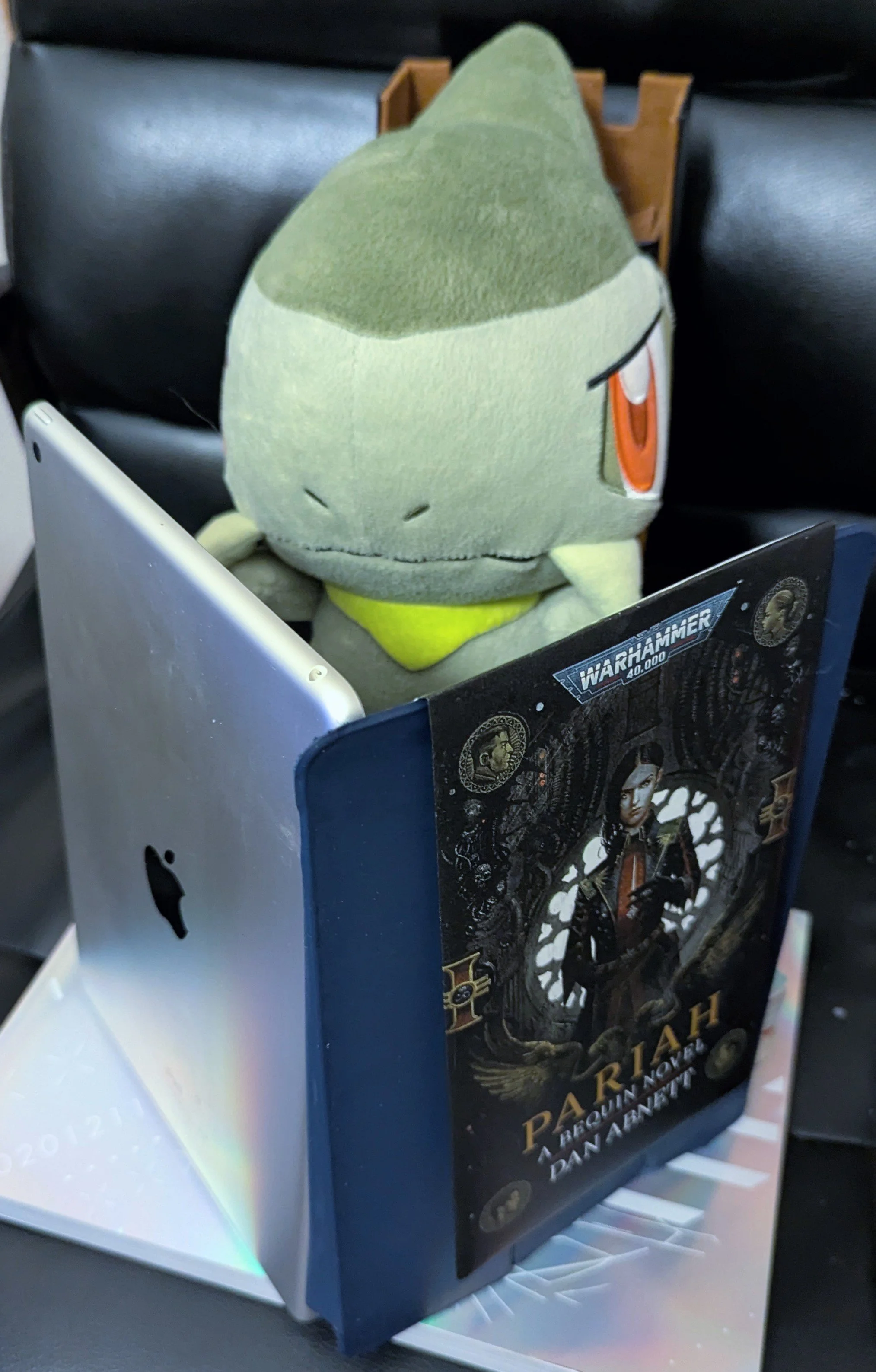
Pariah (The Bequin Trilogy, Book 1) (Part 4 - Series)
Hello, everyone. Welcome back to the ongoing analysis of Pariah, Book 1 of the Bequin Trilogy.
Today’s going to be a shorter entry, focusing on just the publication history of this trilogy. If you’re looking for an overview of the book and an analysis of the prose, please see Part 1. You can find breakdown of the plot in Part 2 and of the characters and worldbuilding in Part 3. The analysis of fanservice is coming next week in Part 5.
Limiters off, everyone. Today’s a day for a subtler exploration of heresy.
STATS
Title: Pariah
Series: The Bequin Trilogy, Book 1
Author(s): Dan Abnett
Genre: Science Fiction (Space Opera)
First Printing: 2012
Publisher: Black Library (Games Workshop Publishing)
Rating: 9/10
SPOILER WARNING
Both minor and heavy spoilers for Pariah will be provided throughout this review. I will try to keep the first paragraph of each section as spoiler-free as possible and will confine heavy spoilers to clearly labeled sections. There won’t be any spoilers for the sequel, Penitent, which I chose not to read until I finished reviewing Pariah.
Heavy, unmarked spoilers will be provided for any and all of the Eisenhorn and Ravenor content we’ve covered thus far.
TERMINOLOGY
The Alizebeth Bequin in the story is not the same woman from Eisenhorn’s novels. This Bequin is her daughter (or, at least, a person engineered from the original Bequin’s genetic material). Within the narrative itself, Abnett establishes distance between the two characters as early as Chapter 1, with Bequin operating by the “affectionate contraction” of “Beta”. I’ll therefore be referring to this character as “Beta” throughout this review, while her mother will be referred to as “Alizebeth”.
SERIES
The Bequin Trilogy is a rather curious beast when viewed as a single entry within a larger continuity of published works.
History
Originally, I thought that both Pariah and Penitent released in 2021. Those are the dates listed on Amazon, and it was why I originally thought Pariah and Penitent were written as one book and split in two.
However, it turns out that, in the case of Pariah, this date only referred to the release of the version of Pariah with an updated cover (to match the cover used for Penitent). The original release of Pariah actually happened in 2012, between the wrapping-up of the Ravenor trilogy and before The Magos. That’s quite the gap.
Why did this happen? Well, my Google research provided a couple of answers:
In his review of the The Magos, Arthur of Fake Geek Boy claims that Abnett attributed this to wrtier’s block, with other projects taking up his time while he worked through it.
In an interview with Track of Words, Abnett stated “the Horus Heresy kept getting in the way”. He didn’t mention writer’s block, but he did comment on how he feels the “additional thinking time” will have benefitted Penitent.
The particular reason doesn’t matter, of course. However, it would seem to shoot my theory about these books originally being one in the foot. I’m therefore going to analyze the ending of Pariah the same way as any other standalone or first entry in a series.
On a related note, the delay of Pandaemonium has explicitly been linked to Games Workshop. As covered in this IGN article from June 2025, the conclusion of Pandaemonium will have massive repercussions for Warhammer 40K has a whole. Games Workshop is reportedly keeping the project in a hold pattern (and keeping Abnett quiet with an NDA) so that all of the Warhammer media can handle whatever bombshell reveal is waiting for us.
Spin-Off
Not going to lie, I find Bequin (whether Alizebeth or Beta) to be a rather curious choice for a novel series.
It could have been done, of course. Alizebeth was with Eisenhorn for more than a century, and she trained an entire cadre of blanks (known as the Distaff) to aid his operations. There’s a lot of juicy potential for stories here.
The issue is that this spinoff is carrying things forward within the Warhammer 40K timeline. It’s after Alizebeth’s death in Hereticus. Yes, she was placed in stasis, yet that just means that her revival was possible, not automatic. Ravenor doubled down on this by showing us that Ravenor has been carrying Alizebeth’s body with him on his travels. While Alizebeth was ignored for the remainder of the Ravenor Trilogy, the implication was that her return would be significant.
Jumping straight to Beta feels rushed. There should have been a story in the middle to explain her existence, not just a few lines of exposition to handwave it. Perhaps the future books in the trilogy will correct this issue. For now (and, for that matter, in the 9-year gap between Pariah and Penitent), Beta’s existence feels like the same favoritism that undid Ahsoka’s death in Star Wars: Rebels.
With all that being said, at least Abnett has a story to tell here. That elevates Bequin’s resurrection (so to speak) to something more akin to Darth Maul still being alive in The Clone Wars. The handwaving of consequences is being pivoted into telling a good story, rather than merely erasing cause and effect so that the author could bring back a favored character.
Bequin Trilogy & Inquisitor Nonet
With all that said, I think that Pariah functions well as an introduction to the Bequin Trilogy. It effectively sets up the multiple factions involved within the story and a deep mystery to draw readers onward.
How it functions within the wider mythos of Abnett’s Inquisitor nonet (as one Warhammer wiki called it, comprised of the Eisenhorn Trilogy, the Ravenor Trilogy, and the Bequin Trilogy) is more complex.
I think this makes sense in concept. Just as the Ravenor Trilogy comes after the Eisenhorn Trilogy in the chronology, the Bequin Trilogy follows the Ravenor Trilogy. The placement of Eisenhorn and Ravenor as enemies also makes sense after the fallout of their respective trilogies (though after “Perihelion”, I’m not sure what changed Ravenor’s mind and convinced him to hunt Eisenhorn down).
In execution, though, it’s not yet clear what actually links these stories into one coherent narrative. If it were just about the characters, fine. However, by making the Cognitae and Enuncia a focus, Abnett has associated the Bequin Trilogy far more closely with the Ravenor Trilogy. Throwing in Glaw as a surprise antagonist factor in the story doesn’t really make this feel like a true sequel to the Eisenhorn Trilogy (though having Glaw revealed as an antagonist out of left field certainly is consistent with how the Glaws were applied in the Eisenhorn Trilogy).
Maybe I’m just overthinking this. To be honest, I don’t think that these separate trilogies need to be framed as one massive series. Having them be in continuity and sharing common characters is plenty to be going off of. It’s sort of like how the Eisenhorn Trilogy didn’t need to be reframed as the Eisenhorn Quartet to accommodate The Magos. Telling a good story that stands on its own while respecting what came before is more meaningful than trying to construct an epic framework to unite such stories into one narrative.
FOR FANS AND NEWCOMERS ALIKE
Next Friday, May 15th, the analysis of Pariah concludes with a Spotlight Analysis on Abnett’s application of fanservice. This book had the potential to be a terrible mess, either leaning too much on past works for substance or else failing to give elements from past books the respect they deserve. Abnett found the perfect balance, telling a story that stands on its own while still giving elements the weight they deserve. I feel this is a standard all fiction with legacy elements should strive for, so let’s break down why things work so well.
Thanks for stopping by. Please remember to subscribe and share if you enjoy what you’ve read here. Take care, everyone, and have a good weekend.