The Mixed Blessing of Fanfiction
Hello, all. I hope you’ve enjoying your week thus far. Welcome to this off-the-cuff interlude about fanfiction in traditional publishing.
I’ve toyed with the idea of writing an editorial about the fanfiction-to-novel pipeline for the past month, inspired by all the discussion about SenLinYu’s Alchemised (which, on the off chance you didn’t already know this, was originally a Dramione fanfiction bearing the title of Manacled). What ultimately prompted me to write it was a recent video by Dov James on this same topic. I think he made some good points about how the pipeline of fanfiction into trad-pub, and I’d like to add in a few thoughts of my own.
BACKGROUND
Definitions
Merriam-Webster defines “fanfiction” as:
stories involving popular fictional characters that are written by fans and often posted on the Internet
Basically, any time a someone other than the original author(s) (or, at least, those individuals with a legal right to utilize the intellectual property in a commercial capacity) writes their own work within an established setting or franchise, that is considered fanfiction.
There are some gray areas to this, of course. Public domain muddles the waters of what is fanfiction versus being an original work (which is why some people refer to The Divine Comedy as fanfiction). The term fanfiction is also derogatively applied to works where the authors have legal (or, at least, uncontested) authority to make use of an existing intellectual property yet break from the original source material in an irreconcilable way. (We’re not going to be using the derogative usage here today.)
The most agreed-upon usage I’ve seen for fanfiction has been for the fair use works published to websites like Archive of Our Own (AO3). These are produced by people to celebrate fiction that they enjoy, to explore what-if scenarios, or simply to try to rewrite a story in a manner more to their liking.
The Pipeline
Fanfictions can become quite popular in their own right, building large followings and attracting a lot of page views. This is a quantifiable audience, one that predates modern social media metrics and remains far more reliable than them. It should therefore come as no surprise that enterprising trad-pub saw an opportunity to cash in on that audience.
Obviously, a fanfiction can’t be published as-is. Its writers can only get away with what they do because their activities constitute fair use. The moment those works are monetized, that defense is gone, and they can be penalized for copyright infringement. However, that hasn’t stopped publishers from signing these writers. They just need to change names and various elements to the point that a story that was once fanfiction can legally be considered a distinct work from the source material.
I don’t know what the first work this happened with was, but I can name fairly recent and popular two book series that originated with fanfiction: the Fifty Shades series by E. L. James and the Mortal Instruments series by Cassandra Clare. And that trend hasn’t stopped with them. If anything, it has evolved.
WHERE WE ARE NOW
These days, trad publishers aren’t just cherry-picking particularly successful fanfictions. They are targeting entire fandoms - in particular, shipping fandoms (fandoms build around relationships between fictional characters, whether the canonical relationships or what-if scenarios).
One of these is the Dramione fandom, which favors a pairing of Draco Malfoy and Herminone Granger from Harry Potter. Alchemized is only one of a series of recent books that were originally Dramione fanfictions, with Rose in Chains and The Irresistible Urge to Fall for Your Enemy also falling into this category (and probably others on the horizon, though these other titles haven’t yet gotten much attention by the wider community of reviewers). Another fandom is the Reylo fandom, pairing up Rey and Kylo Ren from the Star Wars Sequel Trilogy. Some of these fanfictions stick close to the original premise of their source material (all the Dramione books thus far seem to be Dark Romantasies, building off the Fantasy of Harry Potter) while others are alternative universe takes (which is why more than one Reylo book ends up as a Contemporary Romance).
I Don’t Hate the Concept
I’m not a fanfiction person. There’s a sort of uncanny valley effect for me. The different writing styles from the original (if there is one author of the original) just feel wrong, and every deviation from the source material that isn’t accounted for in the original premise ends up feeling like a mistake. The source material becomes a skinsuit (which, incidentally, is how the term “fanfiction” sometimes gets applied derogatively to even official works).
There’s nothing inherently wrong with fanfiction, though. It’s sort of a genre in its own right. Plus, it can be a learning tool for new writers. Using an established intellectual property, one where plot, characters, and worldbuilding are ready-made, can provide the same benefits as training wheels on a bicycle. The writer can flex creative muscles and build good writing habits without needing to think through literally every detail.
And, for all of my criticism about recent trends being pushed by trad-pub, this is one that actually makes sense. An established audience is identified, and a product is produced for them, rather than merely flooding the marketplace with things trad-pub insists needs to be exist regardless of actual demand. In this sense, Alchemised isn’t all that different from either Eragon or The Shadow of What Was Lost. This is a pretty unambiguous example of high demand for a work encouraging investment and distribution on a wider scale.
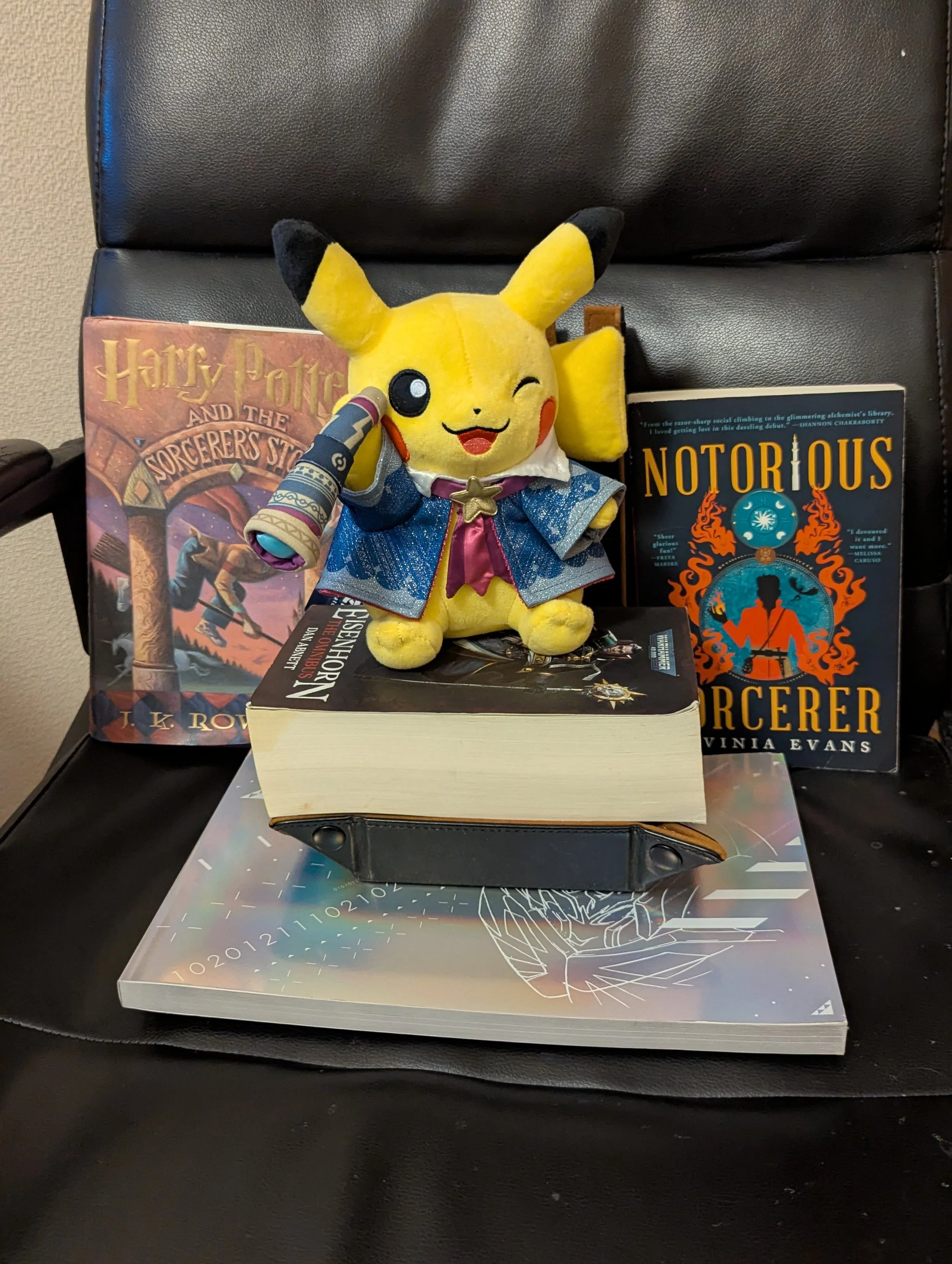
Also, just because a work originates as fanfiction, that doesn’t mean it’s necessarily derivative. For all my criticisms of Notorious Sorcerer, I’m happy to admit that it reads like an original idea (at least when one disregards the odd worldbuilding to support the sexual content). So by digging into fanfiction, trad-pub can both satisfy an existing demand and also potentially provide some stories that feel more original than the copy-pasted tropes we see too often these days.
Flaws in Execution
That being said, as much as I’m supportive of this in concept, I can’t deny that there are some problems with this trend.
Again, I avoid fanfiction. I also avoid novels that I know were adapted from fanfiction. I therefore can’t comment on these problems out of personal experience. However, I’ve heard enough complaints about these issues on BookTube that I can, at the very least, acknowledge them.
Cutting Corners
This was a focus in the Dov James video. Trad-pub is snapping up fanfictions but not investing in adequate editing. The finished products are apparently being modified the bare minimum to avoid legal penalties, without any effort to improve the quality of the writing.
Fanfiction isn’t inherently lesser to other forms of fiction, but the expectations are lower. This is free fiction being pumped out in people’s free time, and because of this is fiction with training wheels, everyone is very understanding about the writers being amateurs. That makes flaws a lot more forgivable.
When a fanfiction is repackaged as an original work, though, the standards rise. The associations with the original work are being dissolved. It’s going to be put into a market where a lot of people who aren’t already part of the fandom (and, thus, won’t share in the understanding about the training wheels) are going to buy it. Perhaps more importantly, people will buy it, and they deserve to get their money’s worth.
All this is to say that any given fanfiction is probably not as ready for publication as, say, a manuscript being queried for trad-pub. Odds are good that it isn’t even at the same level as the average indie manuscript. It really does need more than name changes and other odd tweaks to make it legally distinct. It needs development, line, and copy edits …
… and those edits apparently aren’t happening. The development edits, at the very least, are being dropped. Trad-pub is rushing the product to market and expecting the same grace these books got when they were free and only targeting a dedicated fandom.
What this means is that, while this pipeline is certainly moving forward a product with an existing demand, it is also further watering down the overall quality of what’s on the shelves, all because trad-pub can’t be bothered to invest time and money into properly polishing the product.
Inundation
While I am supportive of trad-pub chasing fandoms and fanfiction, I can’t ignore the fact that it is a far more intense version of acquiring and marketing books based and tropes rather than good storytelling.
For example, from what I’ve heard from reviews of Dramione stories, they share more than just being Enemies to Lovers stories set in a Dark Fantasy setting. They are Enemies to Lovers stories that package a specific Female Main Character (a Hermione clone) and Male Main character (a Draco clone) is a Dark Fantasy story that likely features some combination of war, prejudice, and captivity.
There’s a real risk of flooding the market with the stories that go beyond being predictable due to repeated elements and end up as slight reskins of the same story. Maybe that’s fine for Contemporary Romance, but for Romantasy, this aggravates the issue we previous covered about alienating an established audience. Yes, I applaud trad-pub for choosing to push forward books with some form of proven audience, but that audience does not encompass everyone who shops in bookstores. Clogging the shelves with blatant copies of the same story can only further alienate an already disenfranchised Fantasy audience.
Solution
How does one fix these problems?
As much as I hate to say this, the only way I can see to improve editing standards and encourage more diverse storytelling is to boycott every republished fanfiction that comes out for the next few years.
Trad-pub targets fandoms and cuts corners because it can get away with it without going bankrupt. Once these acquisitions become so unprofitable that trad-pub can’t ignore the damage, they’ll have to change their approach. Either trad-pub will become more strategic about the fanfiction is acquires, thereby cutting back on clones and improving quality in that manner, or they will invest in better editing so that these stories will stand up on their own and appeal to people without that connection to the source material.
I hate suggesting this. I don’t want to discourage trad-pub from a strategy that will actually give the readers what they want. Frankly, when it comes to trad-pub, I’m not entirely sure that financial concerns will actually dissuade them. As we covered while discussing Romantasy, I’m not sure how accountable agents and acquisitions editors actually are, so it’s possible they would continue pumping fanfiction into the market even if it became a money pit.
At the end of the day, though, voting with one’s wallet is the best way for the consumer to change the direction of a commercial industry. The content coming out of the pipeline won’t improve if that message isn’t sent. If people don’t want to read repetitive fanfictions, they’ll need to buy other stories instead.
POTENTIAL
I don’t like being pessimistic about the fanfiction-to-trad-pub pipeline. I like that it rewards writers who build their own audience. It’s also an improvement over trad-pub’s other obsessions. It’s just that I don’t trust trad-pub to fix the problems associated with the pipeline.
If you are a fanfiction writer who is gets the chance to be traditionally published, all I can really ask is that you be prepared to do the work. Find yourself good beta-readeds who can give you developmental-level feedback, and be open to what they say. If trad-pub can’t be trusted to help you achieve your full potential, it falls on you to chase that level of quality yourself.
Thank you all for joining today. Please remember to subscribe and share if you enjoy what you read here. Take care, everyone, and enjoy the rest of your week.

On Tuesday, February 3rd, Volume I of my first serialized Romantasy novel, A Chime for These Hallowed Bones, premieres!
Kabarāhira is a city of necromancers, and among these necromancers, none are more honorable or respected than Master Japjot Baig. Yadleen has worked under him since she was a girl, learning how commune with bhūtas and how to bind these ancient spirits into wights. Her orderly world is disrupted, however, when a stranger appears with the skeleton of a dishonored woman, demanding that her master fabricate a wight for him.
To protect her master from scandal, Yadleen must take it upon herself to meet this stranger’s demands. Manipulating the dead is within her power, but can honor survive in the face of a man who has none?
You can see the full schedule for Volume I here! I hope you’ll join me on this new adventure.