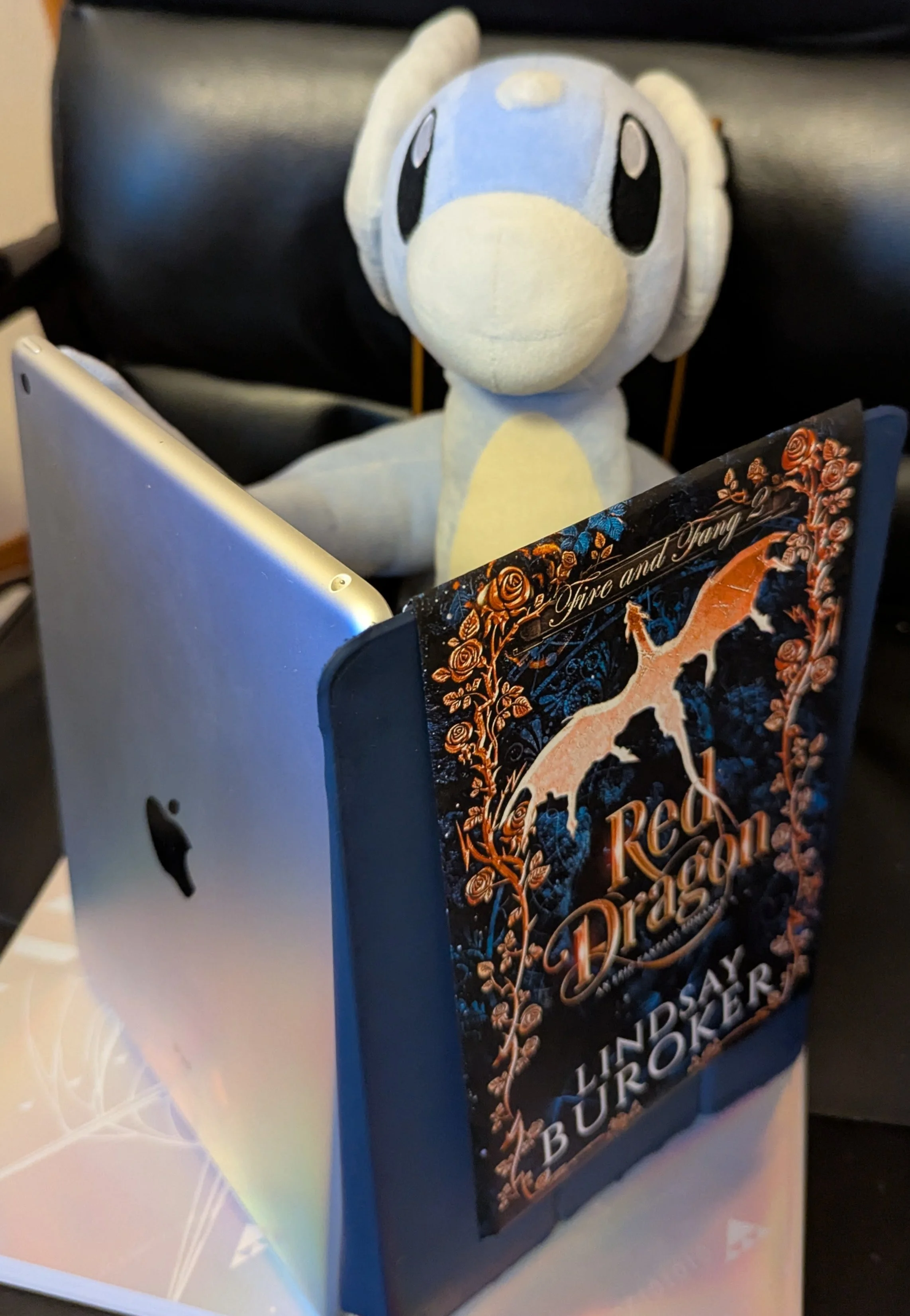
Red Dragon (Part 3 - Character, Worldbuilding, Romance)
Hello, all. Welcome back for Part 3 of the analysis of Red Dragon, the sequel to Sky Shielder and second book of the Fire and Fang series.
If you’re looking for just a high-level overview, please set Part 1. A breakdown of the plot can be found in Part 2. If you’re all caught up or don’t care to do so, then let’s fly.
STATS
Title: Red Dragon
Series: Fire and Fang (Book 2)
Author(s): Lindsay Buroker
Genre: Fantasy (Romantasy)
First Printing: November 2025
Publisher: Self-published to Amazon
Rating: 6/10
SPOILER WARNING
Mild spoilers for Red Dragon will be included throughout this review, through I will keep the first paragraph of each section as spoiler-free as possible. Heavy spoilers will be confined to clearly labelled sections.
Heavy, unmarked spoilers for Sky Shielder will be provided throughout this review. I’m also going to assume that you’ve already read that review series, though it isn’t necessary to do so to understand this review.
CHARACTER
I don’t have a lot to say about the characters that wasn’t already covered while discussing the plot. Buroker seems to have a pretty firm understanding of who all of her characters are. All the recurring characters are handled consistently and react to the consequences of the previous books, while the few new characters are least make sense as individuals living within this world and dealing with the events unfolding around them.
The most notable additions to the cast are Syla’s two cousins: Relvin and Teyla. Relvin is a pretty one-note antagonist, a conniving individual who wants to use public perception and backroom deals to slide the throne out from beneath Syla. Teyla is effectively a next-generation model of Aunt Tibby. Tibby is in the early chapters of this book. However, in Sky Shielders, Buroker established that moon-marks bestow different gifts and proclivities onto their beneficiaries. Tibby was established as an engineer, but the fetch quest needed and archeologist, so she rotated in Teyla for the actual quest. While this is a change that feels very utilitarian, I much prefer this to Buroker retconning how the moon-marks work, so I don’t see any issues in doing this.
Other characters introduced in this book are leaders of specific factions. One of these is General Dolok, a military leader who more directly tries to overthrow Syla in the wake of the inciting incident. He’s a fairly one-note antagonist. His role in the story isn’t to actually be a character so much as it is to be the face of general opposition. We also get Chieftess Atilya, the stormer who lead the Freeborn Faction, who is likewise the face of her faction (more on them in a moment).
While the character work is mostly fine for a plot-driven narrative like this, there were two minor issues here that impacted the Romance plotline and the tone of the story.
The Honorable Man
Vorik adheres to a code of honor. We’re not given the full scope of this code, but it seems to oppose such things as harming the weak and innocent, betraying allies, or going back on a promise. This aspect of his character was introduced in Sky Shielder, and Buroker continues to play it consistently.
Here’s the problem: in a handful of the moments when Vorik grapples with the conflict between his orders and his feelings for Syla, he makes his honor the deciding factor. If he did it only once, I’d shrug this off as him making excuses for how he’s not putting feelings ahead of the mission, but it happens enough that it really starts to seem like his honor is more important than those feelings. He is able to justify opposing Syla by jumping through hoops to keep his actions honorable.
Is this true to he character? Absolutely. It’s just that this waters down the Romance. With Vorik doing the heavy lifting for that plotline, Buroker didn’t have a lot of wiggle room to water things down.
Sweet Tooth
During the Sky Shielder review, I mentioned that Vorik’s quipping about his love of berries and other sweet things was a reflection of his circumstances and character.
In Red Dragon, Buroker expands this trait to the other stormers, with diminishing returns.
The fact that Vorik banters with the stormers about all the wonderful fruit in the Garden Kingdom, and that those stormers banter back with him and are awed by baked goods, does make sense. It’s just that this no longer feels like something personal, and thus, doesn’t feel feel contained. It spills out into the wider world and contributes to the tonal confusion we’ll be discussing in Part 4.
WORLDBUILDING
Moon-Marks
Moon-marks don’t get a lot of expansion in this story. Buroker instead plays with previously established elements. We get to see Syla make sure of the wider biokinetic applications of the power to incapacitate people in rights. Also, as mentioned above, the limited scope of moon-mark powers appears to be the motivation behind replacing Tibby.
Religion
Buroker does not tell us anything new about the gods. They still don’t get names. The storm god’s laboratory, seen in the climax, builds upon an implication in the last book that the “gods” may in fact have been some sort of Sufficiently Advanced civilization that dropped in for a little bit before departing.
One element that Buroker does expand upon, though, is the perception of the gods. Everyone in this world accepts the gods as objectively real, and they give thanks to those gods … but almost no one expects the gods to ever come back. The “godders”, as they are called, are the only people who expect a return, and they are widely dismissed as irrational zealots. It’s not clear whether this same attitude extends to prayer in general or just to the gods returning. Still, I think it is a small detail that makes the society feel much more real.
Freeborn Faction
In Sky Shielder, all we were really told about the Freeborn Faction was that they were the stormers who wanted to rejoin the Garden Kingdom and that they were willing to spy on the other stormer tribes and pass their findings onto the gardeners. Vorik tried to get into Syla’s good graces by pretending to be part of this group.
In Red Dragon, we actually get to meet some of them, including Chieftess Atilya. Buroker uses the opportunity to portray them as much more nuanced. We learn that, while Atilya and the Freeborn are frustrated that the Garden Kingdom won’t re-admit them, this isn’t merely a case of the gardeners writing them off. Atilya indicates that, while other stormers were originally exiled criminals, the Freeborn were ejected from the kingdom in an era where the moon-marked abused the privileges granted to them by their special status. They felt oppressed. This grievance hasn’t healed - the Freeborn want to live on Garden Kingdom islands, but they don’t want to have to answer to the regime anymore. They’re effectively just demanding territory, without even establishing any sort of historic claim to it. They also aren’t interested in helping Syla hold onto her throne, even through they know she’s more sympathetic to them than any of the alternatives, because at their core, they are still stormers, and they expect her to hold onto her throne with her own might.
I’m not sure whether Buroker is going to have the Freeborn become antagonists in the future. It’s just nice to get this more complex exploration of them, just as the Garden Kingdom and the other stormer tribes were allowed complexity in Sky Shielder.
Dragons
There are only two minor lore updates about dragons in Red Dragon.
The first of these is revealed early on, when Wreylith reveals to Syla that a dragon who is bonded to a moon-marked individual can freely through the protective barrier of a shielder (provided that the marked individual is inside that particularly shielder’s protective bubble). This is apparently something at least some stormers are aware of - General Jhiton knows, at the very least. Given that Wreylith was previously bonded to one of Syla’s ancestors (a running bit of background lore throughout this books, which I believe Buroker’s novella in this world is about), it at least makes sense that Wreylith knows this. How Jhiton knows it is less clear.
Second, Buroker acknowledges that dragons can use their own magic to stick riders to their backs, rather than relying purely on the rider’s own magic or muscles. This addresses my question of how the riders who aren’t marked are able to stay on while their dragons perform various maneuvers. It also lends some importance characterization to the dragons: we only see stormer dragons do this, while Wreylith vehemently refuses to. This combines with Wreylith’s various comments about stormer dragons debasing themselves by submitting to riders. The implication is that, in the eyes of a wild dragon, a rider who needs help staying on a dragon’s back isn’t worth of riding on a dragon, so assisting such a rider devalues the dragon who does so.
ROMANCE
The relationship between Syla and Vorik is still purely about sex. Buroker tries to build a deeper bond between them by having the pair share quippy banter. This worked well enough in Magnetic Magic for Luna and Duncan. Here, though, the quippy banter is spread pretty broadly among the characters, so it doesn’t have the same impact in terms of forging a bond between the characters.
The obvious downside of this is that it undermines efforts to move the relationship forward. Vorik gets permission from General Jhiton to bring Syla back to the stormer tribes as his mate. This makes sense as a concession by Jhiton to ensure his brother’s feelings don’t get in the way of the mission, but Vorik does toy with the idea, only dismissing it because he doesn’t believe Syla would give up her comfortable life and responsibilities in the Garden Kingdom to be a stormer. This feels like things are moving way too fast for a relationship that is nothing but a few sexual encounters and some flirting.
Buroker does still make effective use of the relationship, though. As a consequence of the last book, both Syla and Vorik are committed to their respective causes, each choosing to put duty first. This path is straightforward enough for Syla, since serving the needs of her kingdom doesn’t necessarily force her to oppose Vorik. Things are more complicated for Vorik. His mission is to undermine, oppose, and deny Syla’s goal. He has to keep bending over backwards to justify not simply kidnapping Syla and resolving things the easy way, instead delegating most of the dirty work to the rider sent to accompany (and spy on) him for this mission. This conflict is watered down a bit by Vorik’s code of honor (to the point that there are moments where Vorik very clearly puts Syla in a bad spot, but justifies it because he did so honorably), yet the idea is still there. The Romance plot fundamentally alters the progression of the Fantasy plot.
I do think that the Romance is a step up in this book. There’s no more time wasted on Will They Won’t They drama. Everyone’s honest about their feelings, and those feelings stir up conflict. It’s just I wish there was more substance to it than just sex and mild flirting. At least when Xaden starting asking Violet about marriage when they’d barely spent any time together as a happy, stable couple, at least we’d seen them in a domestic living situation for some of that time.
ARE THEY TAKING THIS SERIOUSLY?
Next Wednesday, February 4th, we’ll dive deeper into the prose of Red Dragon and the impact that this prose has on the tone. The lighthearted tone of this story isn’t necessarily a bad thing. Unfortunately, it clashes with the existential stakes, creating a scenario where it’s hard to tell if the audience should be invested or not.
Thank you all for stopping by. Please remember to subscribe and share if you enjoy what you read here. Take care, everyone, and have a good week.

Next Tuesday, February 3rd, Volume I of my first serialized Romantasy novel, A Chime for These Hallowed Bones, premieres!
Kabarāhira is a city of necromancers, and among these necromancers, none are more honorable or respected than Master Japjot Baig. Yadleen has worked under him since she was a girl, learning how commune with bhūtas and how to bind these ancient spirits into wights. Her orderly world is disrupted, however, when a stranger appears with the skeleton of a dishonored woman, demanding that her master fabricate a wight for him.
To protect her master from scandal, Yadleen must take it upon herself to meet this stranger’s demands. Manipulating the dead is within her power, but can honor survive in the face of a man who has none?
You can see the full schedule for Volume I here! I hope you’ll join me on this new adventure.