The Strength of the Few (Spotlight on the Magic System)
Hello, all. Welcome to the first entry in the deep-dive analysis of The Strength of the Few, sequel to The Will of the Many.
This Spotlight Analysis was not part of my original plans for this review. However, while writing down my concerns about magic superpowers in modern Fantasy, it occurred to me that a central element within The Strength of the Few is a perfect example of how to do undo the advantages of magical superpowers in a manner that actually benefits the story. Additionally, understanding this feature of the magic system is very important to understanding the plot of The Strength of the Few. It therefore seems prudent to shine of a spotlight on it now, before we dive into the analyses of individual POVs.
Please see Part 0 for my high-level thoughts on the novel. Otherwise, let’s dive right in.
STATS
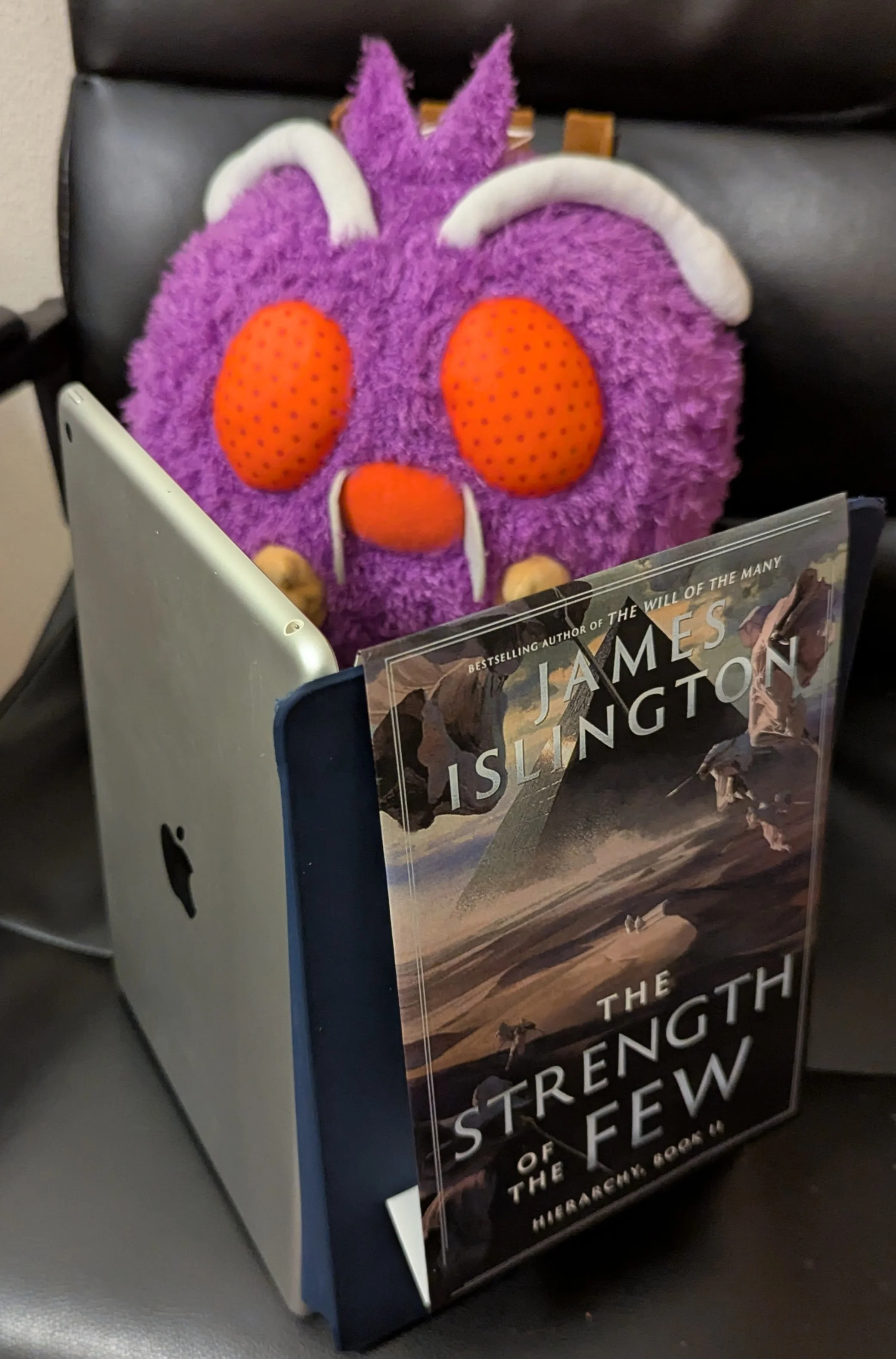
Title: The Strength of the Few
Series: Hierarchy (Book 2)
Author(s): James Islington
Genre: Fantasy (Epic)
First Printing: November 2025
Publisher: Saga Press (imprint of Simon & Schuster)
Rating: 8.5/10
SPOILER WARNING
Minor, unmarked spoilers for The Strength of the Few will be provided throughout this review. I will keep the first paragraph of each section as spoiler-free as possible. Heavy spoilers will be confined to clearly labeled sections.
Unmarked, heavy spoilers for The Will of the Many will be provided throughout this review. I will also be referencing my review series for that book throughout, though you will not need to have read that previous review to understand this one.
TERMINOLOGY
The titles of this book, its predecessor, and its sequel (the title of which was announced of Islington’s blog in December) will be abbreviated as follows going forward:
The Will of the Many = Many
The Strength of the Few = Few
The Justice of One = One
“SYCHRONOUS IS DEATH”
In Many, Vis encountered animated corpses in the ruins that Ulciscor ordered him in investigate. The corpses in one of these ruins began chanting this phrase when Vis awakened a device that he shouldn't have. This is used in the moment to generate tension. It was an unsettling mystery.
Many ended with a double epilogue, one that implied that Vis has been “copied” across two alternate realities. In one of these, he meets Ulciscor’s brother Caeror. Few then opens with the continuation of that meeting, and Caeror explains the true nature of the setting.
Omne Trium Perfectum
The explanation is, quite frankly, utterly bonkers.
Three millennia prior to the start of the series, a threat known as the Concurrence rose. In order to fight back, the enemies of the Concurrence broke the universe. They split reality into three, producing three worlds that each traveled on its own divergent path. The Vis we followed in Many was only the world of Res; the one with Caeror is on Obiteum; and the final Vis, whose arm was ripped off in his epilogue chapter, is on Luceum.
The justification behind this sundering of reality was to compartmentalize the magic system. The functions of Will were split up across the realities:
As covered in the previous review, Will on Res allows an individual to enhance his or her physical attributes, along with enabling a form of telekinesis (and, by extension, machinery driven by telekinesis) by imbuing will into the object to be manipulated.
We quickly learn in Few that Will on Obiteum is necromantic. It can be used to preserve the living against harm and to raise corpses as undead called iunctii.
No clear explanation is given for what Will is supposed to do on Luceum. Based on what we see druids do with it, the implication is that it allows commune with animals (particularly the alupi wolves) and spirits (implied to be spirits of the dead).
There are only two ways by which a person in one world can access the Will powers of another world. The first is to use relics that originated in that world. We learn in this book that the medical devices known as Vitaerium (which were referenced but not shown) were originally from Obiteum, as are a group of obsidian swords that are now identified as Instruction Blades (which can compel an iunctus to obey the wielder). The other way is what we are here to talk about.
More Powerful Than We Could Possibly Imagine
A person who is Synchronous - that is to say, who has a living copy on all three worlds, either by having been alive when the three worlds were split or by being copied across worlds via a relic known as a Gate - maintains a connection between the copies. It’s strongest right after the copies are made, to the point that injuries will transfer, though it fades to more of a spiritual connection over time. This is why Vis’s arm turned gangrenous at the end of Many - the copy on Luceum had his arm torn off, and thus, the corresponding tissues in the copy on Res died. (The Vis on Obiteum avoids this fate because Caeror immediately straps a Vitaerium onto his arm, preserving the flesh until the connection fades to a safe level.)
Now, this spiritual connection does more than just share injuries. It does more than allow Vis to occasionally experience the emotionally perilous moments of his other selves (or to know if one of them dies, an experience Caeror is able to describe to Vis). It allows each version of Vis to access the Will abilities of all three worlds. It also allows him to share knowledge and experience for how to use Will between his copies, so if any one Vis learns out to use a power, the other two instinctively know how to use it, even if they don’t immediately understand the applications.
How broken is this?
Well, rather helpful, Caeror spells this out in the early chapters of Few.
An iunctus can be compelled to cede Will, bypassing the usual free will component of the process. The amount of Will gained through this ceding is less than the investment needed to raise and maintain the iunctus. Furthermore, an iunctus can raise more iunctii and compel them to cede will, thereby creating a self-sustaining, every-expanding pyramid of Will to feed back into the living person who raised the first iucntus.
A Synchronous individual can then apply this collected Will to enjoy all the benefits of Will on Res. We learn in this book that massive amounts of Will slow aging. When combined with the enhanced durability that we’ve also seen on Red, this puts total immortality on the table.
Eventually, a positive feedback loop forms, granting the Synchronous person literal lifetimes to keep making iunctii and harvesting Will.
In short, by combining the powers available from Obitieum and Res, and unscrupulous person can accumulate godlike power.
What we effectively have here is an author who set up a system of compartmentalized magic with absolute limits as to what it can actually do. These aren’t literal magic superpowers, as it’s scaled up to a whole magic system, but in practice, the benefits of compartmentalization are the same. Said author than blew a hole clean through the system to make his already-overpowered POV character into an entity whom even Violet Sorrengail would have trouble defeating.
And yet, in this case, such breaking of the magic system doesn’t break the narrative with it. It enhances the narrative.
DELIBERATE ACTION, NOT A LAMPSHADE
While Islington’s decision here superficially resembles the haphazard use of magical superpowers that we previously analyzed, this isn’t an exercise in giving a character “power for power’s sake”. It’s not a lazy shortcut. Islington broke his own rules as soon as he made them because the story is about the breaking of the rules.
The Antagonist
There is an important piece that I have left out thus far: Vis is not the only Synchronous person in the setting.
The antagonist is a Synchronous man named Ka. He has been alive for an unknown number of millennia, sustaining himself on the Will of hundreds of thousands (if not millions) of iunctii. He has wormed his way into the civic power structures on all three worlds to ensure his continued survival and dominance. The Cataclysms are a routine purge he conducts every three centuries to cull the numbers of the living, which has the benefit of ensuring that no one else is ever able to mass enough Will to threaten him.
Only a Synchronous person can truly challenge Ka. Unfortunately, with the possible exception of Ka (we don’t know for certain how old he is), the only way for someone to be Synchronous is to use the Gate. On all three worlds, the Gates have safeguards in place, designed to kill (or, at least, maim) copies as they attempt to leave the Gate site. Vis only lives along enough to stay Synchronous in this book because Caeror was expected someone to come through the Gate at the time Vis did, so Vis had someone on hand to get him out alive and to send messages to save the lives of his other copies.
Now that Vis has survived that initial stage, he’s effectively become a Chosen One to slay Ka. He needs to master his combined Will abilities and wield the energy known as mutalis (more on that in Part 1) to kill Ka’s copy on Obiteum (the only one whose location is known).
At first brush, this does comes across as a Chosen One narrative, but it’s important to consider the power imbalance. Yes, Vis has the potential to become a god … if he kills someone who is already at this peak, and that someone has engineered entire societies to avoid losing Synchronous status. All of Vis’s new power is nothing compared to the challenge he faces. He still must still rely on his non-Will skills to progress through the narrative.
What this means is that the narrative has being configured so that the breach in compartmentalization does not break the narrative. It propels the story forward in a meaningful way. What’s more, this particular path preserves …
Stakes
If any one of Vis’s copies die, he cannot fulfill his mission.
This doesn’t seem like a big deal at first blush. After all, the Vis who is actually committed to assassinating a god understands the trouble he’s in. We know Vis has a good head for surviving. He understands his assignment and will protect himself.
The problem is neither of the other two versions of Vis have any idea that their deaths could ruin everything, and their lives are at risk for other reasons.
The Vis on Res has access to the information. Caeror and Veridius were trying to create a Synchronous person back when Caeror vanished (again, more on this in Part 2). Veridius wants explain all of this to Vis. However, in the aftermath of the climax of Many, Vis made it clear that he does not want to talk to Veridius, at least, not until the emotional scars of that finale have had time to heal. This means that Vis is plunging in to the politics of Catenan society with zero awareness that his death will hurt more than just himself. He’s still a hothead who is easily manipulated in dangerous situations by playing on his rage. He’s also still on the hook with the Anguis, so that’s more danger he’s getting himself into.
The Vis on Luceum has it even worse. He has access to neither Caeror or Veridius. What’s more, as soon as he’s found by people on that world, he’s recognized as Synchronous (or, at least, as someone who is marked for death) and has people trying to kill him. The fact he is missing an arm while having no resources to protect and support him makes things even worse. The Vis on Res may be the most likely to do something stupid, but the Luceum POV is the one where Vis seems most likely to die. The dramatic irony of his situation causes tension to hum through nearly every scene he’s in.
Payoffs (Heavy Spoilers)
Vis’s ability to harness the Will powers that his other selves have mastered creates an issue of unearned skills. After all, all three of the Vis POVs are effectively different characters. It doesn’t matter if one character earns power through character development. The others have not, and those accomplishments don’t transfer with the powers.
This is a element that has a lot of potential to destabilize the narrative. I’d be lying if I said I was entirely comfortable with how Islington ends up using it in Few. Still, I think that what’s on the page holds together well enough for the ending of the book to hold together.
At two pivotal points during the Luceum POV, Vis instinctively benefits from the skills acquired by his other selves:
During a druidic rite of passage, he combines the power of Adoption (the ability to steal Will that has been imbued into an object, which his self on Res learns during the events of the book) and the power to command iunctii (which his self on Obiteum learns) to hijack a Will-imbued statue and briefly use it as a bodyguard.
At the climax of the book, his is able to graft a metal arm onto his body and use it as a replacement for his missing arm, something his self of Res previously figured out.
Both of these moments verge of Deus Ex Machina. Vis just happens to tap into these instincts at the exact moment when he needs these skills. What saves the narrative (for now) is that Islington moderates the payoff. He doesn’t pretend that the Vis on Luceum has automatically earned these abilities. Vis is dumbfounded by his ability to tap into these powers and has no idea what he’s doing with them. In the first case, he doesn’t even know how to command the statue, needing to go through a trial and error sequence similar to what the Vis of Obiteum went through when learning to give orders to iunctii. In the second case, it’s also implied that the spirits of the druids are helping him, something that happened earlier in the story as well.
What I’m trying to get at here is that the Vis on Luceum isn’t really the one getting the payoff in either of these circumstances. His instinctive understanding doesn’t equate to effectively wielding the abilities his other selves have earned. This is a payoff for the versions of Vis on Obiteum and Rest. However, unknowingly, their growth during the story allowed them to save their copy on Luceum, and thus, prevent the mission to stop Ka from falling apart.
ROOM FOR FAILURE, BUT STILL GOING STRONG
It’s entirely possible that Islington will drop the ball with Vis’s godlike potential either One or the finale. For now, though, he is not playing with “power for power’s sake”. While Few does lean deeper into power fantasy than the previous book (believe me, I will complain about that in Part 4), it is clear that Islington still respects the integrity of his world and his narrative. Any time he breaks his own rules to help Vis is done with a sense of purpose and consequence. He hasn’t made Vis overpowered. He’s put Vis into a scenario where godlike power won’t be enough to save him if things go wrong.
That really sums up why this series thrills me so much. Islington is taking ideas that have been mishandled elsewhere in modern Fantasy and uses them with care and respect. This isn’t an exercise in self-indulgence masquerading as entertainment for other people. It’s a story crafted with deep respect for both itself and for its audience. Rules are broken with intent and understanding, thereby creating something greater. This level of care is something I really appreciate, especially given other books I’ve read for this site.
THE LAND OF THE DEAD
On January 30th, we’ll continue our analysis of The Strength of the Few with Part 1, dissecting the merits and flaws of the Obiteum POV. This is the story that was more interesting at the outset, but it slowed down in the middle, to the point that I wonder if Islington has to excise a subplot from that section of the story. The ending, though, was surprisingly satisfying, and it once again changes the trajectory of the series.
Thank you all for stopping by. Please remember to subscribe and share if you enjoyed what you read here. Take care, everyone, and have a good week.