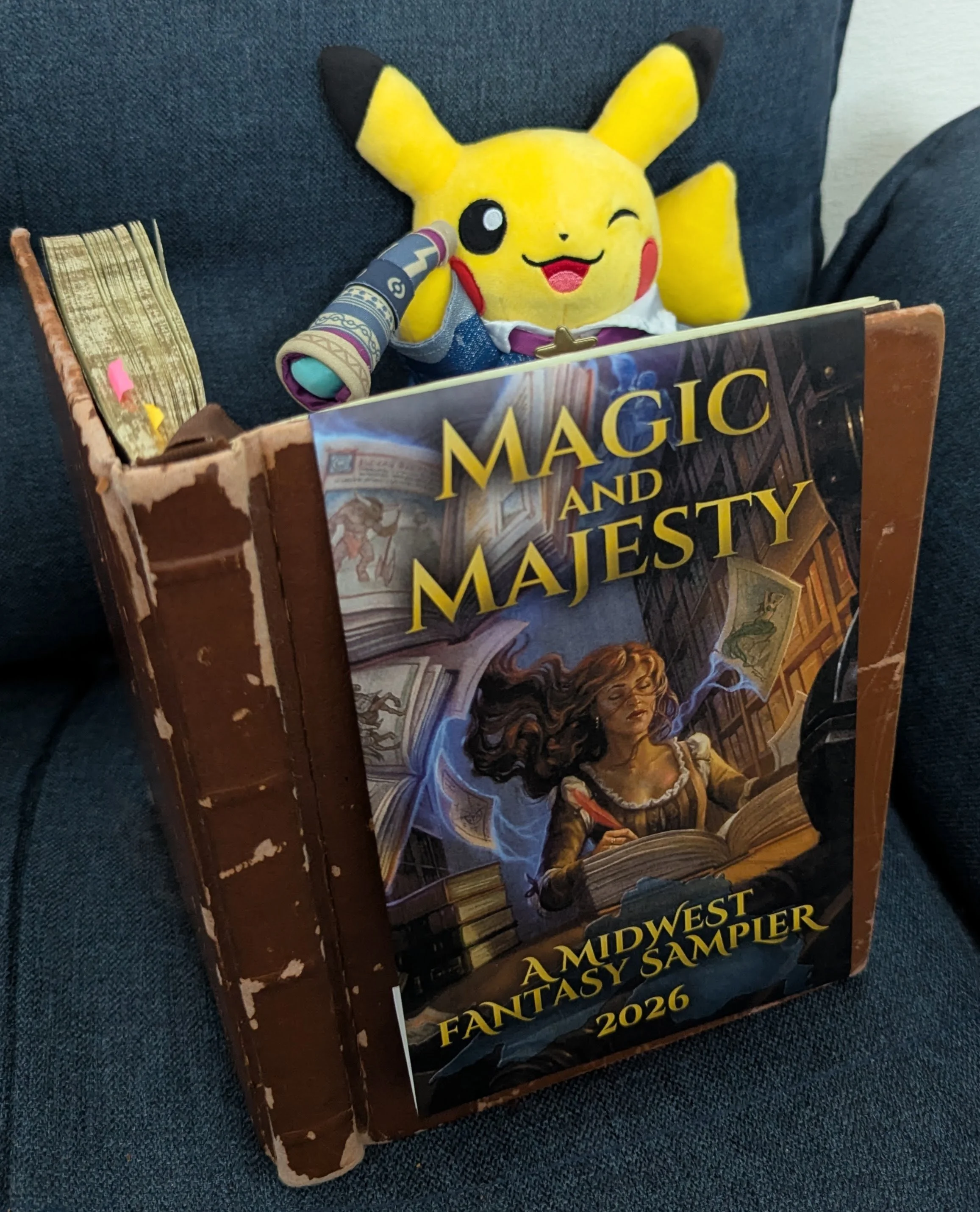
Magic and Majesty: A Midwest Fantasy Sampler 2026 (Part 3)
Hello, all. Welcome back to our ongoing review of the ARC copy of Magic and Majesty.
Today, we’ll be diving into the sixth through eighth stories of the anthology.
“The Butcher of Hudêd” (Sundering the Gods series), by L. James Rice
“Fate of the Nightbloom” (Stormborn Chronicles series), by Starr Z. Davies
“The Salted Crown” (Curse of the Fey Duelist series), by Christopher D. Schmitz
Let’s get right into it.
ANTHOLOGY STATS
Title: Magic and Majesty: A Midwest Fantasy Sampler 2026
Series: Midwest Fantasy Sampler, Book 2
Author(s): Various, curated by Justin Rose
Genre: Fantasy (various)
First Printing: June 10th, 2026
Publisher: Self-published to Amazon
Overall Rating: 8/10
SPOILER WARNING
Mild, unmarked spoilers for all stories in the anthology will be provided throughout this review. Additionally, the Story section of each review will feature heavy spoilers. I will keep the first paragraph of any given section, including the Story sections, spoiler-free.
“THE BUTCHER OF HUDÊD”
Stats
Series: Sundering the Gods
Author(s): L. James Rice
Story
Merdan, a sorcerer in the service of Admiral Nikôdî tû Dêidontâ, is tasked with a secret mission to bring about the total destruction of the city the admiral is currently blockading. He joins a diplomatic mission to the city and, from there, makes contact with a rebel faction within the city. He quickly realizes that the admiral has left him out on key details of the plan and may even had sent him into the city to die.
After unwittingly helping the admiral firebomb the entire city, Merdan confronts him in the temple that the admiral came to loot amidst the chaos. The pair engage in a magical duel that kills the onlookers. Merdan kills the admiral, but is horribly burned in the process. He uses his disfigurement to assume the admiral's identity and sails away from the ruined city to claim credit for the victory.
Rating: 4/10
I really, really want to like this one.
The plot is engaging, with layered schemes and twists that are foreshadowed well without being telegraphed. The world and magic system is complex, yet the audience is provided enough information to understand the elements that actually matter to the resolution of the plot. Characterization is effectively Shown, and while no one involved in this story is heroic, they are relatable.
The problem?
It is all written in a near-indecipherable manner.
I think Rice was going for intrigue with his dialogue. You can see it if you squint at it. In practice, though, the conversations are meandering and needlessly obtuse. For example, Merdan joins a diplomatic mission into the city as part of the plan. During the meeting, the diplomat he is with turns to him and, for not logical reasons, says, "Oh, I've never heard your backstory before! Tell me about it!" Merdan then does so in a passive-aggressive manner.
Likewise, the staging in the scenes is as confusing as in "Bee's Tail". Characters move through spaces as if teleporting. The most glaring example is a scene in which Merdan has a discussion with a man who approached him openly, in broad daylight, with multiple witnesses ... but it is treated as a secret meeting, because this man was part of the angry mob that Merdan's allies are keeping away from him. How was this man allows to saunter close enough for a private chat?
Merdan has bits of commentary throughout the narration, commenting join the schemes unfolding around him. That would be fine. However, with how the things he is commenting upon are written, this feels like an effort to force an interpretation of a very confusing text.
I know I'm being rather critical of what is effectively just a prose issue. The impacts really do add up over the course of a longer story. And given that this is meant to be a sample for the Sundering the Gods series, I think it's worth highlighting that this is the opposite of accessible Fantasy prose. Maybe some people with be drawn to this style of writing, yet a lot of others, myself included, will see this sort of thing as more trouble than it's worth for recreational reading.
“FATE OF THE NIGHTBLOOM”
Stats
Series: Stormborn Chronicles
Author(s): Starr Z. Davies
Story
Vashira, the daughter of traders, is ordered to undertake the rite of passage to join the Tharva, a tribe of assassins operating in the shadows of the Sarak Desert’s civilization. She is informed that she has a role to play within a messianic prophecy. As the first step towards this prophecy, she has to kill a childhood enemy.
If this sounds like a New Adult version of The Ruins of Gorlan, congratulations! You are in for a monstrous disappointment.
After multiple chapters of waffling about, pretending like she has a moral issue with killing someone she threatened to maim over mean words during her opening scene, Vashira finally gets around to completing her kill … and gets caught and sentenced to slavery … and then, after a timeskip that cuts out the slavery entirely, runs away from said slavery so that she can stumble into the plot of the Stormborn Chronicles. All of this is framed as part of a grand cosmic plan, making her waffling about even more pointless.
Rating: 2/10
In July, I’m going to do an editorial series on social commentary in modern fiction. One of the points I am going to bring up there is that the Message gets used as a crutch for bad stories.
“Fate of the Nightbloom” is a perfect example of this.
The only substance in this book is its theme: that being that all men at an age of moral responsibility are either incompetent, treacherous, or evil turbo rapists, while all women are blameless victims. The story bends over backwards to spare Vashira of any agency (and, thus, of any moral responsibility) for her murder while simultaneously making the person she needs to kill as reprehensible as possible (because, of course, he is a turbo rapist), with Vashira oscillating between threatening violence against him and whining about how she could never kill anyone. When she tries and fails to kill her target, and he understandably lashes out at the person who just tries to murder him, the narrative breaks in order to frame Vashira killing him as self defense. Meanwhile, her target’s father is evil simply for marrying a woman younger than himself, in keeping with the social norms of his society (and, later, is exposed as a turbo rapist), and a boy only mentioned in passing as a child is designated as a soon-to-be turbo-rapist after the timeskip brings him to adulthood. The only adult men who are not turbo rapists are Vashira’s father (who betrays her), the leader of the assassins (who manipulates her), and her older brother (who simultaneously is a dumb brute who couldn’t cut it as an assassin and yet is too weak to fight Vashira’s battles - got some serious sibling resentment vibes from that one).
The reason why this is an objective writing problem (versus a subjective reaction that doesn’t detract from the work - that is going to be very important later in this anthology) is because the inherent evil of Vashira’s target undermines the potentially interesting character conflict. Davies could have written a straightforward story of Vashira being handed a moral blank check to murder someone the audience will have no sympathy for. She could also have written a morally gray story about a young woman being forced to commit a murder she didn’t want to commit. By making the murder victim an obvious villain even before the order to kill him is given, then having Vashira waffle on about not wanting to kill him (even after we are Shown how quickly she jumps to violence to deal with him), Davies is just making excuses for the power fantasy. She is working overtime to make killing the victim as palatable as possible while also insisting that Vashira is not a murderous psychopath. Storytelling takes a backseat to this deranged daydream about committing a murder while still being the victim.
The cherry on top of this is Vashira. She’s … special. Just special. The narrative outright Tells us a list of traits that make her perfectly suited to be an assassin while NOT DEMONSTRATING A SINGLE ONE OF THESE TRAITS. Then we are Told she has a role to play in a prophecy, so she’s just the Chosen One.
This is power fantasy slop at its finest. Our Main Character is just so good and virtuous, and her amazingness is recognized by the edgy House Dimir wanabees. The men around her are just so terrible. She MUST kill men, and when she does, we can’t possibly expect her to be held accountable - and if anyone does dare to hold her accountable, well, that’s just victimization of an innocent woman.
What originally irritated me so much about this story is how easy it would have been for Davies to both have the Message and actually tell a good story, if only she’d dialed back the power fantasy. Here are three ways I thought up off the top of my head during the drive home from work:
Vashira learns her rite of passage is to kill the turbo rapist whom she already hates. She readily jumps at this. It’s easily done, and then the twist happens wherein she suddenly realizes her true role in the prophecy. This would make the story about half as long, but better a simple story that is short than one that is bloated without narrative benefit.
Vashira realizes that being asked to kill the turbo rapist she already hates is far too easy as a rite of passage, so she applies those assassin skills that she supposedly possesses to investigate and determine the truth. She could then either decide to follow through with and embrace her prophetic role or else have her hand be forced when she tries to escape her fate.
Rewrite turbo rapist as a sweet and gentle soul. Have Vashira experience genuine anguish about having to kill him, eventually resolving to defy the orders of the assassins by sparing his life. Then have him expose himself as a turbo rapist, forcing her hand. This would not only pack more punch in terms of the moral quandary but would also reinforce the idea that Vashira is a tragic pawn within a greater cosmic plan.
The day after I read this series, I continued onwards through the anthology and I read “The Gryphon Key”. Now I am not irritated by “Fate of the Nightbloom”. I am enraged that Davies wasted my time.
See, “The Gryphon Key” is the same story. Oh, it drops all the nonsense about assassins and prophecy, but it is the same power fantasy about men being evil and useless and the Main Character needing to dispose of said fiends while being presented as a victim with zero accountability. The only meaningful difference is that “The Gryphon Key” is well-written. It reveals that, in fact, there was a fourth way for Davies to write a good story here, and she wouldn’t even have needed to drop the power fantasy to do so. There is absolutely no excuse for Davies to have wasted the audience’s time like this.
If the “Fate of the Nightbloom” is at all indicative of the qualities of the Stormborn Chronicles, then that series must be self-indulgent trash in the vein of The Empyrean. If you just want to snort that sweet power fantasy cocaine, I guess you’ll be happy with it. If you want a story that explores the Message with anything resembling substance, that delivers on the whole House Dimir-in-the-desert premise promised in the opening chapters of this story, or even just tells a competent story in general, then I’m guessing you will be supremely disappointed.
“THE SALTED CROWN”
Stats
Series: Curse of the Fey Duelist
Author(s): Christopher D. Schmitz
Story
Remington “Remy” Keaton, a human assassin in the service of the unseelie fey, is tasked with disrupting the succession process of the fomorian court.
The twist of the story is that his target is not, in fact, either of the two fomorians who are vying for the throne, but the bodyguard of one of those two fomorians. (Why he has to do this is not clear. Remy interrogates the bodyguard before killing him. This implies that the bodyguard had to die because of information he possessed, but Remy asks him basic worldbuilding lore questions that couldn’t possibly have been things that only this specific guy knew, so it really feels like this guy was the target purely for the sake of forcing the twist). Remy also realizes that the true purpose of this mission was to help steal the demonic heart that granted the late fomori king near-eternal life.
Oh, and this story has to play into Representation, spoiling a twist in the process. The two fomorians who are initially set up at the potential targets are in a homosexual relationship with each other. The assassination scene hinges on them being caught in the middle of having sex. I think the fact this was not at all a surprise to me says something about the state of Representation in modern literature. One of the first things we learn about Remy (which ends up being irrelevant to this story) is that his motivation to work as an assassin for the fey is vengeance for the death of his male lover. So the moment it’s mentioned that one of the two potential targets has failed to produce an heir with his wife, it’s obvious that he is homosexual, and a sex scene between him and the other target feels like an inevitable development. It’s a shame, because this would have made a lot of sense as a character-based twist to facilitate the climax. This is a predictable cliché purely because so many authors ram Representation into their texts just to signal their own virtue.
Also, this short story has a prologue and an epilogue. The prologue is a very confusing battle scene that serves to info-dump about the demonic heart. The epilogue features the two fomorians who are the assassination targets in some sort of flashback without clear relevance to the larger story. I’m not sure why Schmitz didn’t just make one of these into the whole story.
Rating: 5/10
I really wish that I had more to say about this story. It’s as long as most of the other ones in this anthology. However, not much actually happens.
The one (semi-functional) twist is Remy’s target. It’s only framed as a twist because Schmitz withholds that information without any justified, in-world reason for doing so (since the bulk of the story is in Remy’s POV, and he knows the target before he sets out for the fomori kingdom). The only reason it isn’t a lie to the audience is that Schmitz does do proper foreshadowing for it at the last minute.
The reason the story is so long is all the Telling. Normally, Telling takes less time than Showing. In this case, though, the story constantly stalls to either info-dump complex lore about the history of the fey or for Remy to spell out the political machinations taking place in the present. The story even has an entire prologue dedicated to a war to set up the demonic heart, and it is bursting at the gills with named characters who play no role in the rest of the story.
“The Salted Crown” isn’t a bad story in concept. It’s just executed in a bloated manner. Maybe if you’re a fan of fey fantasy that recycles well-worn lore, it will be easy for you to follow and enjoy. If you’re not already familiar with the names and general concepts, though, this story may be a sign that the Curse of the Fey Duelist series will be a little too dense for you.
DOING BETTER
Next Sunday, July 5th, we will wrap this anthology review up by looking at the final two stories, “The Gryphon Key” and “The Harrowing of Nerikan”.
Mostly, it will be a discussion of “The Gryphon Key”. It succeeds where “Fate of the Nightbloom” (and other stories driven by power fantasy or the Message) fails, actually telling a good story while indulging the author’s tastes. I think it’s important that we assess why.
Thank you all for joining this week. Please remember to subscribe and share if you’ve enjoyed what you read here. Take care, everyone, and have a good week.