Modern Social Commentary (Part 2 - Dissection of a Bad-Faith Argument)
Hello, all. Welcome back to this editorial on social commentary in modern fiction.
Last week, I promised you a bad-faith argument that not only shoots itself in the foot, but actively upholds and expands upon the position I presented last week. It’s time to deliver.
I am not going to credit the Substacker who vomited up this gem. Her position is not an original one. I’ve heard variations of it before. We are here to break down how the message eats itself, not to pillory any specific messenger. Going forward, I refer to her purely as, “Substacker,” or, “Ms. Substacker.”
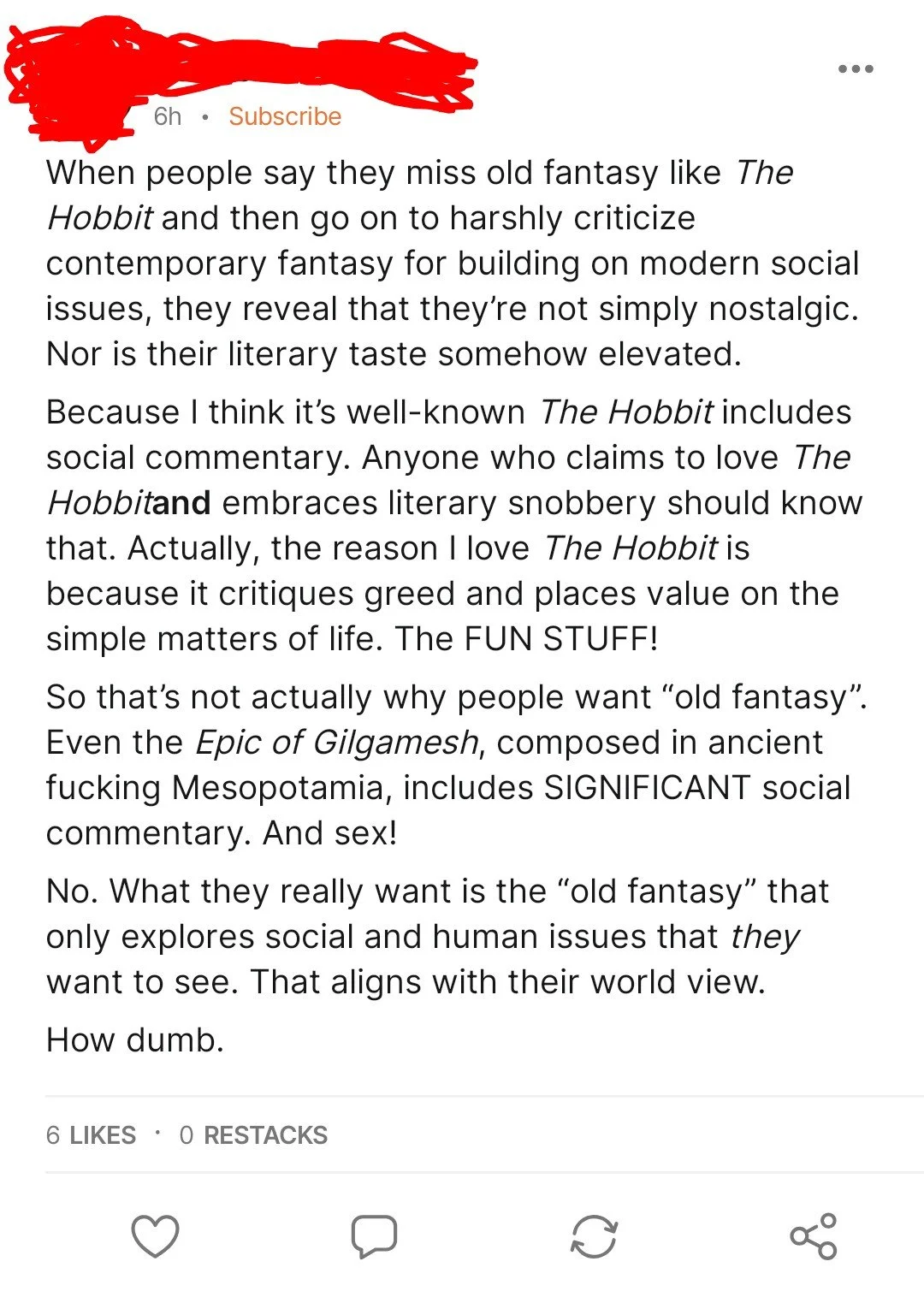
“HOW DUMB”
What a perfect summation of this Substacker’s entire argument.
I actually went nearly three weeks between reading this post and sitting down to write this rebuttal. Despite putting it off, I kept turning over the argument in my head. In doing so, I forgot just how lacking in integrity and how intellectually vacuous the original was. The actual post ended up as the strawman of the argument I came of with while preparing the counterargument.
Now, simply saying that this argument is a rancid, sub-intellectual act of projection does not make it so. Expressing an emotional reaction, such as handwaving the opposition as “dumb” or using colorful prose to illustrate the severe lack of ethnical integrity within an argument, does not make reaction into objective reality. It just expresses that I had an emotional reaction to said argument. I am within my rights to express that emotion, but such expression shouldn’t be confused with substance.
More importantly, my emotional reaction cannot overwrite objective reality.
That’s why the, “How dumb,” line perfectly captures the essence of this Substacker’s entire argument. Her entire post is nothing BUT an emotional reaction. You see it in the all-caps, the unnecessary swearing, and the random tangent about sex. This Substacker is mad that people have an opinion she disagrees with, but lacks the maturity or intellect basis to refuse it, so she is just hurling spaghetti at the wall and praying it sticks. Her, “How dumb,” isn’t an afterthought. Dismissing the opposition as “dumb”, rather than actually engaging in discourse, is the entire foundation of her argument. Her delivering it as a closing statement is the mask slipping once she mistakenly thinks she’s settled the matter.
I should be able to at least praise this Substacker’s effort to provide examples. That effort is the closest thing to substance this emotional reaction has. Unfortunately, this is where objective reality refuses to be overwritten. Oh, these examples work if she was hoping to fire off a quick response and then rush the conversation along without giving the opposition time to think about them, but if one thinks about them for even a moment, they backfire spectacularly. Objective reality shears through her emotional tirade and upholds the very position she is trying to avoid engaging with.
And that ad hominem at the end, falling back to hurling accusations at the people she disagrees with rather than trusting her examples to support her … beautiful. What a master stroke. As is often the case with ad hominem, it exposes the intellectual limitations and ideological blindspots of the person making it, rather than changing the objective reality of the accused. This Substaker announced her hypocrisy to the entire Internet with that accusation. She didn’t just shoot herself in the foot; she blasted her entire leg off.
Then again, my saying all of this is just me having an emotion reaction, just with self-awareness of that fact. So let’s get into some substance. We’re going to dissect both the Substacker’s examples, her wild tangent, and her projection to expose how the truth is the exact opposite of what she makes it out to be.
Sit back and enjoy, as the dishonest argument does all the heavy lifting for me.
THAT’S NOT SOCIAL COMMENTARY
Because I think it’s well-known The Hobbit includes social commentary. Anyone who claims to love The Hobbit and embraces literary snobbery should know that. Actually, the reason I love The Hobbit is because it critiques greed and places value on the simple matters of life. The FUN STUFF!
“The reason I love The Hobbit is because it critiques greed and places value on the simple matters of life.”
Uhh … that’s not social commentary. That’s just a theme. More specifically (because social commentary can certainly be a theme), this theme is one of resonant ideas. Universal values, as some might call them.
Or .. to use the words of Tolkien (you know, the author of the book she’s referencing) from the foreword of the 2nd Edition of The Lord of the Rings … applicability.
“I cordially dislike allegory in all its manifestations, and always have done so since I grew old and wary enough to detect its presence. I much prefer history, true or feigned, with its varied applicability to the thought and experience of readers. I think that many confuse 'applicability' with 'allegory'; but the one resides in the freedom of the reader, and the other in the purposed domination of the author.”
This Substacker is confusing “applicability” with “allegory”. Resonant ideas, universal values, whatever you want to call them, are “applicable”. Their interpretation resides “in the freedom of the reader”. This Substacker is equating the applicable with social commentary, the interpretation of which is “in the purposed domination of the author” - in other words, allegory.
Yes, Ms. Substacker. I’m glad we agree that applicable ideas are, “The FUN STUFF.” The people you are trying to swat aside are of the same mind as the author whose work you’re failing to use to defend your position. We prefer what Tolkien offered us.
I feel like most of us were at least open to overt social commentary - to “allegory” - at one point. However, after years upon years of watching the genres and franchises we love be turned into echo chambers of slop justified by The Message, even the most hardy of us have come to “cordially dislike” it. We would like to return to the thing you claim to love.
Thank you, Ms. Substacker. You have highlighted that we are, indeed, “simply nostalgic.” Whether you read that as us possessing tastes that are “somehow elevated” is matter of your personal judgment. Regardless, you chose the perfect example to demonstrate that we are, in fact, the thing you try to claim we are not.
ZERO STARS FOR EA-NASIR
So that’s not actually why people want “old fantasy”. Even the Epic of Gilgamesh, composed in ancient fucking Mesopotamia, includes SIGNIFICANT social commentary.
You know what? I have never read The Epic of Gilgamesh. 90% of my knowledge of that story comes from the abbreviated retelling in “Darmok”. So sure, why not? Let’s say The Epic of Gilgamesh was preachy, virtue signaling slop to rival the most overt works of the modern echo chamber.
Just a reminder for everyone: The Epic of Gilgamesh is about 4,000 years old. The Substacker herself acknowledges this when she refers to the point of origin as “ANCIENT fucking Mesopotamia”.
How relevant are the issues in The Epic of Gilgamesh to the modern day? I’m not talking applicability or parallels. I mean the very specific contemporary issues that this Substacker is claiming are represented through allegory. How many of you reading this are deeply invested in the social struggles of ancient Mesopotamia? Have you spent the last decade being preached to about those specific struggles?
I’m willing to bet that, for 99% of you (rounding WAY down), your investment in the contemporary socio-political landscape in which The Epic of Gilgamesh was written doesn’t run any deeper than memes about Ea-Nasir’s inferior copper.
Here’s the thing about arguing that “old fantasy” - any fiction of the past, really - “includes SIGNIFICANT social commentary”: that commentary is no longer contemporary.
It’s not breaking our immersion as we read our escapist fiction because it is no longer reviving the reality we are trying to escape from. It’s no longer specific to our real-life circumstances, nor is our entertainment media oversaturated with it. It doesn’t alienate the audience because the world in which the audience lives is no longer the thing being criticized (and, for that matter, the members of the audience are not being alienated by those old messages).
This particular paragraph was the entire reason I included that discussion of theme to cap off the review of The Elf Tangent. Buroker used a fairly recent social issue - whaling - as a shortcut to fast-track a character dynamic. Maybe 40 or 50 years ago, this would have been disruptive, immersion-breaking commentary. However, the issue has cooled with the passage of time, to the point that it has become a clichéd symbol of a more applicable idea (protecting nature / the animals). The Elf Tangent also doesn’t have trad-pub throwing its weight behind it because whaling is an important facet of The Message. The book has to stand on its own.
The same can be said of a lot of surviving fiction that did serve as “significant social commentary” on contemporary issues. These works have survived so long on their own merits that once-allegorical ideas have lost their relevance and become applicable. You don’t need to be deeply invested in the evolution of the USSR under Stalin, the plight of agricultural laborers displaced by the Great Depression, the chaos of McCarthyism, or the impact of racial prejudice on the courts of 1930s Alabama to read, understand, and appreciate the messages of Animal Farm, The Grapes of Wrath, The Crucible, or To Kill a Mockingbird. Whatever reaction readers might have had at the time of their release, the audience who now reads them is no longer being slapped in the face by the allegory. They are not distracted from the merits of these works. Understanding of the contemporary context that the story comments upon only serves to enhance reading comprehension.
How much more true that is for an epic that is forty times as ancient as the oldest of those titles.
And this Substacker admits this. Look back at The Hobbit example. Did the Substacker praise The Hobbit for some supposed allegory about events happening in 1930s England? Did she even try to connect it to Hitler’s growing power in Europe (which was very much contemporary to when the book was published)? Of course not. She ran to the applicable ideas. So even if we do ignore Tolkien’s own words and equate his applicable themes with allegorical social commentary, that’s not what the person trying to make that argument likes about his story.
Thank you, Ms. Substaker, for highlighting the core difference between modern, preachy slop and those classics - including “old fantasy” - that also featured social commentary. The latter has endured the test of time because of its quality. The former cowers behind its messages to justify its inadequacy.
“AND SEX!”
This post had nothing to do with sex in modern fiction before this tangent was injected into it. I can only assume this Substacker tossed a separate topic into the pot because she was hoping people would validate her love of modern pornographic content without her needed to put in any work to defend it.
Because that’s what people are actually complaining about when they talk about sex in modern fiction: porn. We were able to laugh it off when it was confined to Romance with bodice-ripper covers to clearly announce what it was, but now it is getting more pervasive and leaking into other genres, and those covers are now being transformed into cute cartoon art that would be appealing to children.
Let’s be fair, though. I have never read The Epic of Gilgamesh, after all. I was unaware that one of the 12 tablets was wholly dedicated to one long, graphic, blow-by-blow sex scene that described multiple positions and orgasms (which is the base minimum needed to equate The Epic of Gilgamesh’s sexual content with the multi-page, or if whole-chapter, graphic sex scenes we get today).
I mean, if that isn't the case, then this parallel would be an incredibly dishonest comparison to make.
THE RANCID STENCH OF PROJECTION
No. What they really want is the “old fantasy” that only explores social and human issues that they want to see. That aligns with their world view.
There are people in this world who genuinely do not care about social commentary one way or another. I respect that. If you are one of them, the following criticism isn’t meant for you.
However, it’s been my experience that people who claw so desperately to validate modern social commentary - who try to use Tolkien a way that directly contradicts his own words, who equate applicable messages with allegorical ones, who make nonsensical parallels and then rush to assert emotional readings as objective fact - are not neutral. They are, in fact, the true ideologues.
These individuals scramble for footholds to ram their own worldview into places it did not originally exist. They insist that these messages are “necessary” or “timely” or appeal to things always being a certain way (i.e. emotional arguments being imposed upon objective reality) so as to justify beating an increasingly unreceptive audience about the head with the messages. Look at writing and publishing communities on any social media platform for examples of this.
Tipping Her Hand
Actually, the reason I love The Hobbit is because it critiques greed and places value on the simple matters of life. The FUN STUFF!
This Substacker loves The Hobbit … because it has a specific message.
If she’d said, “Oh, I love this book. I vehemently disagree with the message, but it’s so fun that we can have these discussions in literature,” then her projection might have gone unnoticed. That’s not what she went with. She associated her love of The Hobbit with liking specific ideas within the text.
In other words, she likes it because aligns with HER world view.
Gaslighting Doesn’t Work Anymore
A common trend with ideologues, especially of the variety who push identity politics, is to blindly assume that their allegorical messages are the only valid interpretation of applicable ideas, and thus, that anyone who disagrees with their allegory has an agenda to subvert those applicable values.
We saw this with Amazon’s The Rings of Power. Regardless of how one feels about the show and its casting choices, it is objective fact that those casting choices aligned with modern identity politics, that the actors presented this as correcting a flaw in Tolkien’s work, and that this very naked effort to rewrite Tolkien to suit modern political agendas was justified by the fact that Tolkien wrote about an applicable idea (coming together to face a common foe) that could be made specific to an allegorical message oversaturating the market (identity politics). A story that was once for everyone was corrupted into something to serve a specific agenda. And then, when called out on it, defenders of the show wailed about how people who disagreed with them were the ones with the agenda (that being racism).
That is what this Substacker has done in her post. She exhibits outrage that anyone would dare oppose the messages she wants pushed in modern Fantasy, but can’t actually defend her position. So, after sputtering out incoherent examples, the best she can do is Discredit Deflect Distract by accusing others of being the ones who are actually pushing an agenda.
Unfortunately for this Substacker, this tactic has been overplayed. Those of us who want “old fantasy” back are tired of the gaslighting. We see projection like this for what it is. And so when ideologues like her play this card, it no longer has any punch. It just exposes their own biases and lack of integrity.
KNOW YOUR LIMITS, RESPECT THE AUDIENCE
I’ve been quite scornful throughout this post, yet only because the argument that was eating itself was made in such bad faith. I will continue to maintain that social commentary, like all messaging, is not inherently bad from a writing standpoint. Obviously, we can argue about if a message is good or bad, right or wrong, outside of the written work, but this should not be confused for writing quality. This applies as much to whatever Message is currently being pushed be trad-pub and other mainstream media establishments as it does to the themes shared by indie authors who were pushed out of the mainstream echo chamber.
Likewise, the audience reaction should be respected as something different from either the value of a message or the quality of the writing.
You can discuss contemporary social issues through ficiton. You can even assert a specific interpretation of things via “the purposed domination of the author”. You just need to respect your audience while doing so (and, you know, write something good enough for us to being willing to swallow the message). Case and point: “Fate of the Nightbloom” and “The Gryphon Key” were the same story and had the same theme, but the latter is written well and was thus enjoyable, while the former is self-indulgent sludge that wasted the audience’s time.
This Substacker tried to dismiss the growing segment of the audience who are clearly stating that they don’t feel respected by the commentary that is now so common throughout Fantasy literature. No writer needs to write for these particular readers. By that same logic, though, those readers are free to continue to reject fiction that preaches to them or perpetuates the echo chamber that has consumed so much modern media.
Literature should be written for the audiences, after all. They are the customers. We are here for them; they are not here for us. So if the audience pushes back against the oversaturation of social commentary, don’t blame them. Either read the room and make adjustments to put the audience first, or gracefully accept the necessary sacrifice for the cause you have put above the reader experience.
A BETTER COMPARISSON
What would have be an appropriate example for this Substacker to have used for make her argument about “old fantasy” always containing social commentary?
How about … The Gathering Dark.
Superficially, this Magic: the Gathering tie-in novel, written 27 years ago, does resemble the types of commentary-laden Fantasy we see in the modern era. It features a tyrannical religion seeking to crush the rainbow coalition of underdogs who just want to be their true selves, and even features the antagonist who represents this religious faction being utterly clowned by Facts and Logic in a battle that could have been dreamed up on a Reddit thread. Had the Substacker pointed to this book as her example of “old fantasy” always featuring social commentary, that would have been a argument with real teeth to it.
However … times have changed. Whether because of the discipline of the author or higher editorial standards, the messaging within The Gathering Dark reflects a level of quality that much of modern Fantasy seems to have lost.
Unfortunately, The Gathering Dark is now only accessible through secondhand markets. It was never converted to the e-book format. This will make it very difficult for all of you to read for yourselves as a positive example of messaging in Fantasy (or, for that matter, for you to fact-check me, which is rather important for this kind of discourse). The burden will therefore be on me to describe things very clearly, so that you all will be able to at least understand what I’m getting at on a conceptual level. I will do my best to deliver.
That’s analysis will be coming your way in two weeks, on August 19th. In the interim, we’ll do the general review of The Gathering Dark next Wednesday. I do hope you’ll join me for it, as it is quite a good book, and I’m hoping we can generate enough buzz for it to get a e-book re-release.
Until then, thank you all for stopping by. Please remember to subscribe and share if you enjoyed what you read here. Take care, everyone, and enjoy the rest of your week.