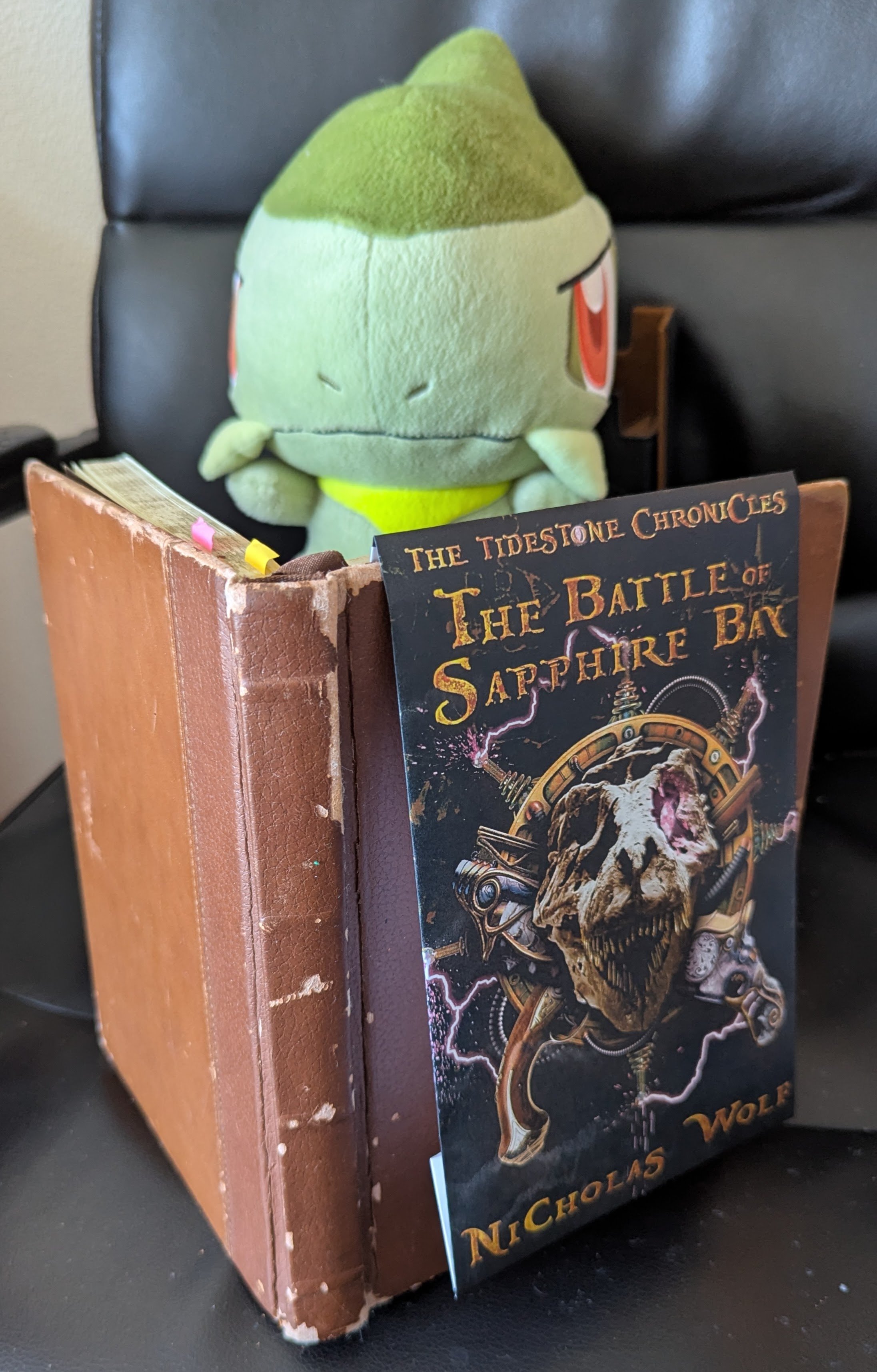
The Battle of Sapphire Bay (The Tidestone Chronicles, Book 2) (Part 3 - Worldbuilding & Character)
Hello, everyone. Welcome back for the conclusion of our review for The Battle of Sapphire Bay, Book 2 of The Tidestone Chronicles.
This last post will focus on the worldbuilding and characters. If you just want the high-level overview, please see Part 0. If you instead want the discussion of flashbacks or the review of other aspects of the plot, please check out Part 1 and Part 2, respectively.
Power up the tidestone core. It’s time to take flight.
STATS
Title: The Battle of Sapphire Bay
Series: The Tidestone Chronicles (Book 2)
Author(s): Nicholas Wolf
Genre: Epic Fantasy
First Printing: April 28th, 2026
Publisher: Self-published to Amazon
Rating: 8.5/10
SPOILER WARNING
Mild, unmarked spoilers for The Battle of Sapphire Bay will be provided throughout this review. Heavy spoilers will be confined to clearly labeled sections. I will keep the first paragraph of any given section spoiler-free.
Heavy, unmarked spoilers of the previous book, Beyond the Crimson Mists, will be included throughout this review. I will also assume that you have read my review of that book, but doing so is not necessary to appreciate this review.
TERMINOLOGY
As in the last book, I’m not going to use Wolf’s names for certain fantasy races in this setting. I’ll instead be referring to these races by the archetypal fantasy races that they are appear to be derived from:
Atantyans = elves
roqlyudi =dwarves
nurians = humans
I will refer to the waraabei by their proper name. While they may be derivatives of gnolls, gnolls are a creation of D&D, so changing the name was likely necessary to avoid legal issues.
WORLDBUILDING
What’s Old is New
Despite being dedicated to catch-up exposition, The Battle of Sapphire Bay introduces surprisingly little in terms of new worldbuilding. What new things are present are expansions upon existing concepts.
The Atlantyoc civilization, which receives the bulk of this exposition, is a prime example of this. We see how the elves go from hunter-gathers who pulled the first tidestones from the waves to a grand empire to their decay. The delivery of this information is certainly impactful. However, it’s something that we could have already guessed based upon the obvious Atlantis parallels and the thematic worldbuilding of the Tidestone Wars as established in a previous book. Wolf wasn't retconning in a decadent civilization, just exploring and fleshing out something he’s already set up.
The same goes for the various bits of elvish tech we see. The devices that Rak-Tak’s crew had access to in the last book already set up that the elves had far superior versions of the tech used by the modern humans, dwarves, and waraabei. So seeing anti-gravity, autonomous drones, golems that can be remotely controlled by an elf at will, and energy shields isn’t flipping the table in this world.
The only two elements that are wholly new additions are the remembrances or the amademoni. Both of these integrate smoothly into the setting. The remembrances build upon the theme of the elves having more advanced technology. As for the amademoni, they are perversions if life that reflect the unnatural evil that is hunting Nyomi.
Environmental / Thematic Storytelling
Wolf continues to fill the world with small details that help with both vibe and theme.
We still see lots of defunct tidestone devices. For example, Lord Croft has an airship that he can no longer afford to run, and thus has nestled the craft inside a hollowed-out ship hull so that he can use the airship’s many weapons in sea battles.
The Sanctuary is a massive building with no internal security and lots of empty bedrooms, hinting that it was meant to house many elves rather than just Malychai (and, now, Nyomi).
Even the descriptions of the elves at different stages of their civilization feeds into this. Wolf does use the remembrances to make the implications explicit (via vibes that are transmitted directly to Hawk’s brain as he wanders through the memories), yet he also writes descriptions in ways that support those vibes, contrasting the beauty and wealth if the elves at their height with the tension and growing despair at the start of their collapse.
CHARACTER
Captain Hawthorne “Hawk” Hawkins
Beyond the Crimson Mists was Hawk's redemption story. Nyomi gave him a chance to remember who he used to be before the 152nd Tidestone War and the deaths of his family (in particular, his sister). He went from a scoundrel living from tankard to tankard to a man willing to fall to his death to save the girl he needed to protect.
The Battle of Sapphire Bay sees Hawk trapped in place. He no longer has an incentive to help Nyomi. Malychai also insists that Hawk has nothing to offer Nyomi, either, and actively wants him out of the Sanctuary. Nevertheless, Hawk is prepared to wait the rest of his life, is necessary, to see Nyomi awakens from her comatose state and ensure that she is safe. He endeavors to learn Malychai’s secrets are all in the interest of helping her.
We also see more of Hawk’s integrity. He spares the life of Eko-Naak, one of the waraabei who survived the destruction of Rak-Tak’s ship in the last book and wound up in Sapphire Bay, because he gave his word that no harm would come to her if she surrendered to him and Urthanq. He continues to advocate for her as best he can despite Malychai insisting she he confined to a cell. We saw a bit of this integrity in the last book with his devotion to Nyomi, but that was colored by both the dynamic between them and the fact he was expecting to be paid. Neither condition applies here. Hawk hates waraabei for killing his family during the war, yet he keeps his promise to Eko-Naak regardless.
Hawk continues to be an unrepentant alcoholic, berating himself for knowing better yet drinking regardless. I still think this is handled effectively. Wolf delves deeper and shows that Hawk has a general lack of impulse control. Coupled with new examples of Hawk’s PTSD, and the alcoholism continues to read like a cross Hawk carries rather than something the narrative condones.
Overall, this book does not so much continue Hawk’s arc so much as it explores where he is after the events of the first book. Much like the plot overall, this is catch-up for the audience so that we are prepared for the next book.
Nyomi
Nyomi does not get further development in this book. I realize that may seem obvious, given that she is in a coma after saving Hawk’s life, but it bears stating regardless. The main thing we learn about Nyomi is what she is: a member of the priestess bloodline of the elves, making her ability to summon tidestones and manipulate the moons something that makes her special among elves.
On that note, I do want to give Wolf credit for successfully doing something other authors have fumbled: making a character special by retroactively nerfing her peers. I don’t recall the first book ever specifying that Nyomi was special among the elves for her abilities; they were implied to be inherent to all elves. The reason this nerf works is that we had no other elf characters before now who might be retroactively diminished by the retcon. The end result therefore feels like like Wolf is insisting specialness exists when it previously did not and more like a clarification on why a special character is actually special.
Malychai (Heavy Spoilers)
Th mysterious, masked elf who runs the Sanctuary immediately raises Hawk’s suspicions with his arrogance and belligerence. He looks down on Hawk as a primitive being and makes it clear that he could kill Hawk at any point. His efforts to keep Hawk from reviewing the remembrances also don’t do any favors for Hawk’s impression of him. Malychai’s one sympathetic feature is that, like Hawk, he wants Nyomi to be kept safe, but his behavior gives Hawk reason to suspect that his long-term plans for Nyomi will harm her.
Who Malychai is behind the mask is treated as a minor mystery. Hawk is tempted to take a peek at his face while he sleeps to see if he can recognize Malychai from the remembrances. There's also a point where Hawk is convinced that he had Malychai’s identity all figured out.
This stage of the narrative - between Hawk guessing who Malychai is and getting a formal declaration of identity from Malychai himself - is one of the weaker points of the story. Wolf does not tell us who Hawk thinks Malychai is when Hawk figures things out, despite the fact that we are in Hawk’s 1st Person POV. This is the pronoun game with extra steps.
That being said … Wolf does not actually impact the narrative by doing this. He does not present the mystery as a cliffhanger. The moment that Malychai’s identity would become relevant (i.e. the next time Hawk uses a remembrance and has a chance to identify him within those memories), the narrative descriptions use Malychai’s name liberally before Malychai confirms anything. This isn’t like Yarros hiding Amber’s identity in Fourth Wing between her attempt to kill Violet and the big reveal when Amber is tried for that murder.
And unlike Violet with Amber, we actually do have a character based reason for this. (It’s a weak reason, but still something.) Hawk isn’t refusing to acknowledge that someone he doesn't respect, someone who challenged him and has given him every incentive to want to accuse of hypocrisy, would do something to harm him. He is simply not dwelling upon Malychai’s identity until doing so becomes relevant. Given Hawk’s characterization (and perpetual drunkedness), it's at least mildly plausible that he would identify Malychai and then not make a big deal out of it without his internal monologue then and there.
All this is to say that, while Hawk not immediately telling us who Malychai is feels contrived for the sake of stringing the audience along, doing so doesn’t actually break anything.
With regards to the mystery: Hawk assumes that Malychai is the figure who turns out to by Caiphys. This is based both on his willingness to believe Malychai would harm Nyomi and the fact Malychai’s mask is the same kind of mask that Caiphys was wearing in the remembrance record in question. Later, when it is revealed that Malychai was actually the emperor of the elves, the reveal ties together neatly. Even the mask is explained as an act of penance by Malychai for leading his people to ruin.
Malychai works fine as a minor antagonist. Given that he gets a hole blown through his chest at the end of this book, I’m 90% sure he’s dead now and won’t resurface in later books. (Of course, Urnthanq was dead at the end of the last book, so who knows what elf tech might be able to do to save Malychai.)
Davyd
A golem in Malychai’s service, Davyd is unfailingly polite and sincere. Hawk is caught off-guard by both how unnervingly lifelike and genuinely emotional Dayvd is. Davyd’s main role within the story is to serve as a foil to Malychai and a means to do work that Malychai is too busy to do (like repairing Urthanq). Malychai also has some form of psychic link that allows him to see, communicate through, and control Davyd, which is used to drive up tension in situations where Hawk needs to keep secrets from Malychai while Davyd is also present.
Eko-Naak
A waraabei slave who is brought to the shores of the Sanctuary by the survivors of Rak-Tak’s crew, Eko-Naak is motivated to survive and obtain her freedom. She is initially antagonistic towards Hawk, seeing him first as another threat to her life and then as another captor. However, Hawk’s efforts to keep his word to her win her over as an ally.
I assume Eko-Naak will be continue adventuring with Hawk in the next book. She is the one who knows the location of the place Hawk will most likely need to go to next.
Urthanq
I already covered most of what I have to say about this golem while breaking down its contributions to the plot. Here, I’ll just add that Wolf does a good job of efficiently relaying Urthanq’s bloodthirst. The last book made it seem like Urthanq was just a dog on a tight leash; this book reveals a deeper layer of sadistic purpose. Urthanq lives to kill, and it absolutely bears a grudge against Hawk for all the times he kept it from doing so.
Lord Croft
The ruler of Hawk’s homeland, Lord Croft is a cruel and tyrannical ruler motivated by greed and ambition. He allowed his citizens (including Hawk’s family) to be slaughtered by waraabei raiders during the 152nd Tidestone War so that he could keep more soldiers on the battlefront. When Hawk calls him out publicly and breaks his nose, Lord Croft throws every available resource into having Hawk killed, then vengefully slaughters anyone who might have helped Hawk when Hawk escapes him.
Lord Croft is established in the flashbacks before arriving in Sapphire Bay in the last third of the book. His desire to control the Sanctuary and all the elvish technology within drags him and his men into the titular battle, despite Hawk’s warnings that they flee. Hawk ultimately has to confront this embodiment of the book’s anti-theme in his efforts to get Nyomi out of danger.
Taken all together, Lord Croft is simple and effective as a one-off antagonist. He is not complex, but he does not need to get for the story to work.
TREASURE IN THE DEEP
The Battle of Sapphire Bay is a compelling continuation of Hawk’s fantastical adventure. The modern Fantasy landscape needs more stories like this. It demonstrates that a slow story does not need to be stagnant, that a story built around dumping lore can be emotionally compelling, and that you don’t need to keep throwing new fantastical elements at the audience to expand upon past worldbuilding. I am eagerly looking forward to Book 3.
However, we don’t need to wait quite that long to read more work by Nicholas Wolf. After seeing praise for his Death Watch novella “Sorrowcrown” on Twitter, I got myself a copy of The Long Vigil so that I could read it. I hope you’ll join me on Monday, September 7th for that review.
Thank you all for joining me today. Please remember to subscribe and share if you enjoyed what you read here. Take care, everyone, and enjoy the rest of your week.