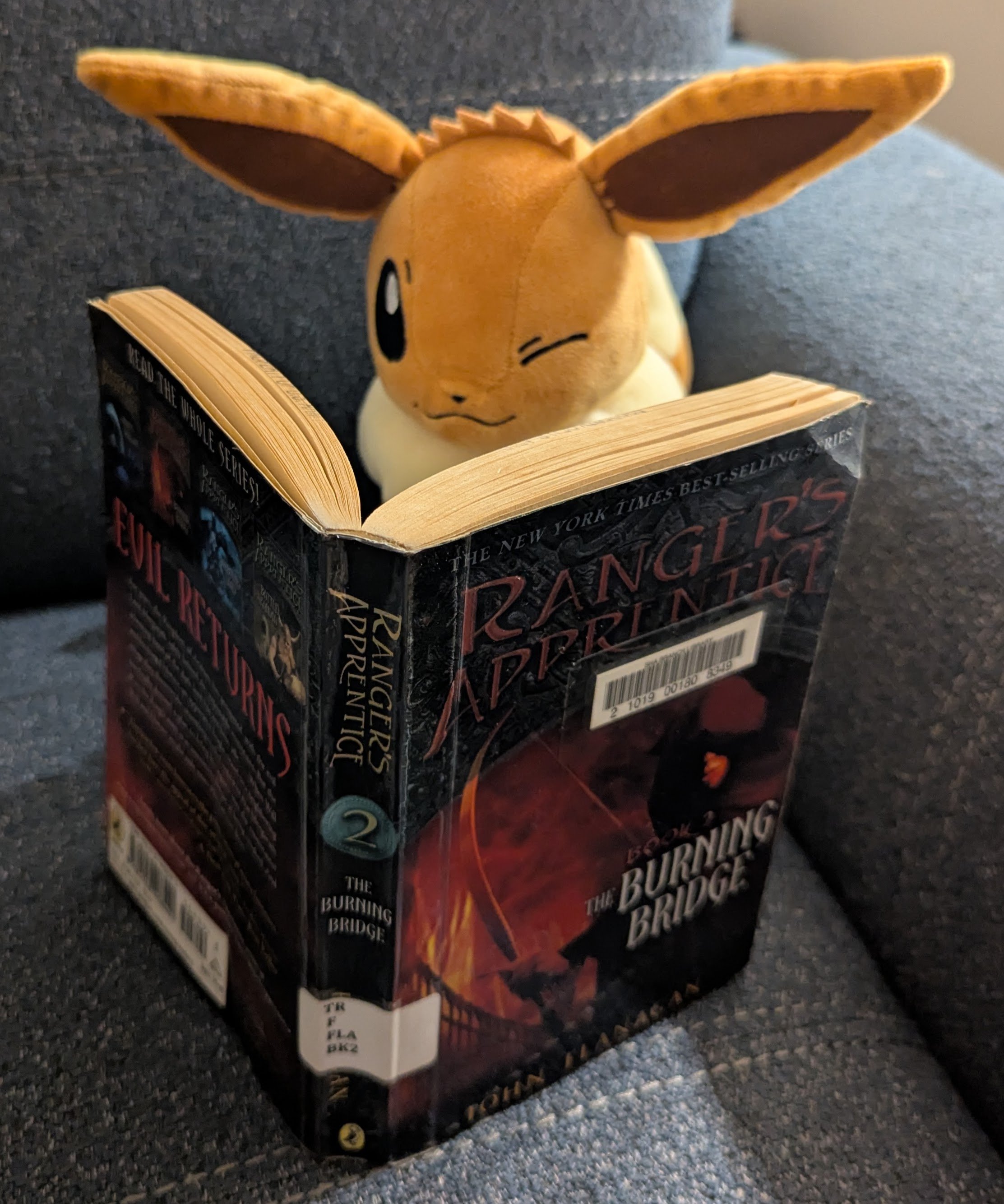
The Burning Bridge (The Ranger's Apprentice, Book 2) (Part 2 - Worldbuilding and Characters)
Hello, all. Welcome back to the ongoing analysis of The Burning Bridge, Book 2 of The Ranger’s Apprentice.
This part is going to focus on just the worldbuilding and characters. Please check out Part 1 if you’d just like the overview. We’ll be getting into the plot next week with Part 3 and then cover the plot contrivances the week after in Part 4.
Step softly now. It’s time to go hunting.
STATS
Title: The Burning Bridge
Series: The Ranger’s Apprentice (Book 2)
Author(s): John Flanagan
Genre: Fantasy (Middle Grade)
First Printing: May 2005
Publisher: Puffin Books
Rating: 8/10
SPOILER WARNING
Mild spoilers for The Burning Bridge will be included throughout this review, through I will keep the first paragraph of each section as spoiler-free as possible. Heavy spoilers will be confined to clearly labelled sections.
Unmarked, heavy spoilers for The Ruins of Gorlan may be used as necessary to support this review. I will also assume that you have read the review series for that book, though doing so won’t be necessary to understand this review.
WORLDBUILDING
The worldbuilding of this story continues to be very simple. It’s perfectly suitable for a Middle Grade audience, yet I also think that, in at least one aspect, it demonstrates qualities that would be nice to see in more adult Fantasy writing.
Magic
This setting is still low-magic, but the the implications of magic are no longer implications.
Morgarath controls his Wargals via mind control. This power was referenced in The Ruins of Gorlan, but the wording made it unclear how literal this power was. The Burning Bridge confirms that this power is very literal. We get a scene from Morgarath’s POV wherein we get multiple lines about Morgarath guiding the Wargals across a battlefield with force of will alone, along with references to how he is unable to completely suppress the Wargals’ innate fear of horses with this power. There’s also a scene that shows that Wargals freed from Morgarath’s control will become docile (either because this is their natural state or because Morgarath’s dominion has robbed them of their ability to be hostile on their own).
How does this work? No idea. Are there limits? Apparently, Morgarath can’t issue precise commands, yet it’s unclear it that’s a limit of the power or the Wargal psyche.
In any case, this vagueness is not a problem. The mind control is a very limited application of soft magic that makes Morgarath a more intimidating antagonist without actually changing the rules of the world.
I like the inclusion of objectively real magic in this particular setting. Enjoyable as it can be for a story to have clever, natural explanations for all the seemingly supernatural elements, it’s a trick with diminishing returns. This was something that made me stop watching the Dwayne Johnson Hercules movie, and it’s the one element of Apothecary Diaries that slightly frustrates me. At a certain point, all the supernatural elements begin to feel like pointless, predictable tease. By establishing that some supernatural elements are exactly what they say on the tin, Flanagan has preserved the sense of mystery regarding such things going forward. This is a long series. That preservation of mystery could end up paying dividends if more (potentially) supernatural stuff is introduced down the line.
Celtica
Celtica is the not-Scotland (or maybe not-Ireland) of this world of reskinned Earth cultures. They have a military treaty with the Kingdom of Araluen to contain Morgarath in his domain (which borders both Celtica and Araluen). They also have an obsession with metal work and a ritualistic culture where the number three is very important (which feeds into the contrivance that lets Horace participate in the plot). Beyond that, we don’t learn much about Celtica in this story.
Skandians
The setup of non-Scandinavians being hired by Morgarath in the last book is paid off here. Sure enough, they are about a non-Scandinavian as a Fantasy culture can be without giving up and just admitting that they are stereotypical Vikings. They wear big horned helms, have round shields, and believe they need to die in battle (more specific to this book, die with a weapon in hand) to go to their version of Valhalla.
Wargals
There are a lot of Wargals in this book. Other than a very open-ended description of them as dog-bear-men (no shade there - it should pair well with a child’s imagination), the only things we get about them is the confirmation that they are afraid of horses (which I think was mentioned in the last book) and that they like to chant as they march.
CHARACTERS
The character work stays very simple in this book. The big change in that suddenly a large cast is more relevant, because the story is less tightly focused. Rather than doing detailed breakdowns on everyone relevant, I am going to divide them up by narrative role, only really getting into detail for the Love Interests.
Protagonists
Will and Horace continue to be the focus on this story. The narrative focuses on the role they play within the larger conflict between Morgarath and the Kingdom of Araluen. They need to overcome challenging using the lessons they learn throughout the story.
Beyond that, there’s not a lot to say about these two. They are perfectly functional. I’m sure the target demographic can connect with them.
Antagonists
Morgarath serves as a very archetypal Dark Lord character. He has the same unwholesome visual vibe that defined Severus Snape, and he is motivated entirely by his perceived right to rule Auraluen and his desire for vengeance against anyone he perceives as an obstacle to that objective. In keeping with the story’s lack of subtlety, there’s not a lot of nuance to this guy. He is a villain.
The Skandians, led by their chief Erak, serve as secondary antagonists - but not villains. Erak and his people are here because they are paid to be, and they don’t have any interest in harming Will or anyone else connected with Auraluen beyond that. Even when they have the upper hand on Will, they aren’t interested in killing him just for the sake of it, even when he’s already killed some of them.
Mentors
Halt begins and ends the story as Will’s mentor figure, but Gilan does the heavy lifting in the middle. What we see from both of them is pretty interchangeable, just continuing the pattern of letting Will make his own mistakes that we saw in the previous book.
In this book, Halt also has a … character arc? … about missing Will while he apprentice is off on this mission. We’re Told that he is moodier and more aggressive than usual. (What we are Shown is really just an extension of his characterization from the previous book, and given the rising tension from the impending war, I’m not entirely sure that missing Will is necessary to explain his decisions in this book.) This sort of has a payoff in the climax, but I’m not sure we needed so much focus in order to justify that payoff.
Love Interest(s)
Alyss
Remember the irrelevant Teen Romance subplot from the last book, where Will crushes on the baker girl and then gets kissed by another girl?
Well, this other girl, Alyss, appears for a few chapters in this book, traveling with Halt as he goes on a mission within Araluen. I think that Flanagan still wants to use her as Will’s Love Interest at some future point. We don’t learn anything new about her on this trip with Halt, and Halt doesn’t really develop either; the only character work that comes of it is Halt thinking what a nice girl she is at the end of it. I assume Flanagan is priming the audience for will and her to have some sort of relationship down the line.
And I have to say “assume”, because with what we are shown on the page, there is another Love Interest.
Evanlyn (?) (Heavy Spoilers)
While in Celtica, Will’s ground encounters a girl named Evanlyn. She claims to be the servant girl of a noble of Araleun, who had already been in Celtica on an unrelated diplomatic mission, only to be attacked by Wargals. Evanlyn escaped and hacked off her hair so that she could pass as a boy during her trek back home. Gilan and Will immediately see that this is a very sloppy lie, but they can’t quite pinpoint what the lie is, other than speculating that Evanlyn is actually the noblewoman in question and is pretending to be a servant for further protection. Evanlyn’s behavior when asked to help out around camp also hints at this.
Despite her initial attitude towards being helpful, Will finds himself attracted to her, because … he likes tomboys? I’m going to be honest, I’m not sure what there is to this attraction outside of teenaged hormones. Granted, the Jenny crush and the reaction to Alyss kissing him were on weak grounds, too, but at least they were childhood friends. We could imagine a history.
Well, the big twist here is not actually the fact that Evanlyn is indeed lying about her identity. The twist is exactly how important she truly is. “Evanlyn” is actually Princess Cassandra, daughter of the King of Araluen.
I’ll have more to say about this twist in the plot section. I’ll just cap this off by nothing that Evanlyn’s characterization feels like a tool of the plot. she’s clueless about chores in the camp, so as to drop hints to confirm that she’s not really a servant, yet she adapts so quickly that her initial cluelessness feels like ignorance … an ignorance that’s hard to swallow, given that she was introduced as someone who was both starving in the wilderness and savvy enough about her situation to hide her identity even in front of men sworn to serve her father. Later, she readily insists on joining Will and Horace on a what (at the time) seems like a dangerous side quest, despite having no skills to contribute. This last is necessary for the situation she and Will end up in at the climax of the book, but it makes little sense for her character. (It also doesn’t make sense for Will to allow this, given what he suspects of her identity at the time.)
Coming back to the Love Interest point, Will and Evanlyn will almost certainly be spending a lot of time together in Book 3 of the series. I assume Flanagan will push her more assertively as a love interest in that book. It’s just I’m basing this on tropes and positioning, rather than because her characterization offers anything beyond, “Will would love watching Tomo-chan is a Girl”.
FORMULA AND DEVIATION
The Burning Bridge recycles the same basic structure as The Ruins of Gorlan. There a very simple and straightforward main plot that gets kicks into gear by a revelation later into its length, plus a subplot that feels like it could be either cut outright or streamlined by associating it more closely to the main plot. That said, Flanagan also manages to execute some very surprisingly developments in the last third. The result is a story that, while formulaic at first, still manages to deliver an original and compelling ending. We’ll dive into this next Sunday.
Thank you all for stopping by. Please remember to subscribe and share if you enjoyed what you read here. Take care, everyone, and enjoy the rest of your week.