Runebreaker (Part 9 - Characters: Vaeris)
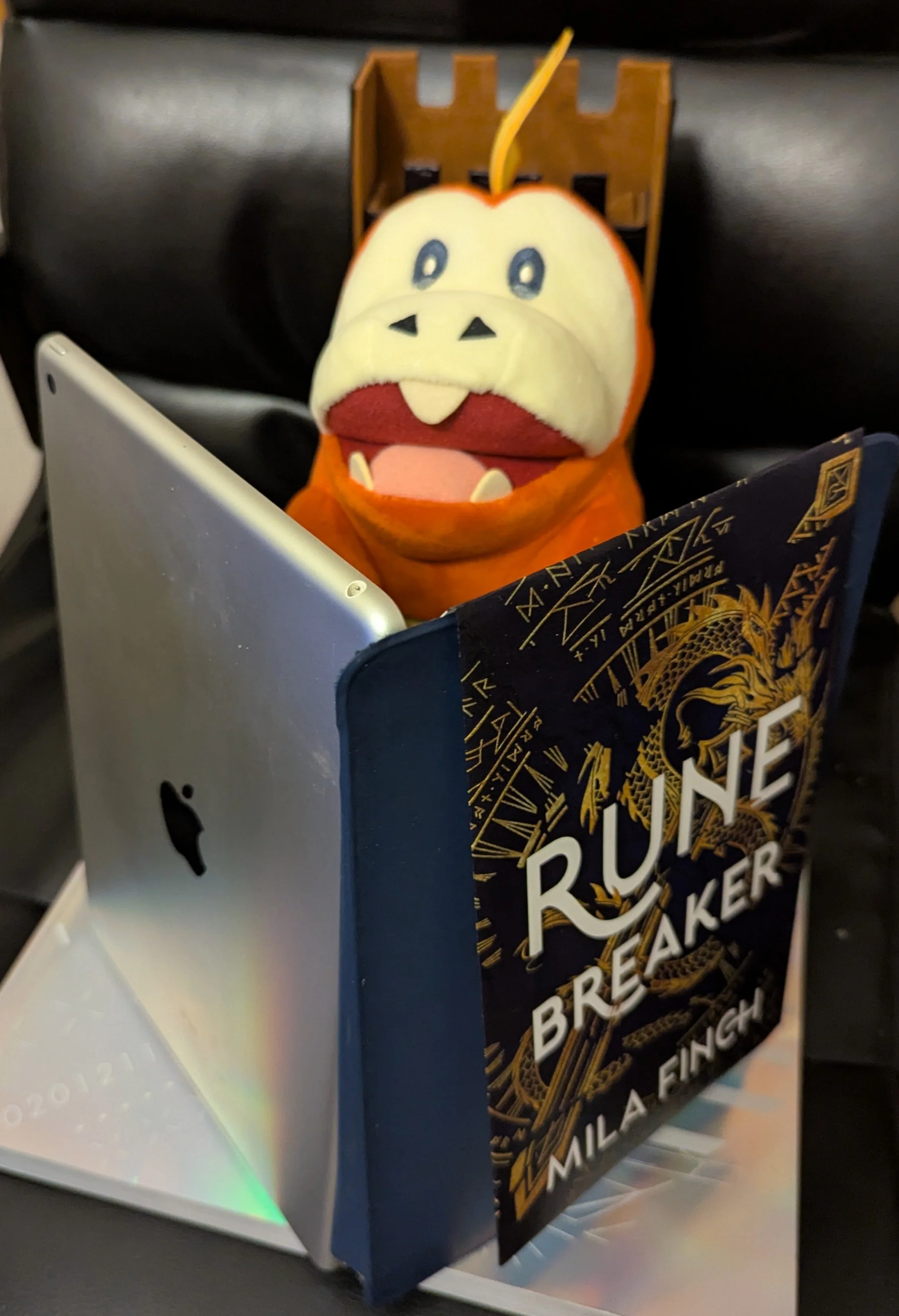
Hello, all. Welcome back to the review of Runebreaker, an indie Romantasy by Mila Finch.
As covered in the introduction of Part 6, this book only has three characters that are worth discussing: Aelie, Kairos, and Vaeris. We covered Aelie already during Part 6 and Part 7, and we did Kairos in Part 8. Now, it’s time to turn our attention to the main antagonist.
Let’s break some bonds.
STATS
Title: Runebreaker
Series: [Untitled Trilogy] (Book 1)
Author(s): Mila Finch
Genre: Fantasy (Romantasy)
First Printing: January 2026
Publisher: Self-published to Amazon
Rating: 0.5/10
SPOILER WARNING
Throughout this review, there will be mild, unmarked spoilers for Runebreaker. I will do my best to keep the first paragraph of each section as spoiler-free as possible. Heavy spoilers will be confined to clearly marked sections.
CHARACTERS (continued)
Vaeris
Vaeris is the character that I wish Dain from The Empyrean had been.
Much like Dain, Vaeris is demonized to an absurd degree. Aelie refuses to acknowledge the blatantly obvious circumstances that compromise his ability to help her, even though those same circumstances are taken as a sign of her virtue. He is smeared as untrustworthy before we’re ever given any evidence to that fact. Aelie bemoans how he’s invoking an oath that she blackmailed him into, yet refuses to consider the fact that she may have killed him by forcing him to swear to an impossible task (because, as we are explicitly told at the end of the book, the oath will kill Vaeris if Rheya does, regardless of whether that death was in his power to prevent). All of this hatred is founded on heartbreak over a love that was never properly established in the first place. It really does feel like a replay of Violet vomiting endless bile onto Dain for pointing out objective facts and for events that were really Xaden’s fault.
And yet … Vaeris actually is an antagonist. He has goals in opposition to Aelie’s (at least, until Aelie decides to fulfill those goals anyway) and motivations that are relatable (especially since Aelie then invokes those same motivations to fulfill his goals). Furthermore, when Finch finally does commit to him being a villain (instead of merely a punching bag), the twist does make sense.
We’re going to start with the bad of Vaeris’s character first, then move on to the good. A lot of this has already been covered to some degree in previous parts, so I’m going to focus on tying things together and adding new points of information.
Heartbreak
Back in Part 2, we went over how Vaeris is always framed in the worst possible light because of heartbreak he caused Aelie. This works well enough for his introduction. The problem is that Finch never really goes back to properly lay groundwork for this relationship. At the very least, it’s not enough groundwork for the raw emotion she wants us to feel about him.
Aelie’s mistrust of Vaeris is not a background detail. It’s what defines their relationship in this story. It’s what is invoked to justify the non-progression of Aelie and Kairos’s romance (because remember, there’s no actual character development or external obstacle to keep those two from getting together). So it’s not enough to simply Tell us how Vaeris and Aelie met via a throwaway line. It’s not enough to give us a pseudo-flashback to indirectly state that they had sex. Harping on the fact that he abandoned Aelie to save face isn’t enough.
At a bare minimum, we needed dedicated flashback scenes. We needed to be Shown their relationship. Three scenes - how they met, Vaeris helping Aelie train her powers, and the moment when he broke things off - would have been enough to at least anchor the heartbreak angle. These didn’t need to all come up-front. They could have been spread across the story, running in parallel to Aelie’s relationship with Kairos, thereby highlighting the similarities that Aelie is wary of and the contrasts that help her to open up.
Virtue for Me, but Not for Thee
What I find so frustrating about Aelie’s efforts to hammer Vaeris into the dirt is that his hands truly are tied by circumstance, and all the information needed to prove this is presented through Aelie’s POV.
Vaeris is only a half-fae. (If I understand correctly, the king of Skalir is his father, while his mother was human.) He may be heir to the throne, but in a city where humans are an oppressed underclass, his mixed heritage denies him the respect of the pure-blooded fae nobility. Any political misstep could cost him the throne, if not his life.
And yet, despite this, Vaeris wants to help humans. He doesn’t distance himself from the people. If I understand this correctly, he met Aelie in the human slums, happening upon her while she was helping people. When he learned of her gift, he committed treasonous acts to procure books on rune magic for her, to help her to study and to hone this talent. What’s more, the moment he’s actually in power (thanks to Kairos murdering his father, stepmother, and probably most of the people who would have directly opposed him taking the throne), he gets to work on stopping the Rite. (Yes, him helping Aelie and stopping the Rite get re-contextualized later, but Aelie did not know that context while demonizing him.)
Aelie knows all of these things … but it’s never good enough. She has no compassion for his precarious political situation. She can’t think beyond her own feelings. Vaeris has demonstrated the will to help humans and has the power needed to do something about it, but because he won’t keep coming to the slum to have sex with her, that makes him a bad person.
All is this is while Aelie steals (it’s okay - she is stealing from fae to feed humans). All of this is while Aelie premediates the murder of city guards (she opened the storm gate for the express purpose of washing away men coming to arrest her for theft). All of this is while she turns a blind eye to flooding the merchant quarter with the dam breach, making the lives of the oppressed people just a little bit worse, because Rheya is the only human life that actually matters to her.
And through it all, Vaeris still tries to help Aelie. The only reason Aelie is able to blackmail him into swearing an oath is because he came to her in prison to try to help her. We later learn that the only reason she was able to free Kairos is because Vaeris deliberately arranged for the pair of them to be alone. (Again, we get more context later, but between learning this information and learning the context, Aelie doesn’t feel even a flicker of gratitude.) And while the oath may compromise his agency, the fact remains that he agrees to this potentially impossible task to save Rheya. Finch only wants us to focus on how the oath harms Aelie, but Vaeris is the actual victim in that situation, because Aelie twisted his arm to put him in the exact same danger.
So, no. Up until the point when Vaeris drops the mask, Aelie’s mistrust of him does not feel at all justified. At best, it reads like Aelie is an immensely insecure person who makes excuses to no trust people.
Belly-Flopping Into Villainy (Heavy Spoilers)
The big reveal around the halfway point of the story is that Vaeris is, in fact, the monster Aelie irrationally accused him of being.
What a twist.
Going back to the point of Vaeris arranging for Aelie and Kairos to be alone, he expected Kairos to murder his father and a bunch of nobles. Kairos was his weapon in a bloody coup. This was all about seizing the throne. Kairos abducting Aelie was decidedly not part of Vaeris’s plans, but as the new king of Skalir, he could at least pursue his agenda in other ways.
The twist also reveals that Vaeris is abusive, if not an outright sociopath. The same scene as the reveal sees him threaten Aelie’s life in order to goad Kairos into breaking an oath of peace. He then gloats as Kairos begins to die from said oath. He also shows a naked desire to possess Aelie for her power.
And the reason for this is that he wants to free the dragons. He wants Aelie to break the binding rune in Skalgard (and presumedly, also the rune in Thalir, but we’ll get into the convenience of all that in the plot breakdown). He believes that the dragons will kill all the fae for imprisoning them but leave the humans and half-fae alive, allowing him to establish a new order as a favored servant of the dragons.
This makes sense in terms of tying pieces of the plot together. It just lacks punch. Vaeris shouldn’t have been demonized throughout this book. If Aelie had been heartbroken but understood his situation, if she’d at least hoped Vaeris would help her instead of dismissing him and blackmailing him at every turn, that would have been enough. He would have been on a sort of redemption arc, only to reveal that he was worse than Aelie had ever imagined. That could have worked.
Instead, the reveal only merited a shrug. Vaeris’s presentation on the page had finally caught up to the way Aelie had always framed him. This isn’t a twist. It’s Finch finally doing the bare minimum.
The Best Character
Vaeris is badly handled as a character, yet he remains the best character in the book, outstripping even characters who are far more functional in their respective roles.
First, I really like that Vaeris is actually a villain. One of the reasons that Yarros’s demonization of Dain frustrates me so much is that she won’t commit to making him the bad guy. Dain is going out of his way to be supportive of Violet (especially when she asks for it, even after she mistreats him) or else isn’t actually at fault in the situations that she blames him for, and yet Yarros keeps heaping humiliation after humiliation upon him. For the first half of Runebreaker, I was worried that Vaeris was going the same direction. Him dropping the mask may not have made for a satisfying twist, but at least it made Aelie’s behavior towards him a little more tolerable from that point onward.
Second, Vaeris is an interesting villain. He has the same values system that Aelie has (or, at least, the initial values system that is used to try to assert that Aelie is virtuous). He despites the oppression of humanity at the hands of the fae and wants to help them. The work put in to try to make Aelie more sympathetic also makes it understandable why Vaeris would think that his plan is necessary. Vaeris may be an unambiguous villain playing with forces he doesn’t understand, but at least we can grasp how circumstances might have tipped him in that direction. There’s a depth to him that’s easy to overlook in all Finch’s efforts to demonize him.
Final Thoughts on Vaeris
Vaeris is mishandled in this story, yet his concept his strong. Most of the issues with his writing are really knock-on effects from problems in other aspects of the narrative. If Finch had dropped the demonization and actually invested pages into Showing us his relationship with Aelie, rather than just insisting how bad he is, I think he could have carried this book in a way that Aelie and Kairos couldn’t.
INSTABILITY
The worldbuilding of Runebreaker is fundamentally contradictory, and of the characters who drive the narrative, two are self-devouring while one is demonized out of any credibility. That just leaves the plot. Can the story of Runebreaker save things?
Well, given that I rated this book 0.5/10, I think you can guess the answer.
Finch drops every single ball that she tries to juggle for this plot. Worse, that ending she asked the audience not to spoil in their reviews tosses anything resembling cause and effect or a moral axis right out the window.
It’s going to take us two parts to get through all the issues. We’ll start on Sunday, May 24th, as we dissect the systemic oppression narrative, Aelie’s captivity, and the mishandling of her oath to Vaeris. I hope you’ll join me for it.
Thank you all for stopping by. Please remember to subscribe and share if you enjoyed what you read here. Take care, everyone, and have a good rest of the week.