Runebreaker (Part 7 - Characters: Aelie, continued)
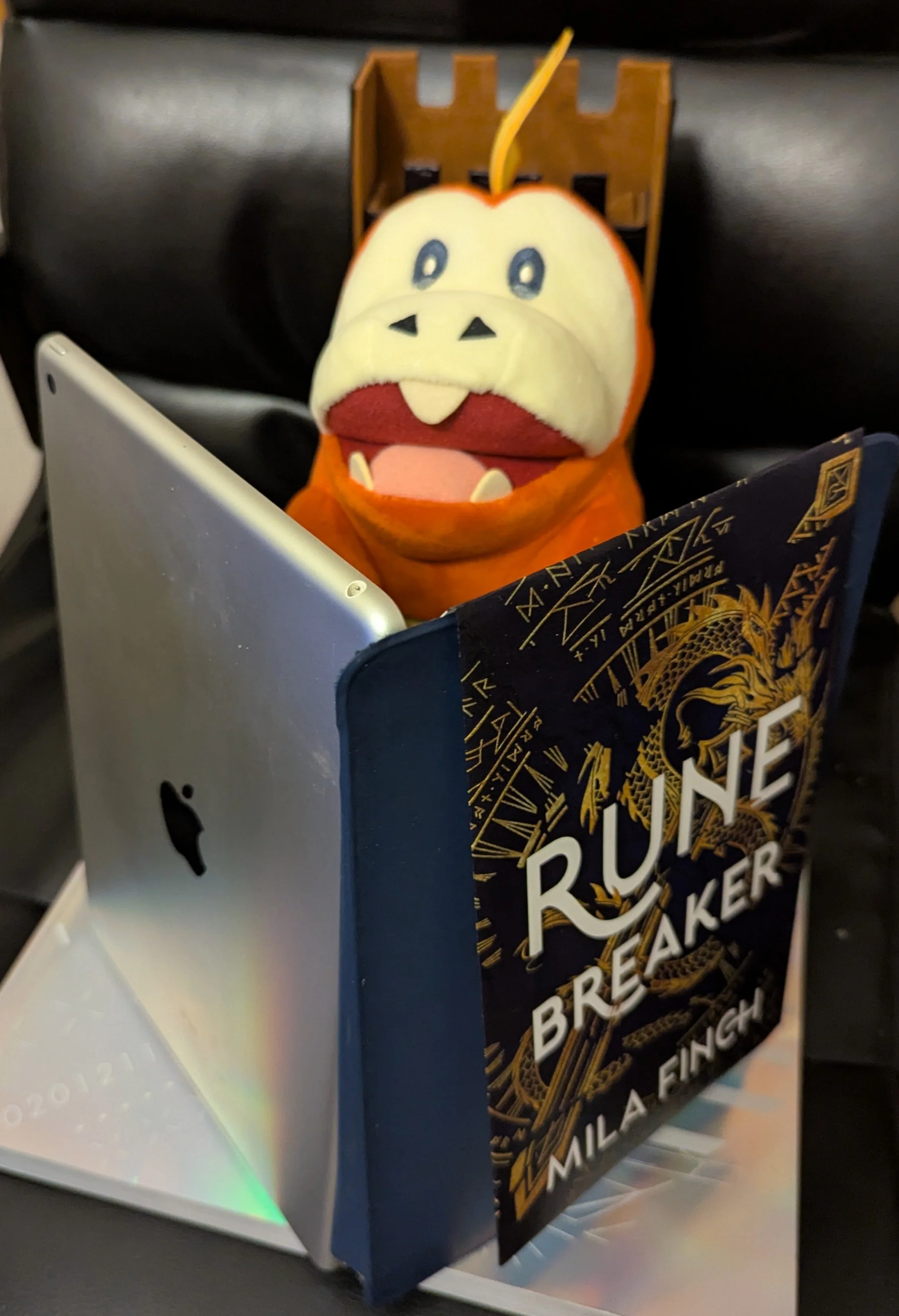
Hello, all. Welcome back to the review of Runebreaker, an indie Romantasy by Mila Finch.
This part is a continuation of the breakdown of Aelie, the Main Character of the book. It was originally written as one part with Part 6, but the analysis ended up being far too long for a singular post. Apologies for being so long-winded on this one.
Please catch up on at least Part 6, if you haven’t already. Otherwise, let’s break some bonds.
STATS
Title: Runebreaker
Series: [Untitled Trilogy] (Book 1)
Author(s): Mila Finch
Genre: Fantasy (Romantasy)
First Printing: January 2026
Publisher: Self-published to Amazon
Rating: 0.5/10
SPOILER WARNING
Throughout this review, there will be mild, unmarked spoilers for Runebreaker. I will do my best to keep the first paragraph of each section as spoiler-free as possible. Heavy spoilers will be confined to clearly marked sections.
CHARACTERS (continued)
Aelie (continued)
Self-Imposed Victimhood
So … that oath. I’ll have more to say about the oath as a plot device in Part 10, but for now, let’s consider what Aelie’s behavior regarding the oath says about her as a character.
Aelie blackmails Vaeris into swearing this oath. He does not want to do it, but she threatens to tell his parents (the king and queen of Skalgard) all the treasonous things he did to help her train her rune breaking magic. (Yes, much like how I’m bringing this up out of nowhere, this fact also spawns out of nowhere in the text.) It’s a straightforward deal, one that she knows will be enforced by a painful death if either fail to uphold their end:
Vaeris will find and protect Rheya.
If Aelie avoids being executed over the dam breach incident, she will do the following three things for him, each of which is presented as a condition independent of the other two:
She will come to Vaeris.
She will break one rune of his choice.
She will not tell anyone else about the oath.
I cannot emphasize strongly enough that Vaeris did not want to do this, yet Aelie did, whilst fully aware of the consequences.
So when the oath starts to kill Aelie (because being held as a prisoner violates the oath, apparently), does Aelie take responsibility for this?
Of course not. The focus is on how Vaeris’s demands are killing her. The oath is reframed in such a manner that Vaeris becomes the villain in this situation. She acts like she was exploited and tricked, rather that going out of her way to force this situation into existence.
Aelie’s hand-wringing over the oath goes over a little better than with her sister. At least in the case of the oath, she really can’t say anything. That being said, this feels like an effort to avoid accountability. We’re being asked to have sympathy on Aelie when she did this entirely of her own volition, as well as thinking poorly of Vaeris despite him trying to spare them both from this situation.
Agency
Back in Part 3, I said that the nature of the power fantasy in this story did not do as much damage as other power fantasies we’ve covered. I do stand by that. However, that was not to say that it is entirely without problems.
For the vast majority of the book, Finch deprives Aelie of agency - or, rather, pretends that Aelie is deprived on agency. She has Aelie worry about Rheya ad nauseum without even trying the one very simple thing that should have been the most obvious course of action. She has Aelie play the victim of a situation that was entirely self-inflicted, without considering the fact that this same situation should ensure that Rheya is safe. Adding in that quote above about how selfless Aelie is and Kairos getting angry that other people let Aelie exhaust herself to help them - in other words, situations where Aelie refused to acknowledge her own limits, yet wanted to play the victim regardless - and a running theme here becomes clear.
This is a power fantasy about not having any accountability.
And that’s … well, it fulfills the wishes of a certain percentage of the population, I’m sure, but it really doesn’t read well for a character whom we are supposed to find virtuous. If Aelie were genuinely a victim of circumstances and genuinely did her best to overcome that, the fact she accomplishes nothing and just waits around for Kairos to do things for her wouldn’t necessarily be a problem. Neither of these are the case. So the longer the book goes on, and the longer Aelie whines about all these things that are supposedly out of her control but really aren’t, the more it seems like the we’re supposed to root for someone who makes no effort to earn our support. All this adds up to make Aelie extremely unsympathetic.
And it only gets worse.
The Oppressed (Heavy Spoilers)
We already discussed back in Part 5 how the systemic oppression shown in Skalgard is milked for emotion, without any thought being put into how humans interact with the rest of the fae. Thus far, we’ve touched on this purely from a worldbuilding perspective. Now we get to talk about how this poisons the Main Character.
The oppression of humans by the fae of Skalgard is one of the first things we learn about this world. Throughout this book, whenever Aelie reflects upon her life in Skalgard, it’s always to wax poetic about how horrible life is there and how it’s all the fault of the fae. Furthermore, one of those two traits that Finch did such a poor job of introducing is that Aelie is a champion of the oppressed who gave them “everything”.
Why is it, then, that she never interrogates the situation of humans elsewhere in the world?
At a bare minimum, why does she never ask where all the humans in Sanguir are? Why does she not ask how Sanguir’s fae sustain the magic of their own runes (the ones not marked on their own bodies, that is)? Why does she not even consider the possibility of asking Kairos to somehow help the human population in Skalgard? The closest she comes to caring about other humans is when she goes to Thalir and asks about their breeding program, but even then, she just takes the explanation of the relationship between the fae and humans of that kingdom at face value.
It really seems like Aelie’s moral outrage at oppression was only because she could see the oppression, and that made her feel bad. Once she got away from Skalgard, it merely became a button she could press to play the victim, or else an excuse to write off Vaeris as a bad person for not doing more to help humans (with zero regard for his own precarious position in society).
But wait! There’s more!
When the reveal comes that the Rite sustains the rune that binds the dragons, and Vaeris is suspending the Rite so as to free them, suddenly, helping the oppressed becomes a bad thing. All of Vaeris’s efforts to do things Aelie previously supported are just a front for a sinister plan that will destory the world. Even when he is raving to Aelie about how the dragons will only harm the fae, thereby giving humans and half-fae vengeance for millennia of oppression, she dismisses any possibility of noble intent and insists that his actions are unambiguously villainous.
At least, until the climax. Then Aelie decides to free the dragons herself, for the exact same reasons that she just demonized Vaeris for! This isn’t framed as an act of desperation where she felt she had no other choice, or even as something she regrets after the fact. She just decides that they really should take vengeance on the fae (well, excepting the fae she personally likes) and goes through with the plan she previously wrote off as villainous, doing the exact same actions for the exact same reasons that she previously condemned.
I’ll get into this in more detail when we discuss the plot. For now, suffice it to say that Aelie is utterly broken as a character. To say she is a hypocrite is too small a word. At least hypocrisy can be rationalized by some difference in circumstances, something that might crack under the slightest bit of reflection but at least holds up to a cursory glance. Finch will build Aelie up as being a righteous character for opposing evil before flipping on a dime, having Aelie commit to or ignore the exact same evil, and then expect Aelie to be framed as the hero.
Final Thoughts on Aelie
Aelie is a terrible protagonist. Frankly, she’s more delusional than Violet Sorrengail. At least when Violet Sorrengail betrays her own values, ignores her own agency to solve problems, and blames other people for circumstances that are actually her fault, there are variables in place to lend her behavior the surface-level impression of integrity and rationality. Aelie will do a precise 180, and the only thing that will have changed is that Finch wants the audience to forget what she previously established.
I PROMISE HE'S NOT REALLY A BAD BOY
I wish I could say that things get better with the Bad Boy Love Interest, but sadly, that isn’t the case.
Much like Aelie, Kairos isn’t bad in concept. It’s just that he is also maddeningly contradictory. Finch wanted him to both be the edgelord whose edge makes him sexy and the innocent victim who is so loving and soulful. There are ways to do this properly. Finch instead chose to pull the same reversals as with Aelie. In doing so, she ended up undermining the character and making him look less like an intimidating Shadow Daddy and more like a whiny teenager.
We’ll get into that on Sunday, May 10th. for now, thank you all for stopping by. Please remember to subscribe and share if you enjoyed what you read here. Take care, everyone, and have a good week.