Runebreaker (Part 3 - Power Fantasy)
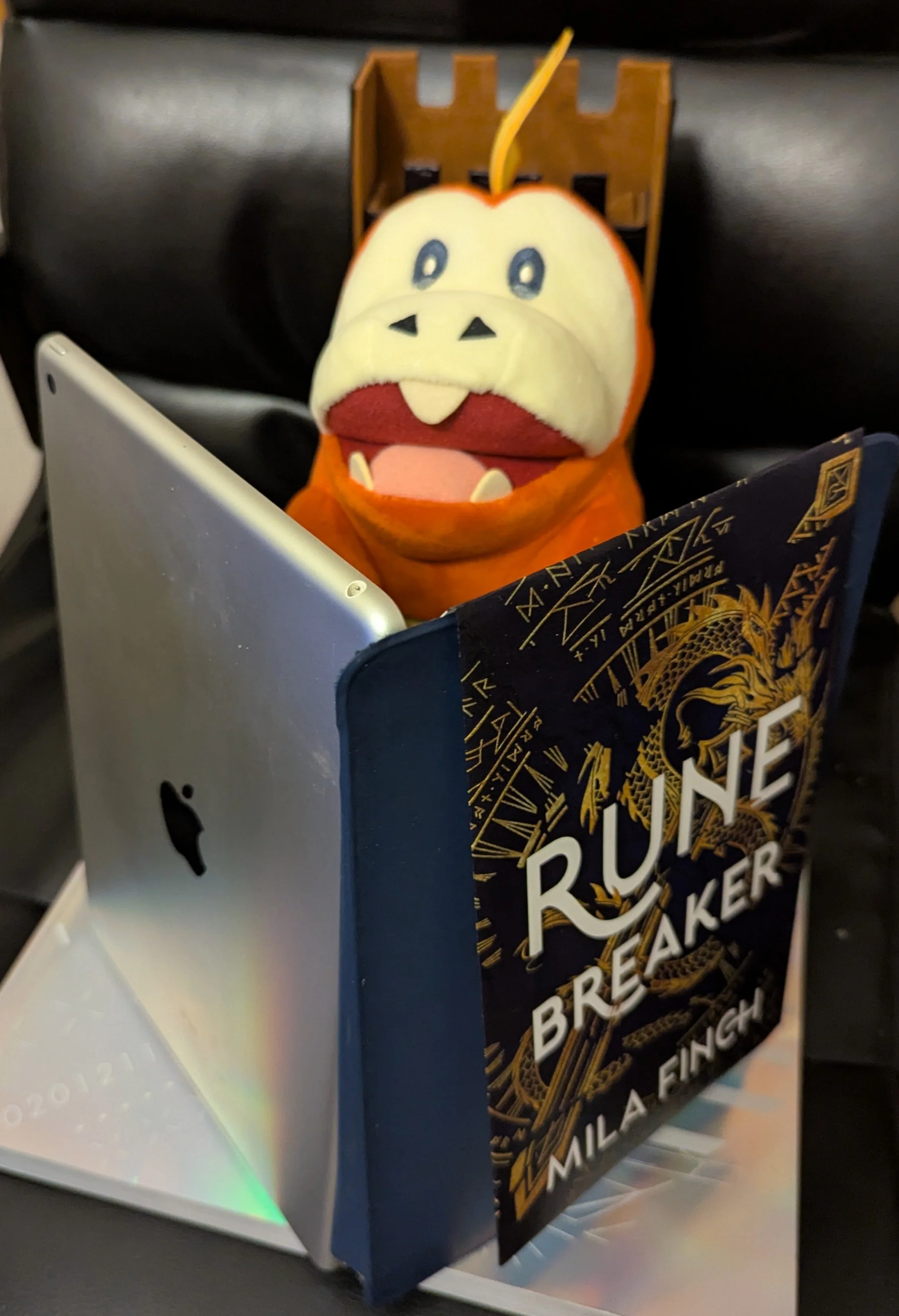
Hello, all. Welcome back to the review of Runebreaker, an indie Romantasy by Mila Finch.
This part is going to specifically focus on the application of power fantasy within this narrative. If you’re looking for the overview, please check out Part 1, while Part 2 covered the romance elements. We’ll be getting deep into the worldbuilding, characters, and plot in the weeks to come.
Let’s break some bonds.
STATS
Title: Runebreaker
Series: [Untitled Trilogy] (Book 1)
Author(s): Mila Finch
Genre: Fantasy (Romantasy)
First Printing: January 2026
Publisher: Self-published to Amazon
Rating: 0.5/10
SPOILER WARNING
Throughout this review, there will be mild, unmarked spoilers for Runebreaker. I will do my best to keep the first paragraph of each section as spoiler-free as possible. Heavy spoilers will be confined to clearly marked sections.
POWER FANTASY
Emphasis on “Female”
Runebreaker is a “female” power fantasy - and yes, that qualifier does have genuine meaning being it.
See, the power fantasy in this book is a slightly different flavor from, say, that of Shadow of the Conqueror or The Empyrean. Those put focus on the power of the protagonist to invalidate and overcome obstacles without serious struggle. In The Empyrean, there are also the added elements of validation (always being presented as intellectually and morally right, constantly being praised, etc.), never facing consequences, and having access to indirect power via the love interest.
Runebreaker tees up to operate by that same playbook. Aelie’s ability to break runes gives her unfathomable power within a world where runes dictate all the magic. She is set up as this deadly weapon and needs to hone her power. That same power is pivotal to resolving the climax.
… and then the narrative strips Aelie of agency.
Between the inciting incident and the climax (i.e. during the period when the Fantasy plot is effectively suspended to put all the focus on the Romance), Aelie is unable to actually influence anything in the narrative. At least, Finch frames it as if she doesn’t have the power. She plots her escape from Kairos, angsts about being separated from her sister Rheya, and frets about an oath she swore to Vaeris, but Finch goes out of the way to insist that Aelie can’t actually do anything about any of these conflicts. Aelie is, quite frankly, treated as a helpless damsel.
The first time Aelie gets any kind of agency is in convincing Kairos to take her to a peace conference where Vaeris will be present. At first, this seems like she is taking her first steps towards agency. The problem is, once she is there, her agency vanishes. She does things, and that advances the narrative, but the closest we get to these things happening because of a choice Aelie freely made is her decision whether or not to let Kairos die in a pivotal moment. It’s a little hard to celebrate character agency when there is only one option that wouldn’t immediately end the series midway through the first book.
It’s in the second half of the book, though, that it becomes clear why this is. The true power fantasy isn’t that Aelie is the one with the power. It’s that she secures a Love Interest who exerts power on her behalf.
Kairos was framed as Aelie’s captor up to this point. From here, he is reframed as a protector. His possessive jealousy dials up. When others dare to criticize or doubt Aelie (such as in a scene we’re going to get into in a moment), he goes out of his way to browbeat them. When Aelie exhausts herself trying to help others, he gets angry at them for not considering how hard it is for her to be so selfless.
This is a power fantasy written to cater to Romance. The objective is not for the reader to feel awesome and powerful, but to swoon over a Love Interest who his made attractive by being awesome and powerful. And given that Romance is a genre that makes no effort to hide that women are its target audience, that makes a power fantasy associated with it decidedly less gender-neutral. Hence, this is a “female power fantasy.”
So, with that definition established … what does this actually mean for the narrative?
I actually think that female power fantasy, utilized within a Romance narrative, is less destructive to the stakes and tension than the more gender-neutral form of power fantasy. This goes back to the external/internal conflict balance we touched up in in Shadow of the Conqueror. The power fantasy of Love Interest being a protector and provider doesn't inherently invalidate the external conflicts. If anything, it means that resolving internal conflict (i.e. resolving the Romance story) facilitates the resolution of the external conflict.
It’s worth noting that The Empyrean does have elements of this female power fantasy in the form of Xaden, with all of the magical and political power he wields to fulfill Violet’s desires. It’s just that it takes a backseat to the more gender-neutral power fantasy of Violet herself invalidating obstacles.
(Also, I should clarify something: while Runebreaker is not damaged purely by having female power fantasy, this removal of Aelie’s agency is tied into a different issue. I’ll explore this more in a few weeks, once we get around to discussing Aelie’s characterization.)
Contrived Highs
That being said, much like the power fantasy in The Empyrean, Finch forces the narrative to bend over backwards to force the power fantasy into position. There is one sequence of chapters in particular that highlights this problem.
Setup
There's a scene where Kairos needs to ride out with his warriors to save a village that’s been razed. Aelie insists she go with him. Her stated reasoning for this is that her power to break runes can help protect his warriors.
This makes no sense. Aelie’s power is not a general anti-magic effect. She only disables runes, not any effect spawned by a rune. Furthermore, breaking a rune requires direct physical contact with it (i.e. her hands have to touch whatever the rune is inscribed upon). She is fully aware that offensive magic that extends behind the surface of a rune exists - Kairos’s body is covered in runes that lets him kill people outside rod his physical reach.
All this is to say that this would be like if I said, “Hey, I can flip the safety on a pistol, remove its clip, and empty the chamber. Therefore, you should trust me to stop bullets in midair like Neo.”
Punching Others Down
Once at the village, there is a painfully forced attempt to make Aelie took intelligent, one that only works by making Kairos and all the fae warriors into unobservant dumbasses.
The moment the group arrives at the village, it is obvious that the village has been subjected to a rune that froze it and its inhabitants in time. This is how the scene is established.
It was too quiet. No wind or rustling leaves, only… stillness. The air smelled like winter stripped of its bite, and the water wasn’t moving. Frost rimmed the banks despite the mild temperature, and nets hung abandoned between poles, stiff with ice.
The fields on either side of the river were halted in the same unnatural pause, and chimney smoke hovered, motionless, caught in perfect gray ribbons. A woman was bent over herbs, her hands suspended.
Despite the level of detail put into spelling out that this is a time stop, the fae (some of whom have a millennium or more of experience with rune magic) all think the villagers are dead. Aelie has to have a eureka moment where she notices the “bodies” are too warm and that the fruit that should be days old is still fresh. This is done purely so Aelie can be the one to figure out something that the far older, far more magical fae could not.
My Hero
Upon realizing what the rune is, Aelie sets out to find it. A soldier expresses doubt that she can help. Kairos then harshly rebukes this soldier. (As the story progresses, we’ll learn this soldier gets assigned to guard Aelie as a punishment. His loyalties will also be questioned in the climax, for no other reason than that he doubted Aelie in this one scene.)
This whole interaction feels so forced. Why is this warrior sassing the king’s girlfriend within earshot if the king? Was he not informed of Aelie’s ability to break runes? If there's any chance he wasn’t, why does Kairos react so aggressively, rather than explaining the situation? It really feels like this all only happened so a cliché could be checked off.
That Was Lucky
The rune responsible for stopping time is hidden down a well.
Aelie only finds it because a fight breaks out, forcing her to jump down said well.
Fine. I guess Finch couldn’t think of a way to have Aelie find the rune via the intelligence she (supposedly) showcased moments earlier.
Self-Acceptance
To break the time rune, Aelie as to travel into some sort of demiplane “inside” the rune. This has not previously happened with any other rune (a fact acknowledged in the scene itself). While I think this is justified within the world - the time rune is already established as behaving abnormally - this doesn’t make what happens next feel any less contrived.
You see, to destroy the rune, Aelie has to resist illusions it spins for her, based on her desires, insecurities, and guilt. This ultimately amounts to … Aelie deciding she had nothing to feel insecure about or apologize for. It’s just more validation. It affirms that the protagonist is morally pure and doesn’t need to grow, change, or generally improve from her current state.
Is Aelie a Mary Sue?
The example given above is merely the most obvious. This narrative is hell-bent on not holding Aelie accountable and not letting her have flaws. So, the question does need to be asked.
I am honestly not sure how to answer it.
The thing about a Mary Sue is that it’s not enough for her to be the focal point of a power fantasy. It’s not enough for her to be the most important person in the world. It’s not enough for morality to bend around her (something we will get to when we dissect the plot). The narrative needs to break to keep her from being challenged.
Aelie may have immense power … but her power isn’t what invalidates conflicts. Kairos’s is. Ironically enough, by writing a power fantasy rooted in the acquisition of a powerful love interest, Finch may have swerved around Aelie becoming a Mary Sue. It’s a little hard to accuse the character of breaking the world when the fantasy is about her chasing someone else who might break the world.
This could change in the sequel. For now, I will tentatively say that Aelie is not a Mary Sue.
WHERE THINGS WENT DOWNHILL
Up until this point, it may have sounded like I’ve been making a mountain out of a molehill by rating Runebreaker below a 1/10. Granted, what we’ve covered isn’t great, but it’s not remarkably bad, either. I’d agree with you if you said it sounds like maybe a 4/10.
Starting Sunday, April 12th, we’ll get into the aspects of the narrative where things start to change.
The real contradictions that undermine the story and require the audience to turn our brains off aren’t in the power fantasy or the romance. Rather, they’re in the foundations of the story. They’re in lore that makes Aelie seem delusional and exonerates the characters she demonizes. They’re in characters whose identities are entwined with tropes but nonexistent when those tropes aren’t in play. Worst of all - as we’ll get into further down the line - they’re in a plot that demands the audience perceive things one way, only to violently flip the moral axis without acknowledging the reversal.
Thank you all for stopping by today. Please remember to subscribe and share if you enjoy what you read here. Take care, everyone, and have a good week.

Looking for a tale with another entity of reality-warping power? Check out my free novella, The Unbottled Idol, available over in Tales of the Five Worlds!
Mohsen Yavari's task within the Imperial Inquisition of the Kimian Empire is simple: monitor the gods' activities in the mortal world. However, when a diplomat is killed by a goddess, a maverick inquisitor recruits him for her investigation. Their search for answers will lay bare sinister truths, with a child’s soul hanging in the balance.
Join me on this adventure of intrigue, martial arts, and divine assassination!