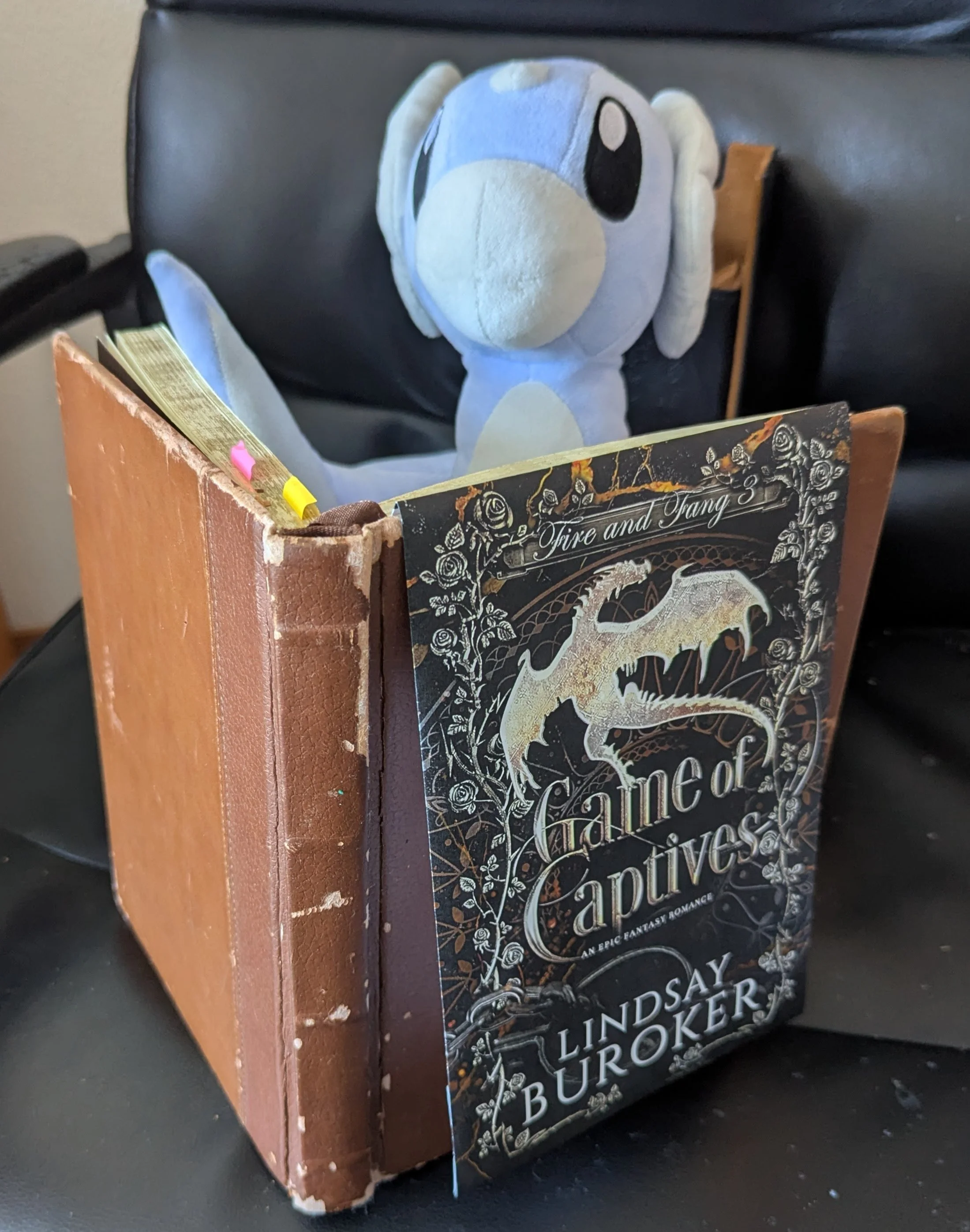
Game of Captives (Part 2 - Plot)
Hello, all. I hope your week is going well. Thank you for joining me as we continue our exploration of the third Fire and Fang book, Game of Captives.
Today, we begin the deep-dive analysis of the book’s qualities. We’re going to be starting with the plot. If you’re looking for an overview of the book’s qualities, please instead see Part 1.
If you’re all caught up (or don’t care about that), let’s fly.
STATS
Title: Game of Captives
Series: Fire and Fang (Book 3)
Author(s): Lindsay Buroker
Genre: Fantasy (Romantasy)
First Printing: February 2026
Publisher: Self-published to Amazon
Rating: 5/10
SPOILER WARNING
Mild spoilers for Game of Captives will be included throughout this review, through I will keep the first paragraph of each section as spoiler-free as possible. Heavy spoilers will be confined to clearly labelled sections.
Heavy, unmarked spoilers for the previous two books in the series, Sky Shielder and Red Dragon, will be provided throughout this review. I’m also going to assume that you’ve already read the reviews for those books, though it isn’t necessary to do so to understand this review.
PLOT
Pacing and Consequence
I’m not exaggerating when I refer to this book as a roller coaster ride. While this book may not be the most exhilarating action story of all time, it’s a domino chain of choices and consequences. We roll from one action scene to the next, with the outcome of one scene influencing character decisions that trigger the next.
Something I didn’t really go into during the review of Red Dragon was an artifact of the gods that Syla recovered from the laboratory of the storm god: a “weapons platform” that shoots magic projectiles capable of maiming or outright killing dragons. This artifact can only be operated by a moon-marked individual (and, potentially, only Syla). Wreylith arranged for wild dragons to transport this back to the Garden Kingdom at the end of the book. The story begins with Syla having this platform in her possession and trying to decide how best to use it.
At the same time, the challenges to Syla’s rule are becoming more aggressive. While Red Dragon made it seem like Syla’s political enemies had bent the knee, Game of Captives quickly clarifies that they are simply being more subtle. Syla has good reason to believe that staying in her castle puts her in more danger than leading the military campaign against the stormers.
These two variables feed into the inciting incident of the book: Syla orders that the weapons platform be loaded onto a ship, scrapes together a flotilla, and leads an assault on Harvest Island. Her goal is both to drive the stormers off the island and to deny her political opponents opportunities to imprison or assassinate her (with the third, implied goal of winning the loyalty of the military and the people of Harvest Island). She also has the bonus objective of finding some way to recover the shielder components that Vorik claimed in Red Dragon, which she plans to do by interrogating Vorik if she crosses paths with him again.
All this is to say that the story is kicked in motion by decisions that, while not necessarily the best ideas, are a natural consequence of previous events in the plot. It doesn’t feel like Syla is making decisions Because the Author Said So. She is running with the variables she’s been given and making the best of things.
And all of the other plot beats fall into this same mold. Vorik is given the missions to find and destroy the shielder on a third island, Bogberry Island, by capturing the moon-marked heir on that island - but then he learns Syla is sailing to Harvest Island, so he rushes in to protect her from his brethren (while claiming he wants to abduct her to interrogate about the other islands’ shielders). When the stormers assault Bogberry Island without him, forcing Syla to divert the flotilla, Vorik tries to find ways to disable the weapons platform without harming her. It goes on and on like this, with every decision the characters make having tangible consequences. The only place where one could argue the plot ran on autopilot is that Vorik’s efforts to abduct Syla end up not mattering, as another rider ends up abducting the moon-marked hier on Bogberry and getting the shielder information without him, but even then, Vorik’s and Syla’s decisions influence the strength of the stormer force that shows up in the climax of the book.
This isn’t to say that this book is all Plot Plot Plot. There are moments where the story slows down for character development. I don’t think these moments are necessarily used all that well (more on that later), but their mere presence does slow the pace down. The cascade of consequences never grows exhausting because the audience is given time to breathe.
The Unfired Chekov’s Gun
Back in the Content Warning, I mentioned a scene that slams into a wall so Syla and her cousin can discuss abortifacient drugs and how they really would like to be mothers, just not right away. This sort of scene wouldn’t normally merit further discussion. In this case, though, I do think there is a deeper narrative problem, one that goes back to the balance of Show versus Tell.
For context: the second graphic sex scene of Red Dragon occurred under the influence of flowers whose scent has an overwhelming aphrodisiac effect on both humans and dragons. (The implications of this are not acknowledged or explored, and the effect vanishes as soon as the sex scene is done.) This didn’t just affect Syla and Vorik. Their dragons mated. Furthermore, Syla’s bodyguard Fel and cousin Teyla were compelled to have sex.
Fast forward to this book. In the middle of a scene discussing the weapons platform, Teyla pulls Syla aside and announces:
Teyla waved for Syla to join her on the platform, then whispered, “My menses came.”
Syla blinked. Even though she and her female colleagues at the temple had shared such information from time to time, she couldn’t remember discussing such things with her cousin, who was usually so busy studying, writing papers, and practicing swordsmanship that she could hardly be bothered with noticing. But the relief in Teyla’s voice clued Syla in that more than a desire for commiseration about cramps prompted the statement.
My first reaction upon reading this was to sit up. After all, it is being made explicitly clear that this is not a normal conversation for these characters to have. Why, then, would Buroker bring the scene to a screeching halt to focus on this?
… unless … Could this be foreshadowing? Is Syla pregnant with Vorik’s child? There’s such rich opportunity for story here: the queen of a country, pregnant with the child of her lover, who is an enemy of the state. What fascinating drama will Buroker -
Sorry. I can’t finish the bit. That is not what happens. The conversation just becomes a chat about how Syla keeps the contraceptive and abortifacient drugs in her first aid kit (and I’ll be coming back to that point when we discuss her character).
So … no one’s pregnant?
This was so disappointing. If the point wasn’t to foreshadow a plot built around Syla and Vorik conceiving, then what was the point of derailing the scene to call the audience’s attention to this? (I mean the NARRATIVE reason. The actual reason stories with “spice” address this issue has nothing to do with literary quality.)
This doesn’t tell us anything meaningful about Syla’s character. Unlike Luna in Magnetic Magic, Syla’s story has nothing to do with her having children. It could have - she is a queen with no heirs, and having a child with a stormer would have political consequences, something the story does point out - but outside of that brief nod, her journey has nothing to do with having or avoiding children.
At best, one might argue that this is about coherent worldbuilding, but then it becomes an issue of what actually needs to be Shown or Told. We were Told these drugs existed all the way back on Sky Shielder. We’re going to be reminded of them again later in this story, when Syla reassures Fel that she’s taking contraceptives before she goes off to have sex with Vorik again. On top of that, there’s the simple fact of the matter that we don’t need this information to be explained to understand why Syla isn’t pregnant. the reason I made a fuss about the lack of pregnancy in Fourth Wing came down to statistic probability. Hundreds of young men and women engaged in hedonistic sexuality activity is not equivalent to Syla having penetrative sex with Vorik on just … let’s see … two occasions prior to this point in the series. The former needs to at least be acknowledged. The latter can be shrugged off.
Put another way, this is information so unnecessary that it doesn’t need to be Told, especially not in a way that shines a spotlight on it.
Why This Matters
Some of you may be wondering whether an exchange of dialogue that is barely a page in length is really worth the amount of effort I'm putting in to criticize it. If you are such a person … well, first, thank you for bearing with me thus far. I appreciate you patience, and I understand where you are coming from. I’d like to present an analogy to clarify why this small moment is a narrative problem.
That analogy is the Holdo Maneuver.
Prior to The Last Jedi, hyperspace ramming simply wasn’t done is Star Wars. Ramming did happen - in Legends lore, there were even droid-operated suicide ships designed for the express purpose of ramming, and the such ships was considered such a dire threat that their construction was outlawed - but it was always at sublight speeds. No one within the setting acknowledged the possiblity of hyperspace ramming. Since hyperspace ramming is such an obviously devastating tactic (even without accounting for relativistic mass, an object moving any considerable fraction of the speed of light can do catastrophic damage to much larger targets), the fact no one even considered such an easy and effective tactic as an option meant that we could safely assume that it was impossible. And since we could assume it was impossible, we didn't need to ask why it wasn’t employed in every possible circumstance. Confirming that it was possible dismantled the entire paradigm of space combat. Suddenly, we needed to ask why starfighters weren’t being used for hyperspace kamikaze runs, while hyperspace missiles weren’t a think, and why the Death Stars used a Kyber-fueled superlaser instead of some sort of hyperspace MAC gun. The excuses made to justify why it was possible but underutilized just opened new plot holes.
The same applies to pregnancy in a narrative. Conceiving a child is such a life-altering event that it can't simply be ignored once it is put on the table … yet all the author has to do is not put it on the table. The moment the story comes to a screeching halt to put focus on contraceptives, abortifacients, and the characters’ feelings about having children, a narrative-defining variable that the audience did not need to think about is rammed into focus. A background detail becomes a Chekov’s Gun. And when that gun doesn’t go off, then all that was accomplished by putting focus on it was derailing a scene.
To wrap this up, I’d like to given a nod to both Magnetic Magic and one of Buroker’s Science Fiction series, Fallen Empire. Both of these series put focus on conceiving children early on - and both series paid it off. This wasn’t rammed into the middle entry of those series just to explain why the main character wasn’t pregnant after a couple of sex scenes. This life-altering consequence to the Main Character’s and Love Interest’s sex life was built upon, explored as the relationship developed, and then had a payoff.
Action
Buroker significantly improved on the action in this book from Red Dragon. It’s back up to the quality we saw in Magnetic Magic.
While I can’t say the fights are particularly polished or choreographed, there’s a much better sense of weight and position. Most of the action takes place in more open environments that eliminate the confusion of how characters are able to move around without being hit. Even in the action scenes within enclosed spaces, Buroker describes things in a way that make it clear how people are positioned relative to one another and in what directions they’re actually capable of moving.
Another interesting dynamic is that Syla is starting to get magic from Wreylith. This augments her physical attributes. Crucially, Buroker did not try to make Syla into an incredible badass warrior right off the bat. Syla is basically just flailing at opponents, only really hitting them when they grab her (and, thus, have to put themselves inside her reach). At one point, she misjudges her strength and ends up slamming herself into a wall when she only meant to dodge an attack. I’m sure Syla will become more effective in Clutch and Claw, once she has had time to further grow in power and get used to that power, but with how Buroker is handling things, I’m not worried that we’re going to get a complete reversal of how Syla handles herself in a fight.
The Coup (Heavy Spoilers)
The efforts by various power players within the Garden Kingdom to depose Syla have mostly been a background detail in the series thus far. In Sky Shielder, it was really just a matter of the military not respecting Syla’s authority, given how she was the daughter who chose to serve as a temple healer rather than being properly training to inherit the throne. In Red Dragon, it was an excuse for a couple of tense scenes, one where Syla evaded an effort to arrest her and another where a band of assassins boarded the ship she was on.
In Game of Captives, this conflict evolves. We learn in the first few chapters that open opposition to Syla has dissolved, yet people still conspire against her in the shadows. There’s a bit of dialogue with her bodyguard about building a spy network to give her an upper hand against these conspirators. When Syla sets out with the flotilla to retake Harvest Island, Syla learns that the officers on the ships are in on another plan to have her assassinated.
However, that assassination never comes. Syla does win the loyalty of the officers through her conduct in battle, but from what she learns from these officers, they weren’t actually participants in the plan - they were just told to turn a blind eye when the moment came. So what happened to the assassin?
At the climax, Vorik then learns that someone has already seized the throne while Syla was away at Harvest and Bogberry Islands. A fleet from the southern islands has sailed into Castle Island and raised a new flag. The novel ends with the emphasis on these new arrivals being the antagonistic force for the final novel, rather than the stormers (despite the fact the stormers remain just as much of a threat as they were at the start of the novel).
I do like this as a way to evolve the series over time. The setup of a potential assassination attempt and the discussion of building a spy network feel a bit like red herrings, but it wouldn’t be impossible to reconcile them in the next book. My main concern here is whether one book will be enough to both deal with this coup and resolve the war between gardeners and stormers. I’m concerned that, much like with Izzy being introduced in the penultimate entry of Magnetic Magic, this is setting Clutch and Claw up for a scenario where one of the antagonists needs to be handwaved out of the story for the series to stick the landing.
THE DRIVING FORCE
Whereas Red Dragon was driven by plot, I’d say that Game of Captives is driven by its characters. Syla and Vorik’s lives would be a lot simpler if they did simply obey the whims of the plot. Instead, the decisions they make in their struggle between duty and their own feelings stirs up compelling drama and complicates their goals.
We’ll get into it next Wednesday, April 15th. Until then, thank you for stopping by. Please remember to subscribe and share if you enjoyed what you read here. Take care, everyone, and have a good week.

Volume I of my first serialized Romantasy novel, A Chime for These Hallowed Bones, is now available!
Kabarāhira is a city of necromancers, and among these necromancers, none are more honorable or respected than Master Japjot Baig. Yadleen has worked under him since she was a girl, learning how commune with bhūtas and how to bind these ancient spirits into wights. Her orderly world is disrupted, however, when a stranger appears with the skeleton of a dishonored woman, demanding that her master fabricate a wight for him.
To protect her master from scandal, Yadleen must take it upon herself to meet this stranger’s demands. Manipulating the dead is within her power, but can honor survive in the face of a man who has none?
Come for slow-burn tension, and Enemies-to-Lovers dynamic, and bone-based engineering! I hope to see you there. Volume II is in development!