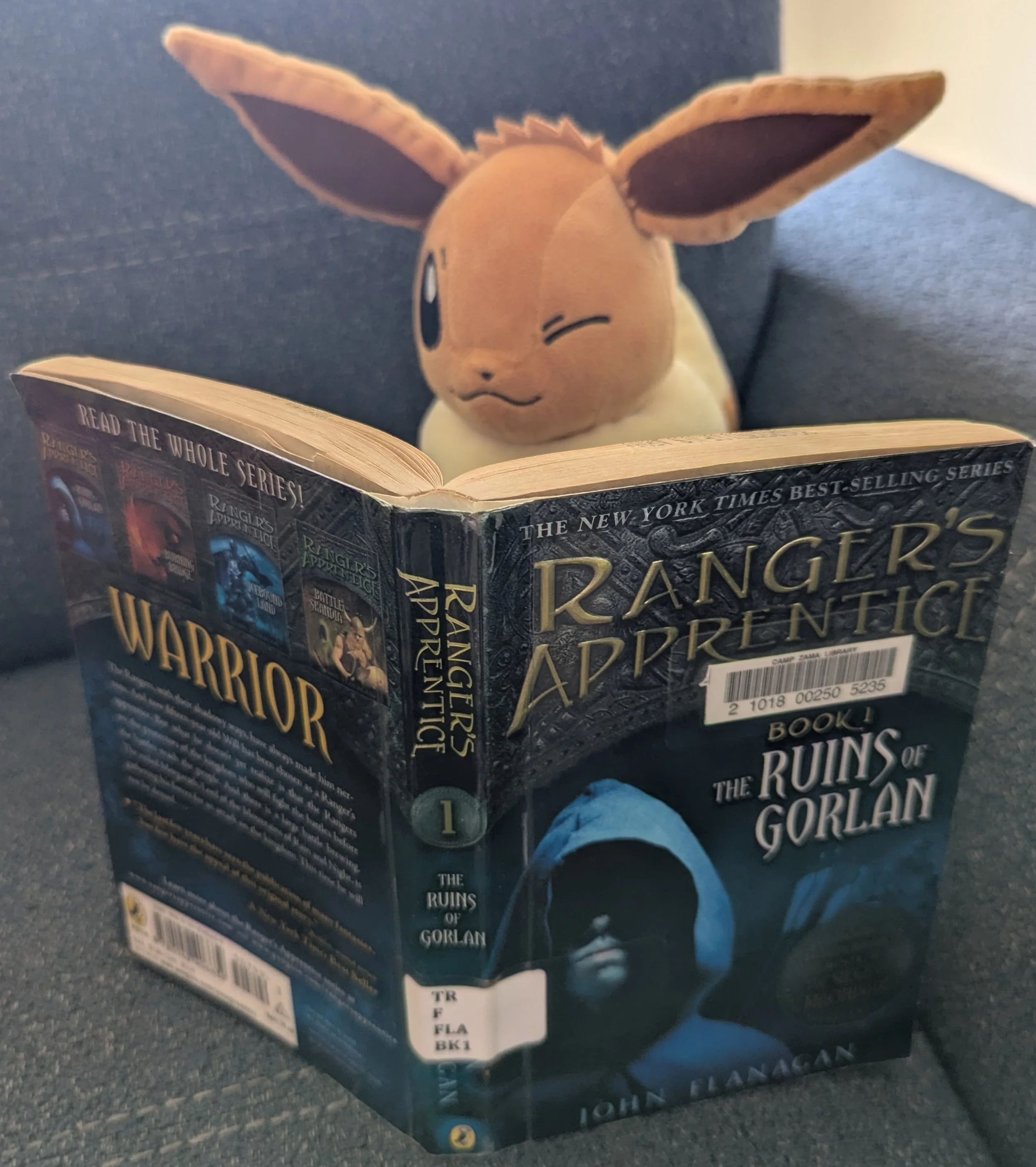
The Ruins of Gorlan (The Ranger's Apprentice, Book 1) (Part 2 - Worldbuilding, Character & Plot)
Hello, all. Welcome back to the review of The Ruins of Gorlan, Book 1 is the Ranger’s Apprentice series.
This second part will wrap up the review with a look at the worldbuilding, character work, and plot. If you want the overview or the discussion of theme, please see Part 1.
Step softly now, and let’s go hunting.
STATS
Title: The Ruins of Gorlan
Series: The Ranger’s Apprentice (Book 1)
Author(s): John Flanagan
Genre: Fantasy (Middle Grade)
First Printing: November 2004
Publisher: Puffin Books
Rating: 9/10
SPOILER WARNING
Mild spoilers for The Ruins of Gorlan will be included throughout this review, through I will keep the first paragraph of each section as spoiler-free as possible. Heavy spoilers will be confined to clearly labelled sections.
WORLDBUILDING
Setting
The world of Ranger’s Apprentice is a low-magic Fantasy. There are implications of supernatural forces, such as Morgarath dominating the minds of his minions, and monsters that don’t exist in our own world are present. However, most magic (particularly that attributed to the Rangers) is explained as superstition born from misunderstanding.
Culturally, this world is a pastiche of real-world cultures. The kingdom where will lives is not-England. Not-French is used at some points. Morgarath plans on recruiting not-Scandinavians for his war effort, and Halt made Will a bow in the style of the not-Mongols. Again, very simplistic, yet also effective for relaying concepts to a MG audience.
Rangers
Superficially, this group embodies the same edgy, cooler-than-the-rank-and-file-soldiers vibe that we’ve seen executed less successfully elsewhere. In this case, though, it's done well. The contrast between the Rangers’ equipment, methods, and operational structure compared to the knights is used to amplify Will’s journey from the person he thinks he should be to the person he truly is. What’s more, all the things that make the Rangers different actually make sense.
One detail that I appreciate Flanagan calling out is the value of training. The Rangers do not train in swordsmanship because the time required to become truly proficient is better invested in skills and weapons more relevant to their trade. The one Ranger we are shown who does carry a sword was explicitly trained in swordsmanship before becoming a Ranger. I do think the value of training is actually taken a little too far here - the narrative frames swordsmanship as an all-or-nothing affair - but this does make sense for simplifying a concept for a MG audience. Additionally, because Will places symbolic value in swords as a symbol of the oath he would have chosen for himself, denying him the weapon does pay off from a character development perspective.
A nitpick I do have - something that I’d normally consider more serious, but that I think is fine for literature aimed at such a young demographic - is the weapons assigned to the Rangers. I feel like giving them bows and knives is purely about copying RPG tropes and Legolas’s build from the Peter Jackson Lord of the Rings films, rather than because it actually makes sense for their role. The bow makes sense, yes. The knives (one long, the other a throwing knife) don't. If the goal was to give the Rangers a close-quarters weapon that is easy to carry a round and isn't a sword, why not give the Rangers a small axe or hammer, both of which would (A) double as functional tools and (B) provide a means to bypass armor? Or why not use the knives as tools and train the Rangers to make and wield improvised spears wherever they might find themselves?
CHARACTERS
The Ruins of Gorlan has a fairly large cast of named characters. Most have only one discernable trait or quirk, like how the baron of Will’s fiefdom keeps trying and failing at comedy or how one of Will’s friends is a motherly baker. Still, the way they are executed makes them feel like complete characters, rather than puppets. This is one place where the 3rd Person Omniscient POV works to the story’s benefit. What the story loses in terms of subtlety is balanced by the glimpses into the interior lives of the characters.
That being said, there are only three characters who are fleshed out to a point that they could have stood on their own without the omniscient commentary.
Will
The Main Character of this book is a scrawny youth who dreams of glory he can’t have. One of the baron's many Wards (orphans whose parents died in service to the kingdom), he has built up a personal mythology that his father was a knight, and he seeks to follow in those footsteps. His physical limitations deny him this opportunity. However, Halt sees his potential for stealth and athletics, recruiting the boy as a Ranger. Will’s arc then becomes about accepting the path chosen for him.
A notable detail about Will is that, despite his talents, he still has to learn, and learning entails mistakes. There are multiple scenes where he makes an assumption and ends up getting injured. Over the course of the story, he matures and growers wiser.
I have only one complaint about Will. One of the unnecessary things I mentioned in the rating is a Teen Romance subplot … or, at least, the shell of one. At the start of the book, Will has an implied crush on Jenny (one of his fellow wards, the baker I mentioned earlier). This goes nowhere and is suggested maybe three times. Then, at the end of the book, some other girl kisses him out of nowhere, and he develops feelings for her. There’s no emotional weight here. It just feels arbitrary.
On the whole, Will is a decent character that I think MG audiences can easily root for.
Halt
The Ranger assigned to Will’s fiefdom takes an interest in him early on int he story. This interest isn't fully explained until the end of the book. For most of the story, Halt is a gruff mentor archetype. His most notable trait is that he will deliberately allow Will to make mistakes, thereby delivering painful lessons that check Will’s reckless over-eagerness. He also has history with Morgarath that drives the climax. A straightforward character, yet an effective one.
Horace
This character is one of Will’s fellow Wards, who bullied Will in their youth and now gets to live the life Will wanted by training as a knight. He serves as a secondary POV character for the first two-thirds of the story. His arc is really more about his dynamic with Will than the character himself. The two of them learn to appreciate each other has then nature and move along their respective oaths.
The rest of my thoughts on Horace are entwined with the plot analysis. For now, I'll just say that I like the character, but he could be cut completely with minimal impact on this story.
PLOT
Coming of Age / Becoming a Ranger
The bulk of this story is about Will’s character arc. It’s a low-stakes series of training scenes with only a couple of mild action beats. Outside of a scene involving a wild boar (more on that shortly), Will's life is not in danger. Over time, he grows to accept his place as a Ranger and let's go of his ambition to be a night.
Very simple story, yet an effective one.
Morgarath
Outside of a prologue to establish him, Morgarath only really factors into this story for the last third. Even then, he’s not personally involved in the story. The “gathering his forces” bit forces Halt and Will to hunt some of his assets down, with the showdown with these individuals being the action climax.
I think the Morgarath elements are fine. This is clearly setup for the ongoing series.
Battleschool (Heavy Spoilers)
This subplot is covered by Horace’s POV. I do not think it is badly written - if anything, I think it is written very well. However, it is so unnecessary to the overall narrative that cutting it entirely might have been preferable.
This subplot is all about Horace getting bullied by older apprentices in the knight training. They verbally and physically abuse him and generally torment him. Reading these chapters was a miserable experience. I’m pretty sure I used to skip them when rereading this book in high school.
Things really come to a head after the boar hunt. During this scene, both Will and Horace are brought along with Halt and the knights to slay the boar. Will ends up saving Horace’s life. After this, the pair mend their relationship, with Horace declaring that he owes Will his life.
Once word of this event spreads, though, Horace’s bullies severely beat him, then go to beat Will. Horace pushes through his injuries and goes to help Will. Halt then shows up to save them both, and forces the bullies to fight Horace one-on-one, during which Horace thrashes them. Halt then reports the bullies to their mentors and gets them expelled from the training.
This is a fine story. The issue is that all this resolves before the two-thirds mark. Horace contributes nothing to the narrative once the stuff with Morgarath kicks off. I misremembered the climax and thought that Horace was involved in it, because surely, all this focus was going somewhere, but no. Horace and Will solidifying their friendship was the end of the subplot.
Did this really need to be in the book?
Don't get me wrong - it's well written. It's just that it has no impact outside of Horace’s personal arc. Will’s personal journey isn’t affected by this, and it doesn't impact the climax. It is very bit as extraneous as the subplot with Sawyer’s leg in Onyx Storm.
For this subplot to really work, I feel like Horace needed to contribute to the climax in some meaningful way. His newfound loyalty to Will should have either directly involved him in the events or else opened some door for Will. Otherwise, this bullying subplot should have been about Will getting bullied and rising above it as part of his development.
Alternatively … this subplot could have been cut, wholesale. Horace and Will's dynamic evolving happens just the same with or without the bullying. The boar hunt goes does exactly the same without it. The pages given over to this could have been used to delve deeper into Will’s character or the explore his dynamics without other members of the cast.
I know I've rambled on quite a bit about something that doesn’t even damage the overall book. I think that illustrates my point. This subplot is fine in principle, fine one execution, but doesn't add anything to the story except a bunch of extra chapters. It just feels extraneous.
TO THE BRIDGE!
The Ruins of Gorlan is a book I highly recommend checking out (or, if you don't care for Middle Grade literature, that you share with children in your life). It’s a good story that’s easy to digest. I have already read the sequel, The Burning Bridge. You can expect the review for that book in either late July or early August.
Thank you all for joining me today. Please remember to subscribe and share if you enjoyed what you read here. Take care, everyone, and enjoy the rest of your week.